


The Best Online Courses to Learn Advanced SEO Metrics in 2026 are not the same old “learn keywords and fix meta titles” programs. That stuff still matters. But it’s basic. Modern SEO has become more serious. You need to read GA4 reports, Search Console data, crawl issues, ranking shifts, algorithm updates, AI search visibility, and revenue impact. You also need to explain those numbers to editors, clients, founders, or product teams without making their eyes glaze over.
That’s where advanced SEO training helps.
Search has changed a lot. Google now uses more AI-powered features in Search, including AI Overviews and AI Mode. So, ranking in the classic organic results is no longer the full story. Brands also need to know whether they appear in AI answers, whether competitors get cited more often, and whether organic traffic still brings real business value.
This guide breaks down the best verified online courses and training programs for advanced SEO metrics, enterprise SEO, algorithm tracking, predictive analytics, SEO testing, and AI search visibility.
| What Readers Want | What This Guide Covers |
|---|---|
| Better SEO reporting | GA4, Search Console, dashboards, conversions |
| Algorithm tracking | Google core updates, ranking changes, traffic-drop checks |
| Predictive SEO | SEO testing, forecasting, experiment planning |
| Enterprise SEO | Crawl health, indexation, templates, large-site workflows |
| AI search visibility | AEO, GEO, brand mentions, citations, AI answer presence |
Why Advanced SEO Metrics Matter in 2026
A traffic drop doesn’t always mean your SEO failed.
Sometimes a Google update hit your site. Sometimes search demand dropped. Sometimes your rankings stayed steady, but click-through rate fell. Sometimes your pages got indexed badly. Sometimes competitors improved. Sometimes AI answers changed how users interact with results.
That’s why advanced SEO metrics matter.
They help you stop guessing.
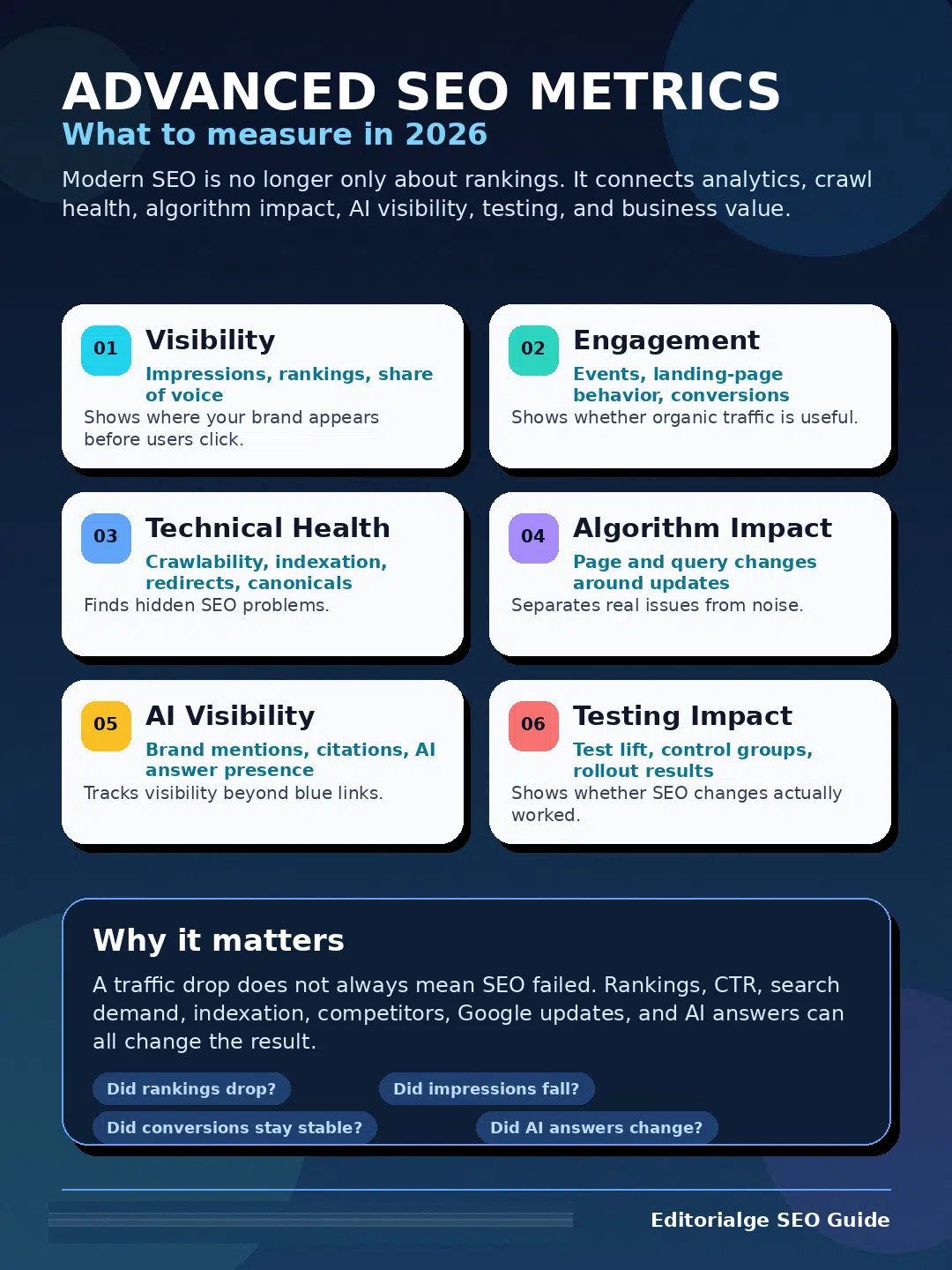
| Metric Area | What It Shows | Why It Matters |
|---|---|---|
| Visibility | Impressions, rankings, share of voice | Shows where your brand appears before users click |
| Engagement | Events, landing page behavior, conversions | Shows whether traffic is useful |
| Technical health | Crawlability, indexation, redirects, canonicals | Finds hidden SEO problems |
| Algorithm impact | Page and query changes around updates | Helps separate real issues from noise |
| AI visibility | Brand mentions, citations, AI answer presence | Tracks search visibility beyond blue links |
| Testing impact | Test lift, control groups, rollout results | Shows whether SEO changes actually worked |
Advanced SEO is now a data job
SEO used to be easier to explain.
“Improve rankings. Get more traffic.”
Now, that’s too simple.
A strong SEO professional should be able to answer questions like:
- Did clicks fall because rankings dropped?
- Did impressions fall for branded or non-branded queries?
- Did only blog traffic drop, or did money pages drop too?
- Did the issue start during a confirmed Google update?
- Did traffic fall, but leads stay stable?
- Are AI tools mentioning our brand or only our competitors?
These are not beginner questions. They need better training, cleaner reports, and sharper thinking.
Enterprise SEO needs even more discipline
Large websites are messy.
They have thousands—or millions—of URLs. One bad template update can affect a whole directory. One migration mistake can destroy years of organic growth. One crawl issue can block important pages.
That’s why enterprise SEO teams need more than keyword tracking. They need page-group analysis, crawl reports, indexation checks, conversion data, and testing systems.
Best Online Courses to Learn Advanced SEO Metrics
The Best Online Courses to Learn Advanced SEO Metrics don’t all look like normal SEO courses.
Some teach analytics. Some teach technical SEO. Some teach testing. Some teach AI search visibility. Some teach platform workflows for enterprise teams.
That mix is useful because advanced SEO sits between marketing, data, content, technical systems, and business strategy.
| Course / Program | Best For | Level | Main Strength |
|---|---|---|---|
| Google Analytics Academy / Skillshop | GA4 and analytics | Beginner to advanced | Official Google Analytics training |
| Google Search Central | Algorithm tracking | All levels | Official Google Search guidance |
| CXL Technical SEO and AI Search | AI search and technical SEO | Advanced | Retrieval, structure, trust signals |
| CXL Growth Focused SEO Testing | SEO experiments | Advanced | Testing, false positives, impact tracking |
| SearchPilot SEO A/B Testing Course | Enterprise SEO testing | Intermediate to advanced | Randomized tests and ROI thinking |
| Lumar Academy | Technical SEO, AEO, GEO | Intermediate to advanced | Website health and AI visibility |
| Sitebulb Enterprise SEO Training | Large-site technical SEO | Intermediate | Enterprise crawl and audit workflows |
| Semrush Academy | SEO analytics basics | Beginner to intermediate | GA4, GSC, rankings, backlinks |
| SE Ranking Academy | Reporting and dashboards | Intermediate | Looker Studio, connectors, API |
| Ahrefs Academy | AEO and competitive SEO | Beginner to intermediate | AI visibility, content gaps, links |
| BrightEdge Certification | Enterprise platform users | Advanced | BrightEdge workflows and reporting |
| Botify Academy / Certification | Botify customers | Advanced | Crawl, methodology, platform use |
| Market Brew onboarding | Predictive AI visibility modeling | Advanced enterprise | Platform-led modeling, not a public course |
How these courses were selected
The goal here is simple: choose courses that help people measure SEO better.
A course made the list if it helped with at least one of these areas:
- GA4 or Search Console reporting
- Algorithm update analysis
- Crawl and indexation diagnosis
- SEO testing
- AI search visibility
- AEO or GEO
- Dashboard building
- Enterprise SEO workflows
- Predictive SEO modeling
Who should not start here
If you’re brand new to SEO, don’t start with advanced SEO testing or enterprise platforms.
First, learn the basics:
- Search intent
- Keyword research
- On-page SEO
- Internal linking
- Technical SEO basics
- Content quality
- Basic reporting
Once those feel comfortable, advanced SEO metrics will make much more sense.
Google Analytics Academy and Google Search Central
Google’s own resources should be your first stop.
They’re free. They’re official. And they help you understand how Google wants site owners to read search and analytics data.
| Resource | What It Teaches | Best Use |
|---|---|---|
| Google Analytics Academy | GA4 reports, events, conversions | Measuring organic traffic quality |
| Google Search Console docs | Queries, pages, indexing, search appearance | Diagnosing SEO performance |
| Google Ranking Systems Guide | How Google explains ranking systems | Understanding ranking changes |
| Core Update Documentation | How to review update impact | Algorithm tracking |
| Search Status Dashboard | Confirmed updates and incidents | Checking real update timelines |
Why GA4 should come first
Search Console tells you how people found your pages.
GA4 tells you what they did after landing there.
That difference matters.
A blog post may bring huge traffic but no leads. A product page may bring fewer visits but better conversions. A landing page may lose clicks but still keep high-value users.
Without GA4, you only see part of the story.
Why Search Central matters
Google Search Central helps you avoid panic decisions.
Google advises site owners to check confirmed update dates, wait until a core update finishes, and compare the right time periods in Search Console. That’s practical advice.
Many teams do the opposite. They see a two-day traffic drop, blame an algorithm update, and start rewriting everything. That usually creates more confusion.
What to learn first
Start with:
- Organic traffic in GA4
- Landing page reports
- Events and conversions
- Search Console performance data
- Query and page filtering
- Indexing reports
- Core update timelines
- AI features from a site owner’s view
This gives you the base layer for advanced SEO work.
CXL Courses for Technical SEO, AI Search, and SEO Testing
CXL is a strong option for experienced marketers who already know SEO basics.
Its courses go deeper into technical SEO, AI search, and testing. That makes them useful for people who want to move from “I think this worked” to “we measured this properly.”
| CXL Course | Best For | Main Value |
|---|---|---|
| Technical SEO and AI Search | Technical SEOs, content engineers, AI SEO specialists | AI search discovery, retrieval, structure |
| Growth Focused SEO Testing | SEO strategists, growth teams, enterprise SEOs | Controlled experiments and impact measurement |
CXL Technical SEO and AI Search
This course fits the 2026 search world well.
AI search systems need to find, understand, and trust your content. That means structure matters. Internal linking matters. Entity clarity matters. Technical access matters. Authority matters.
You can’t just publish a page and hope AI systems pick it up.
This course is best for people who want to understand how technical SEO connects with AI-powered discovery.
CXL Growth Focused SEO Testing
This course is useful because it teaches one of the hardest SEO skills: proving impact.
For example:
- Did a title change improve clicks?
- Did a content refresh improve rankings?
- Did internal links help a page group?
- Did the traffic gain come from your change or from seasonality?
- Should the change be rolled out to more pages?
That’s the kind of thinking advanced SEO teams need.
Best fit
CXL is best for:
- Technical SEO specialists
- SEO strategists
- Growth marketers
- SaaS SEO leads
- Enterprise SEO teams
- Content engineers
- AI search specialists
SearchPilot SEO A/B Testing Course
SearchPilot’s SEO A/B Testing course is one of the most practical choices for enterprise SEO teams.
It teaches a simple but powerful idea: don’t trust before-and-after results too quickly.
Why? Because SEO data is noisy.
A page may improve after you changed the title. But maybe search demand increased. Maybe a competitor dropped. Maybe Google changed the SERP. Maybe seasonality helped.
Testing helps you avoid bad assumptions.
| What You Learn | Why It Matters |
|---|---|
| Randomized Controlled Trials | Gives stronger proof for SEO changes |
| Test and control groups | Helps isolate real impact |
| Result interpretation | Stops teams from overreacting |
| ROI thinking | Connects SEO work to business value |
| Testing process | Builds repeatable SEO decisions |
Why SEO testing is not the same as CRO testing
CRO testing studies user behavior after a visitor lands on a page.
SEO testing studies how search engines respond to changes.
That takes longer. It’s noisier. Search demand changes. Google updates happen. Competitors move. So, SEO testing needs patience and a cleaner setup.
Who should take this course
SearchPilot is best for:
- Ecommerce SEO teams
- Travel websites
- Marketplace websites
- Publishers
- Large SaaS sites
- Programmatic SEO teams
- Enterprise SEO managers
Small websites may not have enough traffic or page volume for full SEO split testing. But the mindset is still useful.
Lumar Academy for AEO, GEO, and Technical SEO
Lumar Academy is useful for teams that care about both technical SEO and AI search visibility.
It covers SEO, AEO, GEO, website optimization, accessibility, and digital marketing. That makes it a good fit for the current search environment.
| Learning Area | Useful Metrics |
|---|---|
| Technical SEO | Crawl depth, broken links, canonicals, redirects |
| AEO | Answer clarity, direct response quality, structured content |
| GEO | AI citation potential, entity strength, brand inclusion |
| Website health | Errors, accessibility, page quality |
| AI visibility | Brand mentions, competitor mentions, AI answer presence |
Why Lumar matters now
AI search visibility doesn’t come from tricks.
Search systems still need clean access to your pages. They need clear content. They need trustworthy signals. They need strong internal structure. They need pages that answer real questions.
That’s where technical SEO and AI visibility meet.
Lumar is useful because it helps teams connect those dots.
What to track after studying Lumar
Build a simple scorecard with:
- Priority URLs crawled
- Priority URLs indexed
- Pages with structured data
- Broken links on important pages
- Canonical conflicts
- Pages buried too deep
- Brand mentions in AI answers
- Competitor citations in AI answers
- High-intent content gaps
- Topic clusters losing visibility
This gives you a practical way to measure AI search readiness without pretending the space is fully mature.
Sitebulb Enterprise SEO Training
Sitebulb’s Enterprise SEO Training is a solid pick for technical SEOs working on large websites.
Enterprise SEO has its own problems. More pages. More templates. More stakeholders. More technical debt. More risk.
| Enterprise Problem | Why It Matters |
|---|---|
| Crawl waste | Google may spend time on low-value URLs |
| Duplicate templates | One weakness can repeat across thousands of pages |
| JavaScript issues | Important content may not render properly |
| Site migrations | Bad redirects can destroy traffic |
| Ecommerce complexity | Filters and facets can create messy URL patterns |
| Internal linking | Key pages may sit too deep in the site |
Why enterprise SEO is different
A small blog can fix SEO issues quickly.
An enterprise site cannot.
You need approval from product, dev, legal, content, brand, and analytics teams. Even a simple title-tag update can take weeks. So, enterprise SEO training should teach prioritization, not just audits.
Sitebulb is useful because it helps SEOs think in terms of crawl patterns, technical risk, and large-site workflows.
What enterprise teams should measure
Large websites should not report only total organic traffic.
That hides too much.
Better reporting breaks traffic down by:
- Page type
- Template
- Directory
- Country or language
- Branded vs non-branded queries
- New vs old content
- Indexed vs submitted URLs
- Revenue pages vs awareness pages
- Mobile vs desktop
- Crawlable vs blocked URLs
That’s where advanced SEO metrics become genuinely useful.
Semrush Academy and SE Ranking Academy for Reporting
A lot of SEO teams collect data but don’t explain it well.
That’s a problem.
Good reporting should tell a clear story: what changed, why it probably changed, and what to do next.
Semrush Academy and SE Ranking Academy help with that.
| Platform | Best For | Main Value |
|---|---|---|
| Semrush Academy | SEO analytics and marketing reports | GA4, Search Console, rankings, backlinks |
| SE Ranking Academy | SEO reporting and data visualization | Looker Studio, connectors, API, dashboards |
Semrush Academy
Semrush Academy is a good bridge between beginner SEO and advanced reporting.
It helps users understand ranking movement, backlink data, competitor insights, Search Console data, and marketing analytics.
This is especially useful for:
- SEO analysts
- Content marketers
- Freelancers
- Small agencies
- Junior SEOs moving into reporting
- Business owners who want clearer SEO reports
SE Ranking Academy
SE Ranking Academy is useful for reporting and dashboard building.
Its Looker Studio training helps users turn SEO data into cleaner, more readable dashboards. That matters because a messy dashboard can confuse even experienced teams.
What a good SEO dashboard should show
A useful dashboard should include:
- Organic clicks
- Organic impressions
- CTR
- Average position
- Organic conversions
- Revenue or lead value
- Top gaining pages
- Top declining pages
- Query movement
- Branded vs non-branded trends
- Indexing issues
- Crawl problems
- Algorithm update notes
- SEO test notes
- AI visibility observations
And most importantly, it should include actions.
A dashboard without next steps is just decoration.
Ahrefs Academy for AEO, Brand Radar, and Competitive SEO
Ahrefs Academy is useful for competitive SEO, content research, backlinks, and AI visibility basics.
It includes courses on Ahrefs tools, Brand Radar, Answer Engine Optimization, Blogging for Business, SEO basics, and link building.
| Ahrefs Resource | Best For |
|---|---|
| Brand Radar | AI visibility and brand tracking |
| AEO Course | Answer engine optimization basics |
| Blogging for Business | Content-led growth |
| SEO for Beginners | Foundation building |
| Advanced Link Building | Authority and backlink strategy |
Why Ahrefs matters for advanced SEO metrics
Ahrefs helps you study the market.
You can see which competitors are gaining links, which pages are ranking, which content gaps exist, and where your brand may be missing visibility.
That matters even more in 2026 because brands also need to track AI visibility. Are AI tools mentioning your site? Are competitors getting cited? Are you missing from important answer-style results?
Ahrefs’ AEO and Brand Radar resources make it useful for that work.
What to track with Ahrefs-style data
Good metrics include:
- Share of voice by topic
- Competitor ranking overlap
- Lost and gained backlinks
- Referring domain quality
- Content gap opportunities
- Brand mentions
- AI visibility signals
- Pages gaining links but losing traffic
- Pages ranking well but not converting
Ahrefs is not the deepest tool for SEO testing. For that, SearchPilot and CXL are stronger. But for competitive research and AEO basics, Ahrefs is very useful.
Enterprise Platform Training: BrightEdge, Botify, and Market Brew
Enterprise tools need their own training.
BrightEdge, Botify, and Market Brew are not simple SEO courses for beginners. They are better for teams already using those platforms or working at a mature enterprise level.
| Platform | Best For | Important Note |
|---|---|---|
| BrightEdge Certification | BrightEdge users | Platform-specific certification |
| Botify Academy / Certification | Botify customers | Platform and methodology training |
| Market Brew onboarding | Predictive AI visibility modeling | Platform-led onboarding, not a public course |
BrightEdge Certification
BrightEdge training helps enterprise teams understand dashboards, keywords, pages, recommendations, and platform workflows.
It is best for companies already using BrightEdge for SEO reporting and decision-making.
Botify Academy / Certification
Botify training is useful for teams that depend on Botify for crawl analysis, technical SEO, and search performance workflows.
Again, this is not a general beginner SEO course. It makes the most sense for Botify customers.
Market Brew
Market Brew should be framed carefully.
It is not a normal online course. It is a predictive AI visibility modeling platform. Its value comes from helping advanced teams model how search engines and AI systems may interpret content.
That makes it relevant for enterprise SEO, but not as a first step for most learners.
When platform training makes sense
Platform training is worth it when:
- Your company already uses the tool
- Your team needs consistent workflows
- You manage a large website
- You report SEO performance to leadership
- You need platform-specific dashboards
- You work with predictive modeling or automation
Do not choose a platform just because it offers certification. Choose it because it solves your actual problem.
Best Learning Path for Advanced SEO Metrics
You don’t need to take every course at once.
A smarter path is to build skills in order.
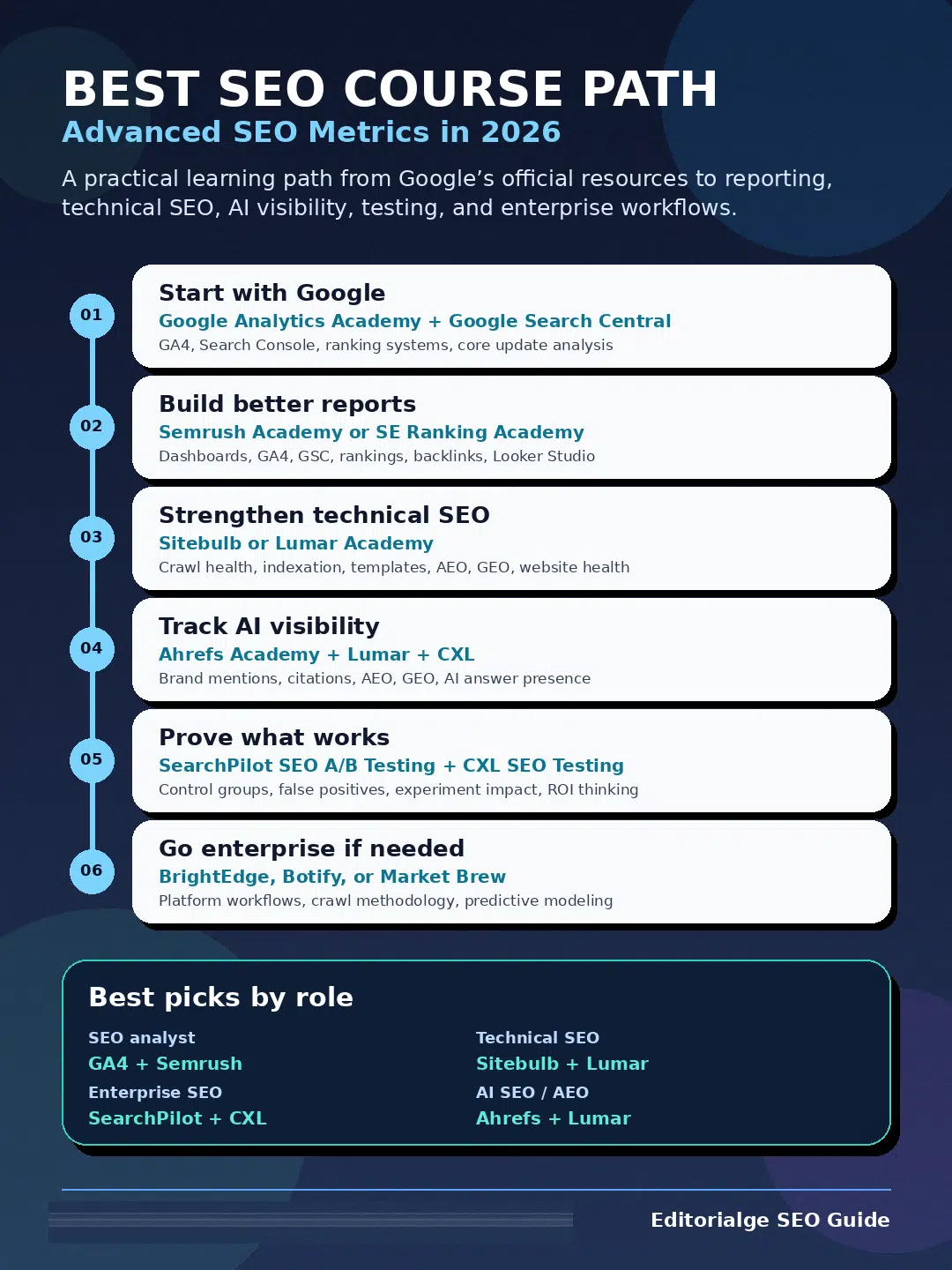
| Stage | Learning Focus | Recommended Resource |
|---|---|---|
| Week 1 | GA4 measurement | Google Analytics Academy |
| Week 2 | Search Console and ranking systems | Google Search Central |
| Week 3 | Reporting and dashboards | Semrush Academy or SE Ranking Academy |
| Week 4 | Technical SEO and crawl health | Sitebulb or Lumar |
| Week 5 | AEO and GEO basics | Ahrefs Academy or Lumar |
| Week 6 | SEO testing basics | SearchPilot |
| Week 7 | Advanced SEO experiments | CXL SEO Testing |
| Week 8 | Enterprise workflows | BrightEdge, Botify, or Market Brew onboarding |
Build one dashboard while learning
Don’t just watch videos.
Use one real website and build a working dashboard.
Track:
- Organic clicks
- Organic impressions
- CTR
- Average position
- Landing page groups
- Organic conversions
- Revenue or lead value
- Indexing issues
- Crawl errors
- Top gaining pages
- Top declining pages
- Algorithm update notes
- SEO experiment history
- AI visibility notes
This will teach you more than passively finishing five courses.
Keep an SEO test log
Every serious SEO team should keep a test log.
Include:
- Test name
- Date
- Page group
- Hypothesis
- Change made
- Expected result
- Actual result
- Control group, if available
- Business impact
- Decision
- Follow-up action
Over time, this becomes your own SEO playbook.
Best Course Picks by Role
The right course depends on your job.
A content strategist does not need the same training as a technical SEO lead. An agency reporting specialist needs dashboard skills. An enterprise SEO manager needs testing and stakeholder reporting.
| Role | Best First Pick | Best Next Pick |
|---|---|---|
| SEO analyst | Google Analytics Academy | Semrush Academy |
| Reporting specialist | SE Ranking Academy | GA4 certification |
| Technical SEO specialist | Sitebulb Enterprise SEO | Lumar Academy |
| Enterprise SEO manager | SearchPilot SEO A/B Testing | CXL SEO Testing |
| AI SEO / AEO specialist | Ahrefs AEO Course | Lumar GEO/AEO resources |
| SaaS SEO lead | CXL SEO Testing | SearchPilot |
| Ecommerce SEO lead | Sitebulb courses | SearchPilot |
| Enterprise platform user | BrightEdge or Botify training | Market Brew, if needed |
Best path for SEO analysts
Start with GA4, Search Console, Semrush, and SE Ranking.
Your job is to explain performance clearly. That means clean data, useful segments, and reports people can understand.
Best path for technical SEO specialists
Start with Sitebulb, Lumar, and CXL Technical SEO.
Your job is to find hidden problems before they hurt rankings. Focus on crawlability, indexing, rendering, internal links, and structured content.
Best path for enterprise SEO managers
Start with SearchPilot and CXL SEO Testing.
Your job is not just to find SEO ideas. It is to prove which ideas deserve time, budget, and engineering support.
Common Mistakes When Choosing Advanced SEO Courses
A lot of people pick courses for the wrong reason.
A course can sound impressive and still be useless for your current problem.
| Mistake | Better Approach |
|---|---|
| Taking another beginner SEO course | Choose analytics, testing, or technical SEO training |
| Learning tools without learning diagnosis | Focus on interpretation and decisions |
| Ignoring Google’s own docs | Use Search Central and the Search Status Dashboard |
| Reporting total traffic only | Segment by page type, query type, and value |
| Treating AI SEO as a shortcut | Focus on crawlability, clarity, authority, and citations |
| Chasing certificates only | Build dashboards, tests, and case studies |
| Trusting guaranteed ranking claims | Avoid courses that promise fixed rankings |
Don’t confuse certificates with skill
Certificates help. They show effort.
But skill shows up in your work.
Can you diagnose a traffic drop? Can you explain a core update impact? Can you build a clean dashboard? Can you prove whether a change worked?
That’s what clients and employers care about.
Avoid shortcut-heavy SEO training
Be careful with any course that promises guaranteed rankings.
No one can honestly guarantee Google rankings. Good training teaches systems, testing, and judgment. Bad training sells tricks.
Google’s spam policies also warn against scaled content created mainly to manipulate rankings. So, any course pushing mass low-value content as a quick win should raise a red flag.
Final Thoughts
The Best Online Courses to Learn Advanced SEO Metrics in 2026 are the ones that help you think clearly.
Start with Google’s own resources. Learn GA4. Learn Search Console. Understand ranking systems and core update analysis. Then move into dashboarding, technical SEO, SEO testing, AI search visibility, and enterprise workflows.
A strong path looks like this:
- Google Analytics Academy
- Google Search Central
- Semrush Academy or SE Ranking Academy
- Sitebulb or Lumar Academy
- Ahrefs AEO and Brand Radar resources
- SearchPilot SEO A/B Testing
- CXL Growth Focused SEO Testing
- BrightEdge, Botify, or Market Brew training if your company uses those platforms
The goal is not to collect certificates.
The goal is to build judgment.
Advanced SEO in 2026 is not about staring at more data. It is about knowing which numbers matter, which ones mislead, and what to do next.
FAQs About the Best Online Courses to Learn Advanced SEO Metrics
What is the best online course for advanced SEO metrics in 2026?
Start with Google Analytics Academy and Google Search Central. Then add Semrush or SE Ranking for reporting. After that, choose SearchPilot or CXL for testing, and Lumar, Sitebulb, or Ahrefs for technical SEO and AI search visibility.
Which course is best for algorithm update tracking?
Google Search Central is the best starting point because it gives official guidance. Use the Search Status Dashboard to confirm update dates, then compare Search Console and GA4 data after the update finishes.
Which course is best for SEO testing?
SearchPilot’s SEO A/B Testing course is one of the strongest choices for enterprise SEO testing. CXL’s Growth Focused SEO Testing course is also strong for structured experiments and impact measurement.
Which course is best for AI search visibility?
Ahrefs Academy, Lumar Academy, and CXL Technical SEO and AI Search are strong picks. Ahrefs is useful for AEO and Brand Radar. Lumar is useful for GEO/AEO and technical readiness. CXL is useful for advanced technical SEO and AI-driven discovery.
Is GA4 enough for advanced SEO reporting?
No.
GA4 is important, but it is only one part of the stack. You also need Search Console, crawl tools, rank trackers, backlink tools, dashboards, and testing data.
Enterprise teams may also need log files, APIs, BigQuery, and platform-specific reporting.
Do I need Python or SQL for advanced SEO metrics?
Not at first.
You can do a lot with GA4, Search Console, Looker Studio, Semrush, Ahrefs, SE Ranking, Lumar, and Sitebulb.
Python, SQL, and BigQuery become useful when you work with huge websites, log files, API data, or custom dashboards.
Are AI visibility metrics fully reliable?
Not yet.
AI search measurement is still developing. For now, track practical signals like brand mentions, citations, answer inclusion, competitor visibility, referral patterns, and business outcomes.





















