

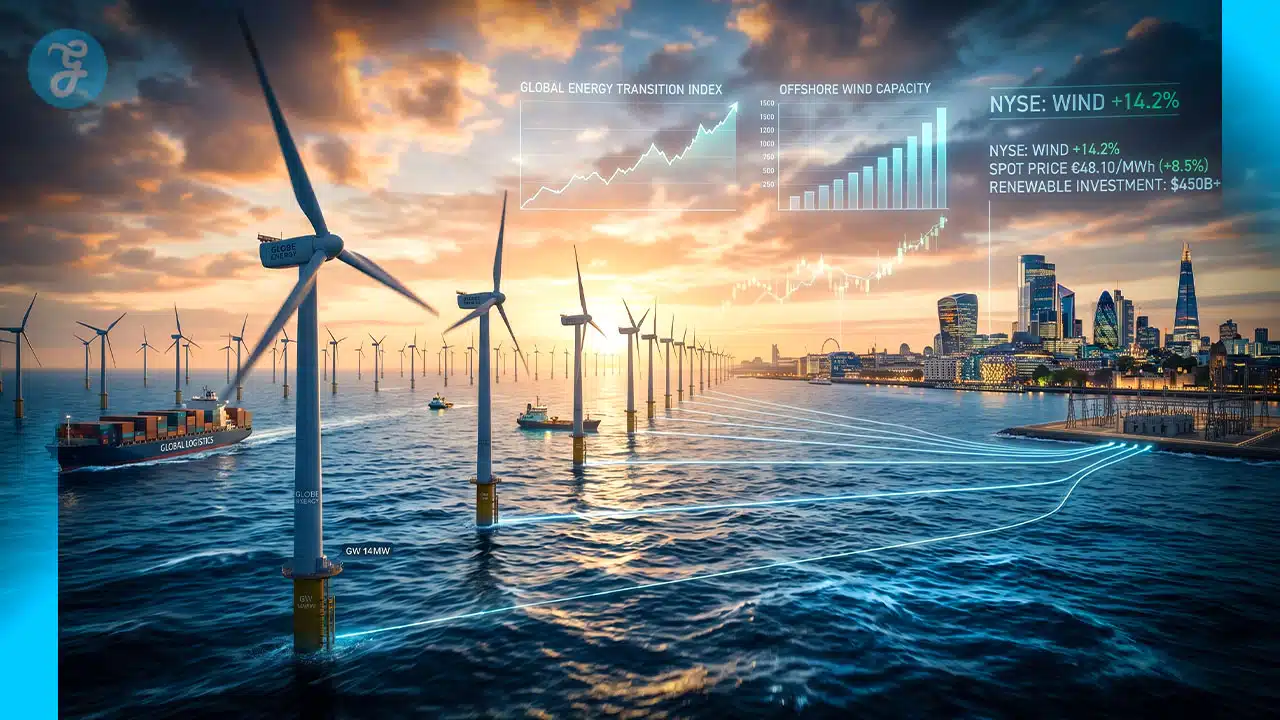
Is renewable energy truly transforming the grid, or just a side story to fossil fuels? The reality is that Wind Power Global Energy Markets are shifting faster than anticipated. Wind is no longer a niche alternative, but a dominant force.
According to the Global Wind Report 2026, the industry added a record-breaking 165 GW in 2025, pushing worldwide capacity to an impressive 1,299 GW. Simultaneously, renewables supplied 34% of electricity globally, with wind and solar generating 17% of that total. This rapid expansion reshapes everything from grid reliability and consumer costs to job creation across major hubs like China, Europe, and the USA. As offshore technologies and advanced storage solutions evolve, understanding these sweeping market changes is essential.
The Rise of Wind Power in Global Energy Markets
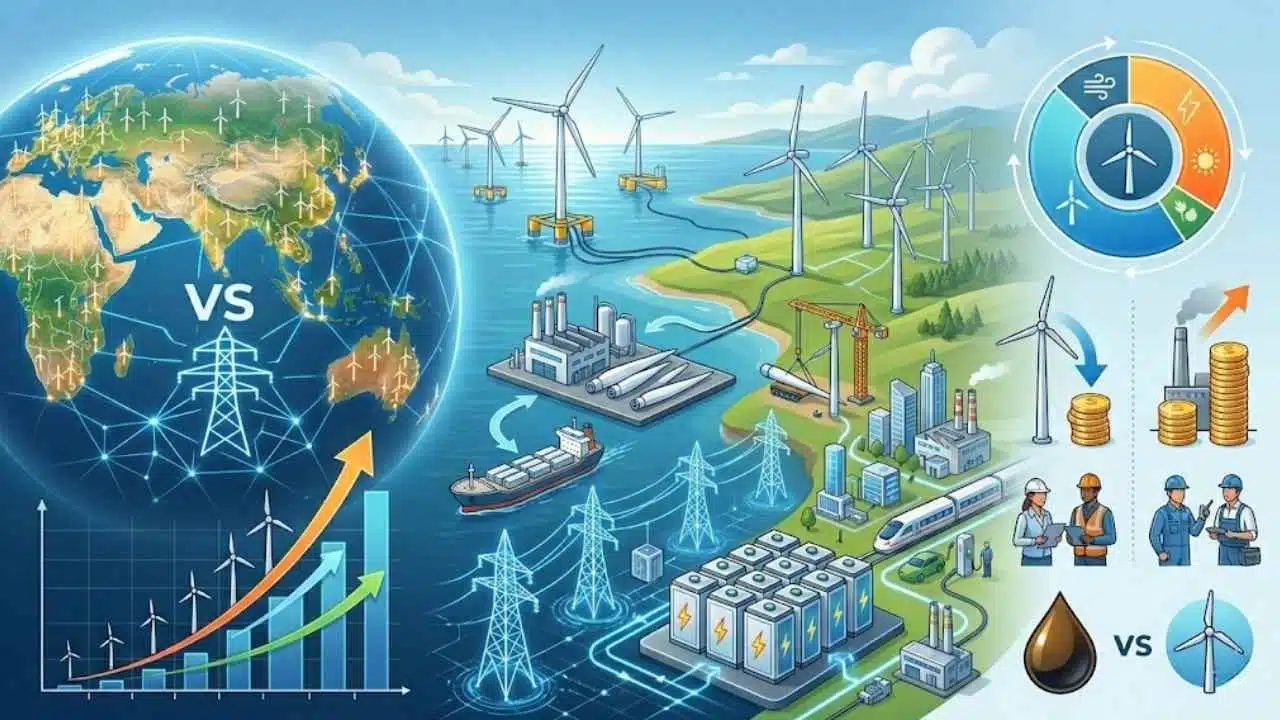
Wind power has moved well past the early-adopter stage. It now shapes how utilities plan new generation, how large companies buy electricity, and how countries think about energy security.
The big shift is simple: once a wind farm is built, the fuel is free. That matters in a market where fossil fuel prices can swing hard and where governments want cleaner electricity without adding more fuel-price risk.
What changed in 2026
GWEC says 2026 was a record year for the global wind industry. That matters because records at this scale usually signal a real market shift, not a one-off spike.
| Global wind metric | Latest figure | Why it matters |
|---|---|---|
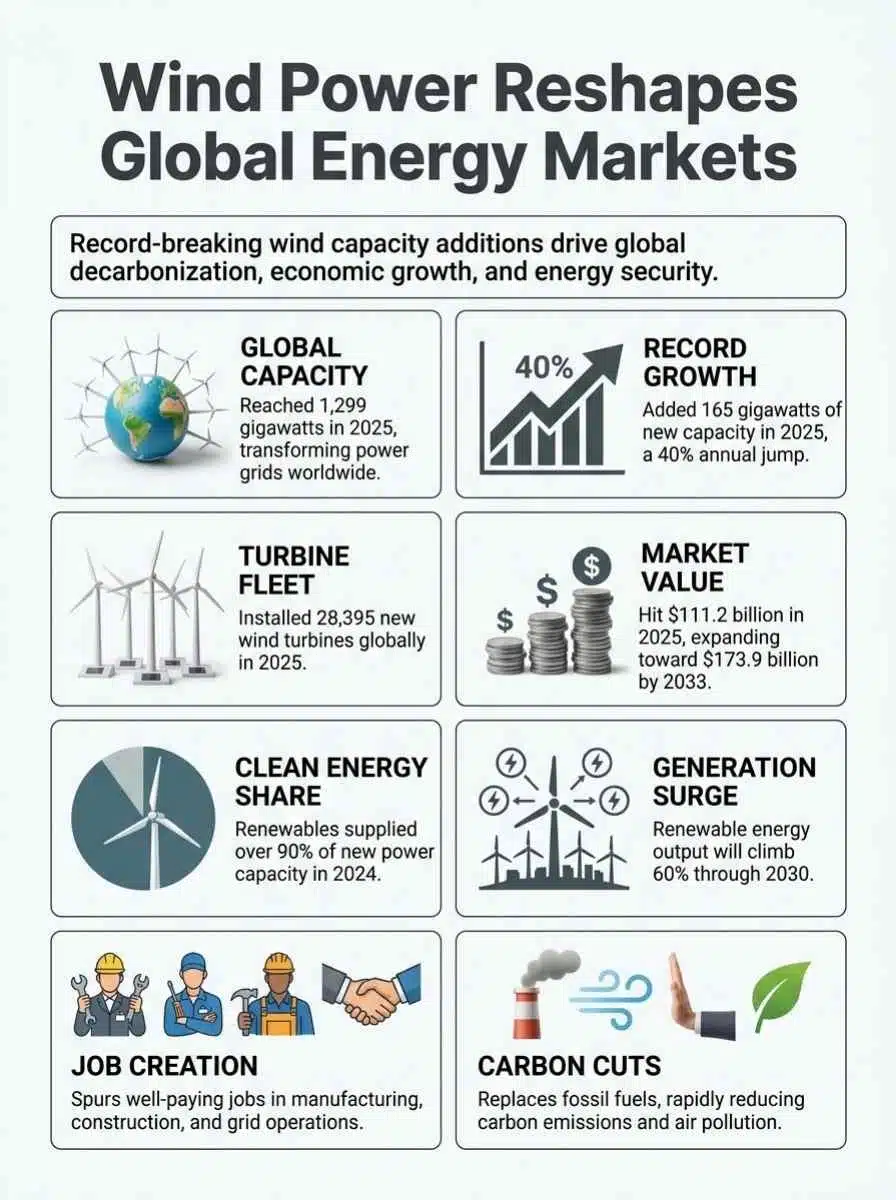
| Total installed wind capacity | 1,299 GW | Wind is now a core part of the global electricity mix, not a niche add-on. |
| New wind capacity added in 2025 | 165 GW | That was a record year, showing developers, utilities, and manufacturers are still scaling up. |
| Countries with wind generation | 138 | Wind is no longer concentrated in a handful of wealthy markets. |
| Turbines installed in 2025 | 28,395 | This points to a massive buildout of towers, blades, cables, and service work. |
| Global renewables share of electricity in 2025 | 34% | Wind is growing inside a much larger renewable system that is already reshaping power markets. |
| Wind and solar share of electricity in 2025 | 17% | Variable renewables now influence pricing, dispatch, storage needs, and transmission planning. |
Why this changes energy markets
Wind does more than add clean megawatts. It changes how power is priced, where grid upgrades happen, and which companies gain an edge.
- It reduces fuel exposure: wind farms do not need coal or gas deliveries, so operators are less exposed to commodity shocks.
- It pushes grid modernization: once wind reaches scale, utilities need better forecasting, transmission, and storage to use more of that power.
- It supports domestic industry: towers, nacelles, blades, cables, ports, and maintenance crews all create local economic activity.
- It changes buying behavior: major electricity buyers now use long-term contracts to lock in cleaner power and more stable pricing.
Wind is no longer competing for a seat at the table. In many markets, it is already part of the table.
Cost also helps explain the rise. IRENA reported that new onshore wind remained the cheapest source of new renewable electricity globally in 2024 at an average levelized cost of USD 0.034 per kWh, and 91% of newly commissioned utility-scale renewable capacity came in cheaper than the least-cost new fossil fuel alternative.
Key Drivers of Wind Energy Adoption
Wind does not grow on good intentions alone. It grows when policy, financing, equipment, and grid access line up at the same time.
Right now, that mix includes climate targets, industrial policy, corporate procurement, cheaper storage, and a growing need for reliable new electricity supply.
Decarbonization goals and climate policies
Climate policy still matters because it shortens the payback period on large projects and gives manufacturers enough confidence to build new factories. In the United States, the Inflation Reduction Act created tax support for domestic clean energy manufacturing, and the IRS notes that the advanced manufacturing production credit includes wind components.
Europe is taking a similar industrial approach. The European Commission’s wind package says the EU will need installed wind capacity to grow from 204 GW in 2022 to more than 500 GW by 2030, and the European Wind Power Action Plan lays out 15 actions to speed permitting, improve auctions, widen financing, and strengthen supply chains.
- Inflation Reduction Act: helps lower project and factory risk for U.S. wind components.
- REPowerEU: pushes Europe to replace imported fossil fuels with homegrown energy sources.
- The Green Deal Industrial Plan: ties clean energy deployment to manufacturing, skills, and financing.
- Net zero targets: give utilities and corporate buyers a reason to sign long-term wind contracts now rather than later.
Investments in renewable energy infrastructure
Money is moving into more than turbines. The real buildout includes transmission, substations, ports, vessels, batteries, software, and workforce training.
As of February 2026, EIA said U.S. developers planned to add a record 86 GW of new utility-scale generating capacity in 2026. Solar makes up 51% of that total, battery storage 28%, and wind 14%, which tells you a lot about where the market is going: wind increasingly works as part of a package with storage and grid upgrades.
| Investment area | What it solves | Why readers should care |
|---|---|---|
| Wind farms | Add new generation | They expand supply without tying power prices directly to fuel costs. |
| Battery storage | Shifts power to high-demand hours | It makes more wind generation usable and reduces curtailment. |
| Transmission | Moves electricity from windy regions to load centers | Without it, good wind projects can sit idle or face long delays. |
| Ports and vessels | Support offshore construction | These are now critical bottlenecks for large offshore builds. |
| Corporate PPAs | Lock in long-term revenue | That helps developers finance projects and helps buyers manage price risk. |
Corporate demand is a real driver here. Big buyers such as Meta, Amazon, and Google keep using long-term clean power deals to serve data centers and other power-hungry operations, which gives wind developers a clearer path to financing.
Regional Trends in Wind Energy
Wind is growing globally, but it is not growing the same way everywhere. The United States is leaning on storage and grid upgrades, China is building at unmatched scale, Europe is pushing offshore wind and industrial policy, and India is accelerating from a lower base.
Wind energy market in the United States
The U.S. market is one of the most important to watch because it combines huge land-based resource potential, fast-growing electricity demand, a rising storage fleet, and major policy swings.
| U.S. trend | Latest detail | What it means |
|---|---|---|
| Wind and solar in power generation | EIA says wind and solar together generated a record 17% of U.S. electricity in 2025 | Clean power is now large enough to affect market prices and planning decisions nationwide. |
| New build pipeline for 2026 | EIA expects 86 GW of new utility-scale capacity, with wind at 14% | Wind remains part of new supply growth, but it is increasingly paired with storage and solar. |
| Land-based wind jobs | DOE’s 2024 wind market reports counted 125,580 U.S. land-based wind jobs | Wind already supports a sizable workforce in construction, operations, and manufacturing. |
| Offshore development pipeline | DOE’s 2024 offshore market report put the U.S. offshore pipeline at 80,523 MW | The U.S. still has a large offshore runway even though project execution remains uneven. |
| Floating wind potential | DOE and NREL estimate 1.5 TW of fixed-bottom and 2.8 TW of floating offshore technical potential | That is why floating wind matters so much for the Pacific Coast and deeper-water areas. |
For readers in the U.S., the practical takeaway is this: the next wave is less about whether wind works and more about whether transmission, permitting, and storage can keep up.
Growth in China, India, and Europe
China is the scale leader. Government data released in February 2026 said China added more than 430 million kilowatts of wind and solar capacity in 2025 combined, taking cumulative wind and solar capacity to 1.84 billion kilowatts, or 47.3% of total installed power capacity, while wind and solar together supplied 22% of the country’s electricity.
Europe is moving more steadily but with strong policy support. Wind Europe said Europe installed 19.1 GW of new wind capacity in 2025, bringing total installed wind capacity to 304 GW, and wind met 19% of EU electricity demand.
India is now firmly in the front rank of growth markets. GWEC identified India as one of the leading countries for new capacity additions in 2025, showing that onshore wind is becoming a bigger part of the broader Asia Pacific energy transition.
| Region | What stands out | Market effect |
|---|---|---|
| China | Very fast buildout and huge domestic manufacturing base | China keeps driving global scale, equipment learning, and supply chain pricing. |
| Europe | Strong offshore focus and coordinated policy support | Europe is trying to pair wind expansion with industrial competitiveness. |
| India | Rapid onshore growth from a lower installed base | India is becoming one of the most important markets for future demand growth. |
| United States | Strong land-based resource and fast storage buildout | The U.S. can grow quickly, but interconnection and permitting will decide the pace. |
Innovations in Wind Power Technology
Technology is one reason wind keeps gaining ground. Modern projects use bigger turbines, better controls, stronger forecasting, and smarter storage, which means more usable electricity from each site.
Offshore wind developments
Offshore wind is where turbine design has become especially important. Larger machines mean fewer foundations, fewer cables, and fewer installation lifts for the same amount of capacity, which can improve project economics.
Two names keep showing up in this space: GE Vernova’s Haliade-X 14 MW and Siemens Gamesa’s SG 14-222 DD and SG 15-236. These machines matter because their larger rotor diameters let developers pull more energy from steadier offshore winds, especially in large utility-scale projects.
- Larger rotors: capture more wind and raise annual output.
- Fewer turbines per project: reduce the number of foundations and electrical connections needed.
- Direct-drive designs: can reduce some maintenance complexity by cutting gearbox dependence.
- Floating platforms: open deeper-water sites that fixed-bottom turbines cannot reach economically.
Transmission is part of the technology story too. DOE notes that high-voltage direct current, or HVDC, is becoming more important because it can move large amounts of offshore or remote wind power over long distances more efficiently and with tighter control of power flows.
Integration with energy storage systems
Storage has gone from a nice extra to a core grid tool. If you want more wind in the electricity system, you need fast-response flexibility to handle ramps, congestion, and shifting demand.
The IEA reported that 108 GW of new battery storage capacity was deployed worldwide in 2025, up 40% from 2024, and around 80% of those additions were utility-scale. It also said lithium-iron phosphate batteries now account for around 90% of deployments, largely because they are cheaper and well suited to frequent cycling.
This is where software matters just as much as hardware. A wind farm with strong forecasting, SCADA-based monitoring, and a co-located battery can often earn more value than a wind farm that simply produces whenever the wind blows.
| Integration tool | What it does | Why it helps wind |
|---|---|---|
| Co-located battery storage | Stores excess output for later discharge | Helps shift wind generation into higher-value periods. |
| SCADA monitoring | Tracks turbine performance in real time | Helps operators spot faults, reduce downtime, and improve dispatch. |
| Short-term forecasting | Predicts wind output and ramps | Lets grid operators schedule reserves more efficiently. |
| HVDC links | Moves bulk power long distances | Useful for offshore wind and remote high-resource regions. |
For U.S. readers, storage growth is especially important. EIA says developers plan to add 24 GW of utility-scale battery storage in 2026, with Texas, California, and Arizona accounting for about 80% of that total.
Economic and Environmental Benefits of Wind Power
Wind power keeps expanding because it offers two benefits at once: it can support jobs and local investment, and it can cut pollution from electricity generation.
Job creation and economic growth
Wind projects create work long before the first megawatt reaches the grid. A single large project can touch survey crews, concrete suppliers, steel fabricators, electricians, crane operators, software technicians, and long-term maintenance teams.
DOE’s 2024 wind market reports counted 125,580 U.S. land-based wind jobs. In the broader clean power economy, ACP says the industry directly employed more than 437,000 Americans in 2025 and supported more than 1.4 million jobs nationwide through wider economic activity.
- Construction jobs: civil works, roads, foundations, substations, and transmission tie-ins.
- Manufacturing jobs: blades, towers, nacelles, converters, cables, and bearings.
- Operations jobs: turbine technicians, control room operators, and spare-parts logistics.
- Community revenue: lease payments, local taxes, and port activity for offshore projects.
If you are judging a wind project’s economic value, look beyond the headline capacity number. The stronger question is how much of the supply chain, service work, and tax base stays local.
Reduction in carbon emissions and air pollution
Wind power produces electricity without combustion. That means no smokestack emissions while operating, which is why it helps cut both greenhouse gas emissions and local air pollution from displaced fossil generation.
The EPA explains this in straightforward terms: electricity from renewable resources such as wind generally does not contribute to climate change or local air pollution because no fuels are burned. EIA makes the same point in its wind and environment overview, noting that wind can reduce fossil fuel generation and lower total air pollution and carbon dioxide emissions.
Cleaner electricity matters twice: it lowers long-term climate risk and it reduces the health burden linked to burning fossil fuels for power.
The market impact is showing up already. The IEA says low-emissions sources reached 43% of global electricity generation in 2025, the highest share in the past fifty years, while coal-fired generation declined by about 0.5% worldwide.
Challenges in Scaling Wind Energy
Wind has momentum, but scaling it is still hard work. The biggest obstacles now are less about proving the technology and more about getting projects approved, connected, financed, and supplied on time.
Regulatory and permitting obstacles
Permitting remains one of the biggest sources of delay in the United States. Local zoning fights, environmental reviews, radar and aviation concerns, and interconnection studies can each slow a project down by months or years.
Berkeley Lab’s Queued Up: 2025 Edition shows how crowded the system has become. At the end of 2024, about 10,300 projects were actively seeking grid interconnection in the U.S., including 271 GW of wind, and the median duration from interconnection request to commercial operation had climbed to more than four years for projects built in 2018 through 2024.
Local opposition adds another layer. The 2025 Sabin Center report identified 498 contested renewable projects across 49 states and said at least 459 counties and municipalities in 44 states had adopted severe local restrictions on renewable siting.
- Check the queue early: a strong wind site is far less valuable if the grid connection is years away.
- Map local constraints first: aviation, military, wildlife, and county zoning rules can sink a project late if they are ignored early.
- Plan community engagement early: delays often grow when developers treat local outreach as an afterthought.
Supply chain and manufacturing limitations
Wind projects rely on a long chain of specialized equipment. If one link slips, the whole schedule can move.
The hard parts are usually not the obvious ones. A project can have turbines ordered and financing closed, then still get stuck waiting on transformers, subsea cable, installation vessels, large bearings, or a port slot.
| Bottleneck | Why it slows projects | What helps |
|---|---|---|
| Blades and nacelles | Large components need specialized factories and transport routes | More domestic manufacturing and earlier procurement |
| Transformers and grid equipment | Interconnection cannot happen without them | Transmission planning and longer supply contracts |
| Ports and vessels | Offshore construction depends on limited heavy-lift infrastructure | Port upgrades and fleet investment |
| Skilled labor | Projects need trained technicians, electricians, and marine crews | Apprenticeships, union training, and regional workforce programs |
There is progress here. DOE’s 2024 offshore market report said $2.1 billion had been invested since 2023 in U.S. ports, vessels, workforce development, research, and related offshore wind supply chain needs. That is helpful, but it also shows how capital-intensive catch-up can be.
The Future of Wind Power in Global Energy Markets
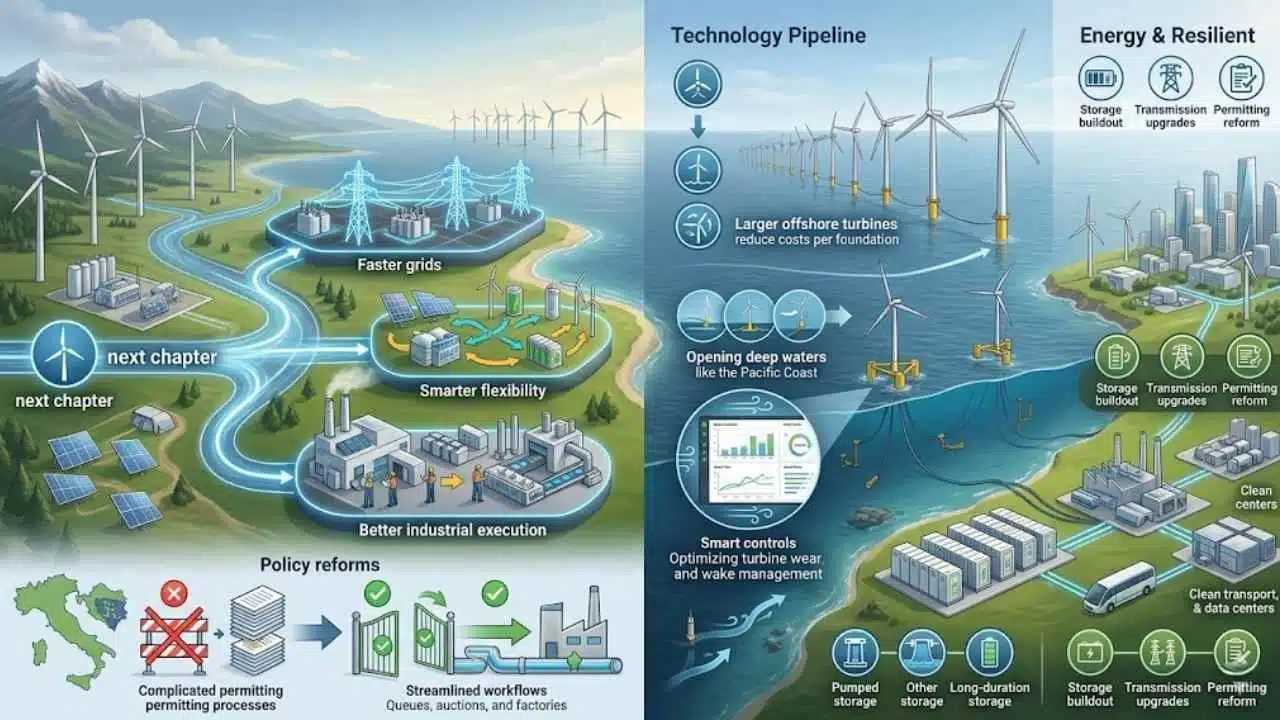
The next chapter for wind power will be shaped by three things: faster grids, smarter flexibility, and better industrial execution. The turbines will keep improving, but the market winners will be the places that can connect projects quickly and use the electricity well.
Policy reforms and international collaboration
Policy is moving from broad climate ambition to delivery. That means governments are spending less time asking whether they want more wind and more time trying to fix the queues, auctions, and factories that slow it down.
In the U.S., grid policy is becoming just as important as generation policy. DOE’s Grid Resilience and Innovation Partnerships program totals $10.5 billion, and the department announced nearly $2 billion in March 2026 for advanced transmission upgrades through its SPARK funding opportunity.
Europe is taking a similar delivery-first approach through the European Wind Power Action Plan, the Wind Charter, REPowerEU, and the Green Deal Industrial Plan. If those reforms work, they should shorten lead times and make more auction awards actually turn into operating projects.
Potential for further technological advancements
The technology pipeline is still strong. Bigger offshore turbines, better power electronics, stronger forecasting, recyclable materials, and longer-duration storage should all improve project performance over the next few years.
Floating wind turbines may be the most important long-term unlock for the United States. DOE and NREL estimate 2.8 TW of floating offshore technical potential in U.S. waters, which is why floating designs matter so much for deep-water regions where fixed-bottom foundations do not make sense.
- Larger offshore turbines: improve output per foundation and reduce balance-of-plant costs.
- Floating foundations: open deeper waters off the Pacific Coast and other challenging regions.
- Smarter controls: let operators reduce wear, improve wake management, and lift annual production.
- More storage: helps wind compete better during peak-price hours instead of only during windy hours.
If you want to judge the future of wind clearly, watch storage buildout, transmission upgrades, and permitting reform as closely as turbine size. That is where the real market reshaping will happen.
Final Thoughts
Wind power has moved from a climate talking point to a serious market force. With 1,299 GW installed globally and 165 GW added in 2025, the direction is hard to miss.
Onshore wind, offshore wind, floating wind turbines, energy storage, and grid integration now work together as one system. That system can create jobs, cut greenhouse gas emissions, strengthen energy security, and give buyers a more stable path through the energy transition.
If you are watching where global electricity markets are headed next, keep your eye on wind. It is already reshaping the future, and the regions that build the grids, storage, and supply chains around it will benefit the most.
Frequently Asked Questions (FAQs) About Wind Power in Global Energy Markets
1. What role does wind power play in global energy markets?
Wind power grows fast, it raises the share of renewables in the electricity mix, and it cuts carbon emissions. It shifts where investment goes, and it changes market share for fossil fuels.
2. How does wind power affect energy prices and investment?
Once built, wind lowers energy prices, because wind has low operating cost. That draws investment to wind farms, factories, and the wider supply chain.
3. What challenges does wind power bring to the grid?
Wind is intermittent generation, it does not blow to a timetable, so grid integration must improve. Operators add storage, smarter transmission, and flexible backup plants, to balance supply and demand. It is like juggling, with electrons instead of balls.
4. Can wind power reshape jobs and industry?
Yes, wind creates jobs across the supply chain, in ports, factories, and services, it fuels local economies. Sea-based wind farms and land projects both need builders, technicians, and planners, so industries pivot and grow.





















