

On September 5, 2025, U.S. Immigration and Customs Enforcement (ICE) conducted one of the largest workplace raids in American history at a Hyundai–LG Energy Solution joint-venture battery plant in Ellabell, Georgia, near Savannah. The facility, still under construction, is a centerpiece of Hyundai’s U.S. electric vehicle strategy and part of the state’s largest-ever economic development project.
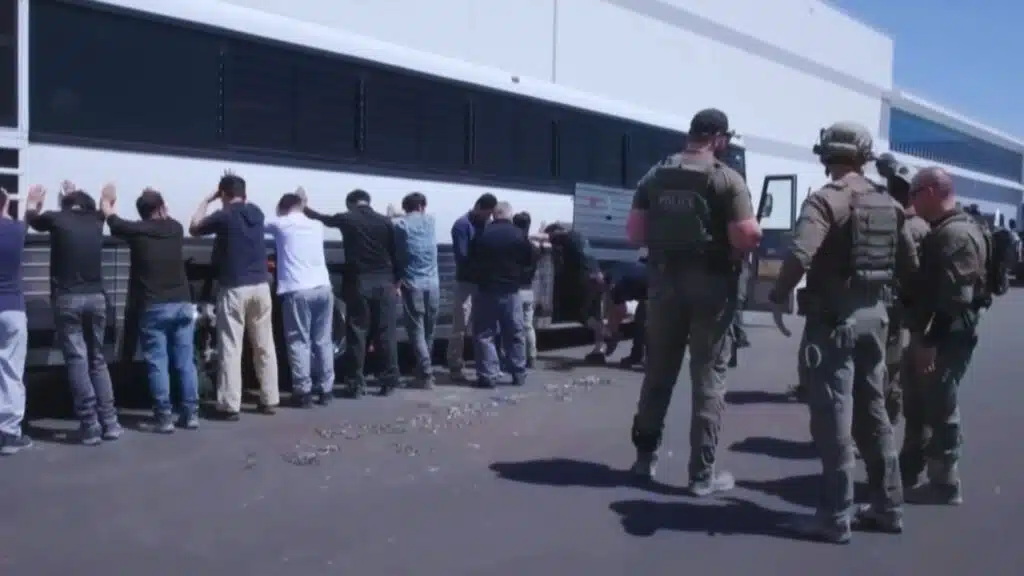
Federal officials confirmed that 475 individuals were arrested, most of them South Korean nationals. ICE described the operation as the largest single-site enforcement action ever carried out by Homeland Security Investigations (HSI). Video released by ICE showed workers shackled, lined up, and placed on buses. The footage has since drawn criticism in South Korea, where government leaders called the public broadcast of such images “regrettable.”
How the Raid Was Conducted
According to ICE officials, the operation was the result of a months-long investigation into unauthorized employment at the plant. Authorities alleged that many workers were in the U.S. unlawfully, while others had entered legally but were working in violation of their visa terms.
The raid involved hundreds of federal officers, helicopters circling above, armored vehicles on site, and support from Georgia state agencies. Reports indicated that some workers attempted to hide—several were found in air ducts, while others jumped into a nearby pond to evade detention. These dramatic scenes highlighted the scale and intensity of the enforcement.
Steven Schrank, special agent in charge for HSI in Georgia and Alabama, said the raid was meant to protect jobs for American and Georgian workers. He stressed that the agency was sending “a clear and unequivocal message” that companies and individuals undermining U.S. labor laws would be held accountable.
South Korea’s Urgent Diplomatic Response
The arrests quickly escalated into a diplomatic crisis. In Seoul, President Lee Jae-Myung expressed deep concern and demanded an “all-out effort” to protect South Korean citizens. He emphasized that the rights of nationals and the operations of Korean companies investing billions in the United States must not be infringed upon.
Foreign Minister Cho Hyun convened an emergency meeting, stating that South Korea felt “a heavy sense of responsibility” over the incident. He also indicated he might travel to Washington to hold urgent talks with the U.S. administration.
Seoul’s Foreign Ministry also criticized ICE’s decision to release video footage of the arrests, calling it “regrettable” and warning that the images could inflame public anger.
Hyundai and LG Energy Solution React
Both Hyundai Motor Group and LG Energy Solution (LGES), partners in the Georgia battery plant, issued swift statements.
- Hyundai said that based on its current understanding, none of those detained were direct employees of the company. The automaker pledged to conduct an internal review of its contractors and suppliers to ensure compliance with U.S. labor and immigration laws. The company reiterated it has “zero tolerance” for illegal practices.
- LG Energy Solution confirmed that at least 47 of its employees or contractors were detained. The company temporarily suspended business travel to the U.S., advised staff already in the U.S. to either remain in safe accommodations or return home, and dispatched its chief human resources officer to Georgia to manage the crisis. LGES stated it was making “every effort” to ensure the safe and speedy return of affected workers.
The Georgia Government’s Position
Georgia officials, who had championed the Hyundai–LG project as a game-changer for the state’s economy, expressed support for the federal action.
Republican Governor Brian Kemp said Georgia would “always enforce the law, including all state and federal immigration laws.” His office confirmed that the Georgia Department of Public Safety and the Georgia National Guard had provided support for the operation.
Republican Congressman Buddy Carter, whose district includes the Ellabell site, praised the Trump administration’s enforcement move. He said the raid was proof that the U.S. government was serious about “putting American workers first.”
Political Reactions in Washington
Reactions in Washington were divided along party lines.
- President Donald Trump defended the raid, saying ICE was simply “doing its job” by removing “illegal aliens.” The president has been pushing for stricter immigration enforcement while simultaneously promoting trade and investment from South Korea.
- Sen. Raphael Warnock of Georgia, a Democrat, criticized the operation, arguing that such raids exploit vulnerable immigrant workers and create fear among Georgia families. He also questioned how major companies were able to employ undocumented or improperly authorized workers in the first place. Warnock said it was “bad for our economy and bad for law-abiding Georgia families.”
Why the Plant Matters
The Hyundai Metaplant and LGES battery facility are part of a $12.6 billion investment—the largest in Georgia’s history. The battery project alone is valued at around $4.3 billion and is expected to supply Hyundai’s expanding EV lineup in the U.S.
Officials have touted the project as a source of thousands of jobs and a major step toward positioning Georgia as a hub for electric vehicle manufacturing. The raid, however, has raised questions about whether immigration enforcement could undermine foreign investor confidence.
Trade and Diplomatic Risks
The arrests come at a delicate moment in U.S.–South Korea relations. South Korean companies have pledged more than $350 billion in investments in the U.S., much of it focused on electric vehicles, batteries, and semiconductors.
The incident risks creating friction just as both governments seek closer cooperation on trade, technology, and supply chains. Analysts warn that if unresolved, it could dent investor confidence and complicate negotiations over future South Korean projects in the United States.
The Larger Debate
The raid has also reignited the broader debate on immigration enforcement and labor practices. Supporters argue that such actions protect American jobs and ensure fair labor standards. Critics say large-scale raids traumatize immigrant communities, punish workers more than employers, and disrupt key industries.
Questions also remain about employer accountability—how contractors and subcontractors at a high-profile, multi-billion-dollar project were able to hire such large numbers of workers allegedly without proper authorization. Both Hyundai and LGES now face pressure to demonstrate compliance and transparency.
The Information is Collected from NPR and BBC.






















