

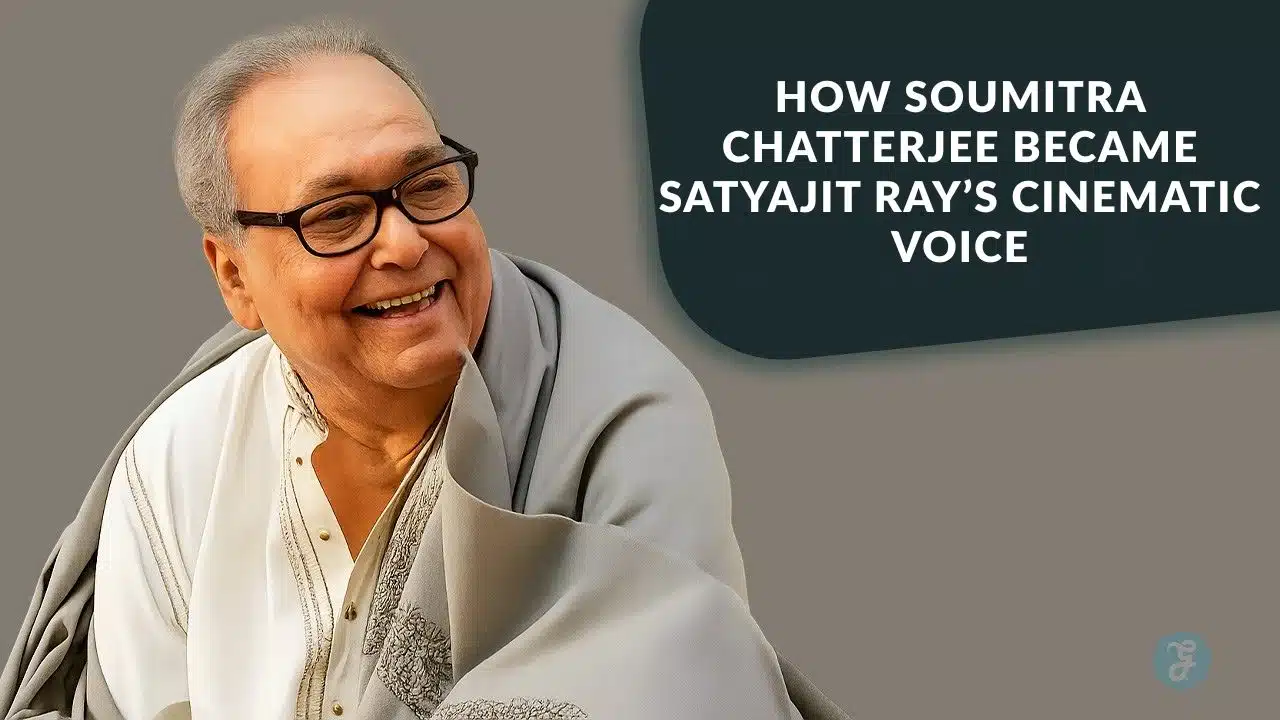
Five years after Soumitra Chatterjee left us, his absence still feels like a silence inside Ray’s cinema. Instead of a void, Soumitra Chatterjee’s absence felt like a quiet breath between frames, a silence that Ray used as a form of dialogue. For generations of cinephiles, Soumitra isn’t merely an actor in Ray’s films; he is the medium through which Ray’s ideas, dilemmas, and intellectual anxieties found human shape.
If cinema is an auteur’s language, then Soumitra Chatterjee was Satyajit Ray’s most fluent dialect.
Ray worked with many great performers—Uttam Kumar, Madhabi Mukherjee, and Chhabi Biswas—but Soumitra alone became his cinematic voice. Together, they forged one of the most profound director–actor partnerships in world cinema, comparable not to Indian industry pairs but to the outstanding narrative duos of global film history: Bergman and Ullmann, Kurosawa and Mifune, and Scorsese and De Niro.
On the 5th anniversary of Soumitra’s passing, we revisit how this extraordinary alchemy was forged—and why it remains unmatched.
Ray’s Search for the Modern Bengali Protagonist
In the late 1950s, Satyajit Ray was transitioning from the lyrical humanism of the Apu Trilogy to a more complex worldview. His films were becoming more urban, more intellectual, and more psychologically layered. He needed a new kind of actor—someone capable of subtlety, introspection, and emotional discipline.
The Bengali screen of the time was dominated by stylized romantic heroes. Ray wanted something fundamentally different:
-
a face that could carry thought,
-
a body that could hold silence,
-
a presence that didn’t “act” emotion but let it emerge.
When Soumitra Chatterjee auditioned for Pather Panchali, Ray noted the spark but felt he was too mature for the young Apu. Yet he didn’t forget him. When Apur Sansar began, Ray called him again. What he saw was not simply a good actor; he saw a vessel through which he could articulate the internal lives of Bengal’s new middle class.
And Soumitra understood Ray instinctively, the way one thinker recognizes another.
The Apu Revolution: Establishing a New Acting Grammar
Apur Sansar (1959) was not just a debut; it was a quiet revolution in Indian screen acting. Soumitra’s Apu was a character built on restraint—not the dramatic, theatrical sorrow that dominated Indian cinema, but a soft, internalized grief. His emotions lived in:
-
the pauses between words,
-
the tremble before a line,
-
the gaze that lingered on the horizon,
-
the body that hesitated before accepting joy.
Apu’s world was filled with heartbreak, but Soumitra never overplayed it. And Ray’s camera responded in kind. He framed Soumitra close, trusting his face to hold entire emotional arcs without speech. This mutual trust formed the core of their long-term collaboration: Ray wrote characters who think, and Soumitra acted thinking itself.
After Apur Sansar, Ray had his actor—and Soumitra had his artistic universe.
Fourteen Films, One Evolving Idea
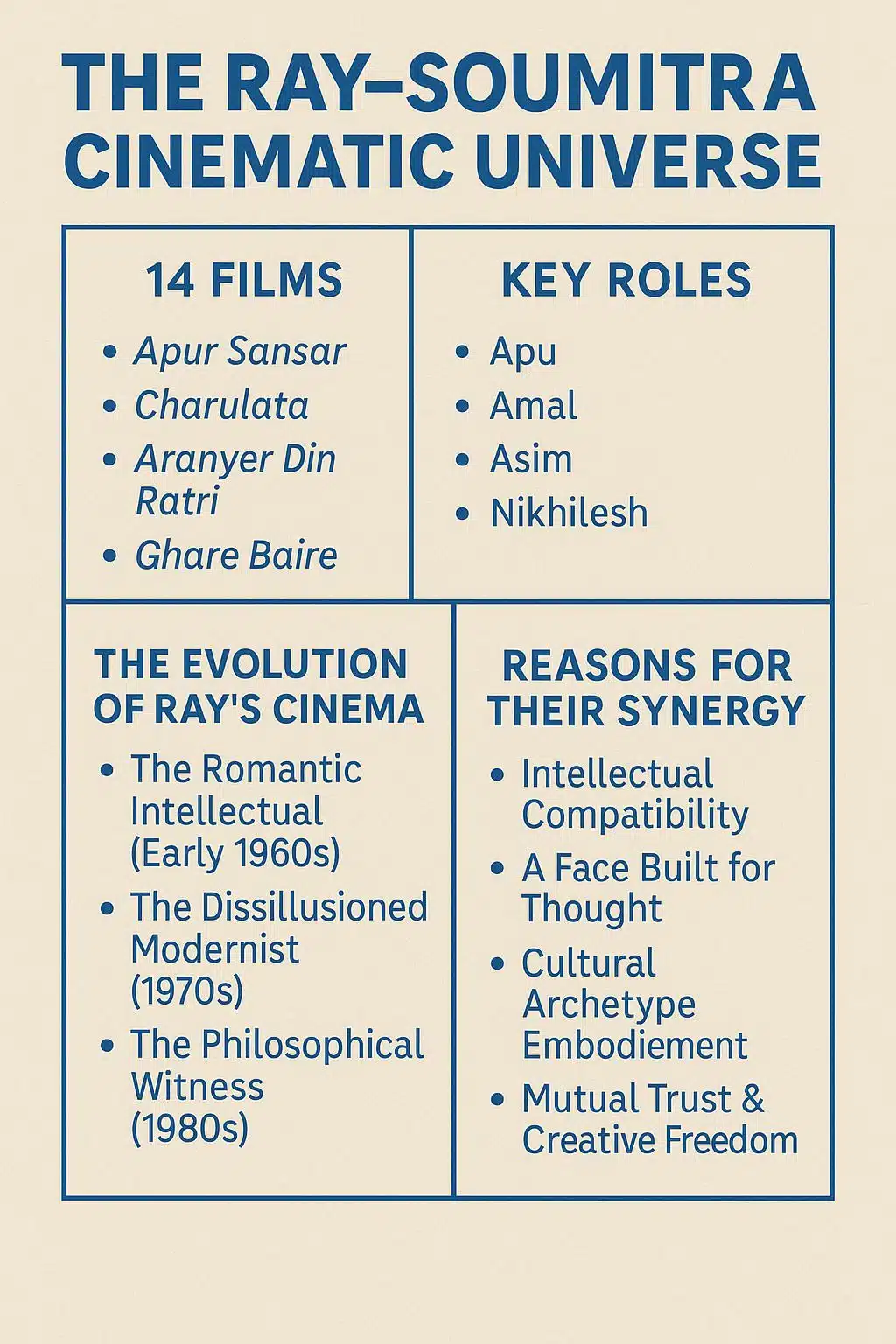
Across 14 films over three decades, Ray used Soumitra not as a character actor but as an evolving philosophical presence. His roles map the emotional and ideological shifts of Ray’s own cinematic journey.
The Romantic Intellectual of the Early 1960s
In films like Devi, Teen Kanya, and Charulata, Soumitra embodied the Bengali intellectual at his romantic peak—youthful, curious, and gentle. He played men who questioned tradition, who engaged in subtle flirtation, and who expressed modernity through body language rather than rhetoric.
In Charulata, his Amal is one of the most sophisticated flirtations in Indian cinema—accomplished without touch, without declarations, built instead on glances, laughter, and shared literary space. Ray’s camera lingers on Soumitra’s playful restlessness because it mirrors the new winds entering Charu’s lonely home.
Soumitra didn’t play Amal; he was Amal—Ray’s symbol of modern male vulnerability.
The Disillusioned Modernist of the 1970s
As Ray’s worldview turned more political, Soumitra’s screen persona matured into one of introspection, cynicism, and moral fatigue.
In Aranyer Din Ratri, Soumitra’s Asim is a man wrestling with class, arrogance, and insecurity. His performance is a masterwork of contradiction: confident posture with hollow eyes and a charming smile that hides deep discomfort. Ray uses him to critique a generation that had education but not wisdom.
In Ashani Sanket, Soumitra’s doctor navigates famine—not as a hero but as a man overwhelmed by the collapse of civilization. His performance is quiet and observational, letting Ray’s lens capture how tragedy erodes idealism.
This was not the romantic intellectual anymore. This was the disillusioned modernist—Ray’s voice for India’s social fracture.
The Philosophical Witness of the 1980s
In Ray’s later works, Soumitra becomes calmer, wiser, and more reflective.
In Ghare Baire, his Nikhilesh is one of the most morally dense characters Ray ever wrote—a man torn between progress and tradition, nationalism and humanism. Soumitra plays him with devastating gentleness. He becomes the observer of his crumbling ideals.
By then, Soumitra was no longer Ray’s protagonist—he was Ray’s conscience.
How Soumitra Chatterjee Became Satyajit Ray’s Cinematic Voice
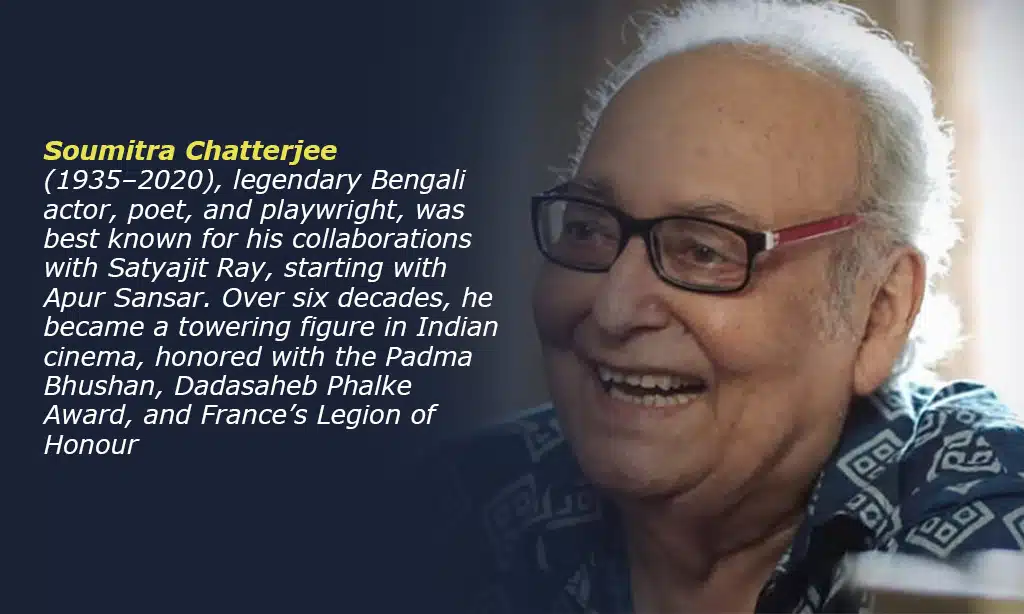
To understand their synergy, we must break down the core principles that shaped their partnership.
Intellectual Compatibility
Ray needed actors who understood silence and subtext. Soumitra, being a poet, playwright, and editor, recognized the architecture beneath Ray’s scripts. He could detect intention without instruction.
Ray famously gave actors minimal direction; Soumitra required even less. He could read Ray’s pauses, his gestures, and even his breathing. They communicated like two musicians playing the same raga without speaking.
A Face Built for Thought
Soumitra possessed what Ray called a “transparent face”—one capable of transmitting inner monologue without movement. His micro-expressions did more than dialogue could.
This made him perfect for Ray’s restrained cinematic grammar. Ray shot faces like landscapes; Soumitra’s was a map of shifting emotional weather.
Cultural Archetype Embodiment
Uttam Kumar could do Nayak because that film needed a star. But Ray needed a different archetype for most of his films—the introspective, educated, flawed, evolving Bengali man.
Soumitra embodied this archetype naturally. He didn’t perform the bhadralok; he was the bhadralok.
Mutual Trust & Creative Freedom
Ray trusted Soumitra more than any other actor. He wrote roles that required emotional intelligence, not dramatic acrobatics.
And Soumitra trusted Ray completely—never overstepping, never diluting the material. Their relationship was not one of director and actor but of two artists building the same thought.
Case Studies: How Ray Used Soumitra to Think on Screen
To see their relationship clearly, we must examine specific cinematic moments.
Apu’s Breakdown in Apur Sansar
Apu collapses on the bedside after Aparna’s death. No grand gestures. No weeping. The scene is characterized by a gradual internal disintegration. The power of the scene lies in Soumitra’s refusal to release emotion, mirroring Ray’s belief in quiet devastation.
The Swing Scene in Charulata
As Amal playfully circles Charu’s swing, Soumitra uses rhythm—body movement as flirtation. The scene is erotic without touch. Ray frames him in gentle light because Soumitra acts as both muse and catalyst.
The Confession Scene in Aranyer Din Ratri
Soumitra’s Asim breaks down psychologically during a memory game. The mask of confidence slips. Ray captures the fragility of middle-class masculinity through Soumitra’s trembling composure.
The Political Dialogues in Ghare Baire
Soumitra’s Nikhilesh speaks with heartbreaking calm, even as his world collapses. His stillness becomes Ray’s moral anchor—a portrayal of principle in a moment of madness.
Why Soumitra Didn’t Belong to Any Other Director
Many filmed him, but few understood him.
Some used him as a conventional hero. Others cast him in literary adaptations. But without Ray’s narrative architecture, Soumitra often felt misplaced—like a symphony played on a toy flute.
Ray created characters that required:
-
inner conflict,
-
emotional restraint,
-
intellectual turmoil,
-
moral ambiguity.
Soumitra excelled only when the script demanded thought rather than theatrics. Ray alone built such scripts consistently. Their partnership was not a coincidence; it was a structural necessity.
Final Words: Five Years Later, the Voice Still Echoes
On his fifth death anniversary, Soumitra Chatterjee remains not just an icon of Bengali cinema but a cornerstone of India’s cultural memory. His performances continue to breathe inside Ray’s frames, sustaining the moral and emotional logic of Ray’s cinematic universe.
Soumitra didn’t amplify Ray’s ideas—he humanized them. He didn’t echo Ray’s thoughts—he embodied them. He didn’t perform Ray’s cinema—he became its language.
In the final analysis, Soumitra Chatterjee was not merely Satyajit Ray’s actor. He was his cinematic voice.






















