
Today, December 5, 2025, marks one hundred years since the birth of Gouri Prasanna Majumdar. A century ago, in Pabna, a lyricist was born who would go on to write not just songs, but the emotional soundtrack of Bengalis on both sides of the border.
Decades after his death, Gouri Prasanna Majumdar still lives in everyday memory. His name returns whenever people argue about the depth of lyrics, the balance between poetry and conversation, or the power of a song to move crowds and shape history. Often called the “Shelley of Bengal” and “the architect of modern Bengali song,” he stands as a bridge between the classical world of Tagore and Nazrul and the busy, modern lives of ordinary listeners.
On his centenary, his legacy also forces a difficult question: in an age of fast content and disposable music, have we forgotten how to tell real stories through song?
Gouri Prasanna Majumdar at a Glance
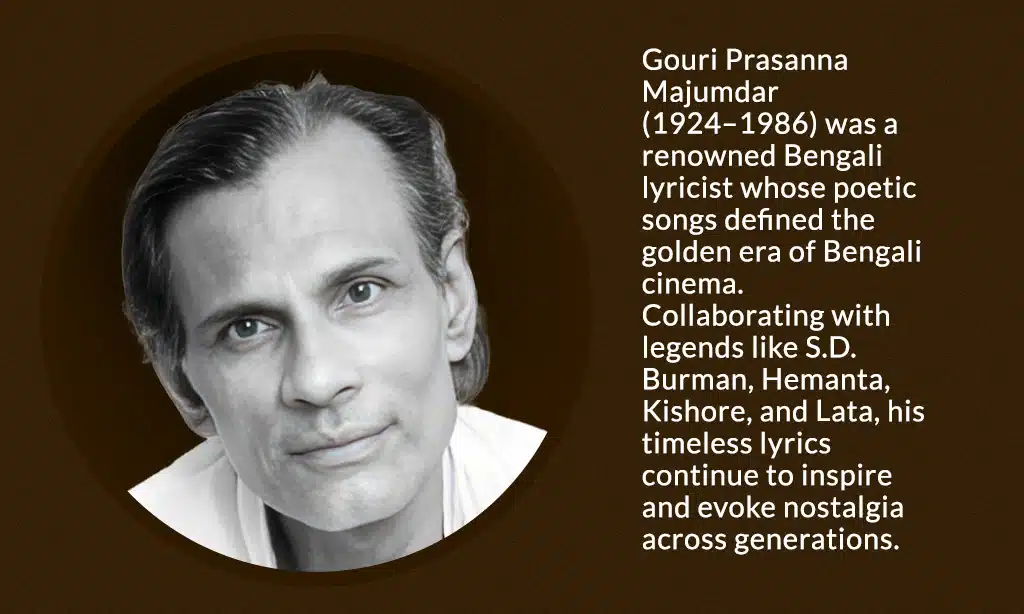
Before exploring his journey, a brief snapshot helps illustrate the scale of his contribution:
- Full name: Gouri Prasanna Majumdar
- Born: 5 December 1925, Pabna (then British India, now in Bangladesh)
- Died: 20 August 1986, Kolkata
- Heritage: Bengali
Key roles:
- Major lyricist of the golden era of Bengali cinema
- One of the most prominent voices behind Swadhin Bangla Betar Kendra songs
- Long-time collaborator with Hemanta Mukherjee, R.D. Burman, and Kishore Kumar
Signature titles:
- “The Architect of Modern Bengali Song”
- “The Lyricist of the Liberation”
Major recognitions:
- Ekushey Padak (posthumous, 2012, from the Government of Bangladesh)
- Bengal Film Journalists’ Association Awards
- National Film Award (India)
These details still only touch the surface. To understand the real weight of the Gouri Prasanna Majumdar legacy, it is necessary to see how he changed the language, tone, and purpose of Bengali songs.
Early Years: Breaking Free from the Classical Mold
Gouri Prasanna Majumdar grew up in a musical world dominated by Rabindranath Tagore and Kazi Nazrul Islam. Their songs were rich, layered, and deeply literary. But for many ordinary listeners, the language often felt formal and distant, like something to admire rather than something to speak.
Gouri Prasanna quietly challenged this tradition. He began to write lyrics that sounded like everyday speech, like conversations overheard in drawing rooms, tram compartments, and coffee houses. Instead of lofty, abstract metaphors, he used familiar words and images.
He showed that a song could still be philosophical without being difficult, and emotional without becoming melodramatic. In his hands, the Bengali lyric slipped out of the ivory tower and walked straight into the streets.
The Master Storyteller: The “Coffee House” Phenomenon
If one song captures Gouri Prasanna Majumdar’s gifts as a storyteller, it is the immortal “Coffee House Er Sei Adda,” sung by Manna Dey.
Realism in Rhyme
Before this song, most film lyrics stayed away from specific, everyday details. They spoke of love, separation, and friendship in broad strokes. Gouri Prasanna did something different. He gave his characters names: Nikhilesh, Moidul, and D’Souza. He spoke of their careers, struggles, and failures.
The song unrolled like a short story set to music, following friends whose lives had scattered in different directions. It was not a vague ode to friendship; it was a portrait of real people, with broken dreams and unfinished plans.
A Mirror for the Middle Class
Listeners saw themselves in those characters. Students, office-goers, journalists, and artists felt their own frustrations echoed back at them through the lyrics. The song was soaked in nostalgia, yet it remained brutally honest about unemployment, economic pressure, and lost ideals.
That is why “Coffee House Er Sei Adda” still resonates in 2025. It proves that a song can be both a personal memory and a sharp social commentary, without ever raising its voice.
The Architect of the Uttam–Suchitra Romance

The golden age of Bengali cinema is impossible to imagine without the on-screen chemistry of Uttam Kumar and Suchitra Sen. Behind their most iconic romantic scenes stood the words of Gouri Prasanna Majumdar.
Redefining the Romantic Hero
In songs like “Ei Poth Jodi Na Sesh Hoy,” he reimagined romance for a new generation. Gone was the constantly suffering, tragic lover of older films. In his lyrics, love became playful, hopeful, and confident.
When Uttam Kumar smiled and lip-synced to Gouri Prasanna’s lines, it felt completely natural. The hero was not reciting poetry from a distant age; he was speaking as a modern man would—light, flirtatious, yet sincere. That freshness helped redefine the Bengali romantic hero for decades to come.
The Voice of a War: Songs of 1971
Gouri Prasanna Majumdar’s influence did not end with romance or nostalgia. During the Bangladesh Liberation War in 1971, his pen turned into a powerful weapon.
Anthems of Freedom
He wrote “Shono Ekti Mujiborer Theke,” which linked the voice of Sheikh Mujibur Rahman to the hopes of millions. Broadcast repeatedly on Swadhin Bangla Betar Kendra, the song helped turn a leader’s call into a shared national heartbeat.
Another powerful song, “Ma Go Bhabna Keno,” spoke to the mother figure—both the motherland and real mothers whose sons were on the front line. It promised that their sacrifices would not be in vain.
These lyrics were not distant commentaries. They were written to be sung in camps, in hiding, on makeshift stages, and on crackling radios. They were meant to bring courage in the darkest hours.
For this extraordinary contribution, the Government of Bangladesh posthumously awarded him the Ekushey Padak in 2012, formally recognizing a role that people had already felt for decades.
The Hemanta–Gouri Partnership: When Words Met Voice
Every music industry has legendary duos—composer–singer, singer–lyricist, or writer–director pairs who shape an era. In Bengal, the partnership of Hemanta Mukherjee and Gouri Prasanna Majumdar is one of those pillars.
Philosophy in Melody
Gouri Prasanna understood Hemanta’s deep, resonant voice instinctively. He wrote lyrics that allowed that baritone to carry both weight and warmth. Songs like “O Nodire” use the river as a metaphor for life itself—its flow, its bends, its quiet acceptance.
In these songs, philosophy never feels heavy. It arrives gently, wrapped in familiar images of rivers, skies, and seasons. Together, Hemanta and Gouri Prasanna helped shape the “Adhunik” (modern) Bengali song, proving that non-film music could be commercially successful while remaining poetic and reflective.
These standalone songs, heard on records and radio rather than only in cinema halls, created a new listening habit. People began to follow songs not just as parts of films, but as independent works of art.
Philosophy in Simple Words
One of Gouri Prasanna Majumdar’s greatest strengths was his ability to hide deep thoughts inside plain language. He resisted the temptation to lean heavily on Sanskritized or overly formal Bengali to sound profound.
In a song like “Neel Akasher Niche,” he writes about the simple joy and pain of living under the same open sky. In “Aamar E Gaan,” he quietly questions what truly remains of us when we are gone—our bodies, our names, or our songs.
He asked difficult questions about memory, mortality, and legacy, yet he did so in a way that a rickshaw puller and a university professor could both understand and feel. That rare universality is one reason why his songs still appear in reality shows, band covers, and stage performances across generations.
His lyrics travel easily between platforms and eras, because they are built on human emotion rather than fleeting trends.
Takeaways: The Invisible Giant of Bengali Music
One hundred years after his birth, Gouri Prasanna Majumdar remains an invisible giant standing behind the soundtrack of Bengali life. Many people today might not instantly recognize his name, but they know his words by heart.
They have hummed his lines on a quiet monsoon afternoon, shouted them in a protest march, or wiped tears while listening alone at night. His songs have walked with people through youth, love, heartbreak, exile, and victory.
His greatest gift to modern Bengali music was its humanity. He removed unnecessary ornamentation and let real feelings speak. He proved that the most powerful songs are often the simplest ones, as long as they are honest.
As Bengal marks its centenary today, it is clear that as long as the Bengali language is spoken and sung, the ink of Gouri Prasanna Majumdar’s pen will not dry. His legacy is not stored only in archives and awards; it lives on in the everyday act of someone pressing “play” and finding themselves in his lyrics once again.
Frequently Asked Questions
When was Gouri Prasanna Majumdar born?
Gouri Prasanna Majumdar was born on December 5, 1925, in Pabna, then a part of British India and now in Bangladesh. Today, December 5, 2025, marks the 100th anniversary of his birth.
What is his most famous song?
He wrote hundreds of memorable songs, but “Coffee House Er Sei Adda,” sung by Manna Dey, is widely regarded as his most iconic work. Its vivid characters, storytelling style, and emotional honesty have made it a cross-generational favorite.
What was his contribution to the 1971 Liberation War?
During the Bangladesh Liberation War in 1971, Gouri Prasanna Majumdar wrote songs that became anthems of resistance and hope. “Shono Ekti Mujiborer Theke” and “Ma Go Bhabna Keno” were among the pieces that inspired freedom fighters and civilians, especially when broadcast from Swadhin Bangla Betar Kendra.
Did he work in Hindi cinema as well?
Yes. Although his primary legacy is in Bengali music, Gouri Prasanna Majumdar also worked in Hindi films. He wrote and adapted lyrics for several projects, often collaborating with music directors like R.D. Burman and singers such as Kishore Kumar.
What awards and honors did he receive?
During his lifetime, he received multiple awards from film and music bodies, including recognition from the Bengal Film Journalists’ Association and the National Film Award in India. In 2012, the Government of Bangladesh posthumously honored him with the Ekushey Padak for his lyrical contribution to the Liberation War and Bengali culture.