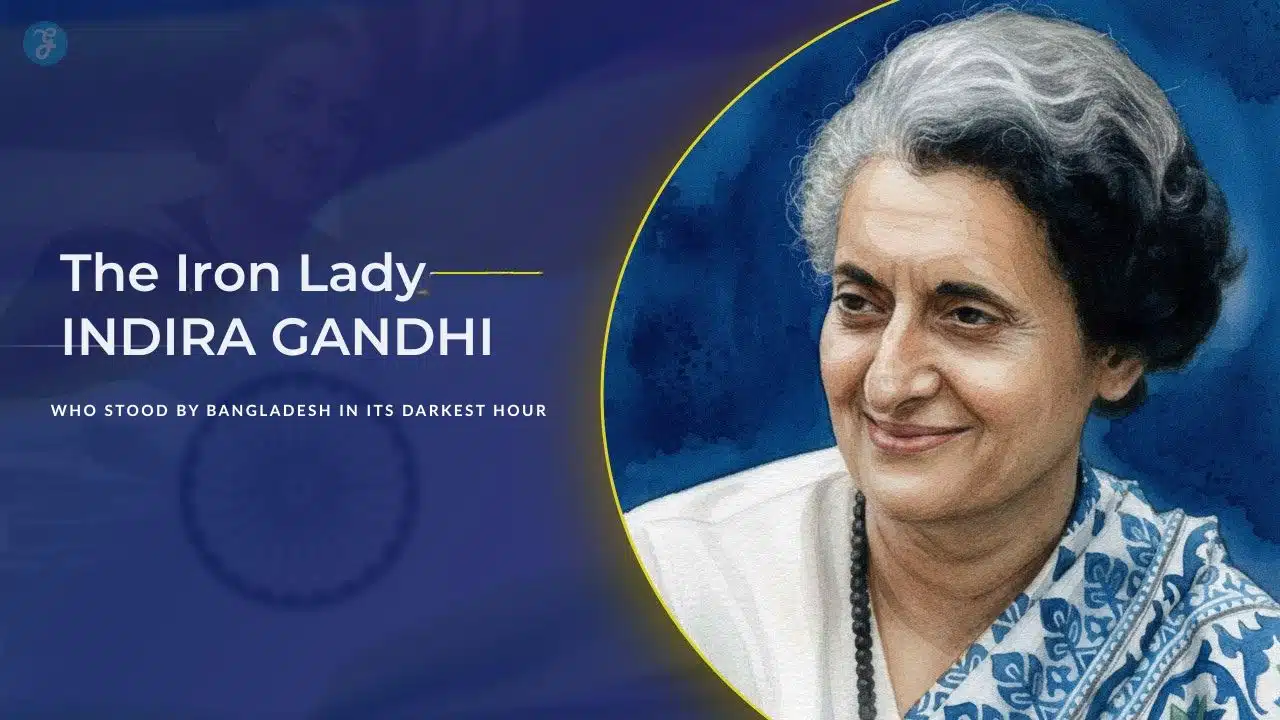
On the 108th birth anniversary of Indira Gandhi, history compels us to pause and look back at one of the most defining alliances in South Asian history—an alliance forged not on convenience, but on courage, conviction, and shared humanity.
For Bangladesh, the name Indira Gandhi is not merely that of a former Indian prime minister; it is the memory of a stateswoman who rose to meet the moral challenge of her time. In 1971, when Bangladesh—then East Pakistan—was plunged into one of the bleakest chapters of its existence, she became the voice the world refused to hear, the strength the oppressed desperately needed, and the ally without whom liberation might have taken a different course.
Today, as Bangladesh proudly stands as a sovereign nation of 170 million people, it is impossible to contemplate its birth without acknowledging the resolute leadership of Indira Gandhi. She was the Iron Lady who stood firm when powerful nations turned away, who confronted diplomatic hostility with extraordinary clarity, and who chose principle over political safety. This is her story—and Bangladesh’s gratitude.
A Region on the Brink: The Crisis That Demanded Moral Courage
To appreciate Indira Gandhi’s role, one must understand the magnitude of the catastrophe unfolding across the border in early 1971. The Pakistan state, politically dominated by West Pakistan, had long treated Bengalis as second-class citizens. The economic disparities were staggering: despite East Pakistan generating most of the export revenue, it received only a small fraction of state investment. Cultural discrimination, most notably during the 1952 Language Movement, had already sown seeds of defiance.
The political flashpoint came after the 1970 national elections, when Sheikh Mujibur Rahman and his Awami League secured a clear majority—yet the military leadership refused to hand over power. What followed on March 25, 1971, under the codename Operation Searchlight, was one of the most brutal crackdowns of the 20th century.
Universities were attacked. Intellectuals were hunted down. Villages were turned into mass graves. Women were subjected to systematic sexual violence. Millions of terrified Bengalis fled towards India’s borders. And the world, preoccupied with Cold War calculations, largely looked away.
But Indira Gandhi did not.
Indira Gandhi’s First Response: Humanity Before Geopolitics
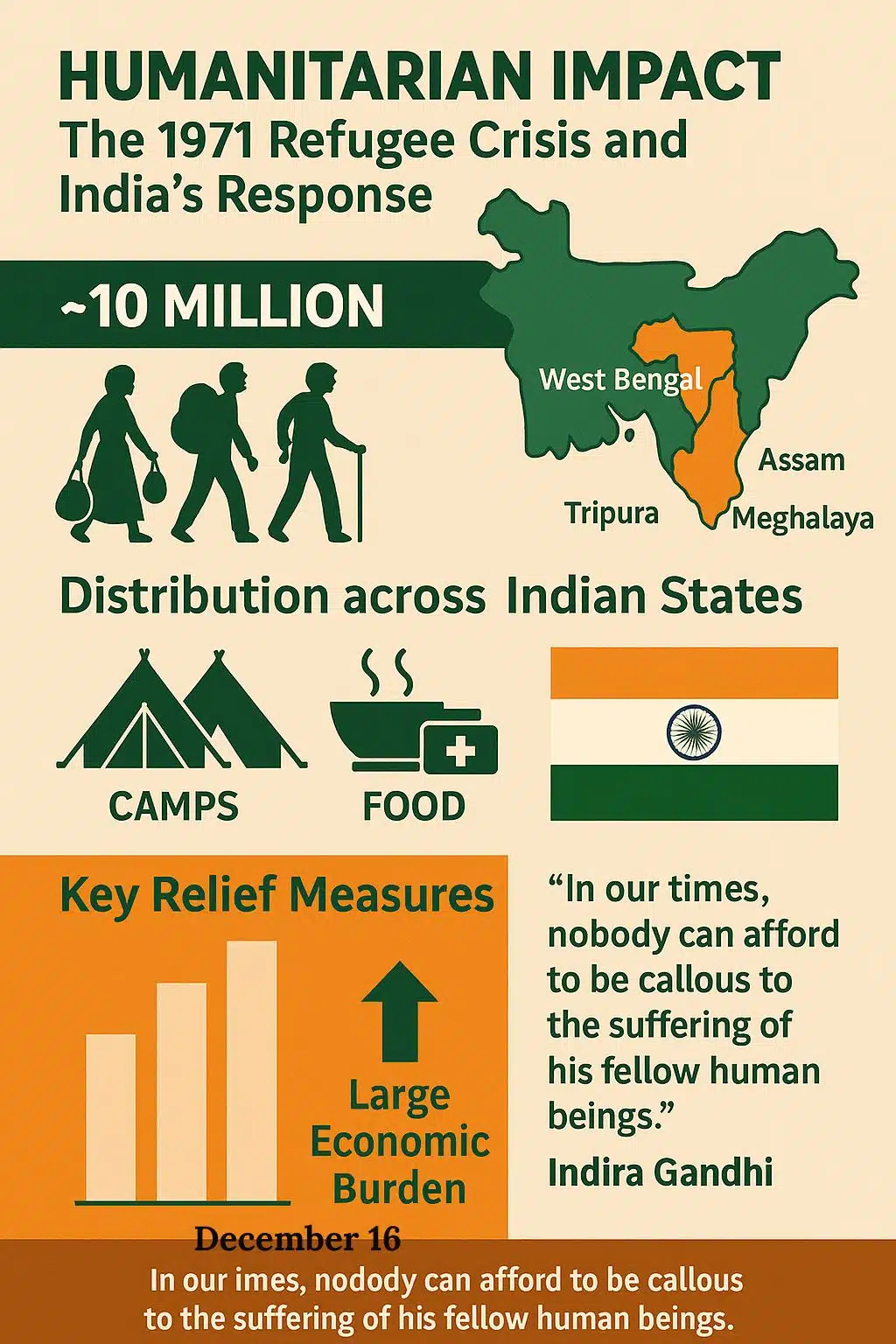
For Indira Gandhi, the crisis was not abstract. It was unfolding directly at India’s doorstep, overwhelming the northeastern states with an unprecedented surge of refugees—ultimately close to 10 million people. The humanitarian disaster was unsustainable, threatening India’s economy, internal cohesion, and security.
Yet she did not shut her borders.
Her first instinct was humanitarian. She ordered large-scale refugee camps, medical units, food distribution centers, and emergency shelters. The financial cost was colossal, but Gandhi insisted that responding to human suffering was a moral obligation. Her speeches during this period carried a tone of deep empathy—she did not speak of refugees as burdens but as victims of an unjust war.
International aid was slow and inadequate. Many powerful nations referred to the crisis as an “internal matter” of Pakistan. But Gandhi rejected this narrative outright, insisting that genocide could never be a domestic issue. Her leadership began to take on a dual role: managing an enormous humanitarian challenge at home while preparing the world to face an uncomfortable truth.
Diplomacy on the Global Stage: A Lone Voice of Conscience
As the crisis escalated, Gandhi understood that the war for Bangladesh’s survival would not be won solely on the battlefield—it would need to be won diplomatically. The United States and China supported Pakistan, placing India in a precarious geopolitical position.
The World Tour of 1971
In the autumn of 1971, Gandhi embarked on an intense diplomatic campaign across Europe and North America. Her mission had three aims:
-
To expose the extent of atrocities in East Pakistan
-
To secure international support for humanitarian efforts
-
To prevent direct foreign intervention against India
She met with British Prime Minister Edward Heath, French President Georges Pompidou, and German Chancellor Willy Brandt and later traveled to Washington to meet U.S. President Richard Nixon.
Her meeting with Nixon is now legendary—not for its warmth but for its tension. Declassified documents later revealed the extent to which Nixon and Henry Kissinger despised her stance. The U.S. continued supplying weapons to Pakistan, even as evidence of genocide mounted.
Yet Gandhi remained unfazed. She articulated the crisis with moral clarity. She became, as one American newspaper described her, “the only global leader telling the world what it did not want to hear.”
The Indo-Soviet Treaty: A Masterstroke
Realizing the geopolitical threat posed by a possible U.S.–China–Pakistan alignment, Gandhi decisively signed the Indo-Soviet Treaty of Peace, Friendship and Cooperation in August 1971. This 20-year pact ensured that if India faced international aggression, the Soviet Union would offer support.
It was a diplomatic coup that deterred intervention and marked one of the most strategically significant decisions of her career.
Aligning With the Mukti Bahini: From Sympathy to Action
As the provisional government of Bangladesh set up its base in Mujibnagar, India took on the role of facilitator and protector. Gandhi authorized support for the Mukti Bahini, providing training, weapons, and operational coordination.
This was not merely military assistance—it was a declaration that India recognized the legitimacy of Bangladesh’s struggle.
Coordinated Strategy
Indian intelligence worked closely with Bangladeshi guerrilla forces. By mid-1971, joint operations had begun undermining Pakistan’s ability to control the region. Gandhi understood that international diplomacy alone would not force Pakistan to stop the atrocities; liberation would require decisive military victory.
December 1971: The War That Changed the Map of South Asia
The full-scale confrontation began on December 3, 1971, when Pakistan launched air strikes on Indian bases in the west. Gandhi addressed the nation with firm resolve, stating that India would not be intimidated.
Lightning Campaign
India’s military strategy, coordinated with the Mukti Bahini, proved devastatingly effective. Within thirteen days, Indian forces surrounded Dhaka. On December 16, Pakistan’s Eastern Command—comprising more than 90,000 soldiers—surrendered.
It was one of the largest military surrenders since World War II.
The map of South Asia had been redrawn.
Bangladesh was born.
And Indira Gandhi’s leadership had played a historic role in shaping that destiny.
The New Nation: India as the First to Recognize Bangladesh
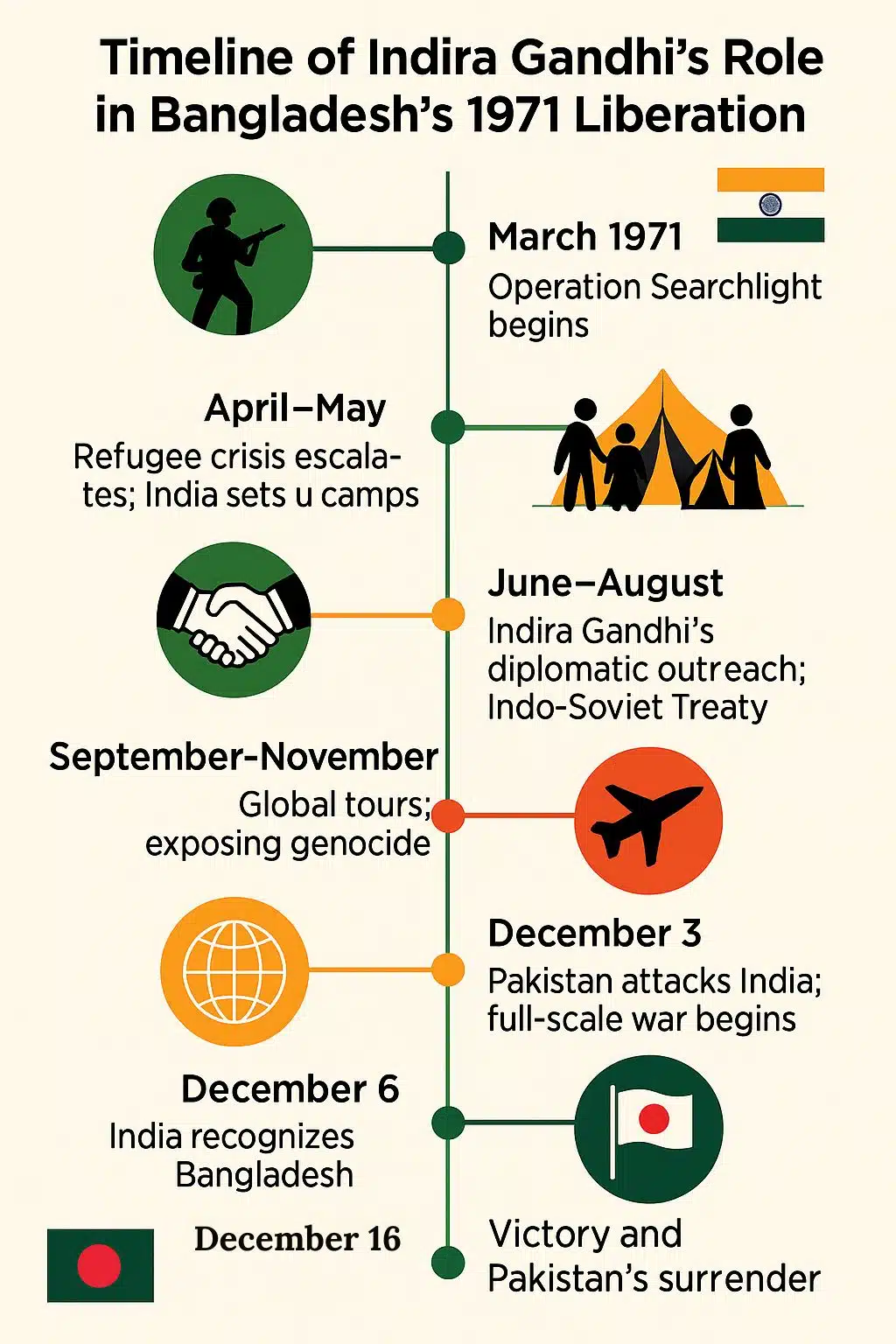
India officially recognized Bangladesh on December 6, 1971, ten days before victory. Gandhi’s declaration brought immense joy to millions of Bengalis. After the war, India rapidly facilitated the return of refugees, assisted in reconstruction, and strengthened diplomatic ties with the fledgling nation.
Her government also supported the repatriation of Pakistani prisoners under international frameworks aimed at stabilizing the subcontinent without undermining Bangladesh’s sovereignty.
The “Iron Lady”: Strength, Empathy, and Political Will
Indira Gandhi earned many labels during her career—some admiring, others critical—but the events of 1971 cemented her image as a leader of rare determination.
Strength Wrapped in Compassion
She showed extraordinary political courage:
-
balancing humanitarian duty with national security.
-
standing firm against U.S. and Chinese pressure
-
risking war on two fronts.
-
committing resources to a refugee crisis of unprecedented scale
Yet behind the iron exterior was deep empathy for the suffering of Bengalis. Her emotional speeches, her visits to refugee camps, and her unwavering insistence that the world acknowledge the genocide reflected not just political strategy but genuine moral conviction.
A Woman Leads in a Man’s World
In an era dominated by male political figures—Nixon, Mao, and Brezhnev—Indira Gandhi’s forceful presence on the world stage was a powerful statement. She confronted global leaders with a firmness they did not expect from “a woman prime minister,” as many described her then. Her leadership challenged stereotypes, redefining what political power could look like.
Critics, Complexities, and Realpolitik Analysis
A balanced editorial must also acknowledge the complexities of 1971.
India’s Strategic Interests
It would be simplistic to claim India acted solely out of compassion. Supporting Bangladesh also:
-
eliminated the “two-front” military threat posed by Pakistan
-
stabilized India’s eastern border
-
decreased refugee burdens
-
strengthened India’s geopolitical position in South Asia
But humanitarian motives and strategic interests do not need to be mutually exclusive. In 1971, they intersected—and Gandhi’s leadership navigated both realities.
Western Criticism
The U.S. justified its pro-Pakistan stance by citing Cold War strategy. Nixon viewed Pakistan as a bridge to China and thus ignored reports of genocide. India was criticized for “intervening in an internal matter.”
But Gandhi maintained that sovereignty could not be used as a shield for mass atrocities. History has largely vindicated her.
Just War and Ethical Intervention
Modern scholars of international relations often cite India’s role in 1971 as a significant example of humanitarian intervention before the concept became globally recognized. Gandhi’s decision is studied as a case where moral duty and political necessity converged.
A Legacy Etched in Bangladesh’s Heart
More than 50 years later, Indira Gandhi’s legacy in Bangladesh continues to resonate.
National Gratitude
Across generations, Bangladeshis express respect and admiration for her decisive role. Monuments and institutions bear her name. Streets and public places serve as reminders of her contributions. Even leaders across the political spectrum—often divided on many issues—acknowledge the depth of her support.
Foundation of Bilateral Relations
The friendship between India and Bangladesh today—manifested in trade, cultural exchange, cooperation, and political dialogue—traces its roots to the solidarity of 1971. Gandhi’s decisions laid the foundation for this enduring relationship.
Final Words: Why Indira Gandhi Still Matters
As we commemorate her 108th birth anniversary, the story of Indira Gandhi in 1971 remains more than historical memory—it is a testament to courage in times of crisis. She was a leader who believed that justice should not wait for the convenience of the powerful. She stood by Bangladesh not because it was easy, but because it was right.
Her legacy is not without controversy, nor was her political career free from flaws. But in the context of Bangladesh’s liberation—one of the most morally unambiguous struggles of the 20th century—Indira Gandhi’s role remains towering.
When the world turned away, she stepped forward.
When great powers chose silence, she chose to speak.
When millions cried for help, she chose to act.
Bangladesh will forever remember Indira Gandhi as the Iron Lady who stood by its people in their darkest hour—lighting, in that darkness, the first sparks of a free nation.