

Listen to the Podcast:
This is exactly what Google showed off at its annual developer meeting, Google I/O, this month. AI was the year’s theme, and the word came up more than 140 times during the two-hour opening speech.
Google showed off AI goods that will be available to the public. This is a big change for the worried internet giant, who has been trying to keep up with the competition.
Late last year, OpenAI released ChatGPT, and almost everyone loved it. All of a sudden, everyone had access to an AI system that seemed to be able to answer any question with a new answer. It is driven by a large language model, or LLM, which lets it act like “autocomplete on steroids” by using huge amounts of text data to figure out what the next best word should be.
ChatGPT has grown faster than any other consumer web tool ever because it is both powerful and easy to use. It made Microsoft invest more in OpenAI and add ChatGPT’s technology straight to Bing search earlier this year. This helped the company get 16% more traffic. The day before Microsoft showed off Bing AI, Google showed off its own creative AI engine called Bard, but the launch went wrong and cost the company $100 billion in stock market value. Since then, the stock has gone back up to its best level of the year so far.
In many ways, Google I/O was a vote on the company’s awkward entry into consumer AI and a clear message to skeptics (and investors) that it’s ready to take radical steps to stay at the top of internet search, even if that means changing its core product. Google Search has long been the main way that people and companies use the internet to find information about products, find the latest news, and do other things. It is also how many businesses make money.
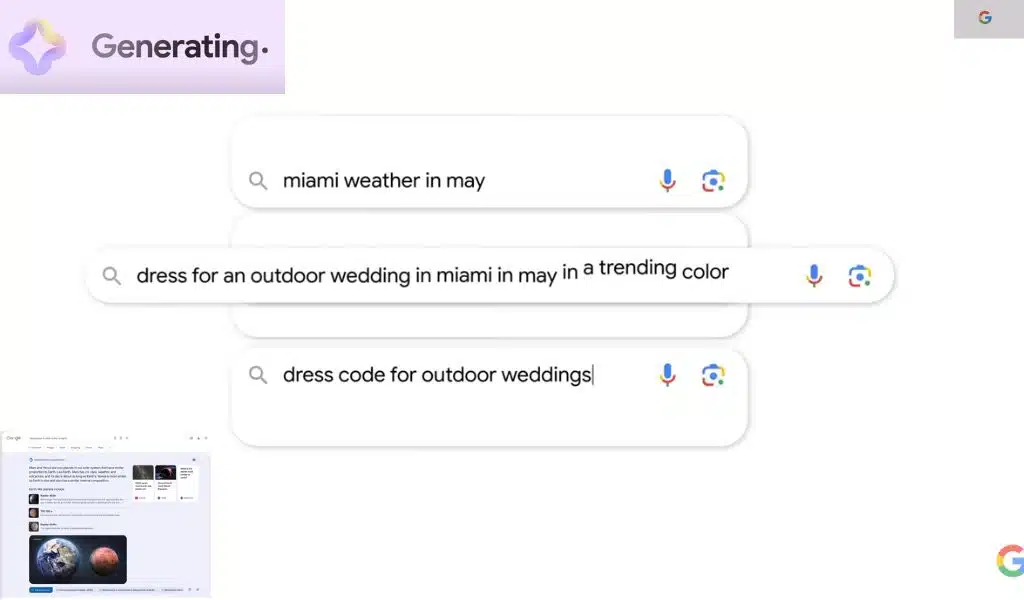
The new Search Generative Experience, or SGE, is an experimental form of Search that gives less weight to the 10 blue links that have made Google what it is for the past 25 years. Instead, a person’s answer to any question, no matter how specific, is given in a green box that grows as it fills the screen.
“Now search does the heavy lifting for you,” said Cathy Edwards, vice president of engineering at Google, at I/O. She said that the way Search works now, complicated questions have to be broken down into smaller ones, and the user has to sort through the information and figure out the answer in their head. All of that can be done easily by SGE, and you can even ask it to do more.
In addition, it eliminates the need to visit several websites, which reduces the number of clicks needed to access a webpage and potentially undermines the internet’s ad-supported economic model.
According to Statcounter, Google commands a 93% market share, making it by far the dominant player in online search. According to a 2019 analysis by Brightedge Research, search engines are also the main sources of traffic for websites, accounting for 68% of all online experiences. At one point, Google was valued at $2 trillion thanks to its hegemony in the search market.
With SGE, Google may be propelling businesses and internet users into a new era that will call for fresh ideas on how to encourage the creation of important material for Google’s AI system while simultaneously ensuring that high-quality information may continue to spread.
There is currently no user experience data to give for SGE because sign-ups have only recently begun. But for the past three months, Microsoft has been gathering input for Bing AI, which might be able to shed light on how users would likely respond to Google searches that are powered by AI.
“Feedback on the answers produced by the new Bing has been largely good, with 71% of those using the preview giving the AI-powered replies a thumbs up, said a Microsoft representative. “We’re observing a healthy level of engagement on the chat feature, with multiple questions being asked during a session to learn new information.”
Uncertainty exists around how AI-generated news articles will integrate with Google or Bing’s AI results. The use of AI-written content is already being tested by publishers. Sadly, AI can suffer from “hallucinations,” when it confidently asserts that something is true when it isn’t.
In the event that the hallucination issue is ultimately resolved, generative AI in search may be quicker and ultimately more beneficial for users. However, it is still unclear how it might impact the digital publication sector, particularly if individuals stop clicking links in large numbers.
A Google representative said, “We’ll continue to prioritize strategies that send valuable traffic to a wide variety of creators and support a healthy, open web as we experiment with new LLM-powered capabilities in Search.” Although it is true that Google does prominently link to sources in SGE, it is unclear whether SGE will result in more or higher-quality traffic for websites.
When asked about the traffic to sources when utilizing AI search, Microsoft did not respond. Google stated that while it does not currently have any plans to disclose publisher payments, it will “continue to work with the broader ecosystem.”
According to Monica Ho, chief marketing officer at SOCi, a digital marketing firm, “I think [generative AI] is going to reduce the amount of traffic going out because that’s the purpose of it.” She suggests, however, that since users are searching for specific information rather than hopping between websites, the traffic that websites receive may be of higher quality.
There may be no workable alternatives if Google’s traffic source deteriorates. Rasmus Kleis Nielsen, head of the Reuters Institute for the Study of Journalism and professor of political communication at the University of Oxford, claims that social media sites like Facebook have shown to be untrustworthy partners for newspapers, lowering news on a whim. Platforms like Instagram or TikTok, he continued, “drive comparatively few referrals, and do not really feature links the way search does and social did.”
Search engines currently “crawl” websites every day in order to collect new information and index it into results. Because of the conversion of traffic, websites permit free crawling by search engines. However, if AI-search results in fewer clicks, the search economy may require a complete overhaul.
Don White, CEO of Satisfi Labs, a conversational AI business, predicted that original information would be put behind paywalls and compel LLM models to pay to read it. Sites will eventually be paid-per-view in the “Spotify-style compensation model,” according to White.
In the end, Google will probably need to figure out a means for money to get to content producers and newspapers so that there is still a motivation to produce high-quality information.






















