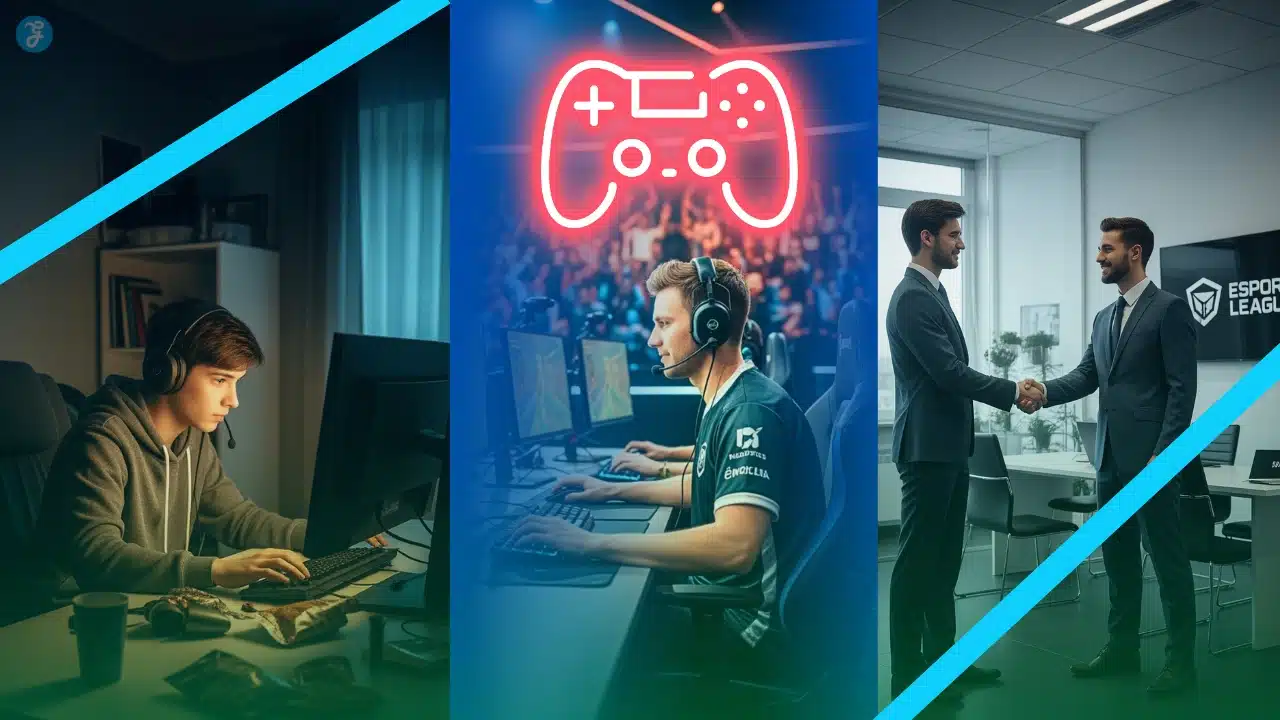
Ever wondered if hours spent playing video games could translate into a lucrative profession? This field is no longer just a mere hobby. A true Gaming Career Path: offers diverse opportunities, transforming passion into a sustainable paycheck for dedicated individuals.
The industry spans far beyond professional players. It includes essential roles like game designers, programmers, artists, sound engineers, esports coaches, and community managers. The challenge lies in identifying the most realistic option. This guide breaks down required skills, relevant education, and actionable steps to successfully transition from gaming enthusiast to industry professional.
The Rise of Gaming as a Career
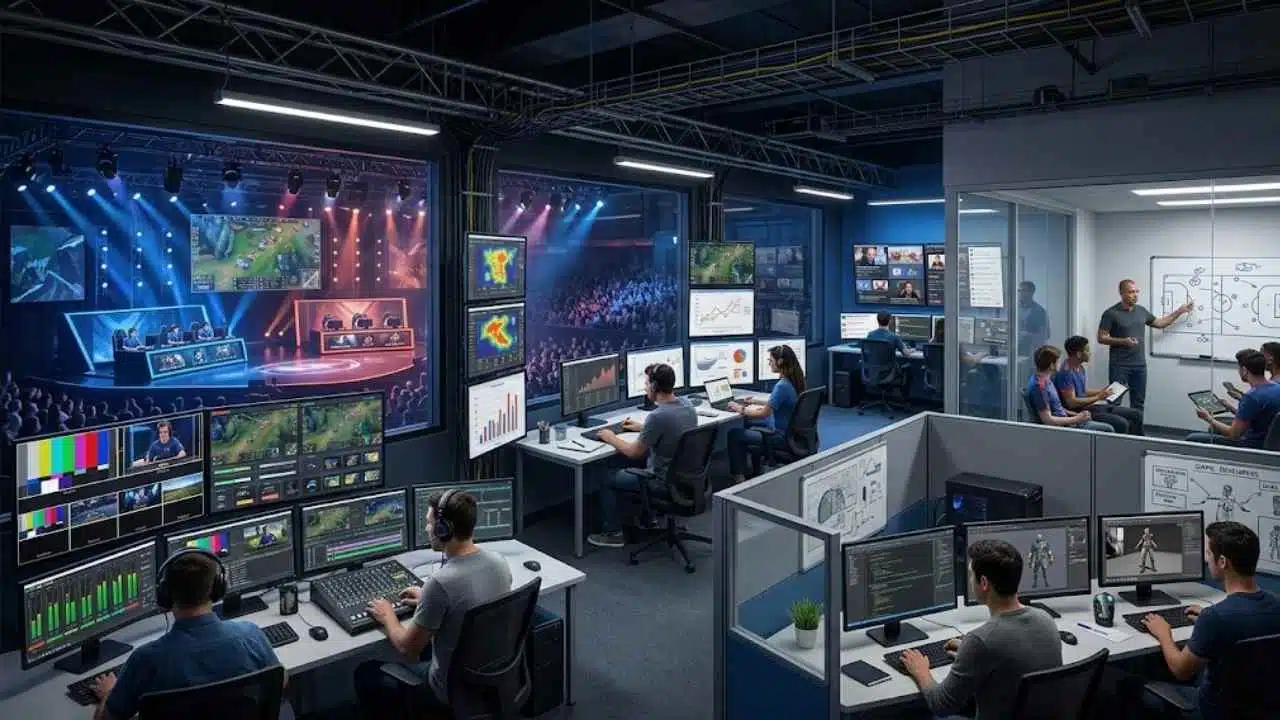
Gaming has grown into a serious part of digital entertainment, and the numbers are hard to ignore. In its February 2026 update, the Entertainment Software Association said U.S. consumer spending on video games reached $60.7 billion in 2025, while its 2025 player study found that 205.1 million Americans play video games.
That matters for your career planning because a bigger audience creates more work. The same market that supports League of Legends, Dota 2, Fortnite, and Call of Duty also supports developers, software engineering teams, quality assurance (QA) tester roles, streamers, analysts, marketers, artists, and event organizer jobs.
The growth of the gaming industry
The gaming sector now competes with the biggest entertainment categories in the country, and it supports work far beyond pro play.
| Point | What it means for your career |
|---|---|
| Market Growth | U.S. spending on video games reached $60.7 billion in 2025, so studios, creators, and service companies have more room to hire and expand. |
| Player Base | More than 205 million Americans play, which means the audience for games, video game live streaming, and gaming platforms is already massive. |
| Economic Impact | The ESA’s 2026 Economic Impact Report says the U.S. video game business creates and supports 250,838 jobs and generates $95.8 billion in total economic impact, which makes gaming a real employment sector, not a fringe hobby. |
| Platform Shift | Mobile now reaches 82% of players age 8 and older, so cross-platform thinking matters for game development, UI, live ops, and marketing manager roles. |
| Career Variety | You can build career paths in game mechanics, level design, game writing, graphic design, community management, audio, analytics, or esports operations. |
| Structured Income | Modern gaming careers often combine salary, freelance contracts, sponsorships, subscriptions, ad revenue, and event pay instead of relying on one paycheck source. |
| Education Paths | U.S. schools, bootcamps, and engine vendors now offer gaming and interactive media design training, portfolio courses, and certifications tied to real tools. |
| Accessibility and Live Service | Studios now need people who understand ongoing updates, player retention, and accessibility features, which opens fresh roles outside pure coding. |
The impact of esports and competitive gaming
Esports helped make gaming visible as work. Fans can now see players training, coaches reviewing game strategies, analysts breaking down drafts, broadcasters covering matches, and content creator brands growing around every big event.
That visibility changed the conversation. Once people saw teams, leagues, sponsors, and regular programming around competitive gaming, gaming careers stopped looking like wishful thinking and started looking like specialized jobs.
- Players compete, scrim, study patches, and sharpen game mechanics.
- Coaches and analysts review footage, build scouting reports, and refine team strategy.
- Broadcast and event staff run tournaments, audio, cameras, graphics, and live production.
- Creators and community leads turn a gaming community into long-term audience growth.
Gaming becomes a career the moment you treat play like training, content like a product, and feedback like a tool.
Even if you never join a top roster, esports still teaches the habits that employers want: clear communication, review cycles, fast adaptation, and performance under pressure. Those same habits transfer well into game development, marketing, production, and community roles.
Career Opportunities in Gaming
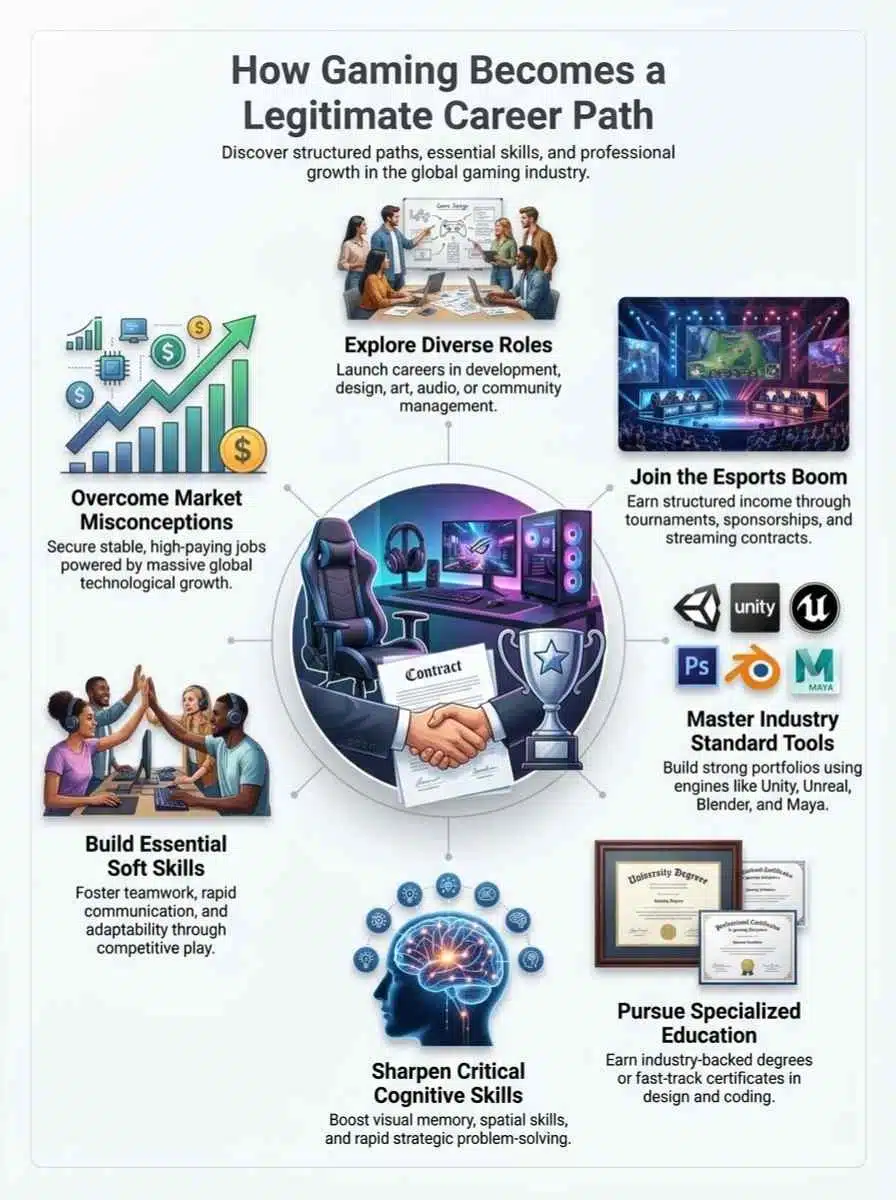
Here is the part most readers care about most: what jobs actually exist, and what do they look like day to day? The answer is broader than many people expect.
You can compete, build, write, animate, test, manage, coach, or grow a brand. The best path usually comes from matching your strengths to the kind of work you already enjoy doing around video games.
| Role | Best fit for | Core tools or proof | Useful U.S. pay signal |
|---|---|---|---|
| Professional gamer / content creator | Players who thrive on practice, performance, and audience building | Tournament results, VODs, stream schedule, clips, sponsorship deck | Income varies widely, so stability usually comes from stacking multiple revenue streams |
| Game developer / game programmer | Readers who enjoy logic, systems, and computer programming | Unity, Unreal Engine, Git, prototypes, bug fixing | Software developers had a $133,080 median annual wage in May 2024 |
| Quality assurance (QA) tester | Detail-focused players who love finding issues and documenting them clearly | Test cases, bug reports, repro steps, patience | Software QA analysts and testers had a $102,610 median annual wage in May 2024 |
| Game artist / animator / technical artist | Visual thinkers with drawing, 3D, or animation skills | Portfolio, Blender, Maya, Substance Painter, engine scenes | Special effects artists and animators had a $99,800 median annual wage in May 2024 |
| Sound designer / composer | Audio-focused creators who love pacing, mood, and immersion | Reel, FMOD, Wwise, DAW sessions, implementation samples | Sound engineering technicians had a $66,430 median annual wage in May 2024 |
| Community manager / marketing manager | Strong communicators who enjoy people, trends, and player feedback | Content calendar, analytics, Discord moderation, campaign samples | Public relations specialists had a $69,780 median annual wage in May 2024 |
Professional gamer and content creator
If you want to become a professional gamer, start by getting honest about how the money works. Prize pools matter, but most sustainable careers come from a mix of tournaments, sponsorships, subscriptions, ad revenue, coaching, affiliate sales, and creator partnerships.
As of May 2026, Twitch says eligible streamers can access subscriptions, Bits, channel points, emotes, and badges, and its Affiliate requirements are now 25 followers, 4 streamed hours, 4 different stream days, and an average of 3 viewers over qualifying days in a 30-day window. On YouTube, the current Partner Program path still centers on 1,000 subscribers plus either 4,000 valid public watch hours in 12 months or 10 million valid public Shorts views in 90 days.
That means your real job is not just playing well. It is building a repeatable audience habit around one game, one voice, and one kind of value.
- Pick one lane first: ranked play, educational breakdowns, funny edits, challenge runs, or coaching clips.
- Track proof of skill: ladder rank, tournament placings, team scrim results, or role-specific stats.
- Post in two formats: long streams for trust, short clips for discovery.
- Show your communication: scouts and teams notice clean comms, not just flashy mechanics.
If you love competitive gaming but hate being on camera, that does not end the story. Many strong players move into esports coach, analyst, observer, caster, or team support roles because they understand game strategies deeply.
Game developer and designer
Game development is where a lot of long-term stability lives. If you like building systems, balancing game mechanics, fixing bugs, or shaping how players move through a world, this track deserves a serious look.
BLS data is a strong signal here: software developers had a median annual wage of $133,080 in May 2024, software quality assurance analysts and testers were at $102,610, and the broader group is projected to grow 15% from 2024 to 2034 with about 129,200 openings a year. That is why computer science, software engineering, and hands-on engine work still open real doors.
The smartest move is to build small and finish things. A short playable project teaches more than a folder full of half-made ideas.
- Use Unity if you want a common entry point for prototypes, mobile games, and general gameplay systems.
- Use Unreal Engine if you want stronger exposure to real-time 3D pipelines, advanced visuals, and level-heavy work. Epic also says Unreal is free to start for game development, with a 5% royalty only after a title earns more than $1 million.
- Practice QA thinking by writing clear bug reports with steps to reproduce, expected result, and actual result.
- Learn version control early, because Git habits matter the moment you work with another person.
Level designer is a great example of a role many readers overlook. Good level designers shape difficulty, pacing, sightlines, encounter flow, and teaching moments, so a playable graybox map often says more than a polished resume.
There is also a new route for aspiring builders through Fortnite. Epic’s Unreal Editor for Fortnite lets creators design, develop, and publish experiences directly into Fortnite across major platforms, which gives junior designers a practical way to show level design, scripting, and player flow in public.
Game artist and animator
Game artist roles are real careers, but they reward proof, not vague talent. Studios want to see whether you can make assets that fit a pipeline, hit a style target, and hold up inside an engine.
The BLS puts the median annual wage for special effects artists and animators at $99,800, and software publishers pay even better at a median of $130,450. At the same time, 62% of workers in this occupation are self-employed, which tells you something important: freelancing is common, and your portfolio often matters more than your title.
So if you want game artist work, stop trying to show everything. Show the exact work you want to be hired for.
- Character artist: anatomy, topology, materials, and one finished in-engine presentation.
- Environment or level artist: modular kit, lighting, set dressing, and clean scene composition.
- Animator: locomotion, combat, timing, weight, and polish.
- Technical artist: shaders, tools, optimization, and problem-solving between art and code.
A pro tip here is to build three to five polished pieces instead of fifteen average ones. Hiring teams usually decide fast, and a tight portfolio shows judgment.
Sound engineer and composer
Sound work is easy to underestimate until you hear a weak mix in a great game. Audio shapes tension, impact, space, and feedback, which means sound designers and composers can change how every action feels.
BLS figures show sound engineering technicians earned a median annual wage of $66,430 in May 2024, rising to $70,810 in the motion picture and sound recording industries. The same BLS profile notes that many audio and sound roles can start with postsecondary programs that take several months to a few years, which makes this one of the more flexible paths if you are building skills outside a four-year degree.
Your portfolio matters here too. A clean audio reel that shows footsteps, UI cues, ambience, combat impact, dialogue editing, and one adaptive music moment can do a lot of work for you.
- Learn one DAW well, such as Pro Tools or Ableton.
- Learn game middleware, especially FMOD or Wwise.
- Show implementation, not just music tracks, because interactive audio is the real job.
- Build for clarity, since readable audio beats flashy audio in gameplay.
Marketing and community management roles
If you enjoy conversations, trends, social posts, patch notes, and player feedback, community work can be a strong fit. It is also one of the most direct ways into the gaming industry because every studio needs people who can explain updates, handle sentiment, and grow trust with players.
The BLS groups a lot of this skill set close to public relations work, and that is useful because the numbers are solid: public relations specialists had a median annual wage of $69,780 in May 2024, and the role is projected to grow 5% from 2024 to 2034 with about 27,600 openings each year. The same profile says employers value clear writing, social media experience, and the ability to manage public response fast.
In plain English, that means your side projects count. Running a Discord, posting clean updates, moderating a fan page, or building a content calendar for an indie game can all become portfolio pieces.
- Write one mock patch-note post that is clear, calm, and easy to scan.
- Create a one-month content plan for Twitch, YouTube, Discord, and short-form clips.
- Track simple metrics like click-through rate, comment themes, retention, and event turnout.
- Practice response tone because a good community manager solves confusion before it becomes backlash.
The Role of Education in Gaming Careers
You do not need one perfect degree to work in gaming. You do need proof that you can do the work.
For some readers, that proof comes from college. For others, it comes from a portfolio, a certification, a shipped mod, a jam game, or a public body of content. The best education path is the one that helps you build proof fastest without burying you in debt or delay.
Gaming and interactive media design programs
College can make sense if you want structure, team projects, internship access, and time with mentors. It helps most when the program forces you to build real work with artists, programmers, writers, and producers instead of keeping every class separate.
In the Princeton Review’s 2026 rankings, New York University took the top spot for both undergraduate and graduate game design, and the methodology used more than 40 data points across academics, faculty, technology, and career outcomes. That is a useful reminder to judge programs by results, not flashy marketing.
- Look for team-based capstones: Games are made in teams, so solo-only coursework leaves a gap.
- Check the tool stack: A solid program should expose you to engines, version control, testing, and production workflows.
- Ask about portfolio reviews: Feedback from working professionals saves time and bad habits.
- Ask where graduates land: Junior roles in QA, production, art, programming, and community all count as wins.
- Do not ignore business tracks: Producing, marketing, and operations keep studios running and can be strong career paths.
- Use campus clubs: Collegiate esports, game jams, and student studios often matter as much as classwork.
Scholarships are worth real attention here. As of May 2026, the AIAS Foundation was accepting submissions for its AIAS Foundation, WomenIn, and Girls for Gaming scholarships, and its program includes tuition support or conference travel help, monthly mentoring, and access to an alumni Discord. That is the kind of support that helps a reader move from isolated practice to real industry contact.
Online degrees and certifications
If you prefer a leaner route, online training can work well, especially for engine skills, programming, 3D art, and audio basics. The catch is simple: online learning only pays off if you turn lessons into finished projects.
| Option | What you get | Best use |
|---|---|---|
| Online degree | Broader foundation in computer science, design, writing, or art | Good if you want structure and a credential |
| Bootcamp or certificate | Faster, more focused training in a specific skill | Good for career changers and focused upskilling |
| Unreal training | Epic offers free self-paced online training and authorized training centers | Great for level design, real-time 3D, and technical roles |
| Unity certifications | Formal proof of engine knowledge, valid for three years | Useful when you need a clear signal on your resume |
| Portfolio-first self study | Maximum flexibility with the lowest formal structure | Best if you are disciplined and already know your target role |
Unity’s own certification page says its Associate exams use 100 questions in 90 minutes, while Professional exams run 105 minutes, and certifications stay valid for three years. That makes certification most useful after you already have project work to back it up.
If you are still in school, tools like Cirkled In can help you organize a student profile for scholarships and internships, while Indeed can help you study how studios phrase job requirements. Reading job posts early saves you from training for the wrong skills.
Skills Developed Through Gaming
One reason a gaming career is easier to justify now is that gaming builds real, transferable habits. The key is learning how to name them clearly.
If you simply say, “I play a lot of video games,” it sounds casual. If you say, “I led raid callouts, reviewed VODs, adapted to weekly patches, and used player feedback to improve strategy,” it starts sounding like work experience.
Cognitive skills and problem-solving
Games train quick decisions, pattern recognition, memory, and rule learning. That does not mean every hour of play turns into career gold, but it does mean the skill transfer is real when you practice with intention.
A 2022 NIH-backed analysis of nearly 2,000 children in the United States found that those who reported playing video games for three hours a day or more were faster and more accurate on tasks tied to working memory and impulse control than children who did not play, though the researchers were clear that the study showed association, not proof of cause. For readers planning a career, the practical takeaway is to treat complex games as training grounds for attention, recall, and fast problem-solving, then show those abilities with real examples.
Playing games can sharpen useful skills, but employers still want proof that you can apply those skills outside the match.
Working memory simply means holding useful information in your head while doing something else. If you can track cooldowns, objectives, map timers, and teammate positions at once, you already understand the basic idea.
Teamwork and communication
Multiplayer games are full of messy human moments, and that is exactly why they teach so much. You learn to give short instructions, recover after mistakes, and stay useful when the plan falls apart.
The ESA’s 2025 U.S. player study found that 69% of adults think video games can teach teamwork and collaboration skills, 53% say they can teach communication skills, and 55% of all players play with others weekly. That is helpful context, because it shows the gaming community is already functioning as a social and cooperative space, not just a solo pastime.
- On a resume: “Coordinated five-person ranked team comms during weekly tournaments.”
- In an interview: explain how you solved conflict, adjusted a strategy, or coached newer players.
- In a portfolio: show patch notes, guides, Discord moderation, or team project documentation.
Strategic thinking and adaptability
Games change all the time. Patches land, metas shift, players counter old habits, and whole roles can change from season to season.
That is why strategic thinking matters so much in gaming careers. A good game designer studies how systems affect player behavior. A good professional gamer studies tendencies and matchups. A good community manager adjusts messaging when sentiment changes. A good QA tester changes approach when a build introduces new risks.
If you want to prove this skill, keep a small review log. Track what changed, what you tested, what failed, and what you changed next. That habit looks great in game development, competitive gaming, and content creation alike.
Challenges in Pursuing a Gaming Career
Gaming can absolutely become a career, but it is still a competitive one. That is why honest planning matters.
The biggest mistake I see readers make is aiming at the dream title before they build the entry proof. A studio cannot hire you as a game designer because you have ideas. A team cannot sign you as a professional gamer because you say you are passionate. Both want evidence.
Competition in the industry
Competition is real because these jobs are attractive. They mix creativity, technology, culture, and entertainment, which draws a lot of smart people into the same lane.
That does not mean you should back off. It means you should get specific faster than everyone else.
- Avoid chasing every game: One strong niche beats scattered effort.
- Avoid portfolio fluff: Finished work beats ideas and mock ambition.
- Avoid weak documentation: QA, design, and production roles reward clarity.
- Avoid silent networking: Thoughtful participation in Discord groups, jams, and student communities helps people remember you.
- Avoid single-income thinking: Many gaming careers become safer when you stack salary, freelance work, coaching, or creator income.
Misconceptions about gaming as a career
The biggest misconception is that gaming careers start and end with streaming or tournament play. In reality, the field includes game writer, technical artist, software testers, community manager, sound designer, marketing manager, and many other roles that readers often skip right past.
Another misconception is that formal education alone is enough. It helps, but studios still look for a portfolio, shipped samples, test cases, a reel, a Git repository, or a clear body of public work.
The third misconception is that gaming jobs are all fun and no pressure. Deadlines, iteration, public feedback, live service demands, and changing tools are all part of the job. If you enjoy learning, testing, and adapting, that pressure can be motivating. If you only enjoy the fantasy of the industry, it gets old fast.
The Future of Gaming as a Career Path
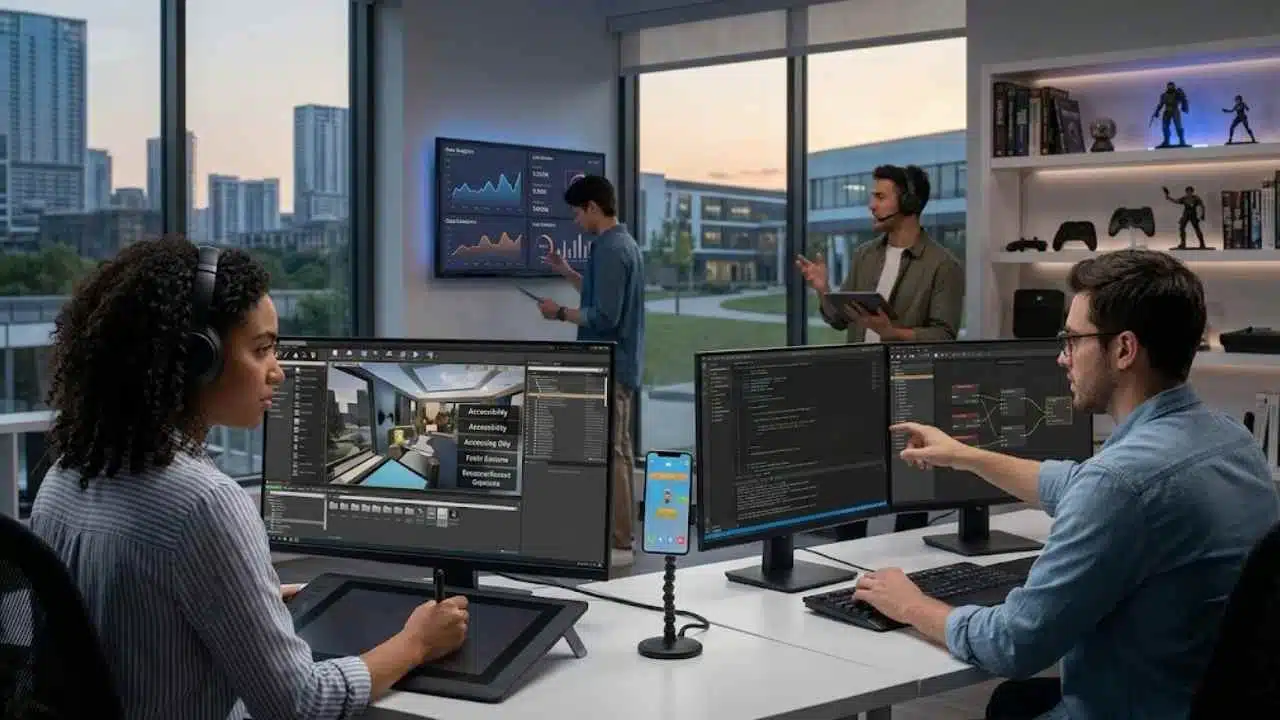
The future looks promising, but the most valuable readers will be the ones who adapt early. New tools are opening doors, and they are also changing what entry-level talent looks like.
Advances in technology and opportunities
AI tools, real-time 3D, creator economies, and cross-platform distribution are all changing the kinds of work studios and creators need. You no longer have to wait for one studio to hand you permission before you build something public.
Mobile is a big reason why. The ESA said 82% of players age 8 and older used a mobile device to play in 2025, so teams that understand performance, UI clarity, and flexible design across gaming platforms will stay valuable.
| Future-ready skill | Why it matters |
|---|---|
| Real-time 3D tools | Useful in games, trailers, virtual production, and simulation work |
| Live service thinking | Helps with updates, retention, events, and community health |
| Cross-platform design | More players now move between PC, console, and mobile |
| Creator economy literacy | Important for streamers, UEFN builders, and branded content work |
| Accessibility basics | Increasingly important in design, QA, UI, and community support |
A smart next move is to learn one engine, one supporting tool, and one public publishing workflow. For example, that could be Unreal Engine plus Blender plus UEFN, or Unity plus Git plus itch-friendly prototypes. Simple stacks win because you can actually finish projects with them.
The growing acceptance of gaming careers
Gaming careers are gaining acceptance because the audience is broad, the spending is large, and the work is now visible to more families, schools, and employers. It is a lot easier for a parent or teacher to take gaming seriously when they can see college programs, job listings, league operations, and creator businesses all built around it.
Accessibility is part of that future too. In March 2025, the ESA launched the Accessible Games Initiative with founding members Electronic Arts, Google, Microsoft, Nintendo of America, and Ubisoft, which is a clear signal that accessibility knowledge is becoming part of mainstream game work.
- Designers should learn remappable controls, readable UI, and subtitle basics.
- QA testers should test for usability, not just broken features.
- Community managers should understand player needs across different ability levels.
- Creators should think about captions, clear audio, and stream readability.
That is good news for readers entering now. The future of gaming careers is not just about who plays best. It is about who can build better, explain better, test better, and serve players better.
Final Thoughts
The gaming industry now supports real career paths in competitive gaming, game development, art, audio, QA, marketing, and community work. If you want a real gaming career, pick one lane first, build proof fast, and use the tools that match that lane, whether that is Unity, Unreal Engine, a polished art reel, a test case library, or a consistent content creator schedule.
Keep learning, keep finishing projects, and keep showing your work. That is how video games stop being just something you play and start becoming something you build a future around.
Frequently Asked Questions (FAQs) About a Gaming Career Path
1. What jobs can gaming lead to as a career?
Gaming can lead to roles like professional players in esports, streamers, content creators, game developers, coaches, and event staff. Many people move into media, tech, or tournament work as the industry grows.
2. How do people earn money from gaming?
They earn from streaming subscriptions, sponsorships, ad revenue, tournament prizes, paid coaching, and studio or site work. Smart creators mix revenue streams, so they do not put all their eggs in one basket.
3. Is gaming a stable career path?
Yes, the field shows steady industry growth, with more jobs and scholarships for players and students. Success often needs skill, practice, and a plan for income. Plan for change, and build backup skills in media or development.
4. How do I start a career in gaming?
Start small, stream or post clip reels, join local events, learn to talk to fans, and study game design or media.