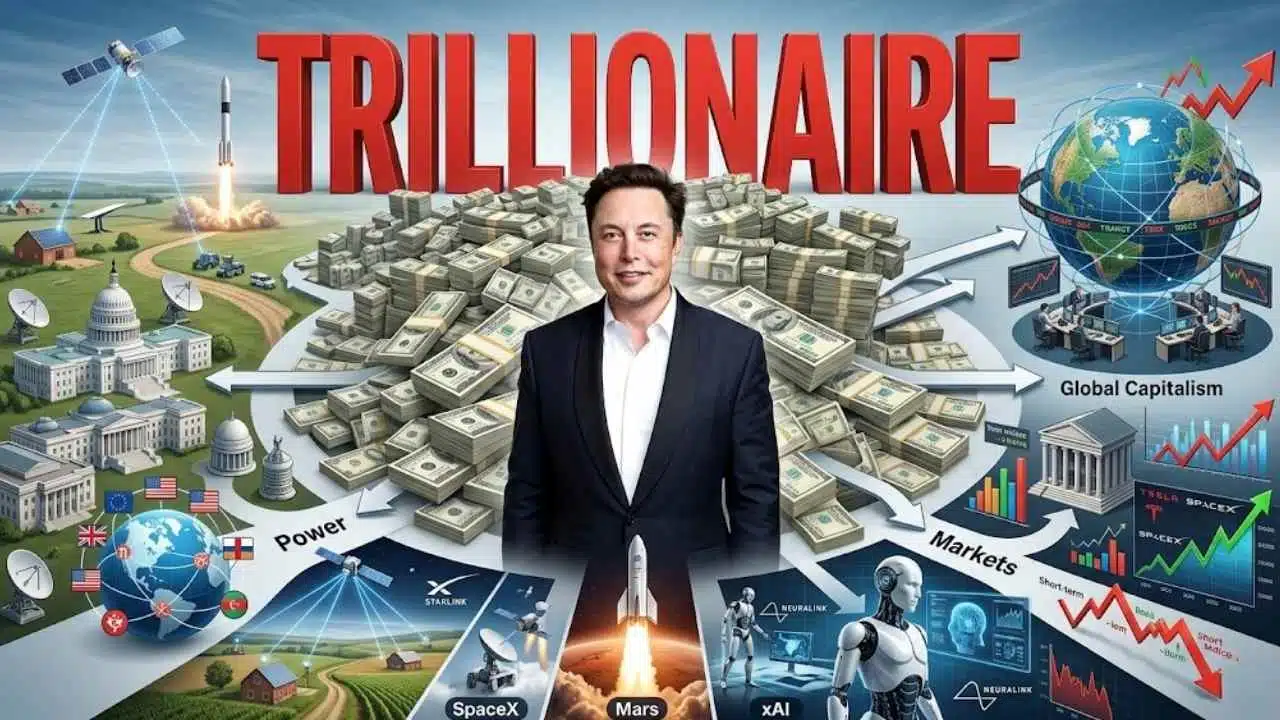
Elon Musk officially became the world’s first trillionaire, reaching an estimated net worth of over $1.1 trillion. This milestone was driven by the historic public debut of his rocket company, SpaceX, on the Nasdaq.
Elon Musk Trillionaire achievement marks a structural shift in global wealth concentration, powered mainly by equity-based valuation growth across high-technology and frontier industries. Musk’s fortune reflects the combined rise of Tesla, SpaceX, xAI, Neuralink, and X, with SpaceX’s market debut and AI-linked capital expansion acting as the strongest accelerators.
Beyond personal wealth, the event raises major questions about inequality, market efficiency, and the growing influence of founder-controlled technology empires. Investors may see it as a bullish signal for AI, space commercialization, and platform ecosystems. Policymakers, however, are likely to increase scrutiny over taxation, monopoly power, data governance, and critical infrastructure control. Through 2035, the implications could reshape markets, geopolitics, and industrial policy.
Background and Context
Elon Musk’s wealth has historically been tied to equity ownership, not salary or liquid cash. His fortune rose through large ownership stakes in Tesla, SpaceX, and related ventures. The decisive trigger was SpaceX’s public listing.
Reuters reported that SpaceX priced the largest U.S. IPO in history at $135 per share, selling 555.56 million shares, raising $75 billion, and valuing the company at $1.77 trillion at the offer price. After trading began, SpaceX moved above the IPO valuation, placing it among the most valuable companies in the world.
The milestone matters because Musk’s empire now spans:
- Tesla: EVs, batteries, robotics, autonomous driving.
- SpaceX: launch, Starlink, defense space systems, Starship.
- xAI: frontier AI models, Grok, compute infrastructure.
- X: social media distribution, real-time data, political influence.
- Neuralink: brain-computer interfaces and medical-device innovation.
This is not just a personal wealth story. It is a capital-markets story, a technology-infrastructure story, and a geopolitical story.
What Could Drive a Trillionaire-Level Wealth Surge
A hypothetical rise of Elon Musk to trillionaire status would not come from a single company or event, but from multiple high-growth sectors expanding at the same time. In modern financial markets, extreme wealth milestones are usually driven by valuation increases rather than cash income. This means equity prices, investor expectations, and future earnings projections play a bigger role than current profits.
In this scenario, industries like artificial intelligence, space technology, electric vehicles, and digital platforms would need to experience rapid and sustained expansion. Investor confidence, speculative capital inflows, and breakthroughs in scalable technologies would all combine to push valuations higher, creating a compounding effect across multiple companies under Musk’s control or influence.
1. SpaceX’s record-breaking IPO
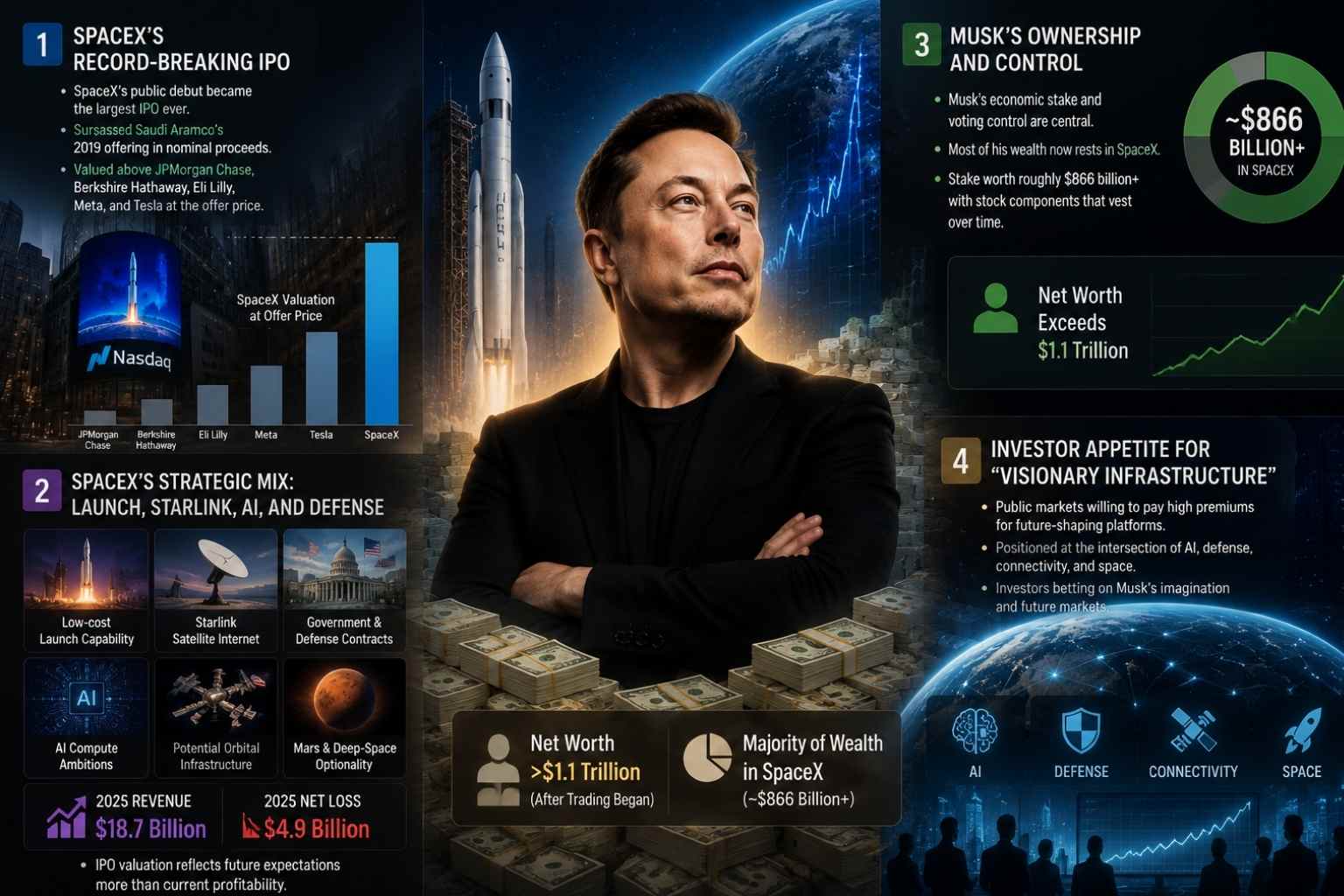
The main driver was SpaceX’s public debut. Reuters described the IPO as the biggest ever, surpassing Saudi Aramco’s 2019 offering in nominal proceeds. At the offer price, SpaceX was valued above JPMorgan Chase, Berkshire Hathaway, Eli Lilly, Meta, and Tesla.
2. SpaceX’s strategic mix: launch, Starlink, AI, and defense
Investors are not valuing SpaceX as a simple rocket company. They are pricing a platform that combines:
- low-cost launch capability
- Starlink satellite internet
- government and defense contracts
- AI compute ambitions
- potential orbital infrastructure
- Mars and deep-space optionality
Business Insider reported that SpaceX’s 2025 revenue was about $18.7 billion, while the company posted a $4.9 billion loss. That means the IPO valuation reflects future expectations more than current profitability.
3. Musk’s ownership and control
Musk’s economic stake and voting control are central. Reuters estimated that most of his wealth now rests in SpaceX, with his stake worth roughly $866 billion when including stock components that vest over time. It calculated that his net worth would exceed $1.1 trillion after trading began.
4. Investor appetite for “visionary infrastructure”
The IPO shows that public markets remain willing to pay high premiums for companies positioned at the intersection of AI, defense, connectivity, and space. Reuters Breakingviews argued that investors are paying heavily for Musk’s imagination and future markets, while warning that the valuation is extremely demanding.
Impact on the Economy
If such a trillion-dollar milestone is attributed to Elon Musk, the broader economic implications would extend far beyond individual wealth accumulation. It would reflect a major re-rating of future-facing industries such as artificial intelligence, space infrastructure, and platform-based digital economies. Markets would interpret this as a signal that intangible assets—data, algorithms, and network ecosystems—are now the primary drivers of global wealth creation.
In the short term, this would likely fuel strong capital inflows into technology equities, particularly in AI and aerospace-linked firms. However, it would also increase concerns about valuation bubbles, as wealth concentration at this scale tends to amplify market sensitivity to interest rate shifts and investor sentiment changes. Economically, it would deepen the divide between asset-owning capital markets and wage-based income groups, reinforcing structural inequality trends already visible in advanced economies.
Wealth creation
The IPO created enormous paper wealth for Musk, early investors, employees, and institutions. It also likely generated thousands of newly wealthy SpaceX employees and major gains for early backers.
Wealth inequality
This milestone will intensify the global inequality debate. Oxfam reported in January 2026 that billionaire wealth rose more than 16% in 2025 to $18.3 trillion, its highest level in history. The World Inequality Report 2026 says the top 10% own about three-quarters of global wealth, while the bottom 50% own only 2%.
In the U.S., the top 1% held 31.9% of aggregate net worth in Q4 2025, according to Federal Reserve data published through FRED. Musk’s trillionaire status will likely strengthen political calls for wealth taxes, unrealized-gains taxes, stricter estate taxation, and tighter rules on founder-controlled public companies.
Capital allocation
SpaceX’s IPO could pull capital toward AI-space-defense infrastructure and away from smaller public companies. Business Insider reported strong institutional and retail demand, including heavy retail interest and large institutional orders.
Elon Musk Trillionaire: Business and Industry Implications
Elon Musk reaching trillionaire status would significantly reshape global industry structures. It would reinforce the shift toward founder-led, vertically integrated tech empires where a single ecosystem controls transportation, energy, AI, communications, and space infrastructure. Tesla could further solidify dominance in AI-driven mobility and robotics, while SpaceX and Starlink could become core pillars of global connectivity infrastructure.
This would intensify competition with legacy automakers, aerospace firms, and Big Tech platforms. At the same time, capital markets may increasingly reward “ecosystem consolidation” over standalone companies. However, regulators in the US, EU, and Asia could respond with stricter antitrust frameworks to limit excessive cross-sector dominance and reduce systemic market concentration risks.
Tesla’s Role in the Wealth Surge
Tesla would likely be the single most important driver of Elon Musk’s hypothetical trillionaire status, primarily through equity appreciation rather than traditional revenue expansion alone. A re-rating into an AI, robotics, and autonomous mobility platform could significantly expand its valuation multiple. If full self-driving and robotics networks scale globally, Tesla’s profit model could shift from vehicle sales to recurring software and fleet-based income streams, dramatically increasing long-term market capitalization.
Bullish impact:
- Musk’s trillionaire status strengthens his founder aura.
- Tesla may benefit from cross-company AI, robotics, battery, chip, and manufacturing synergies.
- Tesla remains a major pillar of Musk’s wealth, with a current market cap around $1.44 trillion and a share price of $406.43 at the latest market reading.
Bearish impact:
- Tesla may no longer be the main public “Musk proxy.” Investors can now buy SpaceX directly.
- IG market analyst Fabien Yip warned that Tesla could face rotation risk as investors gain direct exposure to SpaceX.
- Musk’s attention is spread across too many systemically important companies.
SpaceX
SpaceX would become the most valuable private aerospace company globally, driven by Starlink expansion, reusable launch dominance, and government contracts. A trillionaire valuation scenario assumes massive satellite internet penetration, reduced launch costs, and Mars colonization funding pipelines. This would position SpaceX as critical global infrastructure provider rather than a traditional aerospace contractor, reshaping global connectivity and defense architecture systems globally.
Bullish impact:
- Public capital gives SpaceX more funding for Starship, Starlink expansion, defense contracts, and AI compute.
- SpaceX becomes a benchmark for the public space economy.
- Starlink gives it recurring connectivity revenue, while launch dominance gives it strategic leverage.
Bearish impact:
- A $2 trillion-plus valuation requires near-flawless execution.
- SpaceX is still loss-making at the consolidated level.
- Public investors will demand transparency and quarterly discipline.
xAI
xAI becomes more strategically important because the market is valuing SpaceX partly as an AI infrastructure company. The bull case is that xAI uses X data, SpaceX infrastructure, and future orbital compute to build a differentiated AI platform. The bear case is severe cash burn: TechCrunch reported that xAI lost $6.4 billion from operations on $3.2 billion in revenue in 2025, based on SpaceX IPO filings.
Neuralink
Neuralink is not the main source of Musk’s trillionaire wealth, but the milestone may help it indirectly. A richer Musk can fund long-horizon medical-device bets. TechCrunch reported in 2025 that Neuralink raised about $600 million at a $9 billion pre-money valuation, showing investor confidence but also reminding markets that it remains a regulated, clinical-stage business.
X
X’s role is less about direct profit and more about data, distribution, politics, and AI training. Reuters reported in 2025 that xAI acquired X in an all-stock deal valuing xAI at $80 billion and X at $33 billion after debt.
The upside is that X can serve as a real-time data layer for Grok and a distribution channel for Musk’s companies. The downside is that X remains exposed to advertiser trust, political controversy, moderation disputes, and regulatory scrutiny.
Potential Risks and Challenges
A trillionaire-level wealth concentration tied to Elon Musk would introduce significant systemic and structural risks across markets and governance systems. The most immediate concern would be regulatory escalation, particularly from the US and EU, targeting monopolistic control over AI, satellite communications, and digital platforms.
Market instability could also increase, as Tesla and SpaceX valuations become deeply intertwined with investor sentiment toward a single individual. Another risk is key-person dependency, where strategic decisions across multiple high-impact industries rely heavily on one founder. This creates fragility in governance, succession planning, and long-term institutional resilience, potentially amplifying volatility during leadership uncertainty or policy shocks.
Market risk
Musk’s trillionaire status can reverse quickly if SpaceX or Tesla shares fall. This is equity wealth, not cash. A 25% decline in SpaceX’s share price could erase hundreds of billions in paper wealth.
Valuation risk
Reuters Breakingviews estimated that SpaceX traded at about 105 times 2025 revenue at its opening valuation and warned that the company’s AI ambitions, insider exits, and capital intensity could pressure future demand.
Execution risk
SpaceX must simultaneously execute in:
- reusable rockets
- Starship
- satellite broadband
- defense systems
- AI compute
- X and Grok integration
- possible orbital data centers
That is an unusually wide execution surface.
Governance risk
Musk’s control structure raises questions about minority shareholder rights, board independence, related-party deals, and conflicts between Tesla, SpaceX, xAI, X, and Neuralink.
Political and regulatory risk
SpaceX is now critical infrastructure. It touches defense, communications, spectrum rights, export controls, AI regulation, and public-market investor protection. That makes it more exposed to U.S., EU, Chinese, and emerging-market political pressure.
Geopolitical risk
Starlink and SpaceX are no longer merely commercial assets. They are strategic infrastructure. Satellite internet can affect war zones, disaster response, censorship resistance, defense operations, and state sovereignty. That creates leverage but also political vulnerability.
Expert Opinions and Market Reactions
Market reaction was broadly bullish on day one. SpaceX opened at $150, above the $135 IPO price, and the latest market reading showed $160.95, with an intraday high above $176.
Bullish voices focused on scarcity, scale, and Musk’s track record. Reuters quoted JPMorgan CEO Jamie Dimon calling Musk “the Edison of our time” and “our Einstein,” reflecting the view that Musk has repeatedly turned difficult engineering markets into investable platforms.
Skeptics focused on valuation. Business Insider cited JonesTrading’s “Price to Elon Ratio” framing, arguing that markets are valuing Musk’s vision more than current profits. It also quoted Mike O’Rourke warning that the combined market value attached to Musk-linked enterprises looked bubble-like.
Another caution came from Steve Eisman, who criticized the IPO’s valuation and capital intensity, pointing to capex rising sharply relative to revenue.
Long-Term Outlook: 1, 5, and 10 Years
Looking ahead, the financial and geopolitical impact of a hypothetical trillionaire status for Elon Musk would not be limited to a single market cycle. It would likely unfold in phases, shaped by technology adoption speed, regulatory responses, and global capital flows.
In the short term, markets would react mainly through volatility and speculative investment in AI, EV, and space-related equities. Over the medium term, the focus would shift toward structural changes in how industries are organized around platform ecosystems. In the long term, the key question becomes whether such concentrated wealth accelerates innovation at a global scale or increases systemic fragility in the financial and political order.
1-year outlook: 2026-2027
- Base case: SpaceX remains volatile but institutionally important. Passive funds, retail investors, and growth managers continue building positions. Tesla may face some rotation pressure.
- Bull case: SpaceX proves Starlink growth, wins more defense contracts, and shows credible AI revenue.
- Bear case: IPO enthusiasm fades, insiders sell after lockups, and the stock corrects sharply.
5-year outlook: 2031
- Base case: SpaceX becomes a core public-market infrastructure company, combining satellite internet, launch, AI compute, and defense systems.
- Bull case: Starship lowers launch costs, Starlink expands globally, AI compute becomes a meaningful revenue line, and Musk’s wealth remains above $1 trillion.
- Bear case: AI losses remain large, regulators challenge market concentration, and competitors reduce SpaceX’s launch and satellite advantage.
10-year outlook: 2036, with focus through 2035
By 2035, Musk’s trillionaire status will depend less on headlines and more on whether SpaceX becomes a profitable infrastructure platform.
- Most likely scenario through 2035: Musk remains one of the world’s richest people, but his net worth fluctuates heavily. SpaceX becomes strategically important, but its valuation faces periodic corrections. Tesla’s role shifts from the main Musk wealth engine to one part of a broader tech-industrial empire.
- Upside by 2035: SpaceX dominates low-Earth orbit connectivity, military space logistics, launch, and orbital compute. Tesla succeeds in autonomy and robotics. xAI becomes a serious AI platform. Musk’s wealth could remain above $1 trillion.
- Downside by 2035: SpaceX’s AI pivot disappoints, Starlink pricing comes under pressure, governments regulate satellite infrastructure more tightly, Tesla loses share, and Musk’s wealth falls back below $1 trillion.
Contrarian Perspective: What Critics Might Say
Critics will argue that this milestone is not proof of productive capitalism. They may say it reflects:
- excessive market concentration
- founder worship
- weak public-market discipline
- under-taxed unrealized capital gains
- dependence on government contracts
- privatization of strategic infrastructure
- democratic risk from one individual controlling communications, AI, space access, and a major political platform
The strongest bearish critique is not that Musk failed to build valuable companies. He clearly did. The critique is that public markets may now be pricing political power, narrative control, and speculative future markets as much as earnings.
Reuters Breakingviews captured this concern by noting that investors are paying extraordinary premiums for future stories while SpaceX still faces physics, economics, competition, and capital intensity.
Are Trillionaire Founders Good or Bad for Society?
If individuals like Elon Musk or other tech founders were to reach trillionaire status, the impact on society would likely be mixed rather than purely positive or negative. On one hand, such wealth is usually built on companies that drive innovation in AI, energy, transportation, and space exploration.
These advances can improve productivity, create jobs, and push entire industries forward. On the other hand, extreme wealth concentration raises concerns about inequality, market distortion, and excessive influence over critical technologies and public discourse. Whether trillionaire entrepreneurs are beneficial or harmful depends less on the number itself and more on how their capital, power, and platforms are used, regulated, and distributed across society.
The balanced answer: they can be both.
Potential benefits
- Accelerate frontier innovation.
- Fund high-risk projects that governments often avoid.
- Create new industries and skilled jobs.
- Lower costs in launch, energy, connectivity, and AI infrastructure.
- Push strategic competition in sectors where China, the U.S., and Europe are racing.
Potential harms
- Concentrate too much economic and political power.
- Distort capital markets through personality-driven valuation.
- Increase inequality and democratic distrust.
- Shift critical infrastructure from public oversight to private control.
- Create systemic risk if one founder becomes too central to multiple industries.
The policy challenge is not to punish entrepreneurship. It is to ensure competition, transparency, taxation fairness, national security accountability, and public-interest regulation.
Final Verdict
Elon Musk becoming the world’s first trillionaire is a historic market event, but it should be understood carefully. It is not a simple story of one person “earning” $1 trillion in cash. It is a story of public markets assigning extraordinary value to a founder-controlled empire spanning EVs, rockets, satellites, AI, social media, and neurotechnology.
The bullish case is powerful: Musk has repeatedly built category-defining companies in hard industries. SpaceX, Tesla, Starlink, and xAI sit at the center of some of the most important growth markets through 2035.
The bearish case is equally serious: valuation is stretched, governance risk is high, capital needs are enormous, and the social consequences of trillionaire-level wealth concentration will trigger political backlash.
Future outlook through 2035: Musk’s fortune may stay near or above trillion-dollar territory if SpaceX converts Starlink, defense, launch, and AI compute into durable profits. But the wealth figure will remain volatile, politically contested, and exposed to market corrections.