
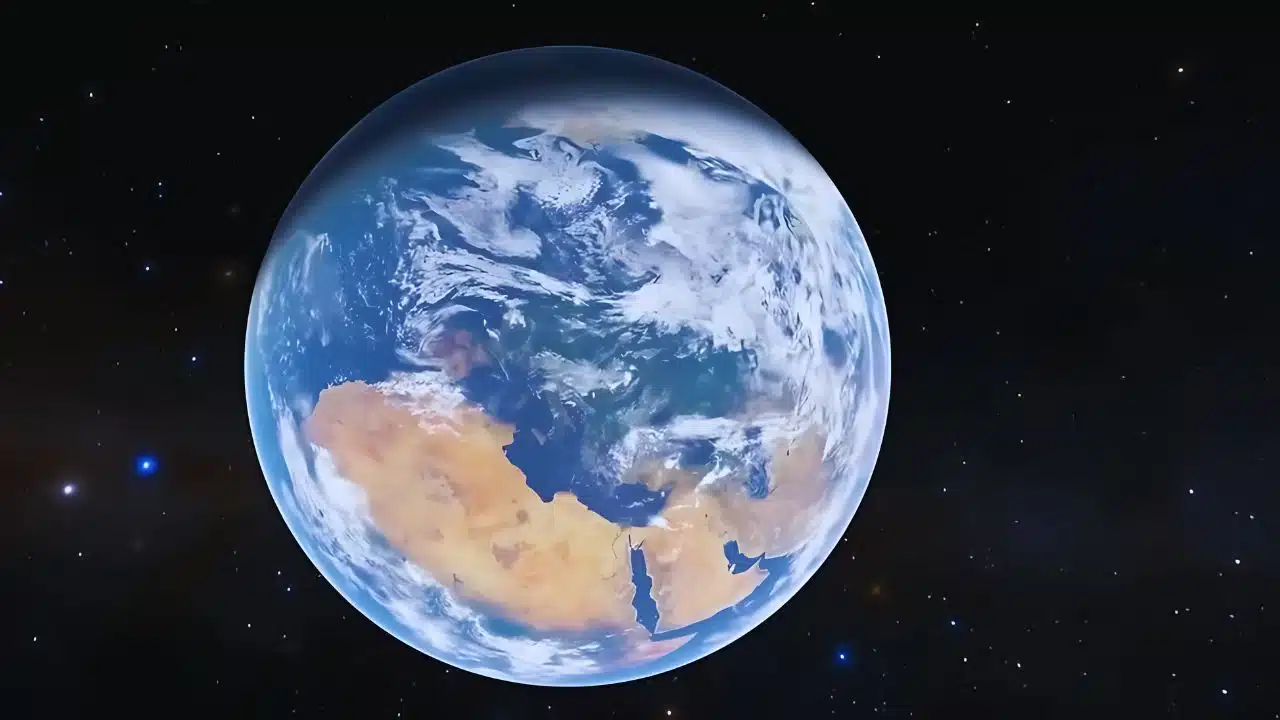
You might think the Moon is Earth’s most constant companion, always appearing in the night sky. However, recent studies show that this may not remain true forever. Scientists have discovered that our only natural satellite is slowly drifting away from our planet—about an inch and a half farther each year, according to NASA.
This increasing distance may seem subtle now, but it will have long-term impacts, making the globe spin slower and gradually lengthening the days on our planet.
Fluctuating Rotational Speed
Earth’s rotational speed is always fluctuating, varying by milliseconds. However, the overall trend shows that our planet’s rotation speed is decreasing. In 2023, the average length of the day became longer for the first time after briefly speeding up between 2019 and 2022, according to Time and Date.
Predictions from the International Earth Rotation and Reference Systems Service (IERS) suggest Earth’s slowdown may continue into 2025, with a day in 2024 lasting several milliseconds longer than in previous years. March 2025 is predicted to have the longest day on record since March 2019.
The Role of the Moon’s Gravitational Pull
The gravitational pull of the moon is primarily to blame for the overall slowdown. According to NASA, the energy propelling the Moon away primarily comes from Earth’s oceans, which bulge out in response to the Moon’s gravity, resulting in lunar tides.
Earth’s oceans exert a gravitational pull of their own on the Moon. This interaction creates friction on Earth’s surface, slowing down the planet’s rotation and causing the Moon to move farther away into space.
Impact of Climate Change
Climate change may also be a factor in Earth’s slower rotation. Melting polar ice caps result in sea level rise, which could be contributing ever so slightly to our planet’s slowing spin, according to recent studies. This additional factor adds complexity to the understanding of Earth’s rotational dynamics.
Predictions for the Future
In about 200 million years, Earth days are predicted to last 25 hours, according to a study from the University of Wisconsin-Madison. “As the Moon moves away, the Earth is like a spinning figure skater who slows down as they stretch their arms out,” said Stephen Meyers, a professor of geoscience at the university and co-author of the study.
The team previously studied sediments of a 90-million-year-old rock formation that captures Earth’s climate cycles to analyze our planet’s interactions with the Moon. The scientists noted that 1.4 billion years ago, a day on Earth lasted just over 18 hours due to the Moon being closer, which made our planet spin more quickly on its axis.
Technological Implications
A millisecond or two might not sound like much, but since today’s technological society depends on digital time, those milliseconds mount up, requiring a “leap second” or, in theory, a “drop second” to bring everything back into sync.
Earth’s quickening rotation has consequences because if earth spins faster, it will get to the same position a little earlier. If GPS satellites don’t take into account the Earth’s changing rotational speed, their positioning data can quickly become unusable.
Historical Perspective
Scientists know that Earth’s rate of rotation is, over the long term, slowing down due to celestial mechanics. A day on Earth lasts 24 hours, largely because of the tidal forces from our Moon. In essence, the Moon takes from Earth’s rotational energy to take it into an orbital path farther from Earth. This means Earth used to spin more quickly, with days lasting a fraction of what they do now.
Recent Observations
Time on Earth is based on Coordinated Universal Time (UTC), which closely follows Earth’s rotation. As the rotation changes, “leap seconds” are added or taken away. So far, leap seconds have only ever been added to counteract the planet’s slower spin.
However, in recent years, Earth has been speeding up. After a long streak of years when the average day was getting slightly longer, 2020 featured the 28 shortest days since atomic clocks began taking measurements in 1960.
That speed-up continued through 2021, and on July 29, 2022, atomic clocks recorded a day lasting 1.59 milliseconds less than 24 hours. However, the average day lengthened to -0.08 milliseconds in 2023 and is now set to lengthen even more in 2024.
Climate change and the Moon’s gravitational pull are two examples of the many factors that affect the Earth’s rotation. While the changes in day length may seem minute, they have significant implications for our understanding of Earth’s dynamics and technological systems that rely on precise timekeeping. The continuing study of these changes helps scientists better understand our planet’s past, present, and future.
The information is taken from Chron and Forbes