
The Nvidia Jensen Huang investigation is a test of how the AI supply chain handles uncertainty. Nvidia’s board is reviewing reports that its chief executive was targeted by a foreign intelligence effort, while the company says it has no reason to believe its secrets or US national security were compromised. The inquiry has not established a security breach. Its outcome could nevertheless influence how chip suppliers, cloud companies and governments think about customer relationships and access to advanced computing.
The immediate distinction is essential: a reported intelligence concern, an actual transfer of confidential information and an unlawful chip shipment are different claims. Each would require its own evidence. Here is how the questions fit together and why the answers matter to AI users beyond Nvidia.
What prompted the Nvidia Jensen Huang investigation?
On November 8, Nvidia’s board announced an independent inquiry following news reports that Huang was the target of a foreign intelligence effort. A committee of independent directors, assisted by outside counsel, will oversee the review. In its statement, the board said it had no reason to believe national security or Nvidia secrets were compromised, while saying it would examine available information.
Huang acknowledged being unfaithful to his wife and apologized. News reports linked the inquiry to allegations involving a former executive of Singapore-based Megaspeed, an Nvidia customer. The New York Times reported that US officials suspected the executive, Alice Huang, of an intelligence role. She and Jensen Huang are not related. The claim remains an allegation attributed to reporting, not a publicly established finding that secrets were stolen or that either person committed a crime.
China has rejected the espionage allegation. Singapore’s government disputed reporting that its officials had raised concerns about her alleged intelligence links or conducted a separate investigation into those links, while saying an investigation involving Megaspeed was ongoing. Those responses address different issues; neither determines the result of Nvidia’s inquiry.
Why AI chips became a national-security issue
Modern AI systems rely on large amounts of computing power. Accelerators, networking equipment, software and data-center infrastructure work together to train and run models. Restrictions on access to specific components can affect the cost, timing and design of computing projects, although hardware alone does not determine a country’s AI capability.
US export controls began tightening around certain advanced computing chips and semiconductor manufacturing equipment in 2022 and were subsequently revised. Rules can turn on product specifications, destinations, end users, ownership and licensing conditions. Describing all Nvidia chips as banned in China would miss those distinctions.
Nvidia’s own 2026 annual filing describes shifting export controls and associated risks to sales, supply chains and cloud customers. The filing reports that some China-related H20 and H200 transactions received licenses under specified conditions. It is a historical company disclosure, not a substitute for checking the rules and licenses applicable to a particular transaction today.
That policy tension predates this inquiry. Editorialge’s discussion of the Chinese and American AI race explains why compute, infrastructure and policy interact rather than producing a simple winner. Earlier coverage of Huang’s comments on AI infrastructure provides background on the competition for computing capacity.
Follow the chain: a chip sale is not one event
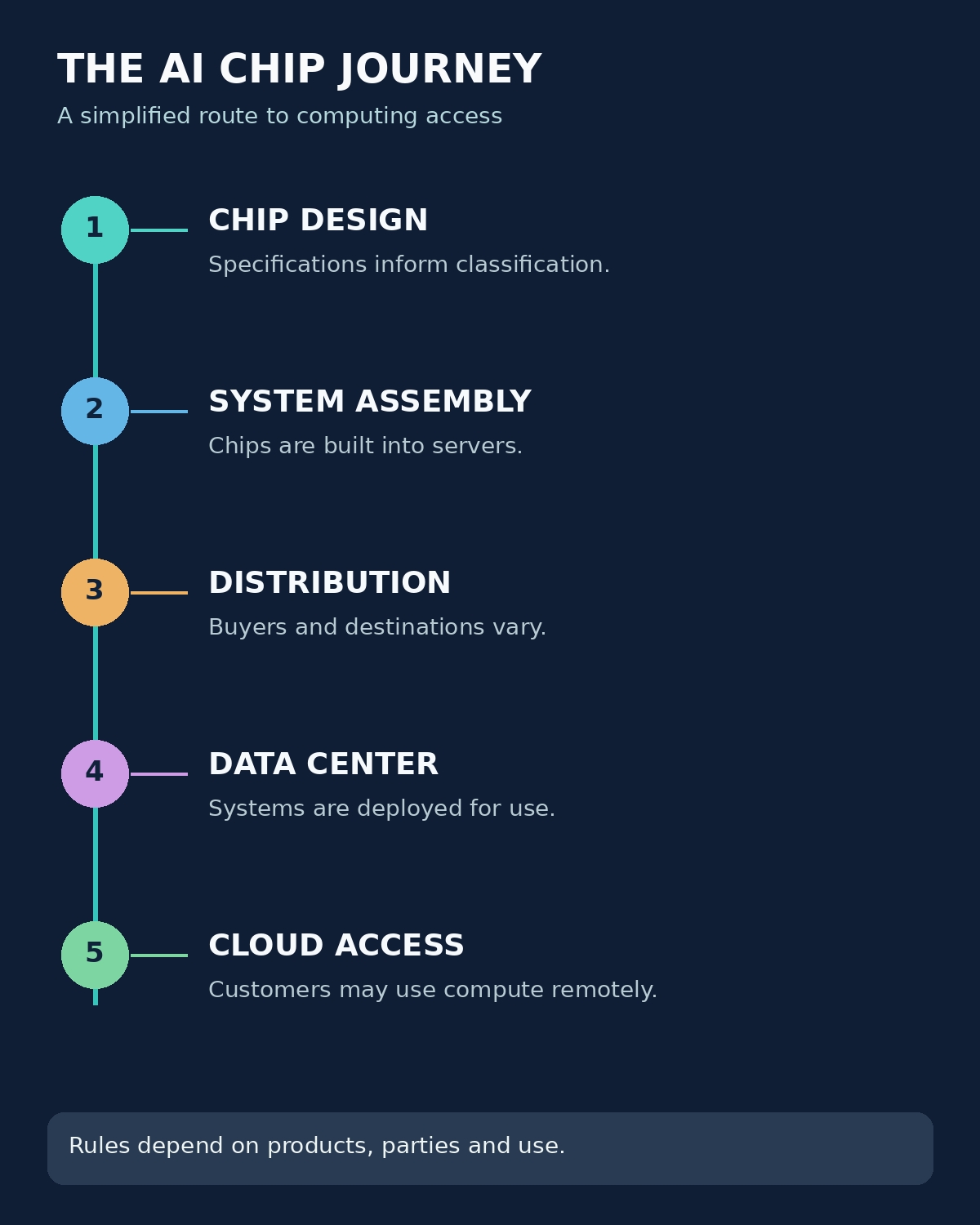
A simplified supply chain runs from chip design to system assembly, distribution, data-center installation and cloud access. A manufacturer may sell to a server maker or intermediary; a cloud provider may then offer computing services to customers elsewhere. Those relationships can be legitimate, but each handoff makes the final user and use case important compliance questions.
The key evidence is transactional: product identification, actual customer and ownership, destination, licensing, shipment records and the circumstances of any subsequent transfer. None of those details can be inferred from the existence of a customer meeting. Nor does an investigation into a company establish that all of its transactions were improper.
Remote access to computing and physical transfer of chips are also different questions. Whether a particular arrangement is restricted depends on the actual services, parties and applicable rules. The public should avoid treating a generalized policy concern as proof of what happened in the Megaspeed matter.
What the board can—and cannot—settle
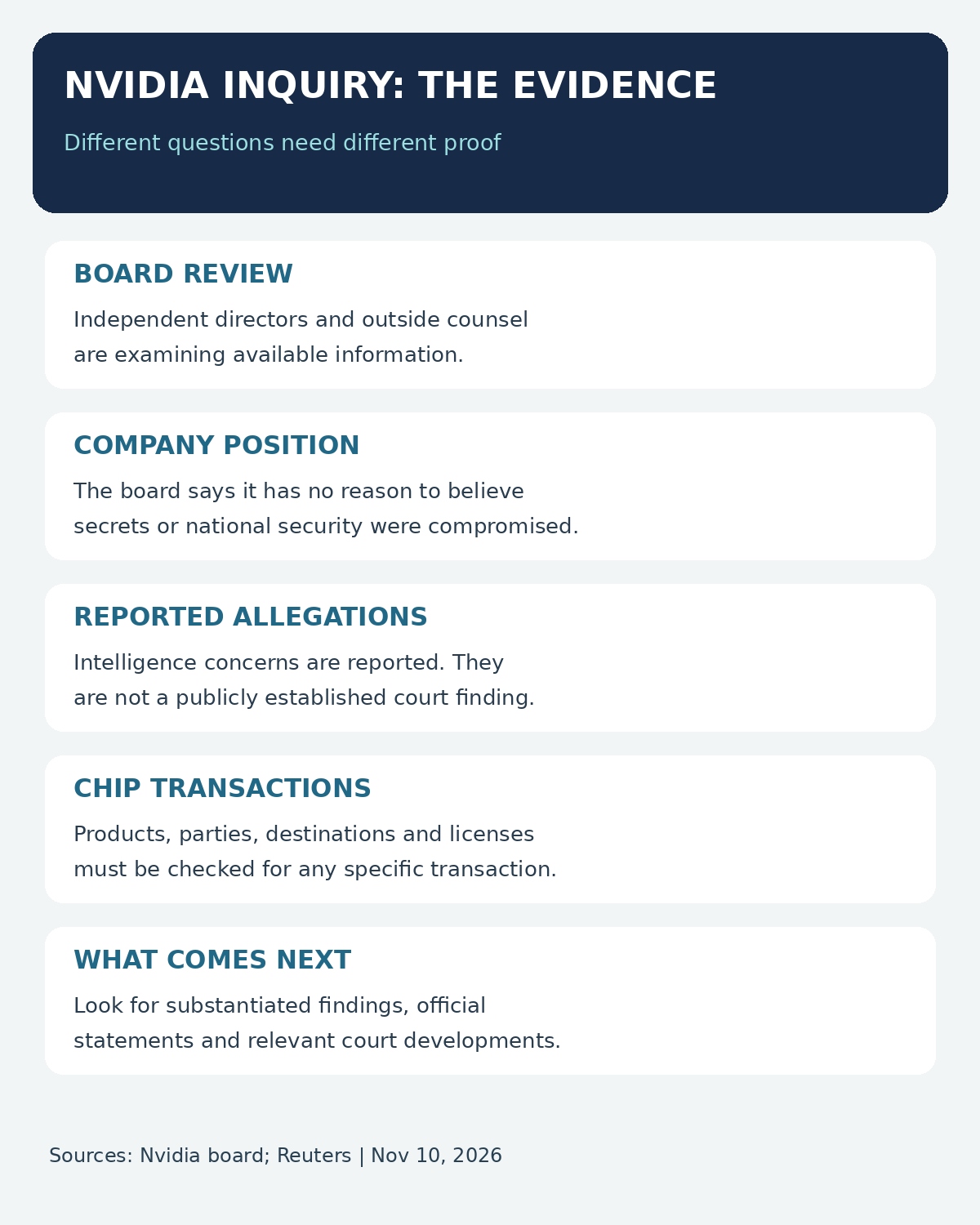
Nvidia’s board inquiry can examine company records, interview relevant people and assess whether policies or controls worked. Its committee’s independence and access to information matter because the CEO is also the company’s founder and a central figure in its strategy. Reuters has reported that long-standing relationships between Huang and some directors have prompted questions about oversight. The board has said it has confidence in Huang and his leadership team.
A company investigation does not replace action by law enforcement or regulators. Conversely, an official inquiry is not itself a finding of wrongdoing. Separate processes can examine different facts under different standards, and some findings may remain confidential. The useful question for readers is what each institution actually concludes, and what evidence it makes public.
US lawmakers have sought information about the allegations and protective controls. Investors also filed a proposed class action alleging misleading disclosure. Those allegations have not been established by a court. A complaint may identify an issue to examine; it cannot prove the case by itself.
What this could mean for AI businesses and users
For cloud customers, the near-term concern is not a demonstrated interruption to Nvidia products. It is whether supplier contracts, approved deployment locations and access to replacement hardware are clear if policies or licensing conditions change. Customers operating across borders should understand who is responsible for confirming the applicable requirements.
For chip suppliers and data-center operators, stronger checks can create operational costs: screening counterparties, keeping reliable records and resolving uncertain orders take staff time. Those costs must be weighed against security and compliance risks. Tighter controls may affect some legitimate transactions, while weaker controls can leave gaps. The right balance cannot be determined from an uncompleted investigation.
For AI developers, more expensive or less predictable access to a particular accelerator can encourage alternatives: software optimization, other hardware, different cloud providers or modified deployment plans. These are possible responses, not forecasts that any company will change course because of this case.
Investors face a separate governance question. Nvidia’s shares fell on November 9 amid the controversy, but a daily price move also reflects other market expectations. A falling share price cannot establish a security breach or predict the eventual investigation findings.
How businesses can prepare without assuming the outcome
A customer using AI services can start by mapping which applications depend on a particular cloud provider, accelerator type or region. Ask the supplier how it communicates changes to product availability, what alternatives exist and whether any contract limits moving workloads. These checks clarify a business dependency; they do not imply that Nvidia customers face an imminent disruption.
For a distributor or data-center operator, the more immediate question is whether records can connect each transaction to the relevant product, parties, intended destination and applicable authorization. Escalate inconsistent information through the organization’s compliance process rather than assuming that a well-known supplier or customer eliminates the need for review. The applicable requirements depend on the actual transaction and current rules.
What evidence would change the picture?
Watch for the scope and findings of the board review, statements by relevant authorities, court filings and any substantiated changes in licensing or corporate controls. A credible account would distinguish the evidence it can release from information it must legitimately keep confidential.
Also watch for a response from the people or organizations named in material allegations. Reported intelligence assessments based on anonymous sources may justify scrutiny but should remain attributed until underlying facts are independently established. Protecting the privacy of uninvolved family members is consistent with examining a public company’s governance.
The verdict: Separate supply-chain risk from an unproven breach
The Nvidia Jensen Huang investigation has brought a long-running policy debate into a sharp corporate context. In the past, chip controls and AI infrastructure already created tension between commercial access and security. Today, Nvidia’s board is investigating reports while saying it has no reason to believe company secrets or national security were compromised.
Looking ahead, the significance will depend on evidence: what information or hardware moved, which controls applied, and what the responsible institutions find. The defensible conclusion now is that AI supply-chain oversight deserves scrutiny; a security breach remains unproven.