
Open-source AI token optimization tools promise to make Claude, ChatGPT-connected applications and coding agents less expensive to run. Some can reduce the amount of context a model reads; others reuse previous results or help developers measure usage. They do not all save money in the same way, and a percentage quoted for one command is not a guarantee for an entire project.
This guide examines 10 repositories and explains where they fit, what their maintainers claim, which limitations deserve attention, and how to evaluate them without mistaking a subscription allowance for an API budget.
How We Selected and Assessed These Tools
We reviewed the projects’ public repositories and relevant provider documentation available on November 10, 2026. We selected tools that document a mechanism relevant to context selection, compression, reuse, routing or measurement. They include both established projects and narrower tools; inclusion does not certify security, current maintenance, commercial licensing or market leadership. List order is not a benchmark ranking.
Our assessment is research-based: we did not install these repositories, run their benchmarks, interview a developer or compare them on a live account. Maintainer-reported savings are explicitly attributed and may not transfer to your model, data or workload. We include a clearly hypothetical cost example and a reproducible evaluation plan instead of invented first-hand results.
See our guide to guide to LLM cost optimization for broader cost drivers, and our guide to tracking AI spend for allocating usage across teams.
Token Optimization Tools Compared
| Tool | Mechanism | Most useful for | Main trade-off |
|---|---|---|---|
| Graffiti | Local code graph and scoped retrieval | Understanding repository relationships | Graph may omit dynamic relationships |
| RTK | Filters coding command output | Agents that repeatedly read verbose logs | Important detail may be hidden |
| TokenEconomizer | Repository session reuse and agent integration | Repeated coding work in one repository | Integration overhead and stale context |
| Aider | Repository map within a context budget | Developers using a terminal coding agent | A map still consumes tokens |
| LLMLingua | Model-based prompt compression | Long context in API applications | Lossy compression and compute cost |
| GPTCache | Semantic response cache | Repeated similar application requests | Wrong or stale cache hits |
| LiteLLM | Gateway, routing and optional caching | Teams operating multiple model APIs | Operational and security complexity |
| LlamaIndex | Retrieval and context filtering | Document-grounded applications | Retrieval may miss key evidence |
| tiktoken | Tokenizer and measurement | Measuring OpenAI text inputs | Counts alone do not save tokens |
| TokenLean | Multi-provider optimization proxy | Teams evaluating a proxy in a sandbox | Maintainer claims need independent validation |
1. Graffiti: A Code Graph for More Focused Repository Exploration
Graffiti, the project that prompted this guide, builds a local directed graph of a repository and supports scoped queries and an MCP server. Its documentation describes an offline Go binary and a soft query budget of roughly 2,000 tokens. Claude Code integration includes project instructions and an optional hook; other MCP-capable clients require their own configuration.
Best for: Developers navigating an unfamiliar codebase or investigating dependencies across files.
What works in principle: Returning a relevant graph slice can reduce unnecessary file reads. The graph is not itself a language-model request, so its local query does not require an API key. Savings occur only if the coding agent subsequently reads fewer or smaller results while still solving the task.
Cons and verification: Static analysis can miss reflection, dynamic dispatch, runtime configuration and unsupported languages. A graph adds indexing and maintenance overhead and must be refreshed as code changes. The advertised local zero-API operation does not make the connected agent’s model calls free.
Setup: Review the repository and release provenance, build or install a trusted release, run graffiti . inside a test repository, then try graffiti query "login handler". For Claude Code, inspect what graffiti init --hook would change before enabling it. For other MCP clients, configure the documented graffiti serve command in that client’s MCP settings; no ChatGPT web-account integration is established by this alone.
2. RTK: Reduce Noisy Command Output
RTK is a Rust command wrapper that condenses outputs such as tests, diffs and package-manager logs before an agent reads them. Its maintainers advertise 60–90% reductions for common development commands and provide rtk gain to report its own measurements. Those are project claims about selected commands, not a verified reduction in every API bill.
Best for: Coding-agent workflows dominated by repetitive command output.
Strengths: Filtering can leave a model with failure summaries instead of hundreds of passing test lines. Its documentation describes integrations for Claude Code, Codex and other agents, with behavior depending on the client.
Cons: A compressed log can omit useful warnings or context. Compare against unfiltered output on failures. Different RTK components have different licenses; its repository distinguishes the open-source CLI from a separately licensed optional proxy.
Setup: Install through a reviewed official release or package, read the agent-specific setup guide and inspect any hook changes. First run the wrapper on a harmless test command; compare full and filtered output and use rtk gain as a diagnostic, not as proof of invoice savings. Repository: github.com/rtk-ai/rtk.
3. Microsoft TokenEconomizer: Reuse Repository Experience
Microsoft’s TokenEconomizer describes a plugin that learns across sessions in a repository and supports several coding agents, including Claude Code and Codex. Its optional repository-map mechanism is one part of a broader approach to session context. It is a distinct tool from LLMLingua.
Best for: Repeated development sessions where the same repository structure and knowledge are encountered frequently.
Strengths: Reusing useful context may avoid rediscovering the same project facts repeatedly. The project publishes integration documentation and supports agent-specific installation paths.
Cons: Reused information can become stale, setup changes may affect agent behavior, and the overhead of collecting or retrieving context must be counted. Savings on one repository do not establish results on another. Review project license and the data stored locally.
Setup: Read the plugin README for your exact agent and version, test in a disposable repository, and compare several independent sessions with and without the plugin. Repository: github.com/microsoft/TokenEconomizer.
4. Aider: A Coding Agent With a Token-Budgeted Repository Map
Aider is a terminal-based AI coding agent with a repository map that selects important symbols and code structure within a configurable token budget. It is a complete agent, not a universal drop-in compressor for the ChatGPT website.
Best for: Developers happy to work through Aider and connect a supported model provider.
Strengths: A compact map gives the model a structural overview without necessarily adding every file to the prompt. Its documentation exposes the map budget and commands to inspect or refresh the map.
Cons: The map consumes context and may omit a critical file; too small a budget can lead to more searches and retries. Your model provider’s billing still applies. Review the documented model integration and auto-commit settings before use.
Setup: Install a verified release in an isolated environment, connect a supported API credential through environment variables, open a test repository and inspect /map. Compare a small and larger map budget on the same issue. Repository: github.com/Aider-AI/aider.
5. LLMLingua: Compress Long Prompts Before Inference
Microsoft Research’s LLMLingua project uses small language models to compress prompts; its later variants explore different compression methods and long-context scenarios. Project materials report up to 20× compression under particular experimental settings. That is a research result, not a promise of 95% lower total cost or unchanged quality for every application.
Best for: Teams sending long documents or retrieved context to model APIs and able to benchmark answer quality.
Strengths: Compression targets the input itself and can be applied before a request reaches an API. The associated peer-reviewed work makes the method more inspectable than an unsupported savings claim.
Cons: Compression can lose negations, source context, identifiers or legal wording. The compressor uses compute and introduces latency; preserving exact instructions and relevant evidence requires care. A useful independent check is to compare results against the published LLMLingua research and then test your own data.
Setup: Use the project’s documented Python package and compatible model in an isolated environment, pin dependencies and check model-download behavior. Compress a non-sensitive context sample, preserve system and critical instructions verbatim, and compare provider token counts and task accuracy. Repository: github.com/microsoft/LLMLingua.
6. GPTCache: Reuse Similar LLM Responses
GPTCache is a semantic-cache library. Rather than shortening every prompt, it can return a previously stored answer when a new request is sufficiently similar. Its README presents ambitious cost and speed claims, but actual benefit depends on cache hit rate, embedding expense and application requirements.
Best for: Repeated low-risk questions with stable answers and clear cache invalidation rules.
Strengths: A valid cache hit can avoid a model call entirely. Developers can choose embedding and storage components.
Cons: Similar questions are not always equivalent. Tenant, permissions, language, model version, time and source changes can make a cached response unsafe or wrong. Embedding generation and vector storage also have costs. The project’s compatibility list should be checked rather than assuming every provider has a native adapter.
Setup: Start with exact-match caching for a non-sensitive endpoint. If semantic matching is necessary, add a conservative similarity threshold, tenant-specific keys, expiration and invalidation. Measure false hits as well as hit rate. Repository: github.com/zilliztech/GPTCache.
7. LiteLLM: Routing, Budgets and Optional Cache
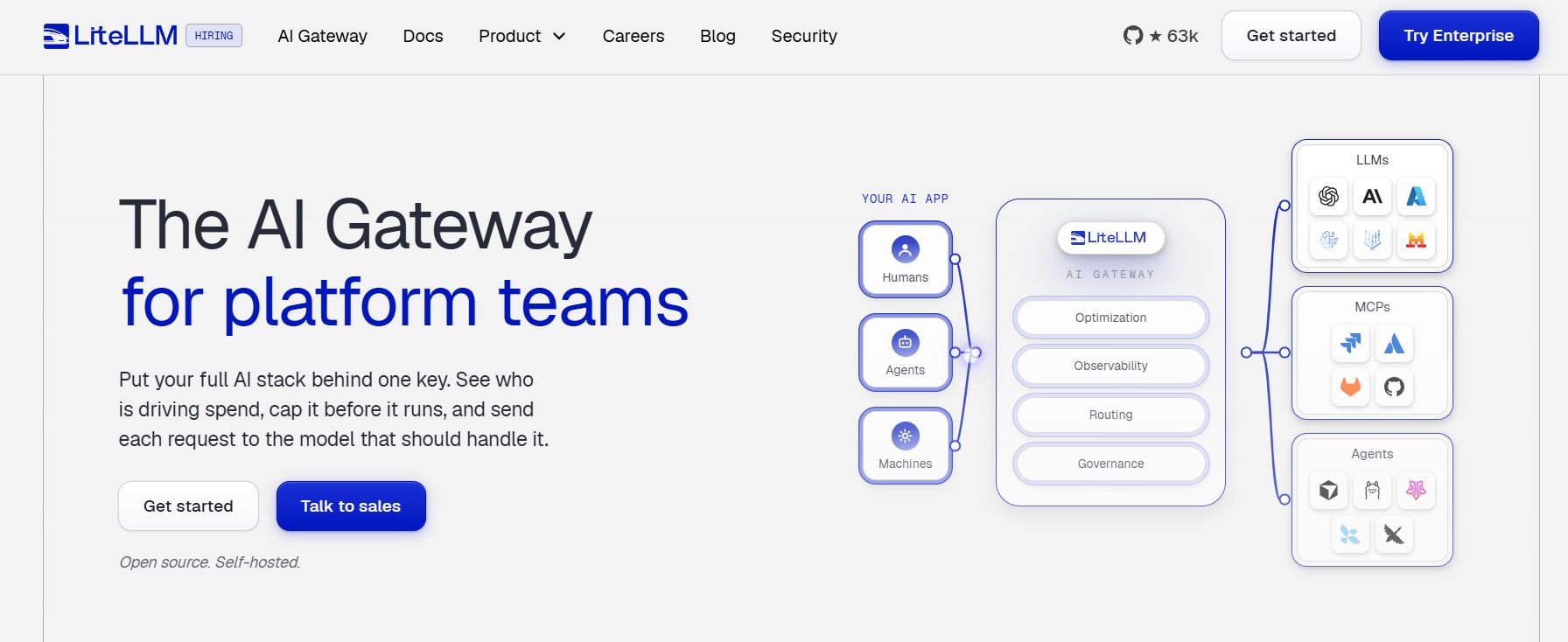
LiteLLM provides an SDK and gateway for routing requests across supported model providers, with configuration options for caching and usage management. It is infrastructure for a development team; installing a gateway does not automatically compress every prompt.
Best for: Organizations that operate several API-based models and need a central place to manage access and routing.
Strengths: Routing selected tasks to an appropriately priced model and caching repeated results can reduce spending when configured correctly. A gateway can support centralized monitoring and policies.
Cons: A proxy becomes part of the security boundary: it may see prompts, responses and API credentials. Hosting, observability, staff time, cache storage and possible wrong-model outcomes count toward total cost. Verify the exact version, deployment configuration, license and supply-chain controls.
Setup: Deploy a pinned, reviewed version in a private test environment, set up a provider credential in a secret manager and restrict network access. Route a small test workload, record per-model usage and enable a cache only after defining isolation and invalidation. Repository: github.com/BerriAI/litellm.
8. LlamaIndex: Retrieve Less, More Relevant Context
LlamaIndex is a framework for building retrieval-augmented applications. Its retrievers and postprocessors can select or filter document chunks before a model receives them. It is not simply a token compression plugin.
Best for: Teams answering questions against large collections of documents or knowledge bases.
Strengths: Sending a small number of useful excerpts can be cheaper and more relevant than repeatedly sending an entire document set. Filtering and reranking can be tuned to the task.
Cons: A missed passage can produce a confident but incomplete answer. Embeddings, indexes, reranking and maintenance cost money and can introduce data-residency concerns. More retrieval is not always better: measure quality as well as token volume.
Setup: Index a small approved collection, keep source identifiers, test a baseline query and reduce retrieved chunk count incrementally. Record answer accuracy and citations against the full-context baseline. Repository: github.com/run-llama/llama_index.
9. tiktoken: Measure Before You Optimize
OpenAI’s tiktoken is a tokenizer library. It does not compress prompts or change the bill by itself, but it can help identify unexpectedly large text inputs. OpenAI notes that complete request accounting may include structured content and other tokens not captured by a simple local text count.
Best for: Developers investigating where OpenAI-compatible application text is growing.
Strengths: Local text counting can inform chunk sizes and reveal waste before a model call. It provides a useful baseline for experiments.
Cons: OpenAI tokenization is not a reliable substitute for Claude’s or DeepSeek’s tokenizer, and plain text estimates can omit tools, images or request framing. Use the target provider’s counting or usage data when available.
Setup: Install the official package in a virtual environment and count only sanitized samples. For production, compare estimates with provider-reported usage. Repository: github.com/openai/tiktoken.
10. TokenLean: A Multi-Provider Optimization Proxy to Evaluate Carefully
TokenLean describes a proxy that combines several techniques, including caching, routing and compression. Its repository reports a quality-gated internal ablation result, but we did not independently reproduce it. A project’s own benchmark is useful for understanding its test method, not a substitute for your own workload evaluation.
Best for: Technical teams that can test an additional proxy in isolation and review its implementation.
Strengths: Combining techniques may address several sources of waste in one architecture. Its documentation describes support for more than one API protocol.
Cons: More transformations can make it harder to attribute savings or spot a quality regression. A proxy may handle confidential prompts and credentials. Provider or agent compatibility, feature coverage and maintenance must be verified for the exact release; a model-routing change can alter output quality even if the token count falls.
Setup: Review the source, configuration and network destinations; pin a release; run with synthetic data and a spending limit; and enable one optimization at a time. Record input, output, cached tokens, latency, cost and task success. Repository: github.com/cbeyondcloud/TokenLean.
Can You Connect These Tools to ChatGPT Pro, Claude or DeepSeek?
ChatGPT subscriptions versus API: A ChatGPT Pro subscription does not automatically provide API credits. OpenAI states that ChatGPT and API billing are separate. A personal coding-agent integration may use a supported account sign-in if its official documentation offers one; that does not mean an arbitrary proxy can intercept the ChatGPT website or that it changes a flat subscription price. Check the exact product and plan limits.
Claude: Anthropic’s Claude Pro subscription and Console API billing are separate. Claude Code may support an eligible plan sign-in, while an API-key route is billed separately; the tool and mode matter. Local hooks and MCP integrations are configured in the supported client, not by pasting a key into a third-party website.
DeepSeek: DeepSeek documents an OpenAI-compatible API with its own key and base URL, https://api.deepseek.com. A tool must explicitly support the required API protocol and features; OpenAI-format compatibility alone does not guarantee identical tool calls, caching or model behavior. API use and a consumer chat subscription must be checked separately.
Business cloud: A team typically deploys an approved gateway or retrieval service in its own cloud, stores secrets in a managed secret store, uses service identities and role-based access, and connects the agent or application to an approved endpoint. Check provider agreements, data residency, logging, retention, prompt-injection defenses, licensing and budget controls before processing customer data. A personal ChatGPT, Claude or DeepSeek web subscription is not a general-purpose cloud credential.
Example: Count a Local Text Sample Before Compression
The following illustrative Python snippet compares two strings using an OpenAI tokenizer. It does not call a model or establish whether the shorter version preserves quality. Replace the samples with non-sensitive text, choose the encoding supported by your target model, and compare with the provider-reported count for a real request. It has not been run as a benchmark for this article.
import tiktoken

encoding = tiktoken.get_encoding("cl100k_base")
baseline = "Summarize this example document in three concise bullet points."
shortened = "Summarize this document in three bullets."

for label, text in [("baseline", baseline), ("shortened", shortened)]:
    print(label, len(encoding.encode(text)))
For DeepSeek integration, the provider documents an OpenAI-compatible client with a DeepSeek API key and https://api.deepseek.com as the base URL. Keep the key in your environment or secret manager, select a currently supported model from the provider’s documentation, and follow the particular tool’s integration instructions. Do not assume a consumer chat subscription includes API access.
A Safe Pilot: Compare Real Work, Not Marketing Percentages
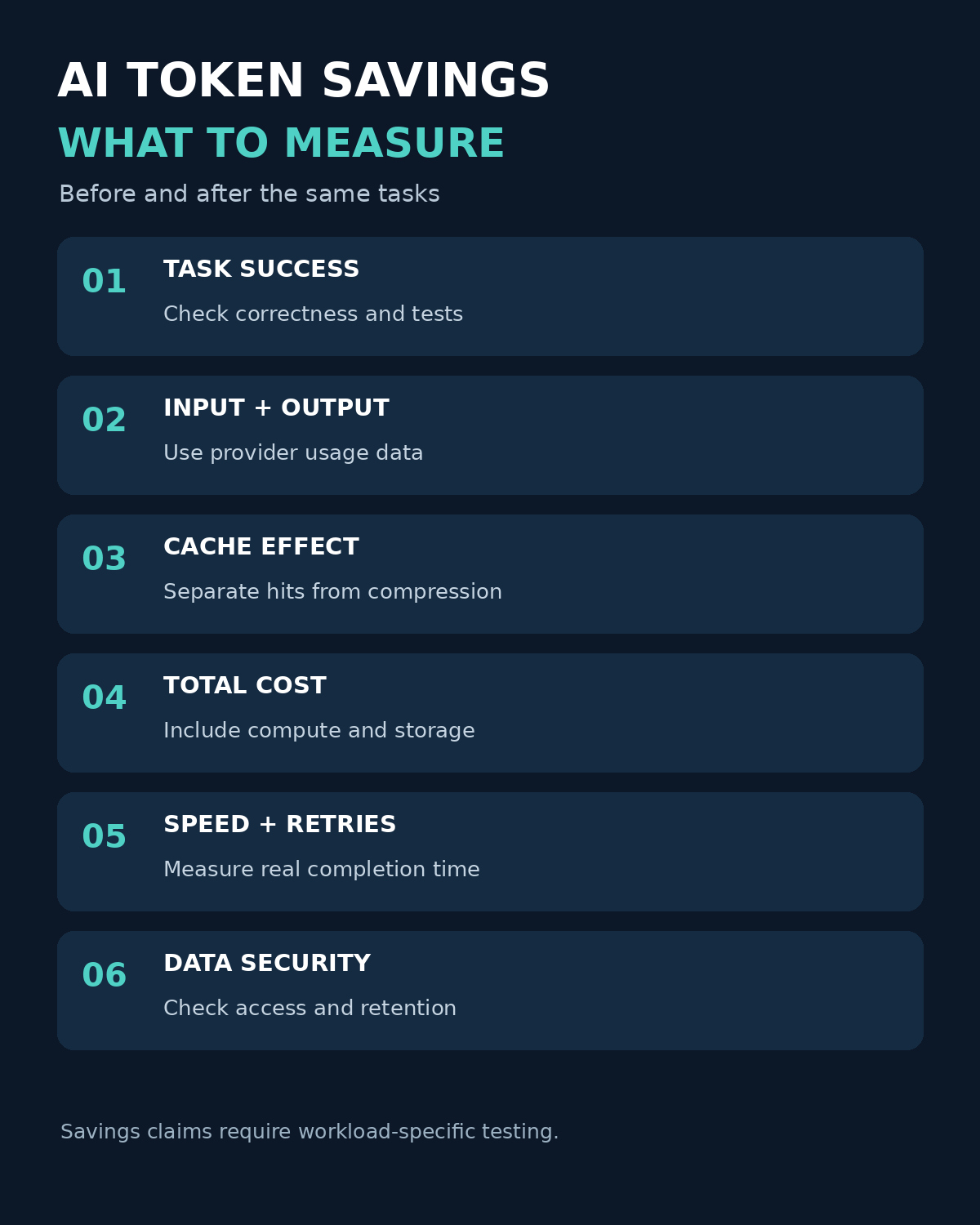
- Pick 20–50 representative tasks with known acceptance criteria, including difficult cases and failure paths. Use non-sensitive data for the first pilot.
- Record a baseline using the same model, prompts, repository revision, tool permissions and task budget. Count successful tasks, retries, latency, input and output tokens, cached input and actual spend.
- Enable one optimization. Keep the target model and evaluation procedure unchanged. Randomize task order and repeat where practical; agent outputs vary.
- Inspect full logs for missed errors and assess correctness, tests and human review time. Measure total cost including compressor compute, embeddings, storage and proxy operations.
- Set an acceptable quality floor before comparing cost. Roll back if correctness, security or latency worsens beyond that limit.
Hypothetical example: Assume 1 million uncached input tokens cost $4, output costs $3, and optimization overhead costs $1 for a workload, for a $7 baseline before overhead. If input tokens fall by 40%, input cost becomes $2.40; output remains $3 and added overhead is $1. The optimized total is $6.40, a saving of about 8.6%, not 40%. This simplified example assumes the same output, success rate and input price and is not a quote from a provider.
Also distinguish cached-token discounts from token elimination. Prompt caching can lower the price of repeated input without reducing the number of tokens represented in the request. A poorly placed optimization may disrupt a stable prefix and reduce cache hits, so compare final invoices rather than raw token counts alone.
Frequently Asked Questions
Does fewer tokens always mean better results?
No. Removing the wrong error message, source paragraph or instruction can make an agent fail, search more or require retries. Compare successful task outcomes and total cost.
Can one tool optimize every ChatGPT or Claude conversation?
No. Repository tools normally integrate with a coding client, API application, proxy or MCP host that explicitly supports them. A web chat subscription is not a universal API endpoint for third-party tools.
Are provider cache hits the same as semantic response-cache hits?
No. Prompt-prefix caching reuses provider-side processing of a matching prompt prefix, while semantic response caches may return a stored answer for a similar query. Their failure modes and billing effects differ.
Takeaway
Graffiti, RTK and Aider address coding context in different ways; LLMLingua changes prompt content; GPTCache and LiteLLM operate at application or gateway level; and tiktoken measures rather than optimizes. Choose the smallest intervention that addresses your actual source of waste, then verify savings against correctness and full cost.