The era of “wellness perks” is dead. As we settle into 2026, the corporate focus has shifted aggressively from reactive mental health days to structural cognitive preservation.
With the rise of the “Agent Workforce”—software agents managing workflows alongside humans—and the enforcement of global digital disconnection laws, organizations are realizing that protecting employee brainpower isn’t just a biological necessity; it is an economic survival strategy. The companies winning in 2026 aren’t just offering therapy apps; they are redesigning work itself to prevent cognitive collapse.
Key Takeaways
- Shift to Infrastructure: Wellness has moved from HR benefits (yoga apps) to operational infrastructure (workflow design, meeting caps, and AI-governance).
- The “Agent” Factor: The integration of AI agents in 2026 has created a new stressor—”management fatigue”—as workers transition from doing tasks to supervising AI.
- Neuro-Inclusion by Design: Offices are being retrofitted not just for collaboration, but for sensory regulation, catering to a neurodiverse workforce.
- New KPIs: Productivity metrics are being replaced by “Cognitive Capacity” and “Restoration Rates.”
- Regulatory Pressure: The EU’s 2026 implementation of strict AI monitoring bans and “Right to Disconnect” policies is setting a global standard.
From “Quiet Quitting” to “Cognitive Scaffolding”
To understand the 2026 landscape, we must look at the trajectory of the last four years. The post-pandemic era (2022-2023) was defined by the “Great Resignation” and “Quiet Quitting,” symptoms of a workforce protecting itself from burnout. By 2024, the conversation shifted to “Productivity Paranoia,” where surveillance tools clashed with trust.
Now, in 2026, we have entered the age of Cognitive Scaffolding. The realization—driven by data from the 2025 Microsoft New Future of Work Report and IMF findings—is that the human brain is the bottleneck in an AI-accelerated economy. Leaders are no longer asking, “Are you happy?” They are asking, “Do you have the mental bandwidth to make high-stakes judgments?” This shift was necessitated by a sharp rise in “cognitive debt”—the cumulative cost of constant context-switching and digital overload that cost the global economy an estimated $1 trillion annually in lost productivity by late 2025.
The Agent Workforce and the “Supervisor’s Burden”
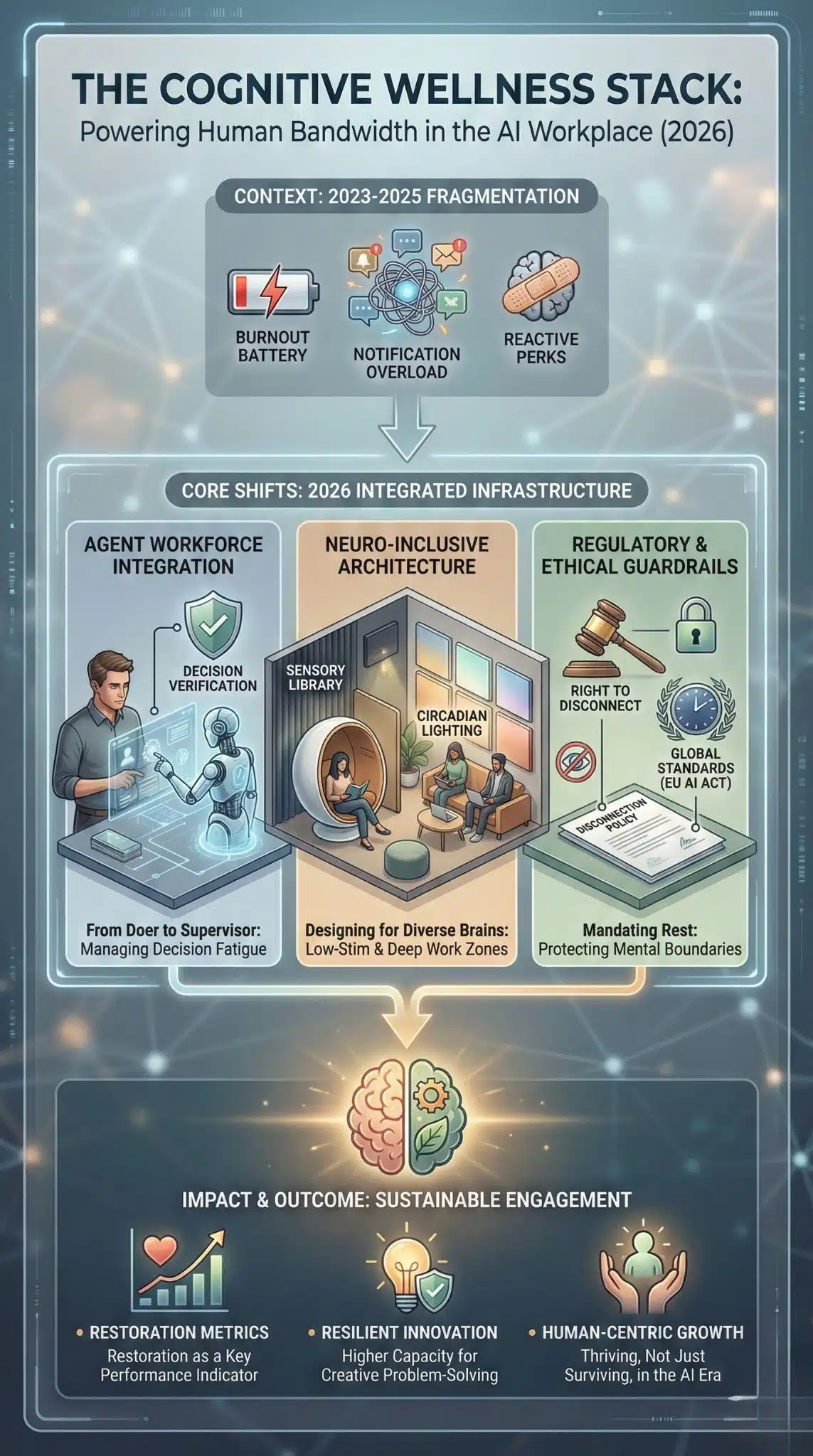
The most significant disruptor in 2026 is the maturity of the “Agent Workforce.” Unlike the generative AI chatbots of 2023, today’s AI agents execute end-to-end workflows. While this promised to liberate humans from drudgery, it has introduced a new form of exhaustion: Decision Fatigue.
Employees are no longer “doers”; they are “verifiers.” Reviewing AI output requires a higher level of sustained critical thinking than performing the task itself.
The Shift in Cognitive Load (2022 vs. 2026)
| Feature | The “Doer” Era (2022) | The “Verifier” Era (2026) |
| Primary Task | Creation & Execution | Review, Edit, & Authorize |
| Mental Strain | Repetitive Stress (Boredom/Burnout) | High-Stakes Vigilance (Anxiety/Decision Fatigue) |
| Skill Value | Speed & Accuracy | Judgment & Ethics |
| Failure Mode | “I made a typo.” | “I missed a systemic AI bias.” |
| Rest Needs | Physical break/Socializing | Sensory deprivation/Deep focus recovery |
Analysts suggest that without “cognitive offloading” protocols, this shift leads to a rapid depletion of executive function. Progressive companies are now instituting “AI-Free Windows”—mandatory periods where human staff engage in deep work without digital agent interruption.
The Neuro-Inclusive Architecture
In 2026, neurodiversity is no longer treated as a recruitment quota; it is the blueprint for office design. With 15-20% of the workforce identified as neurodivergent, and many more experiencing “situational neurodivergence” due to stress, the open-plan office has been declared a failure for deep work.
New “Cognitive Ergonomics” standards are reshaping physical workspaces. We are seeing the rise of:
- Sensory Libraries: Soundproofed, dim-lit zones specifically for “low-stimulation” recovery.
- Circadian Lighting: Office lighting that automatically adjusts color temperature to match human biological rhythms, reducing cortisol spikes.
- Asynchronous-First Culture: A shift away from real-time Slack/Teams demands, allowing workers to process information at their own pace—a critical accommodation for ADHD and autistic talent that benefits everyone.
The Economic Cost of “Brain Fog”
Financial models have evolved. CFOs are beginning to track Cognitive Capacity as a tangible asset. The cost of fatigue—previously hidden in “general administrative expenses”—is now visible.
The Hidden Costs of Cognitive Decline (2026 Estimates)
| Cost Center | Description | Estimated Annual Impact (Global Ent.) |
| Presenteeism | Employee is logged in but mentally offline/ineffective. | ~ $4,000 per employee |
| AI Rework | Cost of human errors made while supervising AI agents. | ~ $1,200 per employee |
| Turnover Contagion | High-burnout teams triggering mass departures. | 2x Annual Salary per exit |
| Innovation Lag | Inability to think creatively due to chronic “survival mode.” | Incalculable (Strategic Risk) |
The winners in this economy are companies that treat rest as a productivity input, not a reward. “Restoration Rates”—the speed at which a team recovers from a sprint—are becoming a key performance indicator (KPI) for managers.
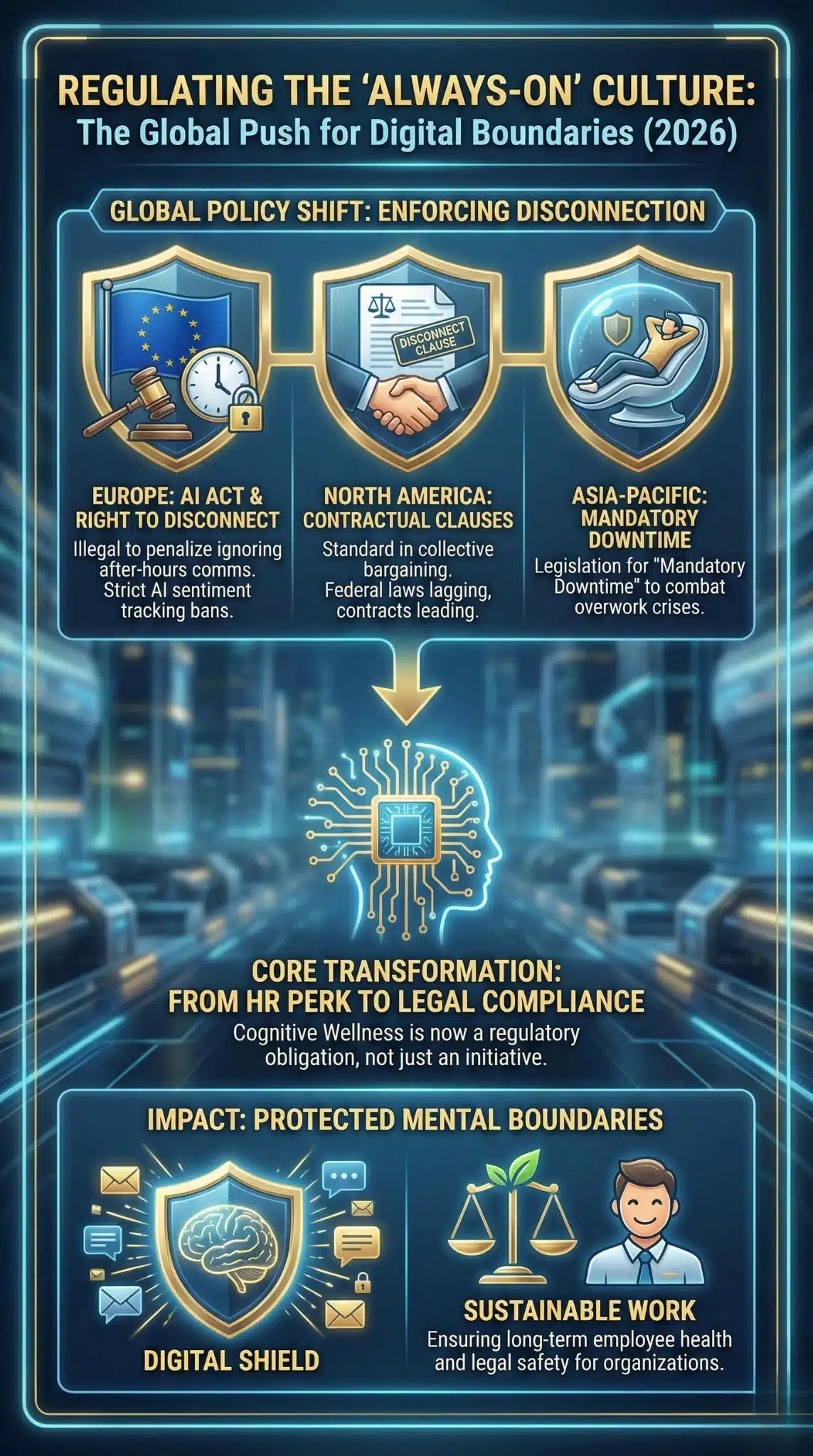
The Regulation of “Always-On” Culture
Government policy is forcing the hand of laggard corporations. The European Union’s rigorous enforcement of the AI Act (fully operational August 2026) and stricter “Right to Disconnect” laws have created a ripple effect.
- Europe: It is now illegal in several jurisdictions to penalize employees for ignoring communications outside contracted hours. AI tools that track “sentiment” or “emotion” are heavily restricted or banned.
- North America: While federal laws lag, “disconnection” clauses are becoming standard in collective bargaining agreements and high-level employment contracts.
- Asia-Pacific: Countries like Japan and South Korea are introducing “Mandatory Downtime” legislation to combat their historical crises of overwork.
This regulatory environment makes “Cognitive Wellness” a compliance issue, not just an HR initiative.
The Rise of the Chief Intelligence Officer (CIO 2.0)
A new leadership profile has emerged. The traditional Chief Information Officer is evolving into the Chief Intelligence Officer (or in some firms, the Chief Cognitive Officer).
This role does not just manage IT systems; it governs the intersection of biological intelligence (humans) and artificial intelligence (machines).
Their mandate includes:
- Metric Governance: Ensuring AI productivity gains don’t simply result in higher quotas for humans.
- Cognitive load balancing: Using anonymized data to spot teams at risk of burnout before they crash.
- Ethical Oversight: Protecting “distinctively human” work (mentorship, creative direction) from being automated into oblivion.
Expert Perspectives
The Techno-Optimist View: Dr. Helena Vance, a leading futurist in Workforce Dynamics, argues, “AI in 2026 is finally doing what it promised—removing the ‘drudgery tax’ from work. If managed well, we are looking at a 4-day work week becoming the standard because the cognitive load of 5 days is simply unsustainable in a high-velocity AI environment.”
The Skeptic’s Warning: Conversely, labor economist Marcus Thorne warns, “We are seeing a ‘Cognitive Divide.’ High-level executives get ‘deep work’ protection and assistants (human and AI), while entry-level workers are subjected to relentless algorithmic management. Without intervention, cognitive wellness will become a luxury good.”
Future Outlook: What to Watch in 2027
As we look toward 2027, the frontier of cognitive wellness will likely move into Bio-Feedback Governance.
- Prediction: Wearable tech that tracks stress (cortisol levels, heart rate variability) will move from consumer gadgets to corporate pilots. The battleground will be privacy: Will employees trade their biometric data for “personalized workloads”?
- Milestone: Watch for the first major class-action lawsuit regarding “Algorithmic Injury”—employees suing for psychological damages caused by unmanaged AI-driven work quotas.
- Trend: “Brain-Healthy Certification” for buildings and software will become as coveted as LEED certification is for energy efficiency.
Final Words
The corporate wellness strategies of the early 2020s—fruit bowls and mindfulness apps—were band-aids on a bullet wound. In 2026, the wound has healed, but the scar tissue remains. The organizations that thrive next will be those that recognize their people are not machines to be optimized, but biological systems that require protection, restoration, and purpose. In the age of AI, being human is the killer app—but only if you have the energy to sustain it.