ChatGPT visibility trackers should help a team answer three questions: where does the brand appear, which sources shape those answers, and what work should follow? A percentage on a dashboard is useful only when the team can explain the prompts, locations, collection method, and dates behind it.
For US marketing teams, the shortlist below covers dedicated monitoring platforms, tools inside established SEO ecosystems, and broader enterprise systems. All ten document ChatGPT tracking. The right choice depends on whether the immediate job is running a focused prompt panel, reporting across clients, investigating citations, or coordinating a larger marketing operation.
Here, “pro level” means professional marketing use. It does not mean that a tracker reproduces the experience of every ChatGPT Pro subscriber.
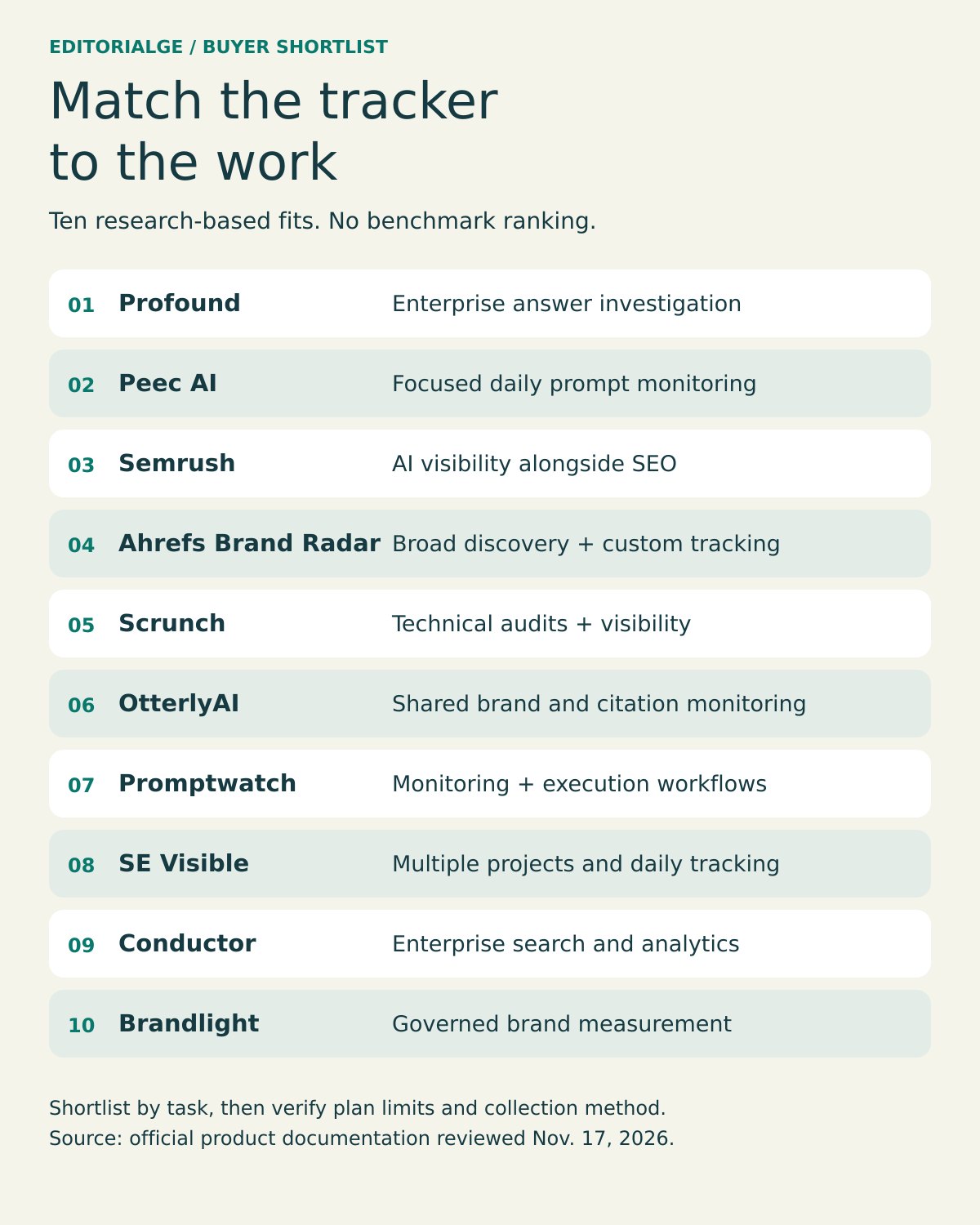
ChatGPT Visibility Trackers: Quick Selection Guide
Peec AI and OtterlyAI are worth evaluating when the main task is repeatable brand and citation monitoring. Semrush and Ahrefs deserve a place on the shortlist when a team already works in those SEO ecosystems. Profound and Conductor are more relevant when visibility research needs to feed a wider enterprise workflow. Scrunch adds a technical investigation angle, while Promptwatch connects monitoring with execution features. SE Visible merits attention for multi-project tracking, and Brandlight for managed measurement across markets and brand entities.
These are assessments of documented fit, not measured performance winners. Official product pages, help documentation, and available pricing were reviewed on November 17, 2026. Ten products were researched, and three public pricing interfaces were checked directly. No authenticated dashboard workflows or common-prompt accuracy benchmark were performed. The numbering organizes the shortlist and does not represent a scored ranking.
The most consequential distinction is what each platform actually observes. For example, Peec’s documentation separates its logged-out ChatGPT interface tracking from an API-based search option. Treating those as identical would make a comparison misleading before the first report is exported.
What We Checked
On November 17, 2026, we compared official documentation for ten tools and completed three public-page checks: opening Profound’s retired-plan FAQ, switching Peec’s billing interval, and switching Semrush’s AI Visibility pricing from annual to monthly. These checks establish the displayed terms and control behavior; they do not establish tracking accuracy, paid-plan performance, or the experience of every ChatGPT user.
The first three entries include the original captures with red editorial highlights and expandable check notes. Open an image to inspect the unmarked full-size capture. The observations below refer only to the actions recorded for this review.
- Profound: the expanded FAQ says Starter and Growth were retired for brands; an old fixed-price comparison can mislead a new buyer.
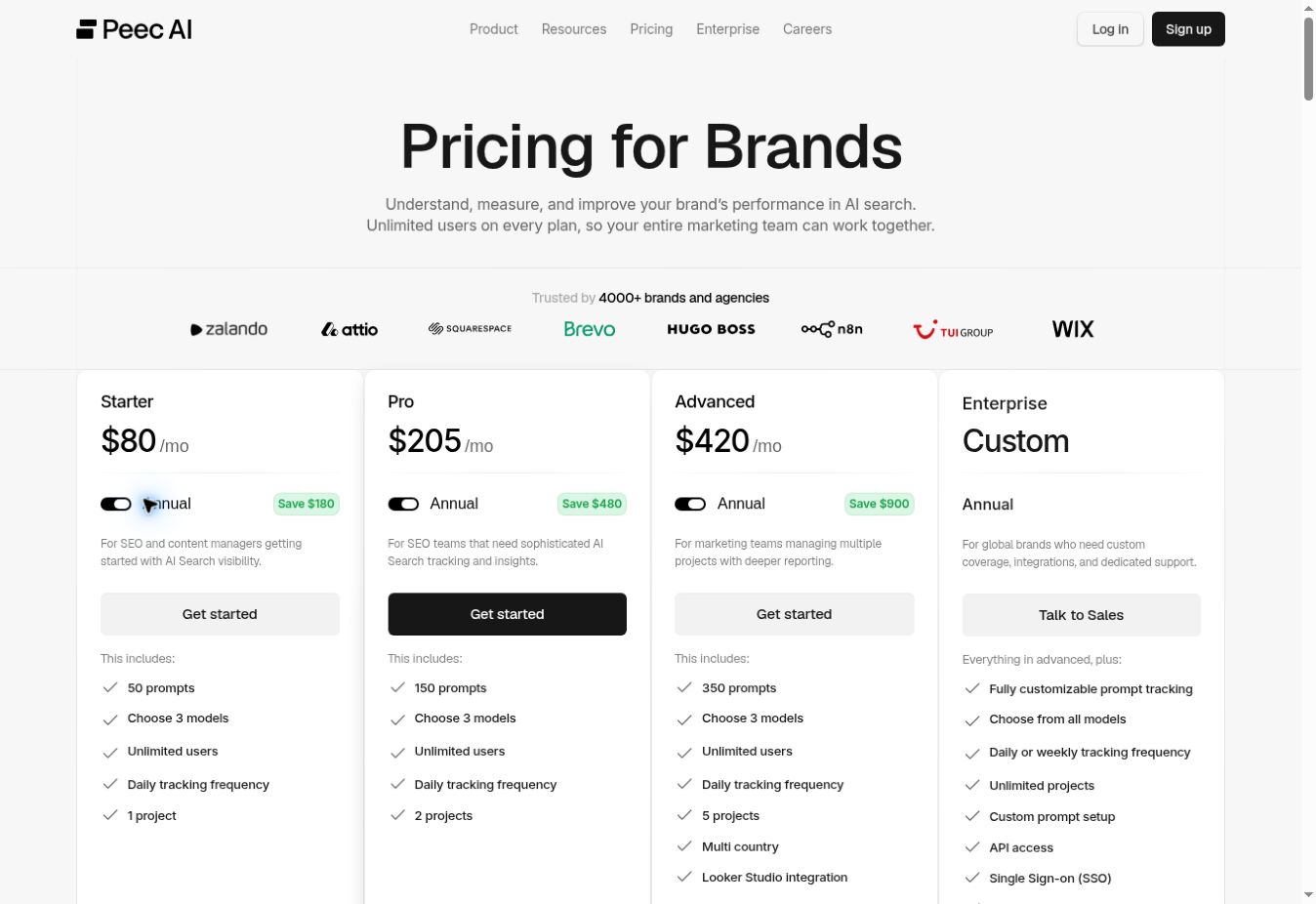
- Peec AI: enabling annual billing changed Starter from $95 to $80 per month and Pro from $245 to $205 per month.
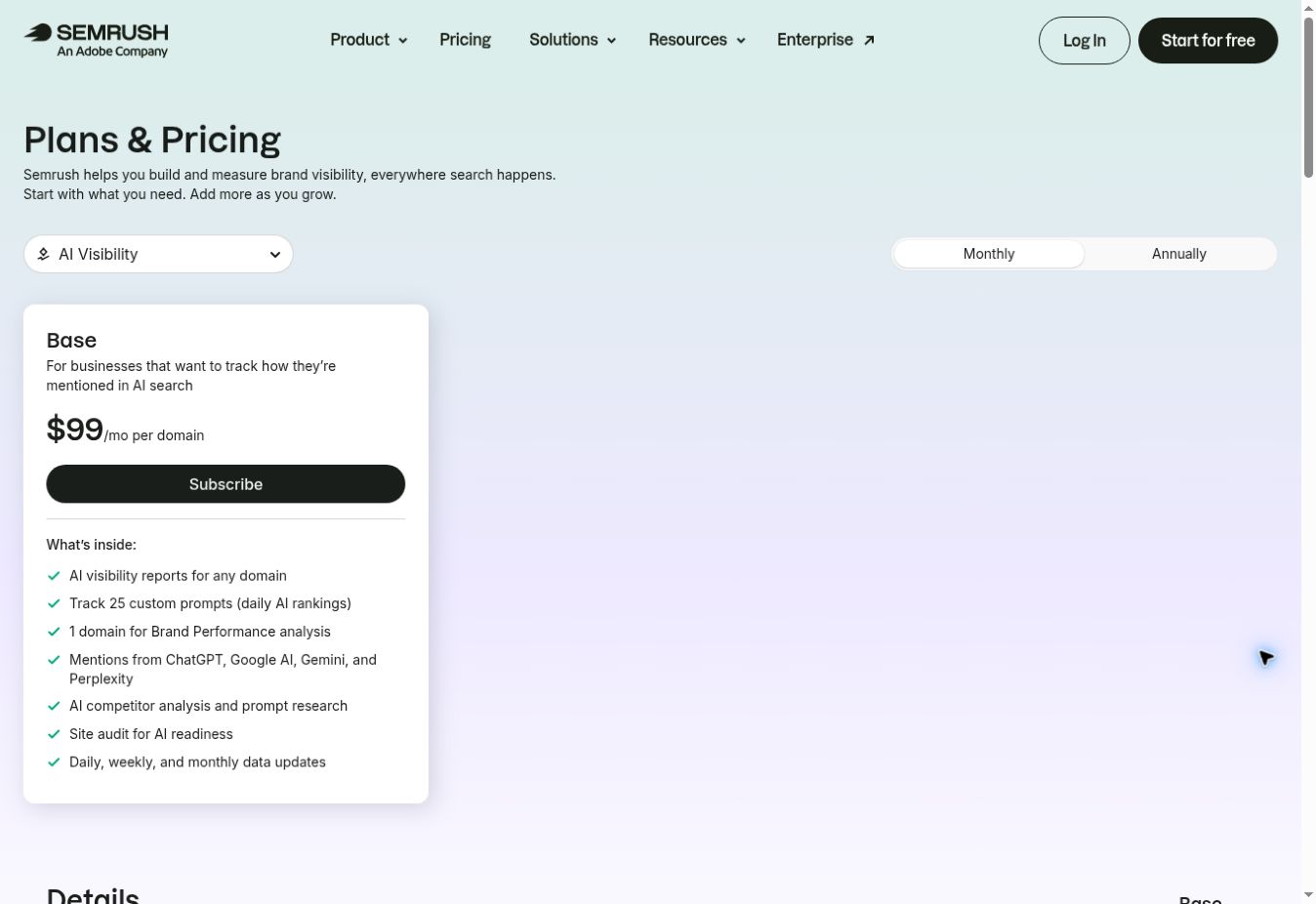
- Semrush: switching to monthly kept the displayed Base price at $99 per month per domain, while removing the annual-billing qualifier.
How the Tools Were Selected
Each selection needed an active official product presence, explicit ChatGPT monitoring, and documented analytical value beyond a one-time brand check. That value could include repeated prompt tracking, competitor comparisons, citation analysis, historical reporting, or connections to wider marketing workflows.
The comparison prioritizes five purchasing questions:
- Can the team isolate ChatGPT results and inspect the answers behind a metric?
- Can it monitor its own buying questions, or clearly understand the vendor’s question set?
- Does it distinguish brand mentions, source citations, and competitor performance?
- Can its allowances and reporting arrangements support the intended workload?
- What must a US buyer verify about location, language, account state, billing, and access?
A vendor’s feature page establishes what it offers, not that its measurements are independently accurate. Plan restrictions and unanswered procurement questions therefore matter alongside feature breadth. General social-listening products, AI writing assistants, and one-off checkers without the required monitoring scope were not used to fill the list.
Compare the Shortlist by the Work You Need to Do
| Tool | Most relevant evaluation use case | Documented distinction | Buying check |
|---|---|---|---|
| Profound | Enterprise answer-engine research | Visibility, citations, sentiment, and claim checking | Scope the paid prompt, engine, and region package |
| Peec AI | Daily prompt monitoring for marketing teams | Country/model filters and source analysis | Starter excludes API access |
| Semrush AI Visibility Toolkit | AI tracking alongside SEO reporting | Custom prompt tracking and cited-page analysis | Separate database reports from tracked prompts |
| Ahrefs Brand Radar | Market research plus precise prompt monitoring | AI Visibility Index and custom tracking | Calculate checks across engines and locations |
| Scrunch | Visibility research with technical diagnostics | Citation monitoring, page audits, and agent traffic | Data API and advanced SSO are Enterprise features |
| OtterlyAI | Brand and link monitoring with shared team access | Unlimited team members advertised across plans | Prompt, credit, and engine allowances still apply |
| Promptwatch | Monitoring connected to operational work | API access, content workflows, and location options | City/state tracking is listed on Business |
| SE Visible | Multiple projects in a dedicated AI platform | Daily tracking with project allowances | Distinguish it from the legacy SE Ranking tracker |
| Conductor | Enterprise SEO, content, and performance reporting | AI visibility alongside website analytics | Request a scoped proposal and integration demonstration |
| Brandlight | Managed brand measurement across markets | Versioned question sets and entity mapping | Confirm cadence, market scope, and access to underlying evidence |
1. Profound: Enterprise Research That Extends Beyond Mentions
Profound’s Answer Engine Insights covers how often a brand appears, how AI describes it, and which websites are cited. Its documented capabilities include sentiment analysis, competitive benchmarking, and FactCheck, which identifies inaccurate claims and the sources behind them.
That combination is relevant when the business problem is more specific than low visibility. A software company, for example, may need to investigate an outdated pricing claim that keeps appearing alongside its brand. Finding the recurring source gives the content or communications team a more concrete assignment than increasing an aggregate score.
The current pricing page lists a free trial with 50 prompts run daily for seven days across ChatGPT, Gemini, and Google AI Overviews. Enterprise packages are custom, with tailored tracking and broader engine coverage. Older fixed-price comparisons should not be assumed to describe the current offer.
For procurement, ask for the exact US tracking configuration, access to historical answers, export arrangements, and the boundaries of claim checking. Detecting an inaccurate statement does not establish that the platform can make an external AI service correct it. Profound is a serious evaluation candidate when several teams need to investigate and act on the same evidence.
We opened the FAQ about Starter and Growth and captured its answer. This gives a new buyer a reason to reject obsolete $399/$499 comparisons; it does not establish the price or capabilities of a negotiated Enterprise contract.
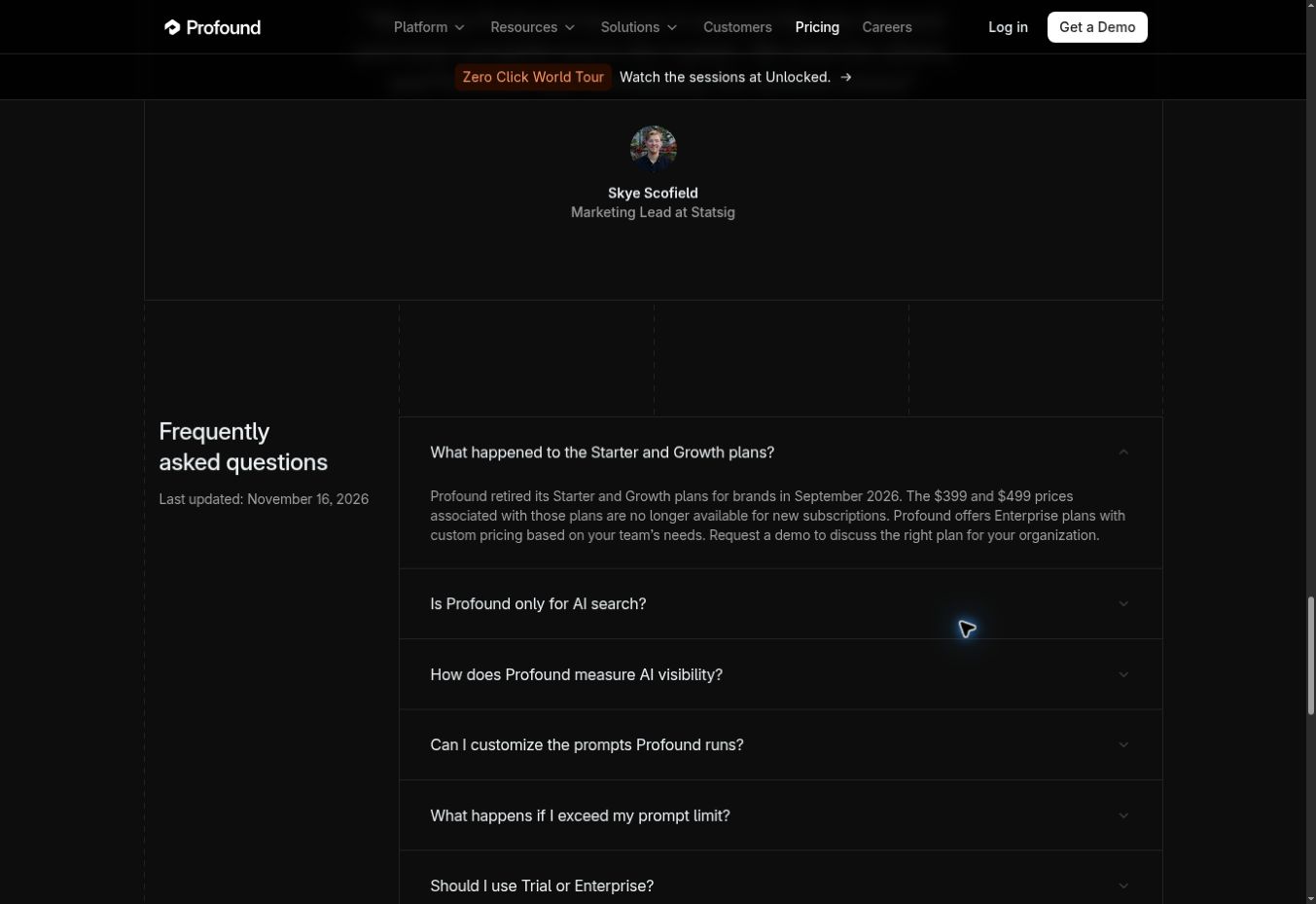
Profound pricing FAQ, expanded November 17, 2026. The highlighted answer says the former Starter and Growth brand plans were retired in September 2026; new buyers are directed to custom Enterprise pricing. Source: Profound public pricing page. Red border is an editorial overlay 2. Peec AI: A Focused Choice for Daily Monitoring
Peec AI documents daily prompt execution, visibility and sentiment metrics, competitor comparisons, and source analysis. Results can be filtered by model, country, and prompt tags, which makes it useful for separating US purchase-intent questions from broader research topics.
Its collection explanation is particularly useful. Peec says its default ChatGPT tracking captures the logged-out interface, where ChatGPT determines whether to search. It documents an API-based option separately. That distinction helps a buyer understand why the tracker may disagree with a personalized conversation on someone’s laptop.
The brand Starter plan lists $95 per month, billed monthly, for 50 prompts, three selected models, one project, and unlimited users. Pro lists $245 per month for 150 prompts and two projects, also with three selected models and unlimited users. These are advertised US-dollar monthly-billing prices checked November 17, 2026. The annual switch displayed $80 per month for Starter and $205 for Pro; the lower monthly equivalent requires the annual billing option.
Reporting requirements can change the decision: Peec’s help center says Starter does not include API access. A team building its own reporting pipeline should evaluate an eligible plan. This reporting API is a separate question from the optional API-based AI model collection described above.
We switched Annual billing on and observed all three self-service cards update. Starter retained 50 prompts, three selected models, one project and unlimited users. This is a billing-display check, not a test of response collection or an annual purchase.
Open the check notes and reproduce this observation
We switched Annual billing on and observed all three self-service cards update. Starter retained 50 prompts, three selected models, one project and unlimited users. This is a billing-display check, not a test of response collection or an annual purchase.
Public desktop browser; no account, purchase or paid dashboard used. Captured November 17, 2026. Click the image for the original full-size view.
3. Semrush AI Visibility Toolkit: Useful When SEO Already Lives in Semrush
Semrush’s Prompt Tracking documentation describes daily monitoring of custom prompts across ChatGPT Search, Google AI Mode, and Gemini. It also covers competitor performance and the domains and pages cited in answers.
The practical attraction is continuity with an existing SEO workflow. A team can investigate questions where its conventional search performance differs from its AI visibility, then inspect the pages appearing as sources. This is more useful than assuming strong Google rankings automatically translate into equivalent ChatGPT exposure.
Semrush has several AI reporting surfaces, and they should not be treated as interchangeable. Broad database-based visibility research answers a different question from daily monitoring of a selected prompt panel. Confirm which report a sales demonstration is showing and which allowance pays for it.
The AI Visibility Base page displayed $99 per month per domain with 25 custom prompts and one domain for Brand Performance analysis. In the November 17, 2026 browser check, the displayed price was $99 under both billing options; switching to Monthly removed “billed annually” from the card. Additional users and reporting options have separate listed charges. An agency should price the required domains, colleagues, and client deliverables together before comparing this offer with a dedicated tracker.
We selected Monthly on the standalone AI Visibility page, rather than the SEO + AI Search bundle. The price stayed at $99 and the annual qualifier disappeared. This confirms the displayed configuration only; reporting add-ons and additional users must still be costed separately.
Open the check notes and reproduce this observation
We selected Monthly on the standalone AI Visibility page, rather than the SEO + AI Search bundle. The price stayed at $99 and the annual qualifier disappeared. This confirms the displayed configuration only; reporting add-ons and additional users must still be costed separately.
Public desktop browser; no account, purchase or paid dashboard used. Captured November 17, 2026. Click the image for the original full-size view.
4. Ahrefs Brand Radar: Separate Broad Discovery From Custom Tracking
Ahrefs Brand Radar offers two complementary approaches: explore an AI visibility index or monitor questions the team defines. The custom tracking documentation supports selecting AI assistants, locations, and refresh frequency, including daily, weekly, or monthly checks.
That distinction matters for a specialist business. A broad index can reveal the competitive landscape, while a custom question set can cover a narrow category or use case that a large database does not represent well. Neither should be mistaken for a census of every conversation about the brand.
Usage arithmetic is unusually important here. Ahrefs defines a check as one prompt execution multiplied by one model and one location. A panel that looks small can consume substantially more checks once additional engines or markets are added.
On November 17, 2026, its help center listed a $50-per-month US-dollar package with 2,500 checks and $0.020 overage per check. This is a usage package, not a promise that every Ahrefs product or seat is included. Confirm the underlying account requirements and pay-as-you-go setting. Use the index for discovery and reserve recurring checks for questions that can change an actual marketing decision.
5. Scrunch: For Teams That Need to Investigate Technical Obstacles
Scrunch combines prompt and citation monitoring with page audits and information about AI agent traffic. Its product material also describes benchmarking by persona, topic, competitor, and geography.
This makes it relevant when visibility work involves both marketing and engineering. A missing citation might prompt a content review, but a page-access problem requires a different owner. Having monitoring and diagnostics in the same evaluation can help a team decide where to investigate first. A crawler visit alone, however, is not evidence that a customer saw a recommendation.
Scrunch also markets its Agent Experience Platform, or AXP, for delivering agent-oriented versions of content. Treat that as a separate implementation decision: request a demonstration of content consistency, deployment requirements, and what the monitoring subscription actually includes.
The pricing page checked November 17, 2026 listed Starter at $300 month-to-month, or $250 per month billed annually, in its displayed dollar pricing. It includes three user licenses, 350 custom prompts, and five page audits. Enterprise Data API access and SAML/OIDC SSO are listed at Enterprise level. Ask the vendor to confirm USD settlement and the full package in the US quote.
OtterlyAI documents monitoring across ChatGPT and other AI search services, including brand presence and website citations. Its public reporting examples separate branded and nonbranded prompts and show country and engine filters.
That is a useful starting point for a small marketing team that needs to move beyond occasional manual checks. Separate the prompts that name the business from questions that ask for a category recommendation. Otherwise, a brand can look prominent largely because the test keeps asking about it by name.
Otterly’s pricing page advertises unlimited brands, competitors, countries, and team members across plans. Those allowances do not mean unlimited collection: the same page specifies prompt counts, monthly credits, and engine coverage. A buyer should request the cost of the complete planned workload, including additional engines.
The retrieved pricing page displayed euros, so this guide does not convert that figure into an assumed US-dollar subscription price. Confirm the checkout currency, billing interval, credit consumption, reporting exports, and available ChatGPT collection settings. Otterly belongs on the shortlist when straightforward monitoring and shared access matter more than purchasing a broader enterprise marketing suite.
7. Promptwatch: Monitoring With a Route Into Execution
Promptwatch connects AI visibility tracking with citation and traffic analysis, content creation or refresh workflows, and tools for investigating brand claims. Its pricing makes the distinction between entry-level monitoring and more advanced execution fairly visible.
The Essential brand plan displayed $95 monthly in US dollars for one project, unlimited seats, 50 prompts, and 6,000 responses, with country-level tracking and API/MCP access. Professional displayed $245 monthly, two projects, 150 prompts, and 18,000 responses, adding capabilities such as content refresh and agent analytics. Prices were checked November 17, 2026; promotional discounts are not used here.
For a US business with location-specific buying questions, the Business plan is the relevant comparison to investigate: it lists state and city tracking, while the lower plans list country-level tracking. Do not assume a national configuration answers a local-market question.
The operational appeal is having a path from an observed gap to a proposed task. During evaluation, require a saved answer, its cited source, the proposed change, and a way to monitor the same prompt afterward. Automated content work still needs editorial ownership; a generated recommendation is not proof that the proposed change will improve visibility.
8. SE Visible: Evaluate the Current Product, Not a Legacy Listing
SE Visible is the dedicated AI visibility platform from the SE Ranking team. Its site documents ChatGPT tracking, source analysis, competitor comparisons, and daily monitoring, with project allowances across plans.
The distinction from the older product is material. SE Ranking’s help center states that AI Results Tracker is available only to accounts that subscribed before October 29, 2026. Newer customers are directed to SE Visible. A guide that presents the legacy tracker as an unrestricted new purchase can therefore send a buyer down the wrong path.
SE Visible’s Basic plan lists 75 prompts tracked daily and five projects; Core lists 200 prompts and ten projects. That makes it worth evaluating for teams managing more than one brand or site, provided the shared prompt allowance matches the workload. Do not assume each project receives the full plan allowance independently.
There is also a roadmap trap to avoid: the inspected site labeled local AI visibility, query fan-out analysis, and AI brand sentiment tracking as “coming soon.” Buyers who need those specific capabilities should verify actual availability instead of treating navigation labels or illustrative dashboards as proof of a shipped feature.
9. Conductor: For Enterprise Teams Connecting Visibility and Website Performance
Conductor Intelligence brings AI visibility into a wider SEO and website-performance platform. Its documentation describes tracking mentions, citations, and sentiment in engines including ChatGPT, alongside traditional search performance and business analytics.
That breadth makes the evaluation different from choosing a standalone tracker. An enterprise may already have search analysts, content teams, and reporting requirements spread across departments. The question is whether Conductor can connect the evidence those teams need without creating another disconnected reporting process.
A useful demonstration should begin with a specific ChatGPT answer, trace the relevant citation or content opportunity, and show how the team would monitor the affected website’s performance. Request that sequence using a representative category rather than accepting an aggregate visibility chart as the whole demonstration.
Conductor’s platform also includes content creation and technical monitoring offerings. Confirm which components, integrations, and support are included in the proposal. Connecting visibility and revenue data does not by itself establish causal attribution. A team that needs only a small daily prompt panel should compare the implementation scope with the simpler options before committing to an enterprise platform.
10. Brandlight: Managed Measurement for Complex Brand Portfolios
Brandlight’s visibility offering emphasizes defining the question set and governing how brands are measured. Its documentation describes brand and alias mapping, approved facts, versioned questions, and market-specific execution, including the United States and ChatGPT.
This is relevant for companies with several products, sub-brands, or similar names. Before trusting a visibility trend, the buyer needs to know whether the system is counting the intended entity. A mention of a parent company may not answer the same business question as a recommendation of a particular product.
Brandlight says it maintains a fixed core question set and records changes, with synchronized weekly measurement cycles. That is a different operating model from a small self-managed daily panel. Weekly consistency may fit executive reporting, while teams investigating a short campaign should ask about the cadence available for that purpose.
Ask for the underlying answers, entity rules, exclusions, and an explanation of how demand weighting affects the result. The vendor’s description of representative panels and significance checks should be examined as methodology claims, not accepted as independent validation. Brandlight is worth evaluating when maintaining a defensible measurement program is itself a substantial organizational task.
What a Professional Buyer Should Verify Before Paying
Which ChatGPT experience is being measured?
Ask whether collection uses the consumer interface, a logged-out session, an authenticated account, or an API. Also ask how web search, location, and model changes are recorded. Peec’s explanation of its interface and API collection methods provides a concrete example of why the distinction matters.
A tracker observes a defined set of responses. It should not be presented as a direct view of every US customer’s private conversation. For this purchase, “US coverage” should mean a documented US collection configuration, not merely English prompts or a vendor with American customers.
Can the team explain the denominator?
For an internal panel, a simple mention rate can be defined as answers mentioning the brand divided by valid collected answers. That is an illustrative reporting definition, not a universal vendor formula. Record failed collections separately instead of silently counting them as brand absences.
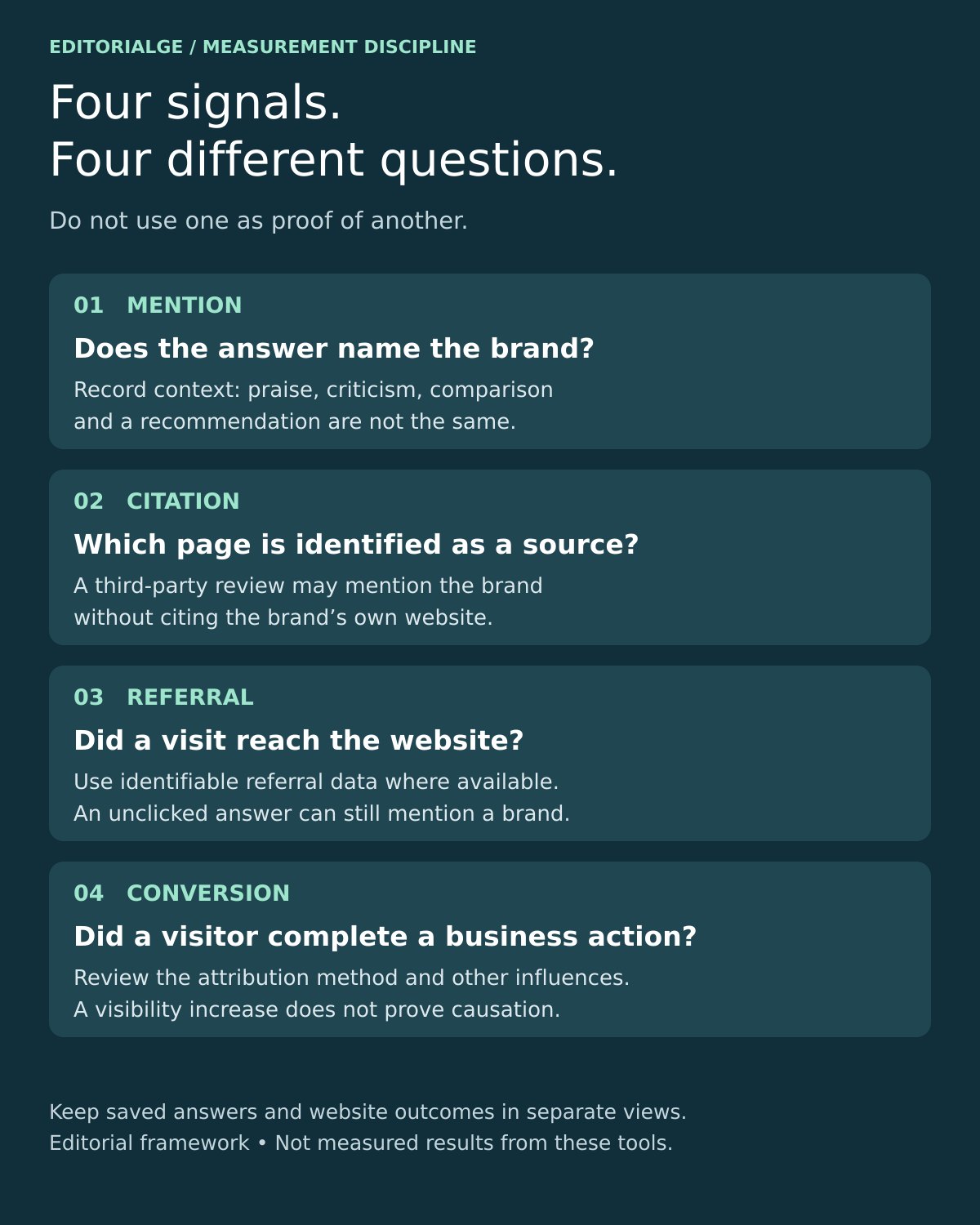
Keep citations and recommendations separate from mentions. An answer can name a business unfavorably, cite a third-party review, or recommend a competitor while mentioning the business only as a comparison. Preserve the answer text so a reviewer can distinguish those cases.
This is more than a reporting preference. Columbia’s Tow Center examined retrieval and citation behavior across eight AI search tools in its 2025 research on AI search and news sources. That study is not a test of the ten trackers here; it is a reason to inspect the underlying answer and source rather than treating a citation count as proof of accuracy.
A separate study published in Cambridge’s Data & Policy examines the gap between pages visited and sources cited by LLM search systems. For buyers, the implication is practical: a crawl, a cited page and a customer visit describe different events.
Will the allowance cover the workload?
Use the vendor’s billing unit. Under the check definition in Ahrefs’ custom-prompt documentation, an illustrative panel of 50 prompts, three engines, one location, and 30 daily runs requires 4,500 checks. This is a workload calculation, not a recommended universal sample size or a rule for every vendor.
Price the intended panel, users, projects, exports, retention, and integrations together. A low entry price is not the relevant comparison if the required reporting feature sits on another plan.
A Practical Pilot for a US Marketing Team
The following is an editorial evaluation template, not a test conducted for this article. Start with a manageable set of real buying questions from sales conversations, support requests, site search, and category research. Remove private customer details before submitting them to a service.
| Prompt group | Illustrative question | What to examine |
|---|---|---|
| Unbranded discovery | Which scheduling tools suit a 20-person US recruiting team? | Which brands are introduced without being named in the prompt? |
| Requirements | Which options support interview coordination across US time zones? | Are the described capabilities accurate? |
| Comparison | How does Brand A compare with Brand B for recruiting operations? | Which criteria and sources shape the comparison? |
| Commercial accuracy | What does Brand A include in its paid plan? | Are price, billing interval, and plan conditions represented correctly? |
| Alternatives | What alternatives to Brand A fit a smaller team? | Which competitors appear and why? |
Keep the core questions unchanged during the pilot and tag them by intent. Use a separate exploratory group for new questions so that expanding coverage does not silently rewrite the baseline.
Review collected answers, not just charts. Check brand aliases, citation URLs, failed runs, and the treatment of answers that do not use web search. Export a sample and see whether another colleague can reproduce the report’s interpretation from the evidence provided.
Then choose one supported action. If several answers repeat an obsolete price, correct the owned pricing information and identify outdated external sources. If important pages cannot be accessed, investigate that technical issue. Recheck the unchanged panel afterward, while recognizing that an improvement does not by itself prove the edit caused it.
Keep website outcomes in a separate view: identifiable referrals, engagement, and conversions answer different questions from mentions. For teams also measuring Google, Editorialge’s guide to AI-generated search overviews offers related background. For the wider software stack, see our comparison of SEO tools for agencies and bloggers. Keep the narrower ChatGPT panel separate from those broader SEO reports.