Have you watched solid content lose clicks the minute AI overviews appear in Google Search? This traffic shift is undeniable. Pew Research Center found that AI summaries drop traditional search result clicks from 15% down to just 8% per visit.
For ecommerce, product reviews, and lead-generation content, this plunge damages organic traffic and sales rapidly. Fortunately, adaptation is entirely possible. To survive this shift, marketers must Optimize For AI-Generated Search Overviews.
By leveraging advanced on-page SEO, robust structured data, deep content optimization, and flawless technical SEO, pages earn a better chance of being cited and trusted. Utilizing platforms like Search Console, Semrush One, Moz Pro, Market Brew, SE Ranking, and Google Analytics turns this search landscape into a clear advantage.
What Are AI-Generated Search Overviews?
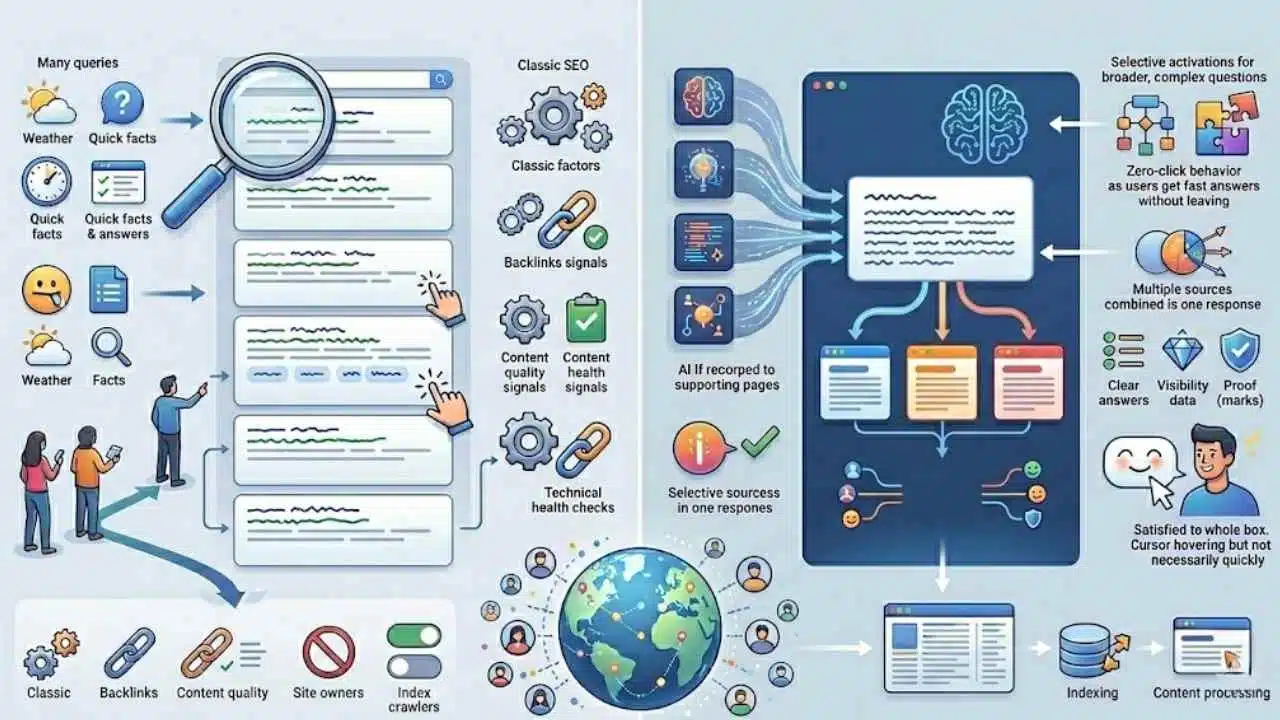
AI-generated search overviews are Google-built summaries that appear above or near standard search results when Google decides a synthesized answer will help more than a simple list of links. They are part of Google Search, not a separate chatbot.
If you followed the old Search Generative Experience tests, this is the public feature that grew out of that experiment. The format uses artificial intelligence to summarize information and then points readers to supporting pages.
Definition and purpose
Google brought AI Overviews to all U.S. users in May 2024, then expanded them in May 2025 to more than 200 countries and territories and more than 40 languages. Google also said the feature had scaled to about 1.5 billion monthly users, which makes it a major search surface, not a side project.
For site owners, the practical takeaway is simple: there is no secret opt-in. As of May 2026, Google Search Central says the same core SEO best practices still apply, your page must be indexed and eligible for snippets, and preview controls like noindex or snippet limits are still the way to manage how much of your content can appear.
How they differ from traditional search results
Here is the short version.
| Aspect | AI-Generated Search Overviews | Traditional Search Results |
|---|---|---|
| Presentation | A synthesized answer appears first, with supporting links pulled into one response. | A ranked list of pages appears, with titles, snippets, and other SERP features. |
| When they show | Google shows them selectively when a query seems to benefit from synthesis, especially for broader or more complex questions. | They appear for nearly every query. |
| Click behavior | They often increase zero-click searches because users get a fast answer without leaving the page. | They usually create a clearer path from impression to click. |
| Source selection | They can combine multiple supporting pages in one answer and surface a wider mix of sources. | Each result stands on its own ranking signals. |
| Optimization focus | Clear answers, strong structure, visible proof, and crawlable content matter a lot. | Classic ranking factors still matter, including relevance, links, and technical health. |
| Relation to AI Mode | AI Overviews are separate from AI Mode and are shown inside the main search results page. | Traditional results remain the baseline search experience. |
Why Are AI-Generated Search Overviews Important?
AI overviews change what a winning search result looks like. You still need rankings, but you also need brand visibility inside ai-generated answers that may satisfy the query before a click happens.
Impact on organic search traffic
Pew Research Center found that users who saw an AI summary clicked a traditional result in 8% of visits, compared with 15% when no summary appeared. It also found that just 1% of visits clicked a link inside the AI summary itself, which helps explain why traffic can drop even when search rankings look stable.
If you only track rankings, you can miss the real damage. AI overviews often change click behavior before they change your average position.
That does not mean every visit is weaker. Google has said clicks that come from search pages with AI Overviews tend to be higher quality, so you should watch conversions, revenue, time on site, and assisted actions in Google Analytics alongside clicks and impressions in Search Console.
Opportunities for visibility and engagement
Being cited still matters because it puts your brand in front of readers before they reach the blue links. Pew also found that Wikipedia, YouTube, and Reddit were the most frequently cited sources in the AI summaries it studied, and together they accounted for 15% of listed sources.
- Build pages that answer the main question fast, then deepen the answer with proof.
- Strengthen your presence beyond your blog, including video, reviews, community discussions, and expert mentions.
- Measure user engagement, not just raw clicks, because a smaller click total can still drive better leads.
- Track branded search lift after you earn citations, since visibility often shows up there before traffic fully recovers.
How Do AI-Generated Search Overviews Work?
AI overviews do not pull content at random. They depend on Google’s search systems, its models, and the quality of the pages those systems can actually crawl, render, and trust.
Role of machine learning models
Google says AI Overviews use a custom Gemini model that works with core ranking systems. In plain language, the model still needs strong search signals and relevant source pages before it can build a reliable answer.
Google also says AI Overviews and AI Mode may use query fan-out, which means the system runs related searches across subtopics to assemble a fuller response. That is why one thin page rarely wins, while a page that answers the main question, the next question, and the comparison question has a better chance to support the final summary.
Content extraction and summarization
Search systems cannot summarize what they cannot read well. Keep key facts in crawlable HTML text, use clear headings, and make sure important details are not trapped inside images full of text, blocked scripts, or hard-to-render elements.
- Put the direct answer near the top of each important section.
- Follow it with proof, examples, definitions, or product details.
- Make sure structured data matches the visible content on the page.
- Support strong text with useful images or video when they improve understanding.
Google’s current guidance also highlights shopping and local signals, so ecommerce teams should keep Merchant Center feeds, product listings, availability, and business details current. Clean inputs give Google a better shot at understanding your page correctly.
Strategies to Optimize for AI-Generated Search Overviews
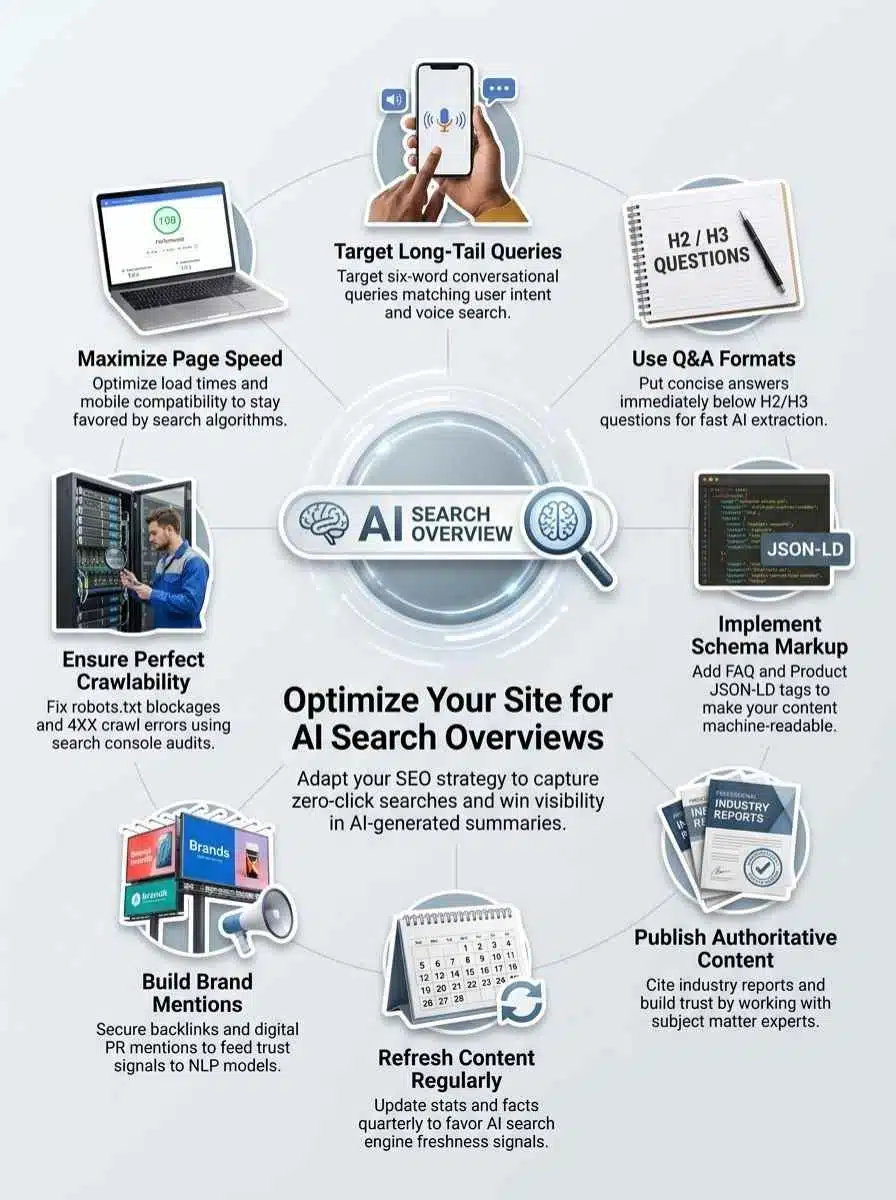
Some teams call this generative engine optimization. In practice, it still looks like disciplined SEO with clearer formatting, stronger evidence, and better alignment to search intent.
Target Long-Tail, Conversational Keywords
Google has said people use AI search for longer and more specific questions, and Semrush Sensor currently shows AI Overviews on about 12.95% of U.S. queries. That makes long-tail keyword research more valuable than ever, especially for ecommerce, software comparisons, and product reviews.
Start with the Queries report in Search Console, then use Google Trends to compare rising wording in the U.S. The Explore tool lets you compare up to five terms, spot regional language, and see whether a phrase is climbing before the SERP gets crowded.
- Prioritize questions with four or more words.
- Group close variants on one strong page instead of publishing several weak pages.
- Use natural question headings that match how readers actually search.
- Add a short, direct answer right under the heading.
Structure Content for Easy Extraction with Q&A Formats
Q&A formatting works because it is easy for people to scan, not because Google promises a special AI bonus for it. In May 2026, Google added fresh guidance aimed at common AEO and GEO myths, so treat Q&A as a clarity tool, not a loophole.
The pattern that works best is simple: ask the question a reader would type, answer it in one or two sentences, then expand with steps, examples, or comparisons. That same structure can help with featured snippets and better on-page SEO for users who want the quick version first.
- Turn major subtopics into plain-English questions.
- Lead with the answer before the explanation.
- Use short paragraphs and lists for steps or options.
- Define technical terms the first time you use them.
- Keep each answer focused on one intent at a time.
Use Schema Markup for Structured Data
This section needs a 2026 update because older advice here goes stale fast. Google Search Central says there is no special AI Overview schema and no extra technical requirement for AI features, but structured data still helps Google understand the page and qualify it for useful search features.
For ecommerce and review content, Product, Review, Article, Breadcrumb, and merchant-related markup are usually the most valuable because they spell out price, availability, ratings, brand, and page relationships in a machine-readable format. Just make sure every marked-up detail also appears in visible copy.
| Markup type | Best use | Why it helps |
|---|---|---|
| Product | Product pages and category leaders | Clarifies price, availability, brand, and specs for shopping-related queries. |
| Review | Product reviews and comparison pages | Adds clear review signals and makes your evidence easier to parse. |
| Article | Guides, explainers, and news-style content | Helps identify page type, headline, author, and publication details. |
| Breadcrumb | Sites with deep architecture | Improves context about where the page sits in the site. |
| Merchant data | Ecommerce stores | Supports cleaner shopping signals when prices, returns, and availability are current. |
One more timely detail matters here: Google documented the FAQ rich result deprecation starting May 7, 2026. So keep FAQ sections when they help readers, but do not build your entire AI overview strategy around FAQPage markup.
Create High-Quality, Authoritative Content
Google’s guidance on generative AI content is direct: using AI to mass-produce pages without added value can violate its scaled content abuse policy. If you use generative AI in your workflow, the winning move is still human review, original evidence, and tight editing.
- Add first-hand testing, screenshots, quotes, or data whenever you can.
- Name real tools, products, studies, or features instead of speaking in vague generalities.
- Show dates, prices, limitations, and trade-offs when they help a reader decide.
- Review every fact in metadata, alt text, headings, and body copy for accuracy.
In practice, content quality improves when your page includes details a model can reuse safely: pricing ranges, time frames, step counts, named tools, return windows, test results, or definitions. Vague advice gives AI very little to trust.
Regularly Update and Refresh Your Content
Freshness matters most on pages where facts change fast, such as pricing, product specs, policies, software features, and seasonal offers. Google also recommends keeping Merchant Center and Business Profile information up to date, which many teams forget while they focus only on blog copy.
Build a simple refresh calendar and start with pages that already affect revenue. A practical baseline is monthly checks for top ecommerce pages and quarterly checks for evergreen guides.
- Use Search Console to find pages losing impressions or clicks.
- Use Google Analytics to see whether the traffic loss is also cutting conversions.
- Use Semrush One or SE Ranking to monitor AI visibility and prompt-level trends.
- Use Moz Pro for ranking, page optimization, and competitive SEO checks.
- Use Market Brew when you need a model-based view of structural issues behind weak visibility.
- Log every update date, fact change, and markup fix so the team can see what moved results.
Leveraging Third-Party Mentions for Better AI Optimization
Your site should stay the source of truth, but AI overviews also reward brands that are confirmed elsewhere on the web. Backlinks, reviews, interviews, and mentions help reinforce that your business is real, relevant, and worth citing.
Build backlinks and increase brand mentions
Do not chase random backlinks. Focus on mentions that strengthen expertise and brand visibility, such as trade publications, associations, podcasts, original data studies, product review roundups, and useful video explainers.
Because Pew found YouTube and Reddit among the most cited sources in AI summaries, your visibility plan should extend beyond standard content marketing. A concise demo video, a well-researched community answer, or a quoted expert comment can widen your citation footprint.
| Mention type | What to create | Why it helps |
|---|---|---|
| Editorial backlinks | Original data, expert commentary, or unique research | Improves authority signals and gives AI more third-party confirmation. |
| Video mentions | Demos, tutorials, comparisons | Strengthens visibility on a source type that appears often in AI summaries. |
| Community mentions | Useful answers in relevant forums or communities | Shows real-world discussion around your brand and products. |
| Review coverage | Independent reviews and list features | Helps product reviews and commercial pages look more established. |
Monitor AI search platforms for your brand presence
Run a monthly prompt set across Google AI Overviews, AI Mode, ChatGPT, Gemini, and Microsoft Copilot. You want to see whether your brand appears, how it is described, and which competitors or publishers show up more often than you do.
- Ask the top questions real customers ask before buying.
- Ask comparison questions that mention your competitors.
- Ask region-specific questions for the U.S. market you serve.
- Track whether the answer cites your site, mentions your brand, or ignores you.
Then compare what you learn with Search Console and Google Analytics. If a page ranks but is never cited, it usually needs a clearer answer block, better proof, or stronger third-party signals.
Technical SEO Best Practices for AI Optimization
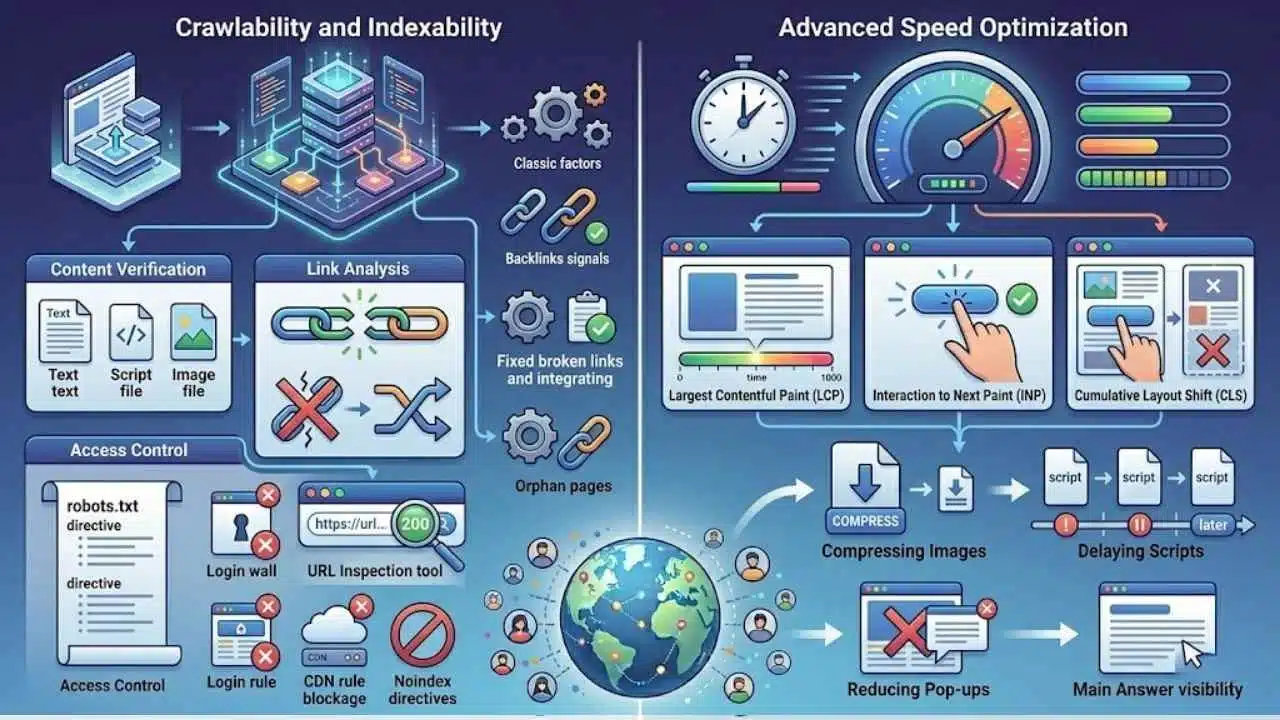
Technical SEO still does the heavy lifting. If Google cannot crawl, render, index, or safely preview the page, the page cannot support an AI Overview no matter how helpful the writing is.
Ensure your site is crawlable and indexable
As of May 2026, Google says pages must meet the normal technical requirements for Search to be eligible for AI features. That means a successful HTTP 200 response, indexable content, snippet eligibility, and no accidental blocks on Googlebot from robots directives, login walls, or CDN rules.
- Check that important pages are not blocked from crawling.
- Make sure key content exists in text, not only in scripts or images.
- Fix broken internal links, redirect chains, and orphan pages.
- Review noindex, canonical, and preview controls after template changes.
Use URL Inspection in Search Console after every major page update. It is the fastest way to see the HTML Googlebot actually received and catch missing content before it costs you impressions.
Optimize for fast page load speeds
Page speed matters because slow pages hurt user experience right when AI overviews send a qualified visitor. PageSpeed Insights is useful here because it combines lab testing with real-world performance data and points to the scripts, images, and layout shifts dragging a page down.
| Metric | Good target | Why it matters |
|---|---|---|
| Largest Contentful Paint | 2.5 seconds or less | Shows how quickly the main content becomes visible. |
| Interaction to Next Paint | 200 milliseconds or less | Measures how responsive the page feels after a click or tap. |
| Cumulative Layout Shift | 0.1 or less | Tracks whether content jumps around while the page loads. |
Start with mobile versions of your top landing pages. Compress heavy images, delay nonessential scripts, reduce pop-up and ad shifts, and make sure the main answer appears quickly without extra friction.
The Future of SEO with AI Overviews
SEO is shifting from ranking alone to answer visibility, brand recall, and conversion quality. That may feel new, but the sites that win are still the ones that make information easy to trust and easy to reuse.
Shifting trends in search behavior
Google has said AI Overviews are driving more than 10% growth in the kinds of queries that show them in large markets like the U.S. and India. Semrush also found that the trigger mix changed fast, with informational queries falling from 89.03% of AI Overview keywords in October 2024 to 57.16% in October 2025.
That shift matters for ecommerce, local services, and product reviews. AI overviews are showing up closer to comparison, planning, and shopping intent, so content built only for top-of-funnel traffic is less protected than it used to be.
Preparing for multimodal and voice search integration
Google’s latest AI search guidance puts more weight on multimodal content, which means your text should work together with helpful images, charts, video, and accurate product or local data. If a customer asks a spoken question, uploads a photo, or compares options on a phone, your page should still answer clearly.
- Add descriptive alt text and captions where they genuinely improve understanding.
- Keep specs, return policies, and store details consistent across your site and feeds.
- Write short answer blocks that also make sense when read aloud.
- Test key pages on mobile first, since many AI-assisted searches begin there.
The future of SEO with ai overviews is less about gaming one box and more about building a brand that Google can verify from several angles. That work is steadier, but it lasts longer.
Final Thoughts
AI overviews are changing click patterns, but they have not replaced strong SEO. Clear answers, accurate structured data, solid technical SEO, and trustworthy third-party mentions still give you the best path to visibility. Start with the pages that already matter most to revenue.
Fix crawl issues, rewrite answer blocks, refresh product facts, and measure conversions in Search Console and Google Analytics. That steady process is how you earn better user engagement, stronger brand visibility, and more resilient organic traffic in a search results page shaped by generative AI.
Frequently Asked Questions (FAQs) About Optimizing for AI-Generated Search Overviews
1. What are AI-generated search overviews?
AI-generated search overviews are short, machine-made summaries that show in search engine results, they pull key lines from web pages to answer user questions.
2. How do I optimize for AI-generated search overviews?
Answer common questions in plain words, put the answer right under a clear heading. Use keyword research and give up to date information, keep lists and short paragraphs that large language models can read fast.
3. How do large language models pick content for search overviews?
They favor direct answers, clear structure, and trusted sources, they match the user query to text that looks like a quick reply.
4. What quick steps keep my content visible to AI-generated search overviews?
Update pages often, fix mistakes fast, and watch which pages get shown. Use clear headings, simple lists, and structured data, let humans check tone and facts so the content reads well.