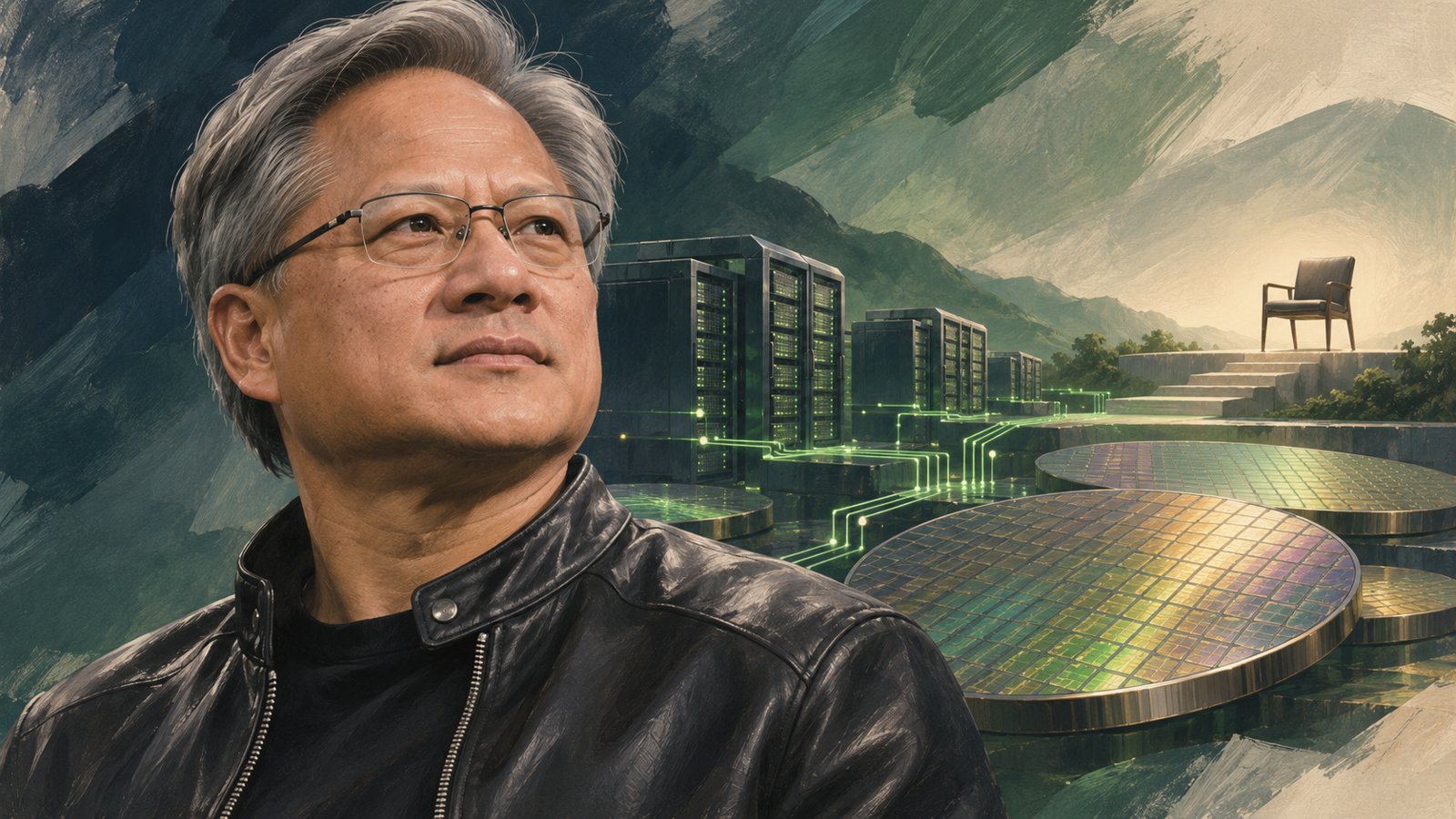
Nvidia now faces a question that Jensen Huang’s success made easy to postpone: how much of the institution can stand independently of the man who became its public identity? The company announced his departure on November 12, 2026. Its SEC filing records that his resignation as president, chief executive, and director took effect the previous day. Colette Kress became interim CEO, while Harvey C. Jones was appointed board chair.
The leadership change gives the question of Huang’s legacy immediate commercial importance. Customers need continuity. Employees need direction. The board must demonstrate that oversight and strategic ambition can coexist.
Huang deserves to be examined as both a visionary and a kingmaker, provided the second description is used carefully. His contribution was to help build a computing platform around which other businesses could develop. That achievement gave Nvidia influence over their choices. It also created responsibilities that cannot be answered by pointing to the company’s growth.
The connecting argument is simple: technological foresight can create a platform; a successful platform can create dependence; dependence makes governance a public concern as well as a corporate one. Huang’s departure now tests whether the organization he helped build can manage all three.
For a customer waiting to bring an AI service online, this is not an abstract debate about a famous founder. It can affect a delivery deadline, a technical roadmap or a conversation with the finance team about another expensive infrastructure commitment. For an engineer, the immediate concern is simpler: will the tools, support and people needed to finish the job still be there?
That is the human scale of Nvidia’s transition. The headlines concern one executive. The consequences will be experienced through thousands of smaller decisions made by people who have built part of their working lives around the company’s technology.
The Vision Behind Nvidia Was Larger Than a Chip
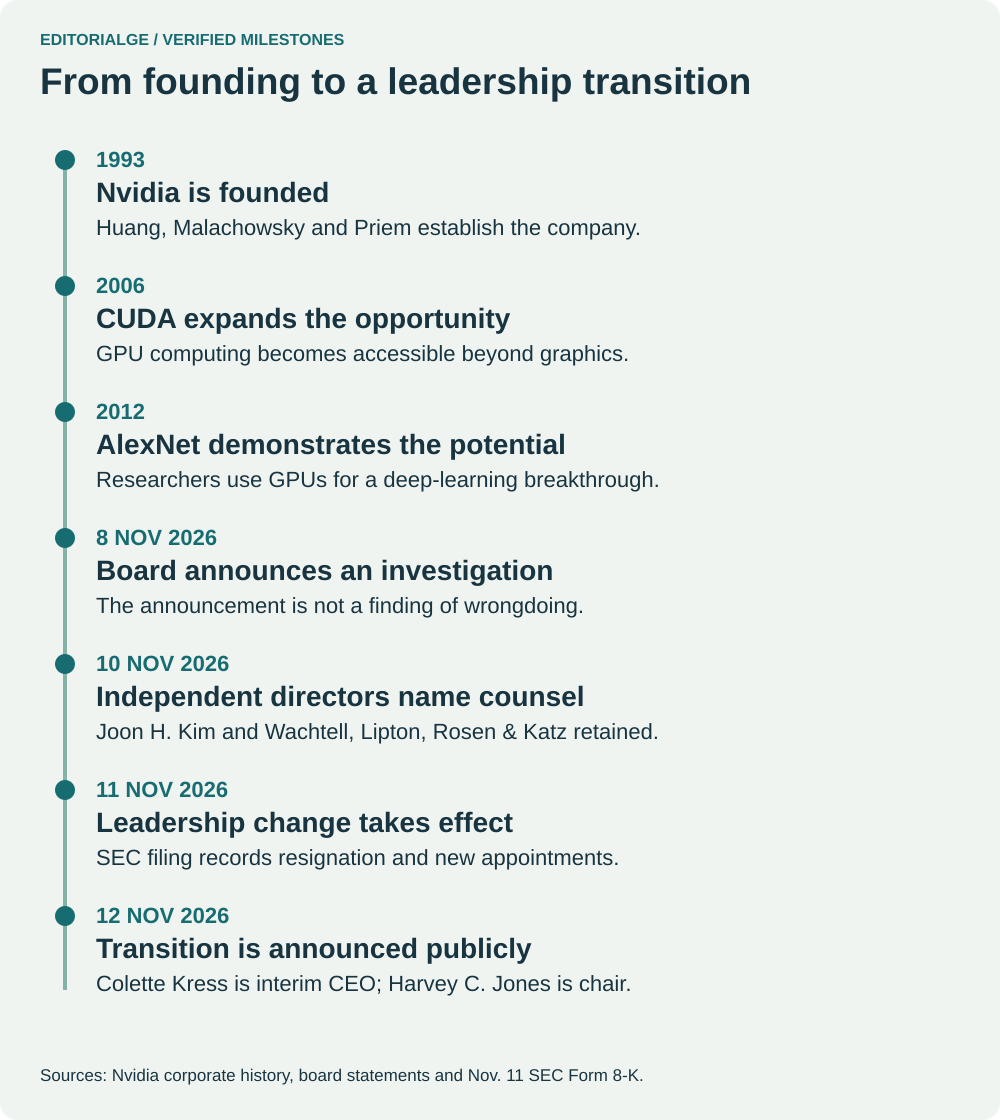
Nvidia’s corporate history records its founding in 1993 by Huang, Chris Malachowsky, and Curtis Priem. Remembering the other founders matters. A company of this scale is a collective achievement, even when one person becomes its most recognizable representative.
The strategic milestone most useful for understanding Huang’s influence came later. Nvidia introduced CUDA in 2006, extending the use of its graphics processors to computing tasks beyond graphics. CUDA provided a programming platform through which developers could apply GPU processing to other workloads.
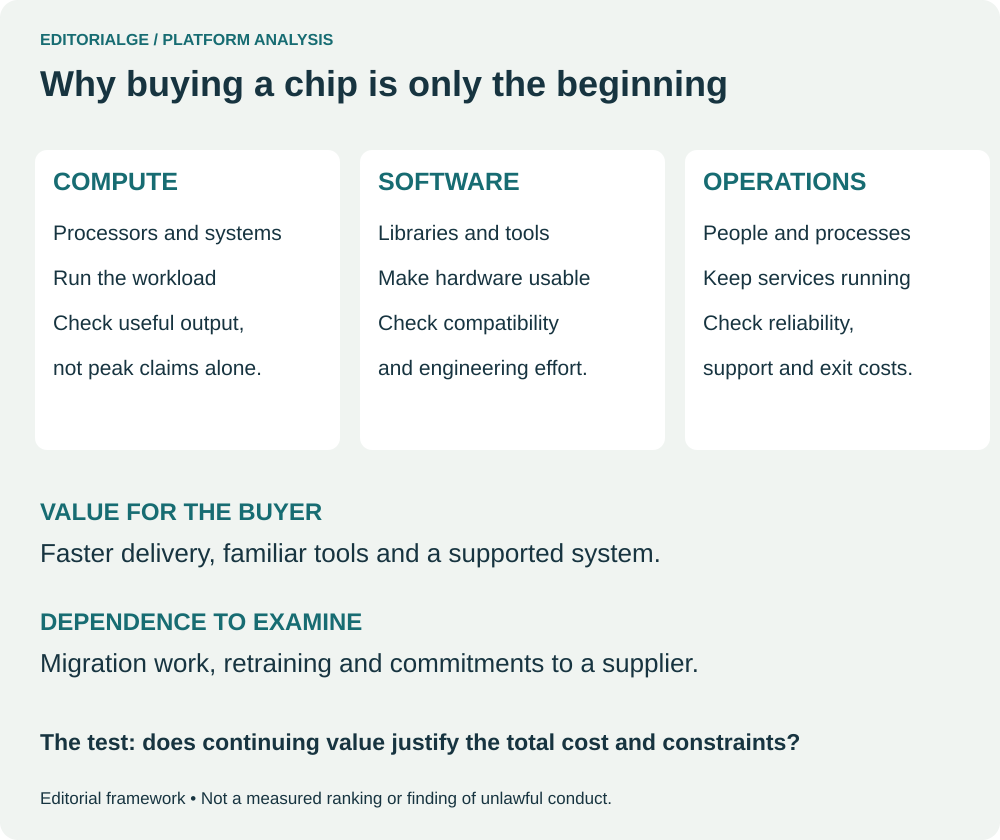
The distinction matters because a capable processor is only part of a useful computing system. Researchers and engineers also need software, libraries, documentation, and a workable route from an idea to a running application. Hardware potential has limited commercial value if too few people can use it productively.
Nvidia’s CUDA documentation describes specialized libraries that spare developers from repeatedly implementing familiar operations. This helps explain the strategic value of the software investment: making a processor easier to use can expand the range of problems for which customers consider buying it.
Huang’s strongest claim to vision lies in that relationship between hardware and adoption. It is more persuasive than the suggestion that he somehow anticipated every detail of the generative AI market. A durable strategy can prepare a company to benefit from developments whose exact form remains uncertain.
In 2012, Alex Krizhevsky, Ilya Sutskever, and Geoffrey Hinton’s AlexNet work demonstrated the significance of GPU-accelerated deep learning for image classification. Their research paper describes an efficient GPU implementation and a substantial advance over previous results. Nvidia’s historical account identifies AlexNet as a pivotal application of its technology.
The researchers supplied the scientific breakthrough. Nvidia supplied enabling technology. Keeping those contributions distinct makes the achievement more intelligible. Huang did not need to invent modern AI to recognize an opportunity to build infrastructure that AI researchers would find valuable.
Why CUDA Made the Hardware More Valuable
Imagine a research team with a promising idea and limited time. A faster processor helps, but the team also needs to make its software work, identify errors and reproduce results. If the tools are unfamiliar, some of the theoretical speed advantage can disappear into development work. This is a hypothetical example, but it illustrates the commercial importance of usability.
CUDA gave Nvidia a way to compete for developers as well as hardware buyers. Once useful software exists for a platform, the next team has less work to do from scratch. An organization may choose the familiar environment because it reduces delivery risk, even while recognizing that another processor could be competitive on a specific task.
This is where Huang’s strategic contribution becomes easier to understand. The valuable decision was to support an environment in which other people could do useful work. The platform’s success depended on those people: researchers who developed new methods, engineers who made systems reliable, and customers willing to invest before every commercial outcome was clear.
None of this makes CUDA an automatic explanation for every Nvidia sale. Availability, pricing, system design and workload requirements also matter. It does explain why an analysis focused only on silicon can miss a large part of the buying decision.
How a Useful Platform Acquires Power
The transition from visionary to kingmaker begins when other organizations start planning around the platform.
Consider a hypothetical startup building an AI service. Its hardware choice affects the software it uses, the engineers it recruits, its deployment schedule, and the cost of serving customers. A familiar platform may reduce development uncertainty. Moving to an alternative may require changes that are worthwhile in the long run but inconvenient before an approaching launch.
That does not establish that customers are trapped or that alternatives are inferior. It explains why competition is broader than comparing two chips on a benchmark. Buyers also evaluate the time and organizational effort needed to make a competing system useful.
Nvidia’s influence is therefore partly cumulative. Work already invested in an ecosystem can make the next investment in that ecosystem easier to justify. Useful integration can strengthen a supplier’s position without requiring a secret agreement or an explicit instruction to exclude rivals.
This is the defensible meaning of “kingmaker”: a supplier whose platform can materially affect the conditions under which other companies compete. It is not evidence that Huang personally selected every winner, that Nvidia controlled every purchase, or that its success proves unlawful conduct.
The label should describe influence, not replace an investigation into how that influence operates.
Scale Makes the Question Harder to Ignore
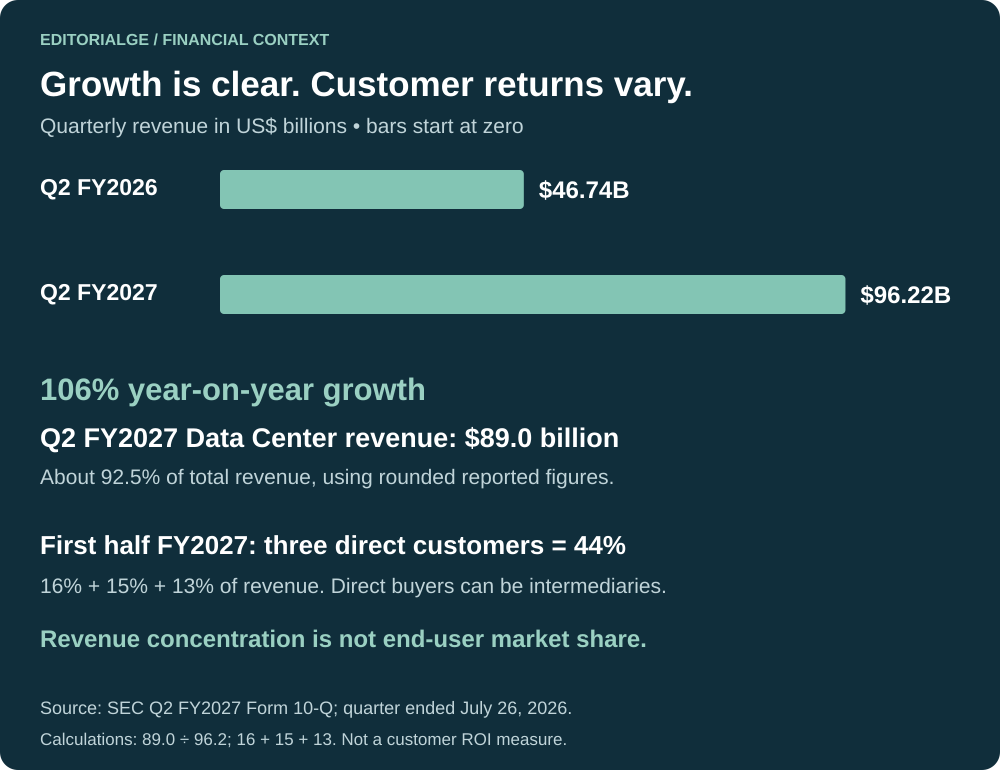
Nvidia reported $96.2 billion in revenue for the quarter ended July 26, 2026, up 106% from a year earlier. Those figures appear in its second-quarter fiscal 2027 filing. They measure the scale of its business, not its share of every AI market or the profitability of every customer project.
In the accompanying earnings announcement, Huang argued that AI was doing economically useful work and that demand was accelerating. That was the assessment of a chief executive whose company sold the infrastructure. It deserves consideration alongside evidence from the businesses paying for it.
The distinction between supplier revenue and customer return is important. A hardware purchase is revenue for the seller when recognized under the relevant accounting rules. For the buyer, the financial outcome depends on what the equipment eventually enables, its utilization, its operating costs, and demand for the resulting service.
A successful infrastructure supplier can coexist with uneven customer outcomes. Equally, a disappointing application does not prove that the infrastructure behind it lacks value. The editorial task is to keep those levels of analysis separate.
The broader question of access also extends beyond Nvidia. Editorialge’s discussion of the compute gap facing open AI projects considers why computing resources can shape who gets to experiment at scale. Huang’s influence belongs in that wider setting: access to technology affects opportunity, but hardware alone does not determine the quality of an idea or the success of a business.
What the Revenue Numbers Do—and Do Not—Tell Us
The same quarterly filing reports data center revenue of $89.0 billion. Against rounded total revenue of $96.2 billion, that is approximately 92.5%. The calculation shows how strongly the business depends on data-center demand; it does not identify Nvidia’s share of the entire AI economy.
The customer concentration figures need equal care. Adding the three disclosed first-half percentages gives 44%. That is a concentration measure for direct customers over six months. It should not be presented as three named AI laboratories buying 44% of Nvidia’s chips, or as the concentration for the second quarter alone.
For a buyer, the question is whether the next unit of computing produces enough useful output to justify its full cost. For Nvidia, the question is whether demand supports continued investment and reliable delivery. The two interests overlap, but they are not identical. A healthy market needs both a capable supplier and customers who can make the economics work.
The Kingmaker Had Dependencies of His Own
Treating Huang as all-powerful would misunderstand the business he led.
Nvidia’s fiscal 2026 annual report describes a manufacturing model that relies on outside suppliers. It names TSMC and Samsung among its wafer foundries and identifies dependencies across memory, packaging, and assembly. The filing also flags energy, data-center capacity, capital availability, and export restrictions as factors affecting its business.
Those disclosures establish limits to managerial command. A product roadmap cannot by itself supply every resource required to deploy a working system. The ability to design an important component is different from the ability to control the entire chain around it.
Demand creates another constraint. For the first half of fiscal 2027, Nvidia reported that three direct customers represented 16%, 15%, and 13% of total revenue. Direct customers can include intermediaries, so these percentages should not be casually assigned to particular AI laboratories or treated as final-user market shares.
The practical implication is mutual dependence. A strategically important supplier can have substantial influence while remaining exposed to the decisions of major buyers. Calling it a kingmaker should not obscure the bargaining power elsewhere in the system.
There are also alternative technical paths. A 2026 Google Research publication describes five generations of its tensor processing units, from TPU v2 to Ironwood. That establishes an existing accelerator program beyond Nvidia’s architecture. It does not prove that those processors are interchangeable with Nvidia products for every customer or workload.
Competition need not reproduce Nvidia’s whole platform to become consequential. A rival could matter by serving a valuable category of work well enough to change a buyer’s next decision. Conversely, the existence of another chip is not proof that switching is economical.
The evidence to watch is deployment: useful work completed, total cost, reliability, and the effort required to operate the alternative.
Accountability Is Now an Immediate Test
The governance question is no longer merely theoretical.
On November 8, Nvidia’s board announced an independent investigation following reports that Huang had been targeted by a foreign intelligence effort. The board said independent directors, assisted by outside counsel, would oversee it. It also said it had no reason to believe national security or Nvidia secrets had been compromised.
That statement establishes the announced review and the board’s position at that time. It does not establish that a security breach occurred. The subsequent resignation is a separate verified event; the sequence alone does not prove a particular allegation or supply the inquiry’s findings.
Editorialge’s earlier explanation of the board inquiry provides background to the November 8 announcement. The leadership developments described here occurred afterward.
The relevant standard is neither automatic exoneration because Huang built a successful company nor automatic guilt because he left it. Oversight should establish facts, distinguish different claims, and explain decisions to the extent appropriate. Commercial achievement cannot settle an evidentiary question.
The same principle applies to the organization. A celebrated founder should not become the sole basis on which customers, directors, or employees assess institutional reliability. Strong governance must function when confidence in a particular individual is under pressure.
The Investigation Is a Process, Not a Verdict
There is a further dated development worth recording. On November 10, Nvidia’s independent directors said they had retained former acting U.S. Attorney Joon H. Kim and Wachtell, Lipton, Rosen & Katz to conduct the investigation. Naming outside counsel identifies who was appointed to investigate; it does not tell readers what the investigation will conclude.
The Associated Press’s November 8 report also covered the board’s decision to investigate and its statement that it had no reason to believe national security or company secrets had been compromised. That position was dated and provisional. It should not be rewritten as a completed independent finding.
Readers should keep three records separate: what has been alleged, what a company has said in response, and what an investigation has actually established. A leadership change can be commercially significant before all the underlying questions are resolved. Reporting can acknowledge that significance without filling the gaps with speculation.
What Nvidia Owes the Businesses Built Around It
Accountability also concerns the ordinary operation of a consequential platform.
Customers need clear information about product availability, support, compatibility, and the assumptions behind performance claims. An impressive demonstration is not a substitute for knowing whether a system suits a particular workload. The more ambitious the investment, the more important those distinctions become.
For the board, a useful question is whether decision-making remains effective when a founder is absent. Are responsibilities sufficiently distributed? Can experienced teams challenge assumptions? Does the organization retain the knowledge needed to explain and execute its strategy?
For customers, the corresponding question is whether reliance on Nvidia reflects continuing value or the accumulated difficulty of moving. Both can exist together. Buyers should be able to understand the balance well enough to make an informed choice.
These are proposed standards for judging stewardship, not claims that Nvidia has failed each one. They also do not require the company to surrender the benefits of its engineering. They require a distinction between earning customer preference and assuming that preference need never be tested again.
There is a legitimate counterargument: customers benefit when one supplier takes responsibility for integrating a complex system. Requiring every component to be independently interchangeable can impose costs of its own. Integration can be a service, not merely a source of dependence.
The appropriate test is the customer’s result. Does integration improve useful performance, reliability, or time to deployment enough to justify its cost and constraints? That question is more informative than treating either openness or integration as an automatic virtue.
Five Questions Customers Should Ask Now
A leadership transition is a reason to examine dependencies, not an automatic reason to abandon a working system. For businesses planning a deployment, the following questions turn a broad concern into a manageable review.
1. Which Commitments Are Documented?
Confirm delivery dates, support responsibilities and the scope of any service commitments with the relevant supplier or cloud provider. A public statement about continuity is useful context, but a customer still needs clarity about its own project. Distinguish a contractual commitment from a roadmap expectation.
2. What Does Useful Computing Actually Cost?
Compare the cost of completing the real workload, including the surrounding infrastructure and engineering effort. A system that looks cheaper to rent may require more work to operate. A system with higher headline performance may offer little benefit if the application cannot use that capacity effectively.
3. How Portable Is the Work?
Identify which parts of the application depend on particular libraries, deployment tools or hardware features. Portability is rarely an all-or-nothing property. A team may be able to move one service or workload while keeping another on the platform that currently serves it best.
4. Can an Alternative Be Tested Fairly?
Use the same task, quality target and operating constraints. Include migration effort and reliability in the comparison. A demonstration can establish feasibility; sustained operation is needed to judge whether the alternative fits the business. This is a proposed evaluation method, not a claim that any specific competitor has passed it.
5. Who Owns the Contingency Plan?
Name the person responsible for responding to a delay, a change in support or an unexpected cost increase. A modest plan that identifies essential workloads and acceptable fallbacks can be more useful than a sweeping promise to become independent of every supplier.
The Founder’s Legacy Is Also a Succession Question
Nvidia’s transition announcement said the board expected operations, customer commitments, and the product roadmap to continue without interruption. That is a statement of expectation, not a completed test of continuity.
Kress’s immediate task is to demonstrate that the company’s capability is embedded in its teams and processes. The board’s longer-term task is to select leadership able to maintain technical ambition while exercising independent judgment about the strategy it inherits.
Those objectives can pull in different directions. Customers may welcome reassurance about continuity while also expecting management to respond when circumstances change. A successor who merely repeats a founder’s language offers less assurance than one who can explain the reasoning behind the choices.
Huang’s departure does not remove the software developers, engineers, customer relationships, or accumulated work inside Nvidia. It does remove him from the executive and board roles identified in the filing. How well the organization responds will help distinguish personal influence from institutional strength.
This is why a simple rise-and-fall narrative would be premature. A leadership exit is consequential. The future performance of the company, the outcome of a separate inquiry, and the historical value of its technical strategy remain distinct questions.
The First Test Is Institutional, Not Theatrical
Kress is not arriving as an outsider unfamiliar with Nvidia’s finances: the SEC filing records that she has been its chief financial officer since 2013 and will retain that role while serving as interim CEO. That experience provides continuity. It does not remove the need for clear technical leadership or independent board judgment.
The important signals may be less dramatic than a keynote speech: whether customers receive consistent answers, whether engineering decisions remain coherent, and whether managers can raise concerns without waiting for one individual to resolve everything. Those are proposed indicators of institutional strength, not observations from inside Nvidia.
The transition should also challenge the way the industry tells stories about success. A founder can deserve substantial credit without becoming the explanation for every achievement. Recognizing the wider organization gives a more realistic basis for assessing what survives a change at the top.
Three Tests for What Comes Next
The three angles converge in a practical set of tests.
The vision test is whether Nvidia continues to solve important computing problems for customers. Relevant evidence includes delivered products and useful improvements under clearly stated conditions, rather than promises alone.
The power test is whether customers retain credible choices. That requires examining alternatives on real workloads and understanding the costs of changing platforms. Neither a competitor’s launch announcement nor Nvidia’s sales growth answers the question by itself.
The accountability test is whether governance works independently of reputation. Evidence would include the handling of the board inquiry, clarity during the leadership transition, and disciplined explanations of consequential decisions. An unresolved allegation should remain unresolved in the reporting until evidence changes its status.
These tests allow Huang’s contribution to be taken seriously without making him indispensable by definition. They also allow Nvidia’s market influence to be scrutinized without treating commercial success as an offense.
Huang was a visionary in helping turn a computing opportunity into a platform others could use. He became a kingmaker in the narrower sense that the platform helped shape other businesses’ options. The responsibility that followed belongs both to the leader who built that influence and to the institution now carrying it forward.
Nvidia’s next chapter will help answer the hardest question in the title: whether the man behind the company built something strong enough to be judged, governed, and led beyond him.
Disclosure: This research-based analysis was prepared with AI assistance using public filings, technical research, and company statements reviewed on November 16, 2026. It does not report original interviews or hands-on product testing.