History is rarely a straight line; instead, it is an intricate tapestry woven from sudden breakthroughs, devastating tragedies, quiet cultural awakenings, and the birth of individuals who forever alter how humanity perceives the world. Across the centuries, November 18 has stood out as a remarkably eventful date. From the thunderous roar of the North Sea floods in the medieval era to the precise synchronization of global time zones, from the magical cinematic debut of a certain iconic cartoon mouse to the profound literary warnings of dystopian futures, November 18 commands our attention.
In this comprehensive, deep-dive historical archive, we explore the multifaceted events, international observances, monumental birthdays, somber deaths, and fascinating trivia that define November 18 across the globe and within the rich cultural architecture of the Bangalee sphere.
At-A-Glance: November 18 Snapshot
| Category | Key Highlight / Milestone |
|---|---|
| Major Global Milestone | North American and Canadian railways adopted standard continental time zones (1883). |
| Pop Culture Breakthrough | Walt Disney’s Steamboat Willie premiered, introducing synchronized sound and Mickey Mouse (1928). |
| National Independence Days | Latvia (Proclamation Day, 1918) & Morocco (Independence Day, 1956). |
| Architectural Marvels | Pope Urban VIII formally consecrated the newly rebuilt St. Peter’s Basilica in Vatican City (1626). |
| Notable Births | Louis Daguerre, W.S. Gilbert, Margaret Atwood, Alan Moore, Kirk Hammett. |
| Notable Deaths | U.S. President Chester A. Arthur, novelist Marcel Proust, physicist Niels Bohr. |
International Observances & National Holidays
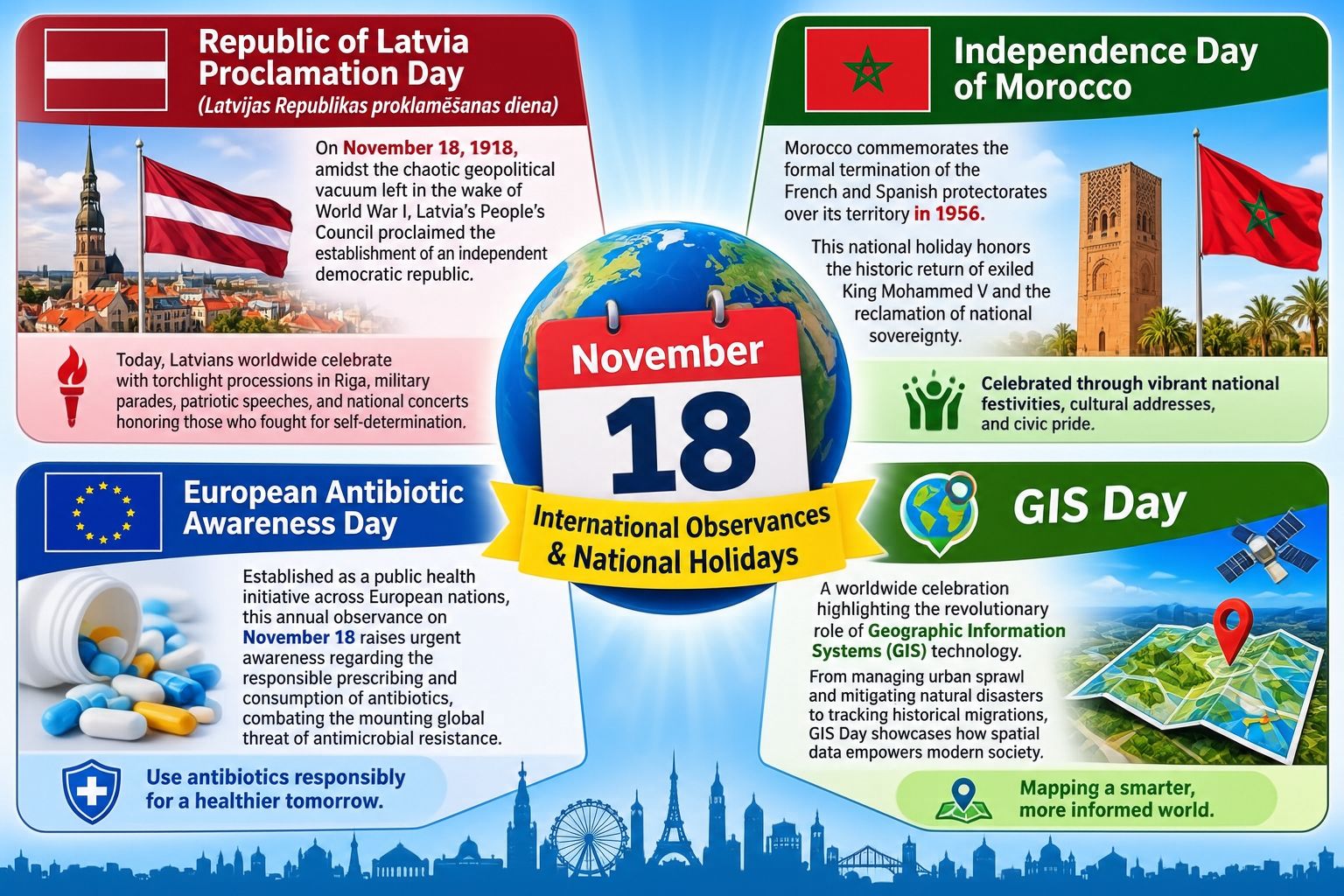
November 18 hosts a variety of deeply significant national holidays, geopolitical commemorations, and international awareness days that reflect sovereignty, public health, and modern technological integration.
-
Republic of Latvia Proclamation Day (Latvijas Republikas proklamēšanas diena): On November 18, 1918, amidst the chaotic geopolitical vacuum left in the wake of World War I and the collapsing Russian Empire, Latvia’s People’s Council officially proclaimed the establishment of an independent democratic republic. Today, Latvians worldwide celebrate this momentous date with grand torchlight processions in Riga, military parades, patriotic speeches, and national concerts honoring those who fought for self-determination.
-
Independence Day of Morocco: Morocco commemorates the formal termination of the French and Spanish protectorates over its territory in 1956. This national holiday honors the historic return of exiled King Mohammed V and the reclamation of national sovereignty, celebrated through vibrant national festivities, cultural addresses, and civic pride.
-
European Antibiotic Awareness Day: Established as a public health initiative across European nations, this annual observance on November 18 raises urgent awareness regarding the responsible prescribing and consumption of antibiotics, combating the mounting global threat of antimicrobial resistance.
-
GIS Day: A worldwide celebration highlighting the revolutionary role of Geographic Information Systems (GIS) technology. From managing urban sprawl and mitigating natural disasters to tracking historical migrations, GIS Day showcases how spatial data empowers modern society.
The Bangalee Sphere
While global calendars record numerous political milestones on this date, the Bangalee sphere holds a profound connection to November 18 through wartime defense, socio-political forums, and regional literature.
Historical Events & Regional Footprints
-
1971 (The Bangladesh Liberation War): As the Liberation War approached its decisive final weeks, the diplomatic and military pressure on the occupying Pakistani military junta intensified. On November 18, 1971, the Yahya Khan regime officially stripped diplomatic recognition and credentials from prominent Bengali diplomats stationed abroad who had publicly defected to swear allegiance to the burgeoning sovereign government of Bangladesh. Figures such as K.K. Panni in the Philippines and Humayun Rashid Chowdhury in India became prominent symbols of international diplomatic resistance. Concurrently, on the home front, fierce guerrilla engagements by the Muktibahini and local freedom fighters disrupted supply lines across Rajshahi and Kushtia.
-
2011 (Civil Society Conclaves): Dhaka played host to the historic South Asian Social Forum 2011, bringing together grassroots activists, environmentalists, labor unions, and intellectuals from across India, Bangladesh, Pakistan, Nepal, and Sri Lanka to debate regional economic justice, climate resilience, and human rights.
Cultural & Seasonal Resonance
-
The Transition to Hemanta Ritu: In the traditional Bengali calendar, mid-November corresponds to Hemanta (late autumn), a season celebrated across Bengali literature, poetry, and folk music. Marking the gentle cooling of the tropical weather, the morning dew (shishir) on green paddy fields signals the harvesting of Aman rice—an agricultural heartbeat deeply embedded in rural Bengal’s cultural identity.
Global History: Region-by-Region Breakdown
To truly understand November 18, one must travel across continents to examine how different nations experienced this singular date through politics, technology, and social upheaval.
United States: Time Zones, Literature, and Telephony
-
1865 (Literary Launch): American humorist and author Samuel Clemens—writing under his immortal pen name Mark Twain—published his breakout short story, “The Celebrated Jumping Frog of Calaveras County,” in the New York Saturday Press. The piece catapulted him to national literary fame.
-
1883 (The Day of Two Noons): North American history experienced a radical shift when major railway companies in the United States and Canada officially implemented continental standard time zones (Eastern, Central, Mountain, and Pacific). Prior to this, every town operated on its own local solar time, creating absolute chaos for train schedules and commerce.
-
1963: Bell System introduced the commercial push-button telephone (utilizing the innovative 10-button Touch-Tone system) to the public in Pennsylvania, rendering rotary dials obsolete and accelerating modern telecommunications.
Russia: Imperial Collapse and New Horizons
-
1918: As the Russian Empire fractured under the weight of revolution and the Great War, the Bolshevik leadership watched as the Baltic territories decisively slipped away. November 18 marked Latvia’s formal declaration of independence, effectively severing centuries of Tsarist, Swedish, and German geopolitical domination.
United Kingdom: The End of the Somme and Urban Tragedies
-
1916 (Conclusion of the Battle of the Somme): After more than four months of relentless, mechanized slaughter in the muddy trenches of the Western Front, British and French commanders officially brought the disastrous Somme Offensive to a close. The battle left over a million casualties, becoming an eternal symbol of the brutal industrialization of warfare.
-
1987 (King’s Cross Fire): A tragic underground fire broke out at the King’s Cross St Pancras tube station in London, claiming 31 lives and prompting sweeping overhauls of fire safety regulations across the United Kingdom’s underground transit networks.
Europe & The Vatican: Sacred Splendor and Ancient Floods
-
1421 (The St. Elizabeth Flood): A catastrophic North Sea storm battered the coastline of the Low Countries, shattering dikes and inundating villages in what is now the Netherlands. Estimated to have claimed up to 10,000 lives, it remains one of the deadliest natural disasters in European maritime history.
-
1626 (Consecration of St. Peter’s Basilica): In Rome, Pope Urban VIII solemnly consecrated the newly rebuilt St. Peter’s Basilica. Spanning over a century of construction and incorporating the genius of legendary artists like Bramante, Michelangelo, and Carlo Maderno, the cathedral stood as the pinnacle of Renaissance architecture.
Canada & Australia: Administrative and Legislative Growth
-
1883: Alongside its American neighbors, Canada adopted standard railway time zones, ensuring unified transcontinental scheduling across vast distances. Throughout Australian and Canadian parliamentary history, mid-November sessions have traditionally served as crucial legislative windows for passing annual budgets and resource-management acts.
Rest of the World: Exploration and Tragic Cults
-
1493: During his second voyage across the Atlantic, Christopher Columbus sighted the Caribbean island known to its indigenous Taíno inhabitants as Borikén, which he claimed for Spain and named San Juan Bautista (now Puerto Rico).
-
1978 (The Jonestown Massacre): In the remote jungle settlement of Jonestown, Guyana, 918 members of the Peoples Temple perished in a horrific mass murder-suicide orchestrated by cult leader Jim Jones, hours after followers assassinated visiting U.S. Congressman Leo Ryan.
Notable Birth Anniversaries (Global)
November 18 has welcomed into the world brilliant minds who revolutionized art, science, literature, music, and statecraft.
On this same day, history bid farewell to visionary leaders, literary giants, and Nobel laureates whose legacies continue to shape modern civilization.
-
The Phenomenon of “Two Noons”: When North American railways instituted standard time zones on November 18, 1883, towns that straddled the boundary lines between newly created zones literally had to turn their clocks backward when the local time reached noon, meaning residents experienced the exact same hour twice in one day!
-
Mickey Mouse’s Synchronized Birth: Walt Disney’s animated short film Steamboat Willie premiered in New York City on November 18, 1928. Starring Mickey and Minnie Mouse, it was the first cartoon to feature fully synchronized post-produced sound, instantly revolutionizing the animation industry.
-
St. Peter’s Scale: When Pope Urban VIII consecrated St. Peter’s Basilica on November 18, 1626, architects embedded markers along the nave floor to emphasize its colossal dimensions—proving theoretically that entire historic cathedrals like London’s St. Paul’s could fit comfortably inside its sprawling enclosure.
Quote of the Day
To reflect upon the deeper currents of human liberty and social constraint, we turn to words penned by Canadian author Margaret Atwood, born on this day in 1939:
“A rat in a maze is free to go anywhere, as long as it stays inside the maze.” — Margaret Atwood, The Handmaid’s Tale (1985)
Final Thoughts
November 18 is much more than a random entry on the calendar; it is a profound intersection of human triumph, artistic ingenuity, and somber historical reflection. From the stroke of genius that gave humanity photography and synchronized animation to the sober lessons drawn from geopolitical struggles in Latvia, Bangladesh, and beyond, this date captures the dynamic evolution of our global story. By remembering these milestones, we honor the past while better navigating the complex contours of our collective future.