LLM evaluation tools can compare generated answers against a human-written rubric, but the score is only as useful as the criteria and examples behind it. A good comparison makes the same task, context and scoring rules visible for each output, then lets people investigate the cases where the results disagree.
This documentation-based guide looks at eight options for building or applying custom evaluation criteria. Some use a second language model as a judge; others include code and human review. The list is not a hands-on ranking, and automated judgments need calibration against human labels before they inform a consequential decision.
LLM evaluation tools at a glance
| Tool | Rubric workflow | Consideration |
|---|---|---|
| Promptfoo | Model-graded rubric assertions | Configure judge and compare test cases |
| Langfuse | Custom judge prompts and experiments | Judge needs suitable variables and model access |
| LangSmith | Custom evaluators and experiment comparisons | Check reviewer workflow and deployment |
| Braintrust | Custom scoring and experiments | Confirm scorer and plan capabilities |
| DeepEval | G-Eval custom criteria | Requires Python test setup |
| Opik | G-Eval and custom judges | Judge calls and data handling need review |
| Arize AX | Custom judge templates for traces | Verify input mappings and access |
| MLflow | Custom judges and code scorers | Capabilities depend on installation |
1. Promptfoo: run a rubric as a test assertion
Promptfoo documents an llm-rubric assertion that uses a model to grade an output against supplied criteria. Teams can configure prompts, models and cases, run an evaluation and inspect how each candidate responds. This fits developers who want rubric checks alongside repeatable prompt tests.
The judge’s model, instructions and available context affect the verdict. Include the source material the rubric needs, keep judge instructions consistent across candidates and inspect failed examples. A confident pass does not prove the answer is correct.
2. Langfuse: compare experiments and attach scores
Langfuse supports custom LLM-as-a-judge prompts and experiments. Its documented prompt experiments compare model or prompt variants side by side on a dataset, with optional judge or code evaluation. A team can write a rubric around its own task and map the relevant input, output and expected answer into the evaluator.
UI prompt experiments and full application evaluations are different workflows; the latter may need the SDK. Verify model connections, permissions and where evaluation data goes before using sensitive examples.
LangSmith distinguishes model-based, code, pairwise and other evaluation approaches. A custom evaluator can encode the criteria a human team has written, while experiment comparisons help reviewers look at multiple runs against common examples.
Separate a judge that grades a single answer from a pairwise comparison that chooses between answers. The two answer different questions, and position effects or vague instructions can affect a model judge. Use human-reviewed cases to check agreement.
4. Braintrust: keep scoring near experiments
Braintrust supports experiments and custom scorers for LLM applications. A team can turn a written policy into evaluation criteria, run candidate outputs against a fixed set and investigate examples behind the scores. This can suit teams that want evaluation results alongside their development workflow.
Before choosing it, check which scorer types, collaboration controls and data retention settings are included in the intended plan. A scorer describes the measurement; it does not create ground truth or replace a domain expert.
5. DeepEval: express criteria in Python tests
DeepEval documents G-Eval for custom evaluation criteria, using test cases and model-based scoring. It is useful when a team wants rubric-driven checks within a Python testing workflow and is comfortable maintaining cases and metrics as code.
Keep the task input, actual output and any required reference material in the case. Inspect the criteria and any generated evaluation steps: an automatically expanded interpretation of a rubric may differ from what its author intended.
6. Opik: build a custom judge and check agreement
Opik documents G-Eval with task descriptions and evaluation criteria, as well as custom judge metrics. It also describes aligning judge metrics with human scores. That makes it a candidate when a team wants to move from an initial written rubric to a measured comparison with human judgments.
Record which model serves as judge and its configuration. Model calls can introduce cost and variation; ask how to pin versions, handle missing context and preserve results for audit.
7. Arize AX: apply a domain rubric to traces
Arize AX documents creating a custom LLM judge from a prompt template and applying it to traces. For an AI application, this can place the response and relevant execution context alongside a domain-specific assessment.
A trace can contain more than the visible answer. Decide which fields the judge should see and whether private customer data should be redacted. A useful answer score should not hide a failed tool call or an unsafe action elsewhere in the trace.
8. MLflow: combine custom judges and code checks
MLflow describes custom judges written in natural language and Python-based scorers as part of its evaluation workflow. It can fit teams already tracking experiments that need to compare variants using both subjective criteria and deterministic checks.
Check your installed version: MLflow documents the Judge Builder UI for version 3.9.0 or later and the make_judge SDK API for version 3.4.0 or later. Confirm the capabilities of your hosted environment as well. A test for valid JSON can be deterministic; a claim that an answer is complete still needs an appropriate reference and careful evaluation.
Build a rubric that makes comparisons useful
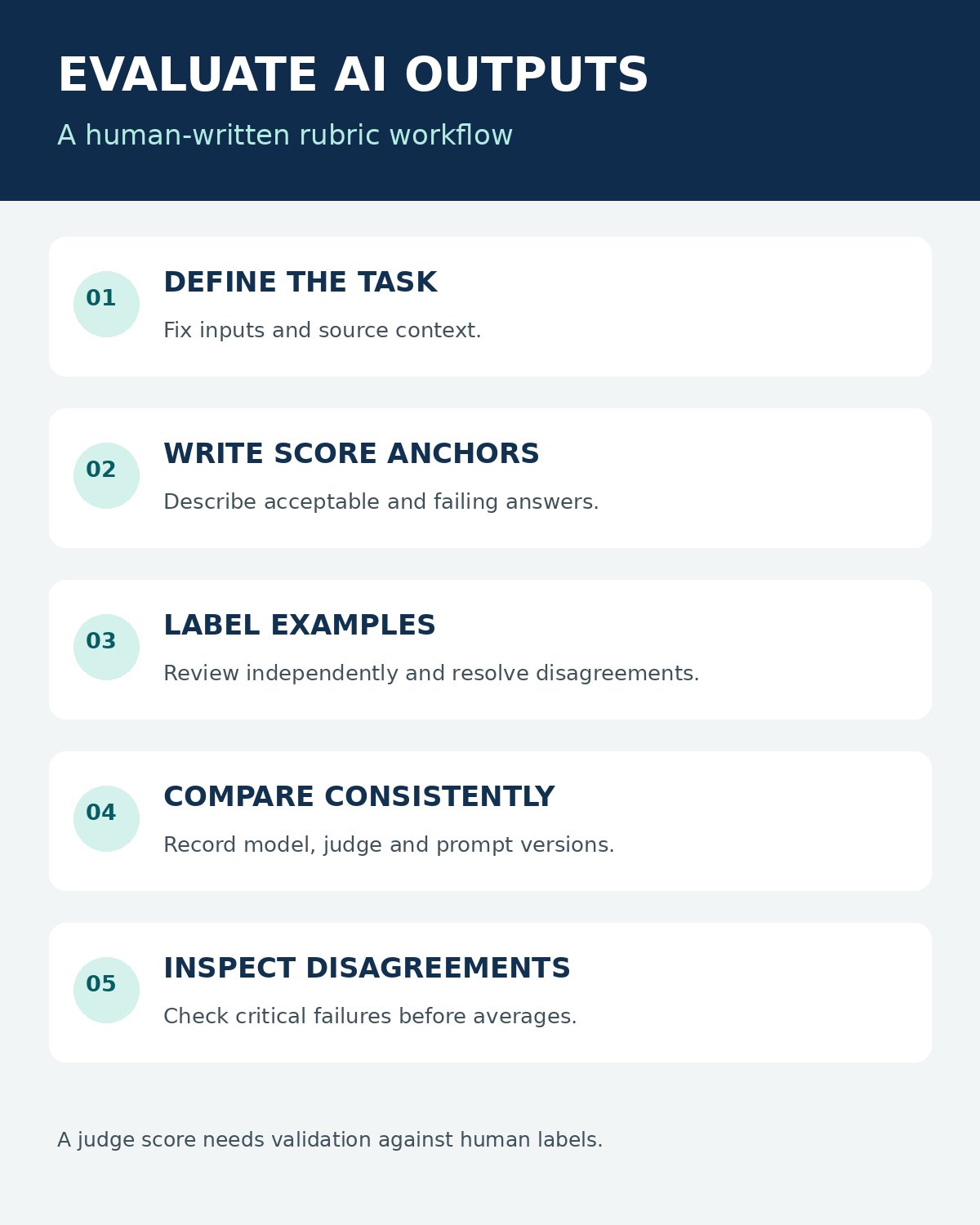
Start with the reader’s task, then define separate criteria. For example, a support-answer rubric might assess factual accuracy, whether it covers the requested steps, and whether it avoids promises outside policy. Describe what each score level means and identify failures that should stop approval even when the average is high.
- Choose representative inputs and preserve the same source context for each candidate.
- Write observable criteria and score anchors, including examples of acceptable and unacceptable answers.
- Have qualified reviewers label a small set independently; resolve disagreements and keep a separate holdout set.
- Run each candidate and the judge with recorded model, prompt and configuration versions.
- Review disagreements, critical failures, cost and latency before relying on an aggregate score.
Human labels are not automatically perfect. Review unclear instructions and disagreements, and repeat calibration when the task, model or policy changes. Never treat a single judge’s explanation as proof of a fact it cannot access.
For background on measurement and risk management, the NIST AI Risk Management Framework provides a broader context for evaluating AI systems. For a practical related case, see Editorialge’s guide to evaluating AI support escalation.
Choosing LLM evaluation tools
Choose LLM evaluation tools based on the evidence your task requires. A code-first test may suit an engineering team; an experiment interface may help reviewers inspect examples together. In either case, keep the rubric human-authored, validate automated scores against independent labels, and treat critical failures separately from the average.