AI knowledge tools with source citations can give customers a way to inspect the information behind an automated answer. The important buying question is what the customer can actually open: a public help article, a source list, or only a notice that a private source was used. A citation helps people check an answer; it does not prove that the answer is correct.
We reviewed product documentation on November 16, 2026 for customer-facing AI answers with a documented source reference or link. This is a documentation-based comparison, not a hands-on test or a ranking of accuracy. Seven products met that narrow evidence threshold; internal-only source traces are not treated as customer citations. Source visibility, channel, configuration and plan can change the result.
Start with the content your customers can open
If your help center already lives in Document360 or HelpDocs, first examine the citation experience within that system. Zendesk and Intercom are natural candidates when the support conversation already takes place there. For an assistant embedded on a separate site, compare CustomGPT.ai, kapa.ai and Newten against the same set of approved public questions. These are workflow matches, not accuracy scores.
Before comparing subscriptions, decide who owns the source articles and who fixes an answer when the underlying policy changes. Include content maintenance, deployment and escalation in the cost assessment. A cheaper assistant can still create more work if its sources are difficult to maintain or its citations send customers to inaccessible pages. Ask for a demonstration using your intended channel and customer permissions; an administrator’s successful preview is not enough.
AI knowledge tools with source citations: seven options
| Product | What a customer may see | Important qualification |
|---|---|---|
| Document360 Eddy AI | Numbered references to public knowledge articles | Private sources display a generic notice rather than exposing the source |
| Zendesk AI agents | Configurable source list for generative replies | CSV sources are not listed; check the channel and settings |
| CustomGPT.ai | Configurable inline and end-of-response citations | Display can be disabled; validate the sources shown in your widget |
| Intercom Fin | Public source article links for applicable answers | Uploaded documents are not linked to the customer |
| HelpDocs Ask AI | Numbered links to source articles | Depends on the available HelpDocs knowledge base and access |
| kapa.ai | Website widget answers with source citations | Requires installation and careful source permissions |
| Newten | Customer support answers show sources used | Verify source access and plan terms for your workflow |
1. Document360 Eddy AI
Document360’s October 2026 release notes describe numbered citations in Eddy AI chatbot responses. For public knowledge-base articles, a reader can preview the article title and open it. That makes the product a useful candidate when a customer should be able to move from a short answer to a maintained help article.
The distinction is important for a support team with a mixture of public and private material. Document360 says citations from private sources, including uploaded files and ticket integrations, show a generic private-source message rather than revealing the content. An administrator gets more information in the playground, but that is not the same view the customer receives. Check access, language, deployment and available plan features before assuming every referenced item will be openable.
2. Zendesk AI agents
Zendesk documents a setting that shows customers sources used for generative replies based on a knowledge source. When enabled, the customer can open a Sources control and see links to articles. For a team already managing a help center and messaging workflow in Zendesk, that gives a natural place to examine the supporting article alongside the reply.
The setting can be turned off, and Zendesk specifically says CSV files are not listed even when used to generate a response. Its web widget also documents inline citations when a message supplies valid reference positions; that should not be generalized to every channel or answer. Verify what the intended customer sees on the selected plan and channel, and decide how to handle an answer whose underlying source cannot be shown.
3. CustomGPT.ai
CustomGPT.ai documents citation settings for an agent: disabled, end-of-response, inline, or both. Its website copilot configuration enables numbered references in the response. A business that wants to embed a documentation assistant can compare these presentation choices with the way its customers browse and ask follow-up questions.
Because citations are configurable, verify the actual published widget rather than relying on an administrator’s settings screen. Test a public article, a changed page and a question with no approved answer. Source visibility and processing terms matter when the knowledge base contains internal information; a link that works for an employee may not be appropriate for a customer.
4. Intercom Fin
Intercom describes Fin using support content to answer customer questions. Its product announcement describes linking the source article in an answer, enabling a customer to inspect that article. This can fit a team with public help-center content and an existing customer messaging workflow.
Do not extend that claim to every source type. Intercom’s document-management guidance says that when an uploaded document is used, the customer is not shown a link to it. Internal snippets and private material also need separate treatment. Confirm the current Fin configuration and test the specific channel with public and private sources; an internal debugging view is not a customer-facing citation.
5. HelpDocs Ask AI
HelpDocs says Ask AI adds numbered inline citations that take a reader to the article behind a claim. Its approach can fit a team whose customer support answers already live in HelpDocs and whose readers should be able to move directly from a response to the relevant article.
As with any knowledge-base answer, the quality and access settings of the articles matter. Check whether the intended reader can open a source and whether an older or restricted article is excluded from the answer. Review current plan limits and how Ask AI is deployed before comparing costs.
6. kapa.ai
kapa.ai documents a website widget that answers from a knowledge base with citations and can be installed on a documentation site, support portal or application. It also documents a conversation handoff by email, giving a customer a way to carry the context into another support workflow.
The widget requires installation and source configuration. A team supporting developers may find its documentation-focused workflow useful, but should check who can access each connected source and whether the cited page opens for the customer. Test the handoff and permissions in the actual deployment rather than assuming every channel behaves like the website widget.
7. Newten
Newten describes a customer-support chatbot that answers from a help center, website and documents while showing the sources used. It also describes passing conversations to a shared live inbox when a person is needed. That combination is worth evaluating for a small team seeking an answer and a human follow-up in one support workflow.
The company describes the feature on its product page; this comparison has not tested the bot. Ask to see how public pages and uploaded files appear to the customer, how deleted content is resynchronized, and what source, message and handoff limits apply to the subscription.
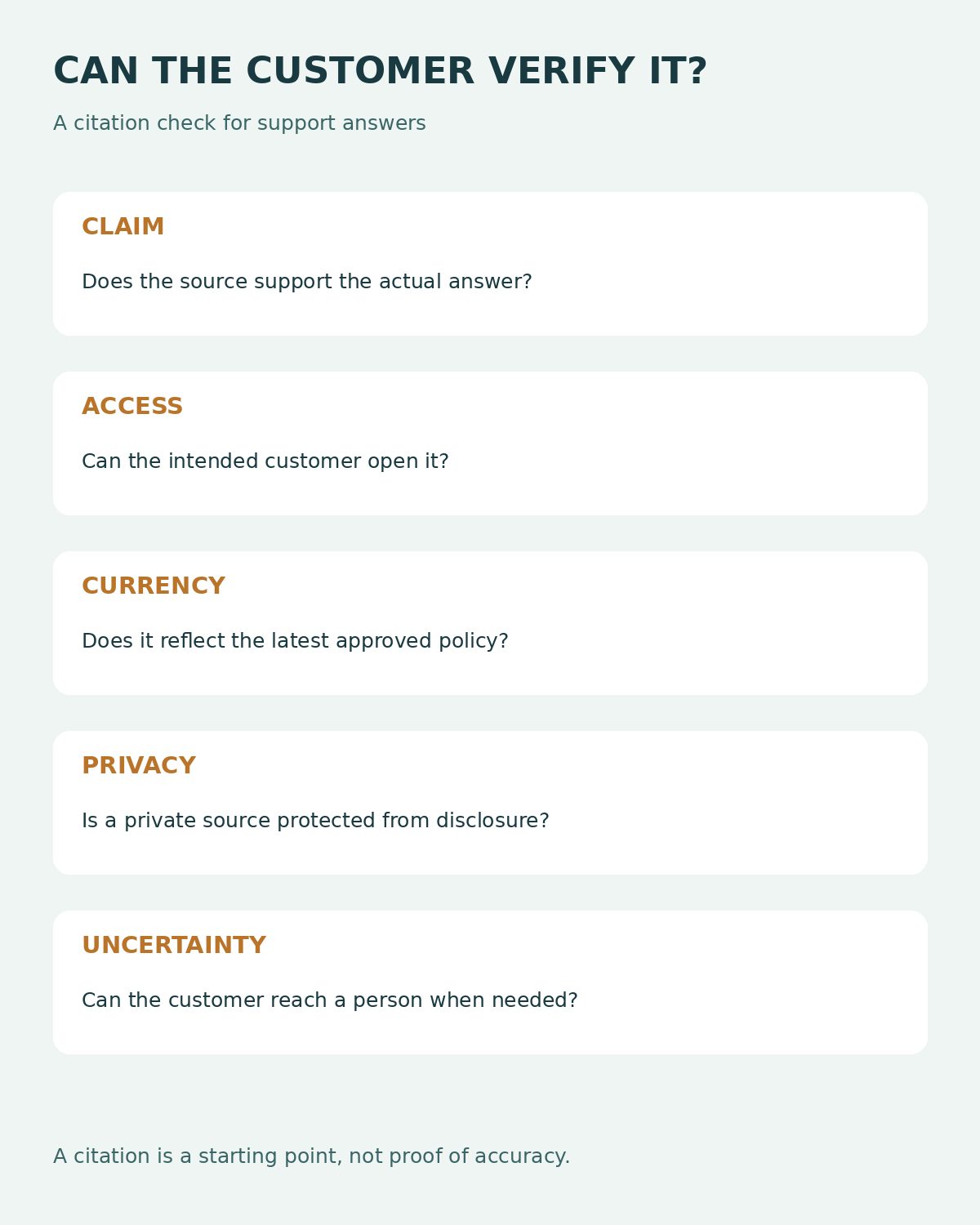
A five-question citation check before launch
Imagine a customer asks, “Can I cancel before renewal?” Prepare a public cancellation article, an older contradictory draft and a private note. Then run the same question in a controlled evaluation with approved test content. Record the answer and the links actually visible to the customer.
- Does the cited passage support the cancellation claim and its conditions?
- Does the link open for a signed-out customer who is allowed to see it?
- What happens when the article changes or is removed? Check again after the documented sync interval.
- Does the answer expose private material, or clearly distinguish a private source from an openable article?
- When sources conflict or do not answer the question, does the workflow offer a safe handoff to a person?
Repeat the check using different phrasings and record the date, channel, account permissions and source version. Do not use customer secrets in an unapproved test. NIST’s work on evaluating machine-generated reports discusses checking whether citations connect claims to source documents. Editorialge’s knowledge-base buying questions can help with the wider procurement review.
Choosing AI knowledge tools with source citations
Choose AI knowledge tools with source citations by testing the reader’s path from claim to accessible evidence, not by counting citation symbols. A clear source trail, appropriate permissions, maintained content and a route to human support work together; none of them alone guarantees a correct answer.