
Changing careers for climate impact does not always mean quitting everything, going back to school for four years, and becoming a renewable energy engineer from scratch. Sometimes it means taking the skills you already have and moving them closer to the systems that matter.
A construction worker can move into building retrofits. A finance professional can move into climate accounting. A software developer can work on grid, carbon, or climate-risk tools. A supply chain manager can reduce waste and emissions across materials, logistics, and procurement. A policy professional can work on resilience, clean transportation, or heat adaptation. A technician can move into solar, wind, EV charging, batteries, or heat pumps.
That is the real opportunity behind career changes for climate impact seekers should understand. Climate work is no longer one, or heat pumps. It is not only scientists, activists, or people installing solar panels on rooftops. Climate careers now stretch across buildings, energy, transportation, finance, data, manufacturing, agriculture, urban planning, insurance, public policy, education, and operations.
This guide breaks down seven practical career changes for climate impact, who they fit, what skills transfer well, and what to consider before making the switch.
Why Climate Careers Are Becoming More Practical
Green jobs are broader than many people think. The International Labour Organization defines green jobs as decent jobs that help preserve or restore the environment, including roles in traditional sectors such as construction and manufacturing as well as newer sectors like renewable energy and energy efficiency. That definition matters because it shows climate work is not limited to one industry.
The labor market is also shifting. The International Energy Agency reported that global energy employment reached more than 67 million workers in 2023, with clean energy employment at 34.8 million jobs compared with 32.6 million fossil fuel jobs. Renewable energy employment also reached a new global high, with IRENA and ILO estimating 16.6 million renewable energy jobs in 2024.
Skills demand is moving too. LinkedIn’s green skills research found that global demand for green talent rose 5.9% annually from 2021 to 2024, while supply lagged behind. The World Economic Forum’s Future of Jobs Report 2025 also lists green and energy-transition roles such as renewable energy engineers, environmental engineers, and electric vehicle specialists among fast-growing job categories.
That does not mean every climate job is booming everywhere. Policy shifts, funding cycles, regional infrastructure, interest rates, and local industry needs all affect hiring. Some climate careers are growing quickly. Some are competitive. Some require certifications. Some pay better than others. Some depend heavily on public incentives or corporate budgets.
Still, the larger direction is clear: climate-related work is becoming part of the mainstream economy.
What Makes a Career Change Climate-Impactful?
A climate career change is meaningful when the work helps reduce emissions, improve energy efficiency, protect ecosystems, cut waste, electrify systems, strengthen resilience, or shift money and operations toward lower-carbon choices. That impact can be direct or indirect.
A solar installer has direct impact because they help deploy clean energy. A building energy auditor has direct impact because they help reduce waste in homes and commercial spaces. A sustainability accountant has indirect but important impact because they help companies measure, report, and manage emissions. A climate software product manager may not install anything physically, but their tools can help thousands of users make better decisions.
The strongest sustainability career switch usually sits at the intersection of three things:
| Career Fit Question | Why It Matters |
| What skills do you already have? | Switching is easier when you reuse your existing strengths. |
| Which climate problem interests you most? | Energy, buildings, food, finance, transport, and resilience all need different people. |
| What roles are actually hiring? | Climate passion needs to meet labor-market reality. |
| What training gap can you close? | Certifications, software, standards, or technical skills may be needed. |
| What level of risk can you handle? | Startups, nonprofits, government, and corporate roles have different trade-offs. |
A good climate career move should not be built only on emotion. It should be built on fit, evidence, timing, and a realistic path into the work.
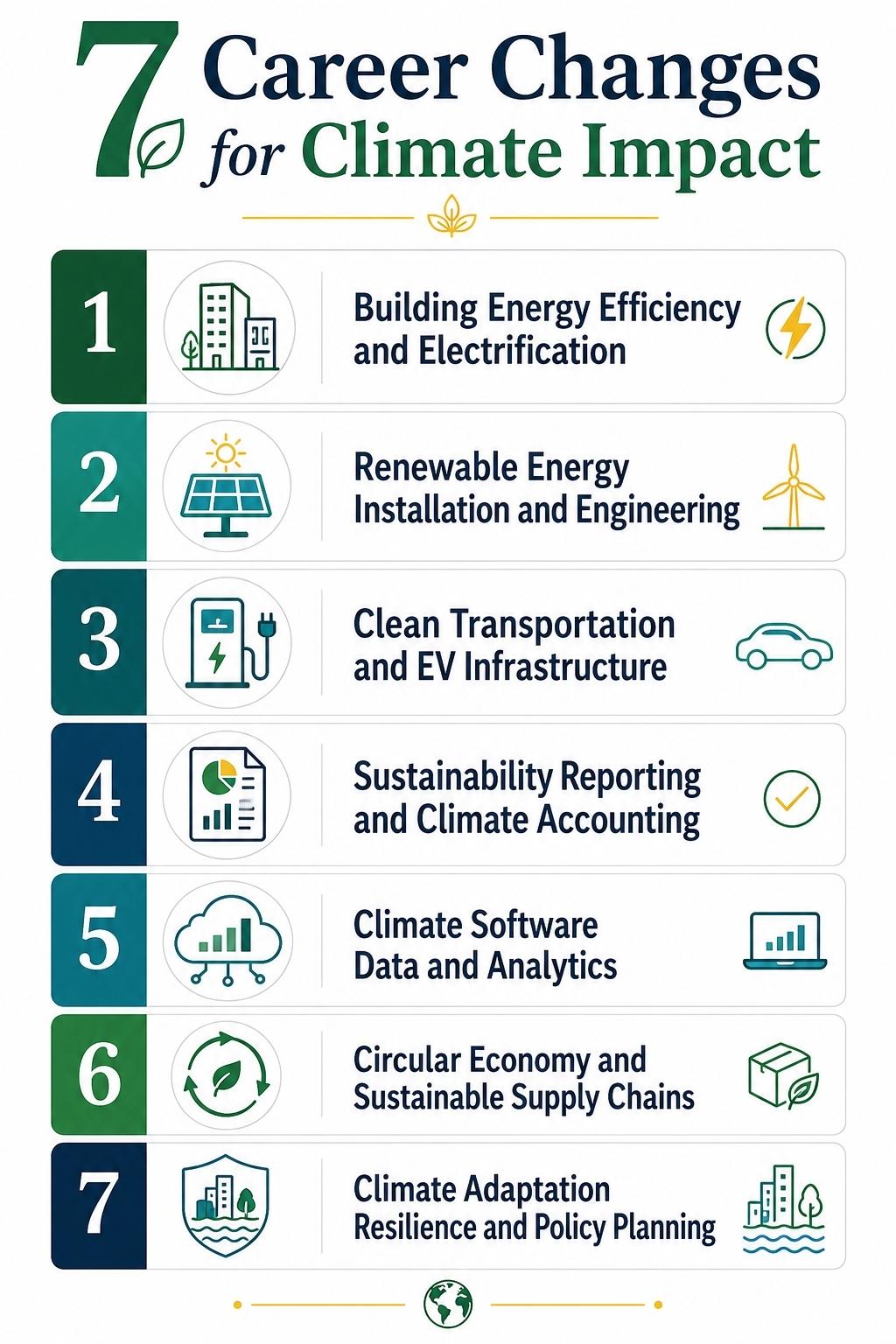
7 Career Changes for Climate Impact
These are not ranked as one-size-fits-all career choices. They are seven practical directions that match current labor-market signals and real climate needs.
1. Move Into Building Energy Efficiency and Electrification
Buildings are one of the most practical places to make a climate impact because energy waste is everywhere.
Homes, offices, schools, hospitals, warehouses, and apartment buildings all need better insulation, air sealing, efficient lighting, smarter controls, heat pumps, energy audits, retrofits, efficient appliances, and better building operations. This makes building performance one of the strongest career-change paths for people who want tangible climate work.
This path can fit tradespeople, electricians, HVAC technicians, architects, engineers, construction managers, facility managers, energy auditors, real estate professionals, and even customer-success workers who understand home services or building operations.
The work is not always glamorous. It may involve crawling through attics, testing ducts, reviewing utility bills, managing retrofit crews, explaining rebates to homeowners, or helping building owners understand payback. But the impact can be real because buildings use energy every day.
In the U.S., clean energy job analysis shows that energy efficiency is one of the largest clean energy employment categories, and construction makes up a major share of clean energy employment. That matters because climate work needs people who can physically upgrade buildings, not only people who can write climate strategies.
Best fit for: HVAC workers, electricians, builders, architects, engineers, facility managers, energy auditors, and people with construction or home-performance experience.
Transferable skills: Project coordination, building systems knowledge, customer communication, diagnostics, construction management, data reading, sales, and technical troubleshooting.
How to start: Learn building science basics, energy auditing, heat pumps, insulation, air sealing, utility rebate programs, and local efficiency standards. Look for roles with energy-efficiency contractors, utilities, retrofit programs, building-performance firms, and clean-energy service companies.
Reality check: This work can be local, physical, and certification-heavy. It may require field training, licensing, or apprenticeship pathways depending on the role.
2. Switch Into Renewable Energy Installation, Operations, or Engineering
Renewable energy remains one of the clearest climate career paths because the work directly supports clean power deployment.
This direction includes solar photovoltaic installers, wind turbine technicians, renewable energy engineers, project developers, grid interconnection specialists, site assessors, operations and maintenance workers, permitting coordinators, and project managers.
It is also one of the best examples of how climate careers include both trades and professional roles. A person may enter through electrical work, engineering, construction, environmental permitting, land acquisition, finance, project management, or community engagement.
The labor-market signal is strong, especially for technical roles. The U.S. Bureau of Labor Statistics projects wind turbine technician employment to grow 50% from 2024 to 2034 and solar photovoltaic installer employment to grow 42% over the same period. Those are among the fastest-growing occupations, although the total number of jobs is still smaller than in many broader industries.
Renewable energy is not risk-free. Hiring depends on policy, permitting, interest rates, utility rules, supply chains, and regional demand. But as a career-change direction, it remains one of the most visible and measurable ways to work on climate mitigation.
Best fit for: Electricians, technicians, engineers, construction workers, project managers, field-service workers, military veterans, and people comfortable with hands-on technical work.
Transferable skills: Electrical basics, safety procedures, troubleshooting, project management, climbing or fieldwork readiness, mechanical systems, permitting, customer communication, and quality control.
How to start: Explore solar installation training, electrical apprenticeships, wind technician programs, renewable energy certificates, NABCEP-related pathways in the U.S., or entry-level project coordinator roles at solar, wind, storage, or clean-energy firms.
Reality check: Some renewable roles are physically demanding. Wind work may require heights and travel. Solar installation can involve rooftops, heat, safety training, and local licensing rules.
3. Move Into Clean Transportation and EV Infrastructure
Transportation is one of the biggest climate systems to change, and that creates career opportunities far beyond designing electric cars.
Clean transportation includes EV charging infrastructure, battery systems, fleet electrification, public transit planning, bike and pedestrian infrastructure, logistics optimization, rail, micromobility, charging software, electric buses, and low-carbon freight.
This career path can fit people from automotive repair, electrical work, urban planning, logistics, fleet management, software, policy, civil engineering, utilities, and transportation operations.
For example, an electrician might move into EV charger installation. A logistics manager might work on route optimization and fleet emissions. A city planner might work on transit-oriented development or safer bike infrastructure. A mechanic might train for EV maintenance. A software worker might join a charging network or fleet analytics company.
This is a useful climate career path because it combines hardware, infrastructure, behavior, and policy. Clean transportation is not only about replacing gasoline cars with EVs. It is also about reducing unnecessary trips, improving transit, making active transport safer, and cleaning up the vehicles that still need to move.
Best fit for: Electricians, auto workers, mechanics, fleet managers, logistics professionals, urban planners, civil engineers, software workers, and transportation-policy professionals.
Transferable skills: Vehicle systems, electrical installation, route planning, operations, logistics data, permitting, public-sector coordination, infrastructure planning, and customer support.
How to start: Learn EV charging basics, battery safety, fleet electrification, transportation emissions, utility interconnection, charger maintenance, and local incentive programs. Look for roles in charging companies, transit agencies, utilities, logistics firms, EV service providers, and clean-mobility startups.
Reality check: EV and clean-transportation work can be shaped heavily by local policy, utility readiness, permitting speed, and infrastructure budgets. The strongest opportunities often appear where governments, utilities, and fleets are actively investing.
4. Shift Into Sustainability Reporting and Climate Accounting
Not every climate career involves installing hardware or working outdoors.
Companies increasingly need people who can measure emissions, manage sustainability data, prepare reports, understand disclosure requirements, and connect climate goals to financial and operational decisions. That makes sustainability reporting and climate accounting a strong career-change option for people with analytical, accounting, finance, consulting, legal, or corporate operations backgrounds.
This work includes ESG analysts, sustainability reporting specialists, carbon accountants, climate-risk analysts, disclosure managers, supply-chain emissions analysts, and consultants who help companies collect and interpret environmental data.
The climate impact may feel less direct than installing solar panels, but measurement matters. Organizations cannot reduce what they do not understand. Poor data leads to weak targets, vague claims, and greenwashing. Better data helps companies identify energy waste, supplier emissions, travel impacts, product footprints, and climate risks.
This path is especially relevant as climate disclosure standards and stakeholder pressure expand. Even where regulation changes, many large companies still face investor, customer, lender, and supply-chain pressure to provide credible sustainability information.
Best fit for: Accountants, auditors, finance professionals, analysts, consultants, legal/compliance professionals, operations managers, and corporate reporting specialists.
Transferable skills: Data quality, spreadsheets, audit thinking, reporting, compliance, financial analysis, stakeholder management, writing, and internal controls.
How to start: Learn greenhouse gas accounting basics, Scope 1, 2, and 3 emissions, carbon accounting software, sustainability reporting frameworks, climate-risk language, and life-cycle thinking. Build a small portfolio by analyzing a company’s public sustainability report or creating a sample emissions inventory.
Reality check: This field can be jargon-heavy and deadline-driven. Some roles are strategic, while others involve messy data collection, supplier follow-ups, spreadsheets, and internal coordination.
5. Use Tech, Data, or Product Skills in Climate Software and Analytics
Climate work needs software people. The transition creates huge data problems: energy forecasting, grid optimization, carbon accounting, climate risk, building performance, satellite monitoring, supply-chain emissions, agriculture analytics, insurance modeling, wildfire risk, flood mapping, and renewable project development.
That makes climate software and analytics a strong sustainability career switch for software developers, data analysts, GIS specialists, machine-learning engineers, UX designers, cybersecurity workers, product managers, and technical writers.
The biggest advantage of this path is skill transfer. A developer does not need to become a climate scientist overnight. A product manager does not need to become an electrical engineer before contributing. But they do need climate context. They need to understand the users, constraints, data quality problems, and policy environment of the sector they enter.
Climate tech also has a wide range of company types. Some are startups building carbon tools. Some are established energy companies modernizing grid software. Some are insurance or finance firms modeling physical climate risk. Some are public-sector teams building resilience tools. Some are nonprofits using data to support policy and accountability.
The key is to avoid vague “AI for climate” language and look for tools that change decisions in the real world.
Best fit for: Software engineers, data analysts, GIS specialists, product managers, designers, AI/ML workers, cybersecurity professionals, and technical operators.
Transferable skills: Data pipelines, product discovery, analytics, mapping, modeling, APIs, UX, cloud systems, security, visualization, and technical documentation.
How to start: Pick one climate domain, such as energy, buildings, transport, agriculture, water, carbon accounting, or climate risk. Learn the basic terms and workflows. Build or document a small project that shows you understand the problem, not just the code.
Reality check: Climate tech can be volatile. Startups may pivot, funding may tighten, and some tools have weak real-world impact. Evaluate the business model and customer problem carefully.
6. Switch Into Circular Economy and Sustainable Supply Chain Work
A major part of climate impact sits inside materials, products, packaging, purchasing, manufacturing, logistics, repair, reuse, and waste. That is where circular economy and sustainable supply chain careers come in.
This path focuses on reducing waste, designing products for longer use, improving recycling systems, lowering material impact, rethinking packaging, sourcing better materials, cutting supplier emissions, and building repair or reuse models.
It can fit people with backgrounds in procurement, logistics, operations, manufacturing, retail, product development, packaging, quality control, industrial design, warehouse management, and supplier relations.
This is one of the most practical climate career changes because most companies already have supply chains. They already buy materials, ship products, manage inventory, deal with packaging, and handle waste. The climate question is whether those systems can become less wasteful and more transparent.
A procurement manager can shift suppliers. A packaging designer can reduce material use. A logistics professional can cut unnecessary transport. A product manager can design for repair. A manufacturing worker can help reduce scrap. A retail operations leader can build take-back or resale programs.
Circular economy work is not always labeled as a climate job, but it can have strong climate relevance because materials and production carry embedded emissions.
Best fit for: Procurement specialists, operations managers, product managers, packaging professionals, logistics workers, industrial designers, manufacturing professionals, and retail leaders.
Transferable skills: Supplier management, negotiation, inventory control, product lifecycle thinking, quality control, logistics, materials knowledge, cost analysis, and process improvement.
How to start: Learn product life-cycle basics, circular design, sustainable procurement, packaging standards, supplier emissions, waste audits, and repair/reuse business models. Look for roles in procurement sustainability, packaging innovation, reverse logistics, circular product design, and supply-chain emissions.
Reality check: This work can involve trade-offs. A material that looks greener may cost more, perform worse, fail compliance needs, or create a different environmental problem. Good circular economy work requires careful analysis, not slogans.
7. Move Into Climate Adaptation, Resilience, and Policy Planning
Not all climate work is about reducing emissions. Some of it is about helping people, cities, ecosystems, and infrastructure survive the changes already underway.
Climate adaptation and resilience careers focus on heat, flooding, water stress, disaster risk, coastal protection, urban planning, public health, agriculture resilience, insurance risk, emergency preparedness, and community planning.
This path fits people from government, nonprofits, urban planning, civil engineering, public health, emergency management, water management, research, communications, law, education, social work, and community organizing.
The need is serious. The World Bank’s 2025 climate jobs work warns that climate impacts could negatively affect employment, with the equivalent of 43 million job losses by 2050 across 49 countries, rising much higher when extrapolated to low- and middle-income countries. That kind of risk makes adaptation work a jobs issue, not only an environmental issue.
Climate resilience roles can be local and deeply practical. Someone may work on cooling centers, flood maps, stormwater planning, disaster recovery, heat-health communication, resilient housing, climate migration planning, or community grant programs.
This can be one of the most meaningful climate career paths for people who care about equity and public service. Climate impacts are not distributed evenly, and many communities with the least responsibility for emissions face the harshest risks.
Best fit for: Urban planners, public-sector workers, nonprofit professionals, civil engineers, public health workers, researchers, policy analysts, educators, and community organizers.
Transferable skills: Stakeholder engagement, grant writing, policy analysis, mapping, public communication, emergency planning, research, budgeting, and cross-agency coordination.
How to start: Learn climate adaptation basics, local hazard planning, heat and flood risk, resilience funding, GIS mapping, community engagement, and environmental justice. Look for roles in city government, regional planning agencies, NGOs, disaster resilience teams, water utilities, and climate policy organizations.
Reality check: This work can be emotionally heavy and politically complex. Progress may be slow, funding-dependent, and shaped by public priorities. Patience matters.

Quick Comparison: 7 Career Changes for Climate Impact
| Career Change Direction | Best For | Climate Impact Area |
| Building energy efficiency and electrification | Tradespeople, engineers, architects, energy auditors, HVAC professionals | Lower energy use in homes and buildings |
| Renewable energy installation, operations, or engineering | Technicians, electricians, project managers, engineers | Clean power deployment |
| Clean transportation and EV infrastructure | Auto workers, electricians, planners, logistics professionals | Lower-emission mobility |
| Sustainability reporting and climate accounting | Accountants, analysts, consultants, finance professionals | Emissions measurement and corporate accountability |
| Climate software, data, and analytics | Developers, data analysts, GIS specialists, product managers | Tools for climate decisions |
| Circular economy and sustainable supply chains | Operations, procurement, manufacturing, packaging, logistics professionals | Waste reduction and lower-impact materials |
| Climate adaptation, resilience, and policy planning | Public-sector workers, planners, researchers, nonprofit professionals | Heat, flood, water, disaster, and community resilience |
Best Climate Career Switch by Background
| Your Current Background | Strong Climate Career Direction |
| Construction or trades | Building efficiency, electrification, solar, heat pumps, EV charging |
| Accounting or finance | Climate accounting, ESG data, sustainability reporting |
| Software or data | Climate analytics, energy software, carbon platforms, GIS, climate risk |
| Operations or supply chain | Circular economy, procurement, logistics emissions, waste reduction |
| Automotive or electrical | EV infrastructure, battery systems, charging networks, clean fleets |
| Government or nonprofit | Climate adaptation, resilience, policy, community programs |
| Communications or education | Climate literacy, public engagement, sustainability training |
| Engineering | Renewable energy, grid, clean transport, water, buildings, resilience |
How to Choose the Right Sustainability Career Switch
Start with your current skills, not the job title you think sounds most climate-friendly. If you are good at technical troubleshooting, look at energy systems, buildings, EV charging, or field operations. If you are good with data, look at carbon accounting, climate analytics, grid tools, or ESG reporting. If you understand suppliers, look at sustainable procurement and circular supply chains. If you know public systems, look at resilience planning, adaptation, and policy.
Choose a climate problem
Buildings, energy, transportation, food, water, finance, materials, and adaptation all need different kinds of people. A vague desire to “work in sustainability” is hard to act on. A specific interest in “helping cities prepare for heat” or “helping companies measure supplier emissions” is much easier to turn into a job search.
Identify the gap
You may need a certification, a short course, a portfolio project, field experience, industry vocabulary, or a better network. Most people do not need to become climate experts before applying. They need enough fluency to show they understand the problem and can contribute.
Test before leaping
Volunteer on a sustainability project at work. Help a local climate nonprofit. Take one short course. Interview three people in the field. Rewrite your resume for one climate job family. Apply to a few roles before assuming you need another degree.
A smart career change is built through evidence, not panic.
Common Mistakes to Avoid
- Thinking climate careers are only for scientists and engineers. They are not. Climate work needs accountants, electricians, planners, writers, analysts, installers, designers, product managers, lawyers, operators, and community organizers.
- Chasing vague job titles. “Sustainability manager” can mean strategy, reporting, procurement, facilities, marketing, compliance, or all of them at once. Read the actual job description.
- Ignoring pay and stability. A job can be mission-aligned and still be wrong for your financial needs. Climate impact should not require pretending money does not matter.
- Assuming every green job has equal impact. Some roles are mainly branding. Others change real systems. Look for work tied to measurable emissions reduction, resilience, resource use, infrastructure, or operational change.
- Starting from zero when you do not need to. Your current skills may be more valuable than you think. The strongest climate move may be shifting sectors, not abandoning your professional identity.
Wrapping Up
The best climate career switch is usually not a total reinvention. It is a redirection. Buildings need energy upgrades. Renewable energy needs technicians, engineers, and project teams. Transportation needs electrification and better mobility systems. Companies need credible climate data. Climate software needs builders who understand real users. Supply chains need less waste and better materials. Communities need resilience planning as heat, flooding, water stress, and disasters intensify.
That means your existing skills may already have a climate pathway. The work is not always easy. It can be technical, political, physical, data-heavy, or slow. But it is also becoming more practical, more needed, and more connected to the mainstream economy.
Do not start by asking, “What green job sounds impressive?” Start by asking, “Where can the skills I already have help reduce harm, build resilience, or speed up the transition?” That is where a sustainability career switch becomes real.
Frequently Asked Questions About Career Changes for Climate Impact
1. What are the best career changes for climate impact?
The best career changes for climate impact include building energy efficiency, renewable energy, clean transportation, sustainability reporting, climate software and analytics, circular economy work, sustainable supply chains, and climate adaptation or resilience planning.
2. Do I need a degree to work in climate careers?
Not always. Some climate careers require degrees, especially engineering, science, law, and policy roles. But many green jobs rely on certifications, apprenticeships, portfolios, trade experience, data skills, project management, or industry knowledge. Solar, wind, energy auditing, EV charging, and building-performance roles can have multiple entry paths.
3. What green jobs are growing fastest?
In the U.S., BLS projects strong growth for wind turbine technicians and solar photovoltaic installers from 2024 to 2034. Globally, clean energy employment has grown larger than fossil fuel employment, and green skills demand is rising faster than supply. Growth varies by country, policy, and sector.
4. How can I switch into sustainability without starting over?
Start by identifying your transferable skills. Finance professionals can move into climate accounting. Software workers can move into climate tech. Operations workers can move into sustainable supply chains. Tradespeople can move into electrification, retrofits, solar, or EV charging. The goal is to add climate fluency to skills you already have.
5. Are climate careers stable?
Some climate careers are stable, especially those tied to buildings, infrastructure, utilities, compliance, public planning, and essential services. Others, especially startup roles or policy-dependent sectors, can be more volatile. Stability depends on region, employer, funding, regulation, and the specific job family.
6. What skills are useful for a sustainability career switch?
Useful skills include data analysis, project management, communication, technical troubleshooting, carbon accounting, energy literacy, GIS, procurement, policy analysis, stakeholder management, building science, electrical knowledge, and systems thinking. The best skill set depends on the climate problem you want to work on.