

Finding a good indie game is easy for about five minutes. Then the storefront algorithms start serving the same trendy roguelike, the same cozy farming sim, and the same “overwhelmingly positive” darling everyone already knows. The best indie gaming communities matter because they give players and developers something algorithms still struggle with: taste, feedback, context, and weird little discoveries that do not arrive wrapped in a marketing campaign.
Our Selection Criteria
A good indie community is not just a place where people dump trailers and vanish. It needs enough activity to be useful, enough moderation to stay readable, and enough variety to help both players and small creators.
Here are the filters used to narrow the list.
| Selection Filter | Why It Matters |
|---|---|
| Active discussion | Communities with recent posts, ongoing threads, or recurring events were prioritized. |
| Indie relevance | The community had to focus clearly on indie games, indie developers, game jams, discovery, or creator support. |
| Discovery value | Stronger picks help users find games beyond mainstream storefront recommendations. |
| Developer usefulness | Communities that offer feedback, devlogs, collaboration, or technical support earned extra weight. |
| Accessibility | Public or easy-to-join spaces were favored over closed networks. |
| Signal over spam | Communities with rules, structure, or dedicated spaces for promotion ranked higher than pure link dumps. |
| Long-term value | Historic communities were included only when they still offer useful archives, culture, or practical learning value. |
That selection method also helps separate “busy” from “actually useful,” because not every loud gaming space is good for indie discovery.
Whom This Is For
This list is useful for different types of indie gaming readers, not just one narrow audience.
| Reader Type | Best Fit |
| Indie game fans | People looking for new, strange, experimental, or under-the-radar games. |
| Solo developers | Creators who need feedback, visibility, motivation, or technical discussion. |
| Small studios | Teams looking for early community traction without a massive marketing budget. |
| Game jam participants | Developers who want challenge-based creation and fast feedback loops. |
| Content creators | Streamers, writers, and YouTubers looking for fresh indie projects before they go mainstream. |
With that audience in mind, the communities below are ranked by overall usefulness, not just popularity.
9 Best Indie Gaming Communities for Discovery, Feedback, and Real Conversation
The indie scene is spread across forums, Reddit, Discord, marketplaces, game jam platforms, and old-school devlog spaces. Some communities are better for players, some are better for creators, and a few are useful for both.
1. r/IndieGaming: One of the Best Indie Gaming Communities for Broad Discovery
r/IndieGaming is one of the easiest entry points for anyone who wants a steady stream of indie trailers, screenshots, demos, feedback requests, and player reactions. It works well because the community is broad enough to include both fans and developers, so the feed often feels like a living indie showcase. You will see polished trailers beside rough prototypes, which is part of the charm. It is not the cleanest space for deep analysis, but it is excellent for quick discovery.
Best Feature/For:
- Broad indie game discovery across many genres.
- Players and developers who want a casual, visual-first community.
Why We Chose It:
- It has a clear indie gaming focus.
- The community is accessible and easy to browse.
- It gives small developers a visible place to share progress.
- It helps players notice projects before they reach bigger storefronts.
Things to consider:
- Self-promotion can get repetitive if you browse casually.
- Deeper criticism usually depends on the quality of each thread.
2. r/indiegames
r/indiegames is slightly more focused on discovery and connecting indie developers with audiences. It is a useful space if you want to see what creators are building without scrolling through unrelated gaming noise. The community’s rules against promoting outside channels help keep the focus closer to games themselves. That makes it a good pick for players who want new indie titles and developers who want feedback without turning the space into a content farm.
Best Feature/For:
- Discovering indie games from developers who are actively trying to reach players.
- Readers who prefer game-focused posts over creator-brand promotion.
Why We Chose It:
- It is built around indie game discovery.
- It gives developers a channel to showcase work.
- It is more focused than many general gaming subreddits.
- It is useful for finding projects before they become widely covered.
Things to consider:
- Promotional posts still need to be judged carefully.
- Feedback quality varies by post timing and presentation.
3. itch.io Community
itch.io is more than a marketplace; its community area supports discussions, release announcements, feedback, game jams, and creator questions. It is especially valuable because itch.io already attracts experimental developers who may not fit neatly into Steam-first commercial logic. You can find tiny prototypes, narrative experiments, jam entries, horror games, zines, tools, and deeply strange projects in the same ecosystem. For indie fans who enjoy the edges of game culture, itch.io is hard to replace.
Best Feature/For:
- Experimental indie games, game jams, and creator-first discovery.
- Developers who want a community tied directly to a publishing platform.
Why We Chose It:
- It has dedicated spaces for general discussion and release announcements.
- It supports creators who publish small, niche, or experimental work.
- It connects community discussion with actual playable projects.
- It is one of the strongest places for finding games outside mainstream storefront taste.
Things to consider:
- Quality varies widely because the platform is very open.
- Players should expect to explore, not simply consume polished recommendations.
4. Indie Games Discord
The Indie Games Discord is useful for people who want faster conversation than Reddit or forums usually provide. It works well for chatting about indie games, sharing creations, asking for feedback, and networking with people who are already interested in the space. Discord can feel messy, but it also offers a sense of immediacy that slower platforms cannot match. For developers who need quick reactions or casual community energy, it can be especially helpful.
Best Feature/For:
- Real-time conversation, quick feedback, and indie networking.
- Developers and fans who prefer chat-based communities.
Why We Chose It:
- It is directly focused on the indie games space.
- It supports both game discussion and creator sharing.
- It gives small developers a more conversational way to meet players.
- It can be useful for feedback, collaboration, and portfolio visibility.
Things to consider:
- Discord conversations can disappear quickly compared with forum posts.
- It may be less useful for long-term searchable knowledge.
5. Game Jolt Communities
Game Jolt has evolved into a social community platform for gamers and creators, with dedicated communities around games, fandoms, art, videos, and indie-style projects. It is especially strong for younger, fan-driven, visual, and creator-heavy gaming culture. If you are looking for polished business discussion, this is not the first stop. But if you want energetic community posts, fan content, and a social-first indie gaming environment, Game Jolt deserves attention.
Best Feature/For:
- Fan-driven indie culture, creator posts, and social discovery.
- Gamers who enjoy art, clips, memes, and community interaction around games.
Why We Chose It:
- It is built around creators and gamers sharing work.
- It supports community discovery beyond traditional forums.
- It gives visual projects and fandom-friendly games room to breathe.
- It can help small games build early audience energy.
Things to consider:
- It leans more social and fandom-driven than analytical.
- Not every community is indie-focused, so browsing matters selectively.
6. IndieDB
IndieDB is one of the more traditional indie game discovery platforms, built around news, downloads, media, developer updates, and project pages. It is useful when you want a more structured look at what indie teams are making instead of a fast-moving social feed. Developers can use it to present a game in a more organized way, while players can browse projects with screenshots, updates, and downloadable builds. It feels old-school in a good way: less chaotic than social platforms, more project-centered than most forums.
Best Feature/For:
- Structured indie game browsing and developer project pages.
- Players who want media, updates, and downloads in one place.
Why We Chose It:
- It is specifically built around independent games.
- It gives developers a place to share news and media directly.
- It helps players follow projects beyond a single trailer post.
- It has strong value for browsing work-in-progress and released indie games.
Things to consider:
- The interface may feel less modern than newer community platforms.
- Discovery depends on how actively developers update their pages.
7. TIGSource Forums
TIGSource is one of the legendary names in indie game culture, especially for devlogs and long-form development discussion. Its golden era helped shape how many people think about independent games, and its archives still carry real learning value. Even if it is not the hottest modern community, it remains useful for developers who want to study how games evolve in public. For serious indie history, devlog culture, and slow-burn inspiration, TIGSource still belongs on the list.
Best Feature/For:
- Devlogs, indie game history, and long-form creative process.
- Developers who want to study how projects mature over time.
Why We Chose It:
- It has deep roots in indie game culture.
- Its devlog format encourages more thoughtful progress sharing.
- It has influenced how indie developers document work.
- It remains valuable as an archive of process, feedback, and creative evolution.
Things to consider:
- It is slower than modern social communities.
- New developers may need patience to find the most useful threads.
8. Ludum Dare
Ludum Dare is not a normal daily community; it is a game jam institution. Its value comes from creative pressure, deadlines, themes, post-jam ratings, and the shared chaos of making something playable in a short period. For indie developers, this can be more useful than passive scrolling because it forces action. Even with uncertainty around its long-term future, Ludum Dare remains one of the most important community-driven spaces for learning by making.
Best Feature/For:
- Game jams, rapid prototyping, and creative discipline.
- Solo developers and small teams who learn best by finishing projects.
Why We Chose It:
- It has a major place in game jam culture.
- It pushes developers to create instead of endlessly plan.
- It gives participants a reason to play, rate, and discuss each other’s work.
- It can help new developers build a finished-game habit.
Things to consider:
- It is event-based, so usefulness depends on timing.
- Its reported long-term wind-down makes it worth watching closely.
9. GameDev.net
GameDev.net is broader than indie gaming, but it is still highly useful for indie developers because it covers programming, design, art, production, beginner questions, and technical problem-solving. It is less about discovering cute new games and more about understanding how games actually get made. That makes it a strong supporting community for creators who need practical answers instead of applause. If your indie project keeps breaking, this is the kind of place that can save you from pretending “the bug is a feature.”
Best Feature/For:
- Technical help, beginner learning, and game development discussion.
- Indie developers who need practical support beyond marketing feedback.
Why We Chose It:
- It has long-running game development forums.
- It supports multiple disciplines, including programming, design, and art.
- It is useful for beginners who need structured help.
- It complements discovery communities by focusing on production reality.
Things to consider:
- It is not indie-exclusive.
- Players looking only for game recommendations may prefer Reddit, itch.io, or IndieDB.
A Quick Overview Before You Join
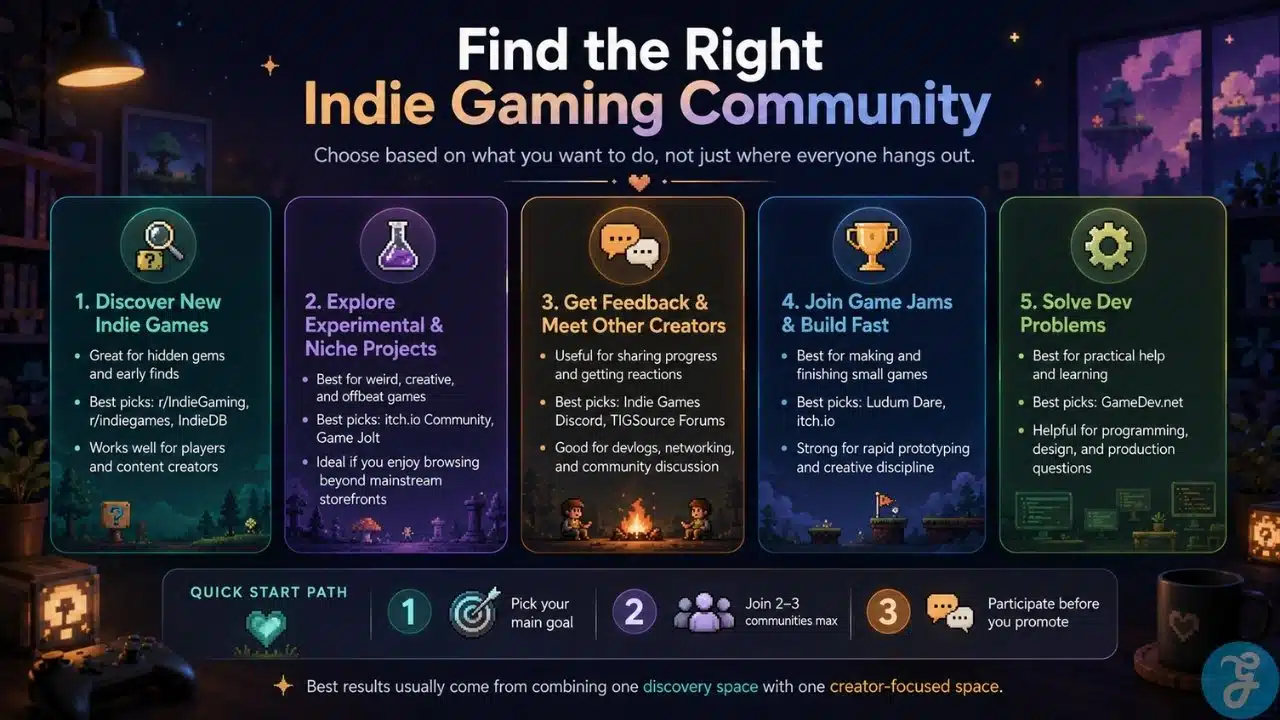
Not every community serves the same purpose. The right choice depends on whether you want to play more indie games, promote your own work, get critique, join jams, or solve development problems.
Overview Comparison Table
Use this quick snapshot to match each community with your actual goal before joining too many spaces at once.
| Community | Best For | Main Audience | Community Style | Usefulness Level |
| r/IndieGaming | Broad indie discovery | Players and developers | Reddit feed | High |
| r/indiegames | Game-focused showcases | Players and developers | Reddit feed | High |
| itch.io Community | Experimental games and jams | Creators and curious players | Forum/platform community | Very High |
| Indie Games Discord | Real-time feedback and networking | Developers and fans | Chat-based | High |
| Game Jolt Communities | Social indie/fandom culture | Gamers and creators | Social platform | Medium-High |
| IndieDB | Project pages and indie updates | Players, developers, press | Database/community hybrid | High |
| TIGSource Forums | Devlogs and indie history | Developers | Forum | Medium-High |
| Ludum Dare | Game jams and prototypes | Developers | Event-based community | High |
| GameDev.net | Technical game development help | Developers | Forum/resource hub | High |
The strongest approach is not joining everything. It is choosing two or three spaces that match your goal and actually participating well.
Our Top 3 Picks and Why?
For most readers, three communities stand out because they offer the best mix of discovery, usefulness, and accessibility.
| Rank | Community | Why It Stands Out |
| 1 | itch.io Community | It combines indie publishing, experimental discovery, game jams, and creator discussion in one ecosystem. |
| 2 | r/IndieGaming | It is one of the easiest places to quickly discover what indie developers are showing right now. |
| 3 | IndieDB | It gives projects a more structured presence, which helps players and creators follow games beyond one viral post. |
These are not automatically the “best” for every person, but they are the safest starting points for most indie gaming readers.
Choosing the Right Indie Gaming Community by Yourself
A community should solve a problem for you. If it only gives you more noise, more notifications, and more guilt for not posting enough, it is not helping.
The Selection Framework:
- Look at the posting culture: Choose spaces where people comment thoughtfully, not just drop links.
- Match the format to your goal: Use Discord for fast feedback, forums for searchable knowledge, Reddit for visibility, and jams for action.
- Check the promotion rules: A good indie community usually has boundaries around self-promotion.
- Watch the feedback quality: Helpful communities explain what works, what fails, and why.
The Final Checklist
Before you commit your time to any indie gaming community, run through this quick check.
- Does the community have recent posts or events?
- Are indie games actually the focus, or just a side topic?
- Do people give useful feedback instead of generic praise?
- Are the rules clear enough to reduce spam?
- Would you still browse it even if you had nothing to promote?
If the answer is mostly yes, the community is probably worth joining. If not, it may become another tab you open once and forget forever.
The Future of Indie Gaming Communities
The uncomfortable truth is that indie communities are doing more work than ever while getting less patience from users. Players want hidden gems, developers want visibility, platforms want engagement, and everyone is tired of spam. That tension is why the best indie gaming communities will probably become more selective, more moderated, and more purpose-driven over time.
The future will not belong to the biggest community automatically. It will belong to the spaces that can protect useful conversation from becoming a marketing landfill. Indie games need discovery, yes, but they also need honest critique, slow devlogs, playable prototypes, and people willing to care before a game becomes famous. That is still the magic of indie communities: they remind us that games are not born as products first. They start as experiments, arguments, mistakes, jokes, obsessions, and tiny playable miracles.
Frequently Asked Questions (FAQs) About Best Indie Gaming Communities
What are the best indie gaming communities for discovering new games?
Answer: r/IndieGaming, r/indiegames, itch.io Community, and IndieDB are the strongest starting points for discovery. They expose you to games before they are heavily marketed or widely covered.
Which indie gaming community is best for developers?
Answer: itch.io Community, Indie Games Discord, Ludum Dare, TIGSource Forums, and GameDev.net are especially useful for developers. Each serves a different purpose, from feedback and jams to devlogs and technical support.
Is Reddit good for indie game discovery?
Answer: Yes, but only if you use it carefully. Reddit communities can surface excellent indie projects, but you will also need to filter through self-promotion, unfinished demos, and low-effort posts.
Are Discord communities better than forums for indie games?
Answer: Discord is better for fast conversation, but forums are better for searchable long-term knowledge. Developers usually benefit from using both: Discord for quick feedback and forums for deeper learning.
Should indie developers join every community on this list?
Answer: No. It is better to choose two or three communities and participate properly. Posting everywhere without understanding the culture usually looks like spam and rarely builds real support.





















