
Most aspiring founders do not need an MBA before starting. They need enough practical education to stop making avoidable early mistakes.
That means understanding customers before building, testing ideas before overcommitting, learning basic finance before hiring, thinking clearly about marketing, and knowing when a course is useful versus when it becomes another way to delay the work. The best free courses aspiring founders can take are not the ones with the fanciest certificates. They are the ones that help a founder think, test, sell, and decide better.
This list focuses on free startup courses, practical entrepreneur courses, and credible founder education free resources from well-known institutions and platforms. Some are best for startup fundamentals. Some are better for small-business planning, digital marketing, sales, or emerging-market entrepreneurship. None of them replaces talking to customers.
Our Selection Criteria
Before comparing the courses, the main filter was usefulness. A free course is not automatically worth a founder’s time just because it has a famous institution behind it.
The selected courses were judged on:
| Selection Factor | Why It Matters |
|---|---|
| Founder relevance | The course should help with real startup decisions, not only broad business theory |
| Free access | The course should offer free learning access, though some certificates or upgrades may cost money |
| Practical value | It should help with customer discovery, business planning, marketing, pitching, sales, or startup thinking |
| Credible provider | Preference went to universities, accelerators, official learning platforms, or recognized business education providers |
| Beginner fit | Aspiring founders should be able to start without advanced business experience |
| Global usefulness | The course should still help founders outside one country or startup hub |
| Actionability | The course should push founders toward testing and building, not just passive watching |
One important note: course access and certificate rules can change. Before enrolling, founders should check whether the learning content, certificate, graded assignments, or platform features are still free.
What Most Founder Course Lists Get Wrong
A founder can spend months “learning entrepreneurship” and still avoid the one thing that matters: testing whether people actually want the product.
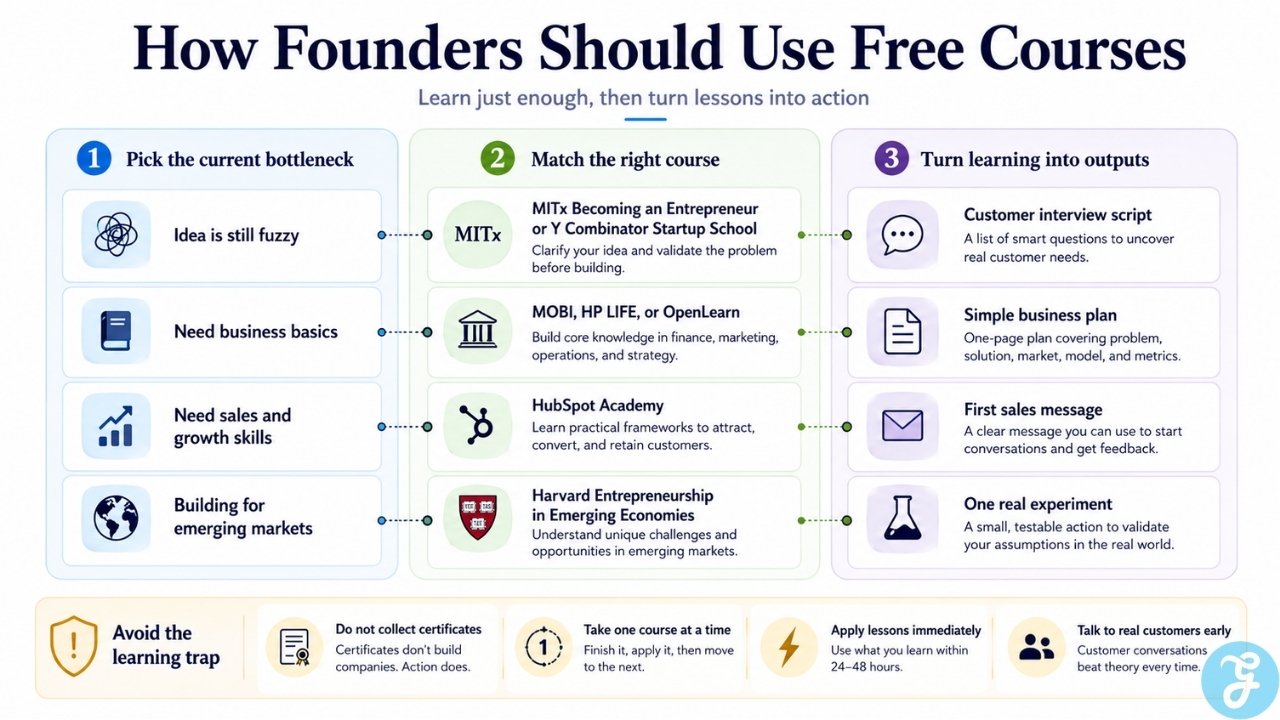
That is why the best way to use these courses is not to watch them like entertainment. Take one course, apply it to the current startup idea, and create evidence. If a module teaches customer research, schedule interviews. If it teaches business models, write down the current assumptions. If it teaches marketing, test one message with a real audience.
The goal is not to collect course names. The goal is to reduce confusion before expensive decisions.
7 Best Free Courses Aspiring Founders Should Consider
1. Y Combinator Startup School
Y Combinator Startup School is the strongest first choice for founders who want startup-specific education rather than general business theory. It is built around the way early-stage startups actually break: unclear ideas, weak MVPs, poor user understanding, fundraising confusion, and lack of weekly progress.
YC describes Startup School as a free online course on how to start a startup, with advice based on 15 years of YC knowledge, weekly accountability, and support for finding a co-founder. Its own page says the course is for anyone at the early stages of building a startup, turning a side project into a company, or learning about becoming a founder. It also says the course can be completed at your own pace in about seven weeks at one to two hours per week.
For aspiring SaaS founders, this is useful because YC’s material is direct about MVPs, startup funding, launch, sales, and the basic founder mindset. It is not a “small business admin” course. It is better for people who want to build a scalable startup, move quickly, and learn what investors and serious startup operators usually care about.
The limitation is that YC has a venture-scale bias. A founder building a slow, local, cash-flow-first business should still learn from it, but not copy every assumption. The course is strongest when the founder is trying to build something that can grow fast.
Start here if the startup idea is still messy but the founder wants a clear startup operating model.
2. MITx Becoming an Entrepreneur
MITx’s Becoming an Entrepreneur is a better fit for someone who is curious about entrepreneurship but not yet ready for an intense startup accelerator-style curriculum. It teaches the business skills and startup mindset needed to begin the entrepreneurial journey, using tools and methods from MIT Launch.
The course page says it is designed for people of all ages and backgrounds and covers business ideas, market research, choosing a target customer, designing and testing an offering, business logistics, pitching, and selling to customers. It also says no previous business or entrepreneurship experience is needed.
That makes it useful for early founders who still need a structured introduction. It is less intimidating than jumping straight into investor decks, cap tables, and venture funding. A founder can use it to learn how to turn an idea into a testable concept before trying to sound like a startup expert.
The practical value is in the exercises. If a founder only watches the videos, the course may feel motivational. If they actually do the market research and testing work, it becomes much more useful.
This is one of the better entrepreneur courses for beginners who need confidence, structure, and a starting path.
3. Harvard Entrepreneurship in Emerging Economies
Harvard’s Entrepreneurship in Emerging Economies is useful for founders who want to understand opportunity in markets where infrastructure, institutions, regulation, access, and social problems shape how businesses work. It is not a simple “how to start a company” course. Its value is in helping founders think about problem-solving in complex environments.
Harvard’s course page lists the course as online, self-paced, introductory, six weeks long, and available to audit for free, with a paid verified certificate option. It is taught by Harvard Business School professor Tarun Khanna and focuses on how entrepreneurship and innovation tackle complex social problems in emerging economies.
This course is especially useful for founders in Asia, Africa, Latin America, the Middle East, and other markets where copying Silicon Valley playbooks often fails. A founder building in Bangladesh, India, Nigeria, Indonesia, Kenya, or similar environments may need to think more carefully about distribution, trust, payment behavior, informal systems, and institutional gaps.
The course may feel less tactical than YC Startup School or HP LIFE. It will not hand a founder a weekly startup checklist. But it can improve the way founders identify problems worth solving.
Choose this if the startup is tied to emerging markets, social infrastructure, healthcare, education, financial access, logistics, public systems, or other complex market gaps.
4. MOBI Starting a Business
Santa Clara University’s My Own Business Institute, or MOBI, is a practical option for first-time founders who need basic business structure. It is less “venture startup” and more “how do I actually start and organize a real business?”
MOBI describes itself as a provider of free online business courses with no prerequisites and no fees. Its Starting a Business course includes 15 sessions and covers choosing a business, writing a business plan, business organization, financing, accounting and cash flow, controlling costs, licenses and permits, marketing, ecommerce, and selling. Students can earn a Certificate of Completion and Digital Badge from MOBI and Santa Clara University by meeting the course requirements.
This is useful for founders who are not yet ready for advanced SaaS metrics or venture funding. It helps with the boring but necessary parts of business formation and planning. For many first-time founders, that is exactly the missing piece.
The limitation is that some material is more small-business oriented than startup-specific. A SaaS founder should not treat every lesson as a perfect fit. Still, the basics of finance, business planning, risk, selling, and operations matter for almost every founder.
MOBI is a good choice when the founder needs practical business foundations before chasing startup terminology.
5. HP LIFE Starting a Small Business
HP LIFE’s Starting a Small Business course is a practical, lightweight option for founders who want simple business planning help without committing to a long academic program. It is part of HP LIFE’s free entrepreneurship course catalog, which includes topics such as starting a small business, social entrepreneurship, growth engines, design thinking, inventory management, strategic planning, and IT for business success.
The Starting a Small Business course focuses on the steps needed to start a small business, create a business plan, and analyze metrics to measure success. HP LIFE also says its broader platform provides free business and digital skills training for learners worldwide.
This course is useful for founders who need a simple starting point and do not want to be buried under venture jargon. It also works well for service businesses, small ecommerce ideas, local businesses, and early founders who are still learning business basics.
For SaaS founders, the course may feel too broad. It will not go deep into SaaS pricing, churn, product-led growth, or venture fundraising. But it can help a founder build basic planning discipline.
Use this course when the immediate question is not “How do I raise a seed round?” but “How do I turn this idea into a structured business plan?”
6. OpenLearn Entrepreneurship From Ideas to Reality
OpenLearn’s Entrepreneurship from Ideas to Reality is one of the stronger free options for founders who want a more complete self-paced course without a platform paywall. It is built for people who want to understand how to set up and run a business, from generating ideas to choosing a business model and assessing the founder’s own skills and risk approach.
OpenLearn lists the course as free and says it offers a free statement of participation on completion. The course description says it uses case studies and covers business models, funding options, business types, location, skills, values, attitudes to risk, and practical advice from real entrepreneurs. The page also says the course was updated on March 3, 2026, includes eight sessions, and can be started without signing up, although signing in is needed to track progress and earn a free statement of participation.
This course is helpful for founders who want more than a short intro but less than a formal degree program. It is also useful for people who want to reflect on whether they are suited to the business they are trying to build.
The friction is time. At 24 hours, it is not the fastest option. A founder who needs a quick primer may prefer YC Startup School, MITx, or HP LIFE first.
Pick this course if the founder wants a structured free learning path and is willing to spend time on business models, funding, risk, and capability building.
7. HubSpot Academy Learning Paths for Startups
HubSpot Academy’s Learning Paths for Startups is not a traditional entrepreneurship course, but it fills a gap many founder education lists ignore: sales. A founder can understand business models, write plans, and build a product, then still fail because they cannot acquire customers.
HubSpot Academy says its startup learning paths feature hand-picked certifications, courses, and lessons to help startup teams grow. Its startup page includes paths such as Selling for Founders, which focuses on acquiring more customers and boosting startup revenue, and Scaling a Startup Sales Team, which covers talent pipeline, quotas, and sales process. The page also says HubSpot Academy learning is completely free.
This is especially useful for SaaS and B2B founders. Early sales often cannot be outsourced. The founder needs to understand prospecting, positioning, discovery calls, follow-up, pipeline, and customer objections before hiring salespeople.
The limitation is that HubSpot’s ecosystem naturally connects to its own CRM and inbound marketing world. Founders should learn the sales logic without assuming every answer requires a HubSpot tool.
Choose this when the company has an idea or product but needs customer acquisition discipline.
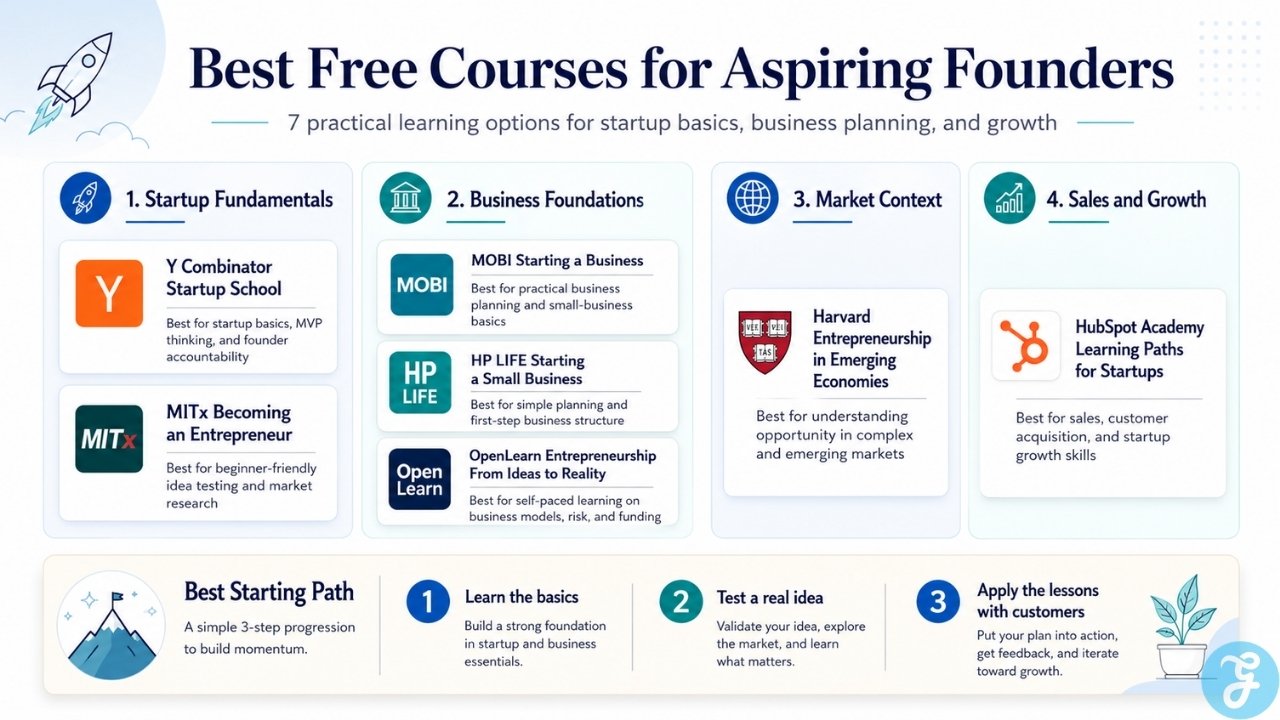
Quick Comparison
This overview helps separate the course fit before getting into the full recommendations.
| Course | Best For | Main Strength |
| Y Combinator Startup School | Venture-style startup founders | Startup fundamentals, accountability, MVP, fundraising, founder basics |
| MITx Becoming an Entrepreneur | Absolute beginners | Startup mindset, market research, idea testing, pitching |
| Harvard Entrepreneurship in Emerging Economies | Global and emerging-market founders | Opportunity evaluation and problem-solving in complex markets |
| MOBI Starting a Business | First-time business owners | Step-by-step business planning and small-business foundations |
| HP LIFE Starting a Small Business | Practical business beginners | Business planning, entrepreneurial thinking, metrics |
| OpenLearn Entrepreneurship from Ideas to Reality | Founders who want structured self-paced learning | Business models, funding options, risk, capabilities, pitching |
| HubSpot Academy Learning Paths for Startups | Founders learning sales and startup growth | Founder sales, customer acquisition, startup sales team basics |
The best course depends on the founder’s current gap. A SaaS founder trying to validate a product does not need the same course as someone learning how to write a first business plan.
Which Free Course Should Aspiring Founders Take First?
After comparing the options, the best starting point depends on the founder’s stage.
If the founder wants startup fundamentals and may build a venture-scale company, start with Y Combinator Startup School. If the founder is still exploring entrepreneurship and needs a beginner-friendly introduction, MITx Becoming an Entrepreneur is easier to enter.
If the founder is working in emerging markets or solving complex social and infrastructure problems, Harvard Entrepreneurship in Emerging Economies is more relevant than many generic Silicon Valley courses. If the founder needs practical business basics, MOBI and HP LIFE are better first choices.
OpenLearn is useful when the founder wants a fuller self-paced business-building course. HubSpot Academy is the right move when the founder needs to learn sales and customer acquisition.
The best path for many founders would be simple: take MITx or YC first, use MOBI or OpenLearn for business structure, then use HubSpot when customer acquisition becomes the problem.
How Founders Should Use Free Courses Without Wasting Time
Free courses can create a dangerous illusion. They feel productive even when nothing in the startup changes.
A better approach is to connect every course to one startup output. After a customer discovery lesson, create an interview script and speak to five real people. After a business model lesson, write down the current revenue assumption. After a marketing lesson, test one landing page, email sequence, or sales message.
Founders should also avoid taking seven courses at once. Pick one based on the current bottleneck. Finish the useful parts. Apply them. Then move on.
Good founder education is not about collecting certificates. It is about building sharper judgment.
The Practical Takeaway
The best free courses aspiring founders can take are useful because they reduce early confusion. They help founders ask better customer questions, understand business basics, think about markets, create simple plans, and learn how sales actually works.
Start with the course that matches the current problem. Do not collect courses as proof of progress. Use them to make one real decision, run one real test, or speak to one real customer.
That is where founder education becomes useful. Not when it looks good on a profile, but when it changes how the company is built.
Frequently Asked Questions(FAQs) on Best Free Courses for Founder’s
Are free startup courses enough to become a founder?
Free startup courses are enough to learn the basics, but they are not enough to build a company by themselves. Founders still need customer conversations, product testing, sales attempts, financial discipline, and repeated decision-making under uncertainty.
Which free course is best for SaaS founders?
Y Combinator Startup School is the best first pick for many SaaS founders because it focuses on startup fundamentals, MVPs, launch, fundraising, and founder progress. HubSpot Academy is also useful once the SaaS founder needs sales and customer acquisition help.
Do free entrepreneur courses offer certificates?
Some do. MOBI offers a Certificate of Completion and Digital Badge when course requirements are met. OpenLearn offers a free statement of participation and digital badge on selected courses. Harvard’s course can be audited for free, but the verified certificate is paid. Founders should always check the latest certificate rules before enrolling.
Should founders take business courses or just start building?
They should do both, but not equally. A short course can help founders avoid obvious mistakes, but building and customer testing should begin early. A founder who keeps taking courses instead of validating the idea is probably using education as a delay tactic.
What is the best free founder education path for beginners?
A practical beginner path is MITx Becoming an Entrepreneur for mindset and idea testing, YC Startup School for startup fundamentals, MOBI or OpenLearn for business planning, and HubSpot Academy for sales. That sequence covers the basics without overwhelming the founder.