When it comes to keeping your home clean in 2026, the “green” aisle has moved far beyond vinegar and baking soda. Modern eco-friendly cleaners now offer the heavy-hitting performance of traditional brands without the harsh fumes or plastic waste.
However, with “greenwashing” at an all-time high, it’s harder than ever to tell which products are truly non-toxic and which are just wearing a clever costume. In this guide, we break down the 15 best eco-friendly cleaning products that actually work, backed by third-party certifications and real-world testing.
Quick Picks: Best Eco-Friendly Cleaning Products
If you’re in a rush, here are the top performers that stood out in our rigorous evaluation for safety, sustainability, and efficacy.
- Best Overall: Branch Basics The Concentrate — A single, human-safe formula that replaces every cleaner in your house.
- Best for Families: Puracy Multi-Surface Cleaner — Plant-derived, hypoallergenic, and tough on sticky toddler messes.
- Best Refill System: Blueland Clean Essentials — Elegant glass bottles and tiny tablets that eliminate single-use plastic.
- Best Laundry: Earth Breeze Eco Sheets — Liquidless, plastic-free sheets that dissolve instantly and save massive shelf space.
- Best Disinfecting Option: Force of Nature — An EPA-registered disinfectant you make at home using just salt, water, and vinegar.
What “Eco-Friendly,” “Non-Toxic,” and “Organic” Really Mean
In the world of cleaning, these terms are often used loosely. Because the FDA doesn’t regulate “natural” claims for cleaners the way they do for food, consumers must look deeper than the label.
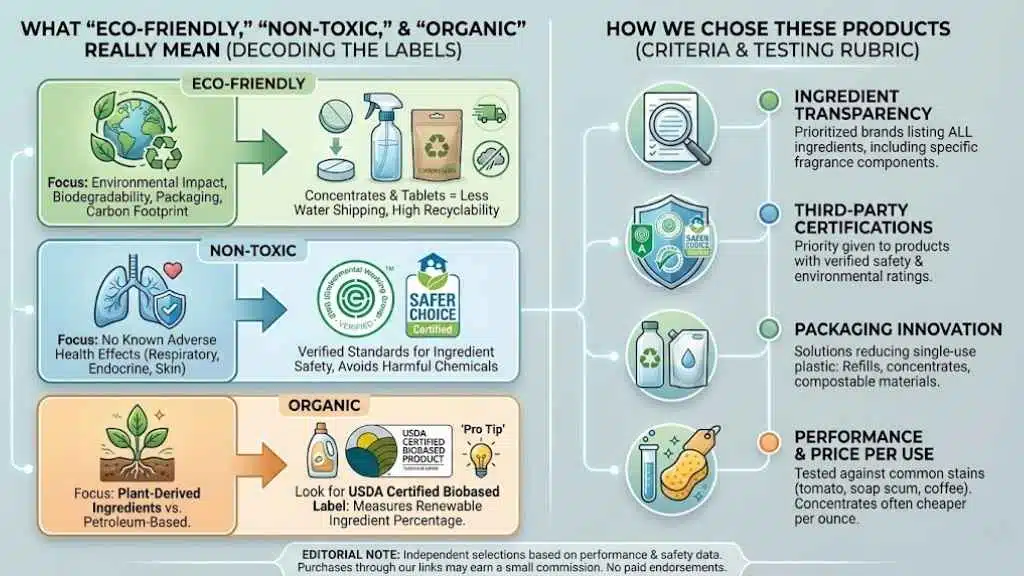
Eco-Friendly
This generally refers to the environmental impact. It includes factors like biodegradability, whether the packaging is recyclable or compostable, and the carbon footprint of shipping (concentrates and tablets score high here because they don’t ship heavy water).
Non-Toxic
A “non-toxic” product should not contain ingredients known to cause adverse health effects, such as respiratory irritation, endocrine disruption, or skin allergies. However, since there is no legal definition, we rely on the EWG (Environmental Working Group) and EPA Safer Choice standards to verify these claims.
Organic
Be careful here: while an apple can be “USDA Organic,” it is rare for a multi-surface spray to be 100% organic. In cleaning, “organic” usually means the ingredients are plant-derived rather than petroleum-based.
Pro Tip: Look for the USDA Certified Biobased label. This measures the percentage of renewable biological ingredients in the bottle.
How We Chose These Products (Criteria & Testing)
To provide a transparent recommendation, we used a multi-point rubric to separate the marketing hype from the high performers.
- Ingredient Transparency: We prioritized brands that list all ingredients, including the specific components of “fragrance.”
- Third-Party Certifications: Products with EPA Safer Choice, Green Seal, or EWG “A” ratings were given priority.
- Packaging Innovation: We looked for solutions that reduce or eliminate single-use plastic, such as refills, concentrates, or compostable materials.
- Performance: We tested these against common household “villains”—dried tomato sauce, bathroom soap scum, and laundry stains like grass and coffee.
- Price Per Use: While eco-brands can have a higher upfront cost, concentrates often end up being cheaper per ounce than traditional big-box cleaners.
Editorial Note: We maintain full independence. If you purchase through our links, we may earn a small commission, but our selections are based solely on performance and safety data.
15 Best Eco-Friendly Cleaning Products
All-Purpose & Multi-Surface Cleaners
1. Branch Basics The Concentrate
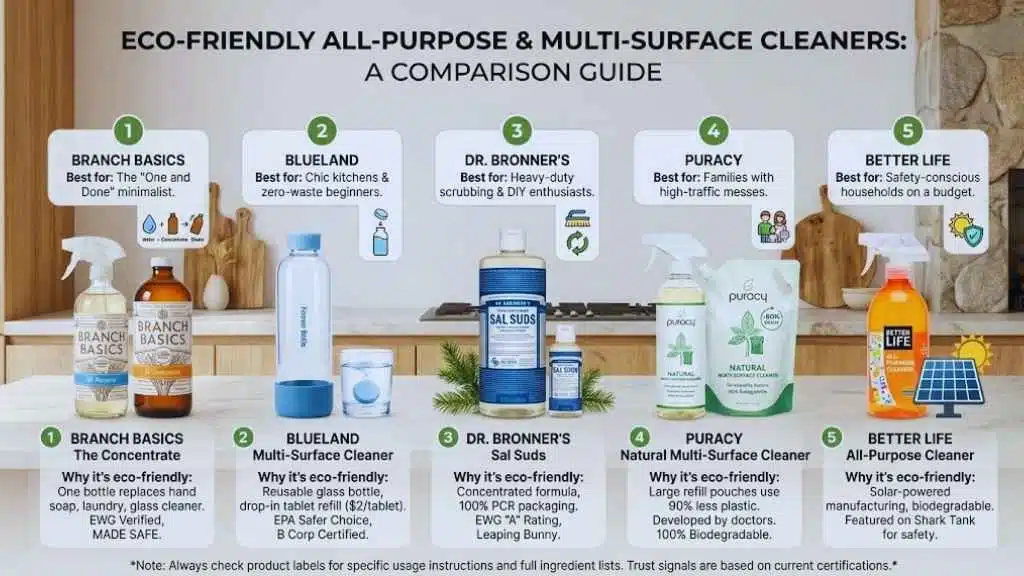
Best for: The “One and Done” minimalist.
Why it’s eco-friendly: One bottle of concentrate replaces your hand soap, laundry detergent, glass cleaner, and all-purpose spray.
Ingredient notes: Fragrance-free, non-GMO, and biodegradable.
Trust signals: EWG Verified, MADE SAFE certified.
- Pros: Ultra-safe for pets and babies; incredible value over time.
- Cons: Higher initial cost; requires mixing your own dilutions.
- How to use: Fill the designated Branch Basics spray bottle with water to the line, add concentrate, and shake.
2. Blueland Multi-Surface Cleaner
Best for: Chic kitchens and zero-waste beginners.
Why it’s eco-friendly: You buy the glass bottle once and drop in a small tablet for every refill.
Ingredient notes: No parabens, phosphates, or VOCs.
Trust signals: EPA Safer Choice, B Corp Certified.
- Pros: Beautiful aesthetic; zero plastic waste; very affordable refills ($2/tablet).
- Cons: Tablets take a few minutes to fully dissolve.
- How to use: Drop one tablet into 16oz of warm water in the “Forever Bottle.”
3. Dr. Bronner’s Sal Suds
Best for: Heavy-duty scrubbing and DIY enthusiasts.
Why it’s eco-friendly: Concentrated formula with 100% post-consumer recycled packaging.
Ingredient notes: Plant-based surfactants; scented with natural fir and spruce oils.
Trust signals: EWG “A” Rating, Leaping Bunny (Cruelty-Free).
- Pros: Cuts through grease better than almost any “natural” soap; a little goes a very long way.
- Cons: Strong scent may be too much for those with sensitive noses.
- How to use: Dilute 1 tablespoon in a gallon of water for general cleaning.
4. Puracy Natural Multi-Surface Cleaner
Best for: Families with high-traffic messes.
Why it’s eco-friendly: Offers large refill pouches that use 90% less plastic.
Ingredient notes: Developed by doctors; uses green tea and lime for a fresh, non-synthetic scent.
Trust signals: 100% Biodegradable ingredients.
- Pros: Streak-free on glass and stainless steel; safe for granite.
- Cons: Refill pouches are still plastic (though reduced).
- How to use: Spray directly on surface and wipe with a microfiber cloth.
5. Better Life All-Purpose Cleaner
Best for: Safety-conscious households on a budget.
Why it’s eco-friendly: Solar-powered manufacturing; biodegradable formula.
Ingredient notes: Free of SLS, petroleum solvents, and synthetic fragrances.
Trust signals: Featured on Shark Tank for its safety (the founder famously sprayed it in his mouth).
- Pros: Very effective on grease; widely available in stores.
- Cons: Standard plastic spray bottle (unless you buy bulk).
- How to use: Spray and wipe; no rinsing required.
Kitchen & Dish
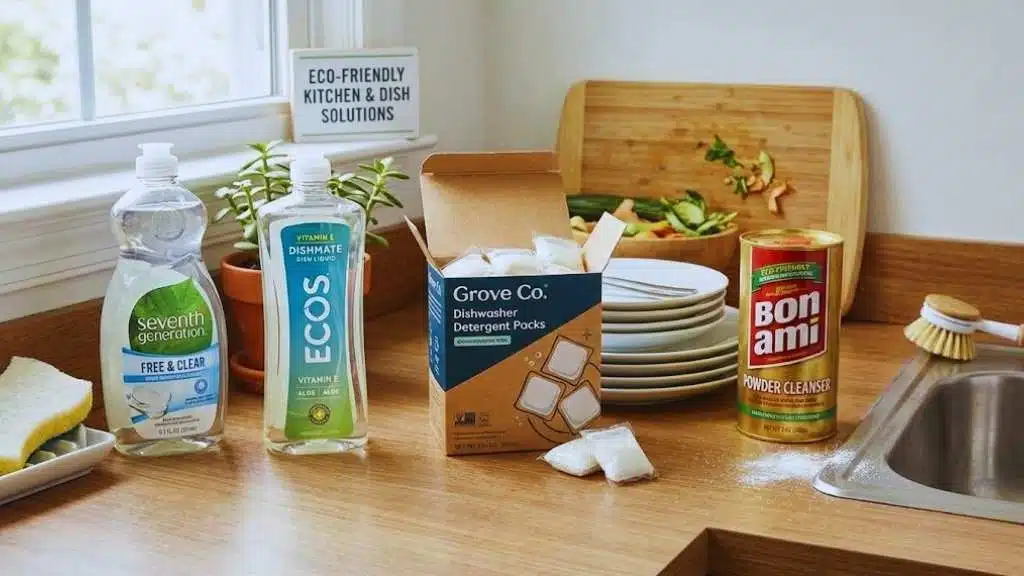
6. Seventh Generation Dish Liquid (Free & Clear)
Best for: High performance without the “perfume” smell.
Why it’s eco-friendly: 100% recycled plastic bottles; bio-based formula.
Ingredient notes: No dyes or synthetic fragrances; uses plant-derived cleaning agents.
Trust signals: EPA Safer Choice, USDA Certified Biobased (95%).
- Pros: Cuts grease as well as Dawn; hypoallergenic.
- Cons: Not a “zero-waste” refill system.
7. ECOS Dishmate Dish Liquid
Best for: Sensitive skin and budget-friendly shopping.
Why it’s eco-friendly: Manufactured in “Climate Positive” facilities.
Ingredient notes: Vitamin E and Aloe included to protect hands.
Trust signals: EPA Safer Choice.
- Pros: Very affordable; large 25oz bottles last a long time.
- Cons: Thinner consistency than some users prefer.
8. Grove Co. Dishwasher Detergent Packs
Best for: Sparkling dishes without the plastic film.
Why it’s eco-friendly: Plastic-free packaging; enzyme-based cleaning.
Ingredient notes: No phosphates or chlorine bleach.
Trust signals: B Corp Certified.
- Pros: Effectively removes 24-hour stuck-on food.
- Cons: Must be stored in a dry place to prevent sticking.
9. Bon Ami Powder Cleanser
Best for: Scouring sinks and removing “burnt-on” messes.
Why it’s eco-friendly: Simple mineral-based ingredients (feldspar and baking soda).
Ingredient notes: No chlorine, phosphorus, or perfume.
Trust signals: Time-tested since 1886.
- Pros: Non-abrasive (won’t scratch); extremely cheap.
- Cons: Requires “elbow grease” and rinsing.
Bathroom & Tough Jobs
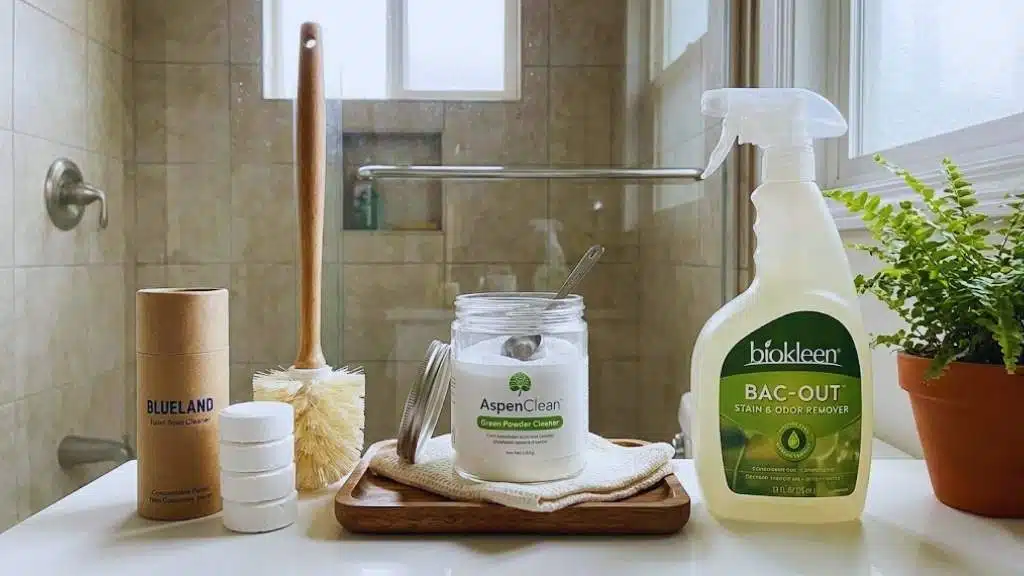
10. Blueland Toilet Bowl Cleaner Tablets
Best for: Eliminating the blue plastic bottle.
Why it’s eco-friendly: Plastic-free tablets; compostable paper packaging.
Ingredient notes: Bio-based; no harsh bleach fumes.
Trust signals: EPA Safer Choice.
- Pros: Fun “fizzy” action; effectively removes rings.
- Cons: Requires a toilet brush (not a “drop and forget” product).
11. AspenClean Green Powder Cleaner
Best for: Grout and heavy soap scum.
Why it’s eco-friendly: 100% natural, mineral-based, and plastic-free.
Ingredient notes: Scented only with organic tea tree and lavender.
Trust signals: EWG Verified (Straight “A”).
- Pros: The most “human-safe” abrasive cleaner on the market.
- Cons: Harder to find in local stores (mostly online).
12. BioKleen Bac-Out Stain & Odor Remover
Best for: Pet accidents and smelly drains.
Why it’s eco-friendly: Uses live enzyme cultures instead of harsh chemicals.
Ingredient notes: No artificial fragrances or dyes.
Trust signals: Family-owned; high EWG rating.
- Pros: Truly “eats” odors rather than masking them.
- Cons: Enzymes take time to work (don’t wipe away immediately).
Laundry & Disinfecting
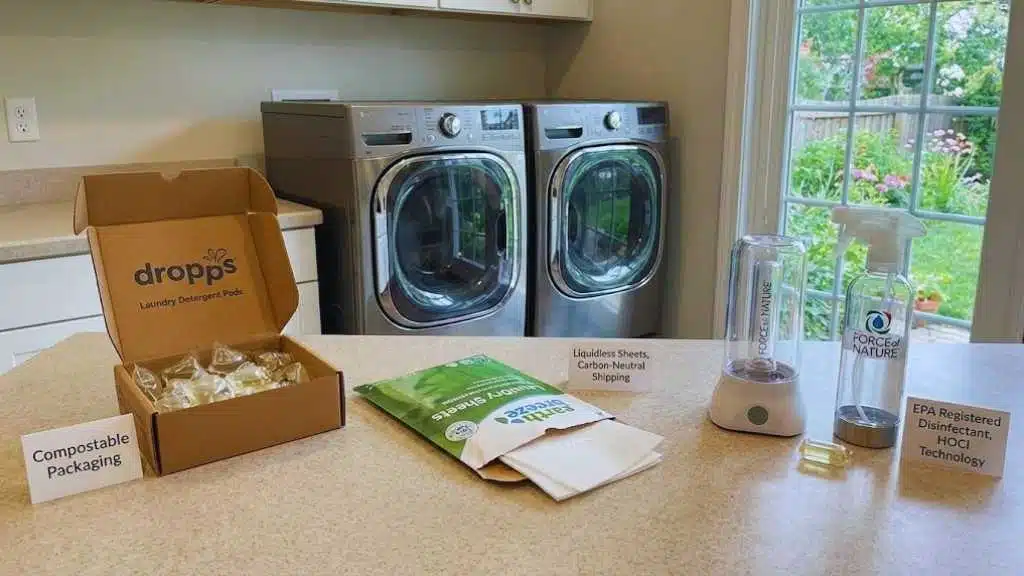
13. Dropps Laundry Detergent Pods
Best for: Convenient, mess-free washing.
Why it’s eco-friendly: Compostable cardboard packaging; water-soluble film.
Ingredient notes: Bio-based; available in “Sensitive Skin” fragrance-free version.
Trust signals: EPA Safer Choice.
- Pros: Powerful stain lifting; no bulky plastic jugs.
- Cons: Pods can occasionally fail to dissolve in very cold water.
14. Earth Breeze Laundry Sheets
Best for: Small apartments and travelers.
Why it’s eco-friendly: Liquidless sheets in a paper envelope; carbon-neutral shipping.
Ingredient notes: Paraben-free and vegan.
Trust signals: Certified “Climate Neutral.”
- Pros: Zero mess; weightless; saves massive storage space.
- Cons: Might need two sheets for extra-large or heavily soiled loads.
15. Force of Nature (Disinfectant)
Best for: Hospital-grade disinfecting without the toxicity.
Why it’s eco-friendly: Small reusable bottle; tiny salt/vinegar capsules.
Ingredient notes: Active ingredient is Hypochlorous Acid ($HOCl$).
Trust signals: EPA Registered Disinfectant (List N).
- Pros: Kills 99.9% of germs including COVID-19/Flu; safe for food surfaces.
- Cons: Solution only stays potent for two weeks; initial kit costs ~$80.
Ingredients to Avoid (And Why)
Even “natural” brands sometimes sneak in irritants. When reading labels, look out for these:
| Ingredient | Why it’s a problem |
| Phthalates | Often hidden in “Fragrance,” these are known endocrine disruptors. |
| VOCs (Volatile Organic Compounds) | Chemicals like ammonia that vaporize at room temperature, causing respiratory issues. |
| Quats (Quaternary Ammonium Compounds) | Found in disinfectants; linked to asthma and skin irritation. |
| Methylisothiazolinone (MIT) | A common preservative in “green” soaps that is a potent skin allergen. |
Do Eco-Friendly Cleaners Actually Work?
The short answer: Yes, but you have to use them correctly.
Most plant-based cleaners rely on surfactants to lift dirt and enzymes to break down proteins. Unlike harsh acids, these need a little more “dwell time.”
- Cleaning: Removing dirt and grease. (90% of your daily chores).
- Sanitizing: Reducing bacteria to safe levels.
- Disinfecting: Killing 99.9% of germs.
Rule of Thumb: You don’t need to disinfect your coffee table every day. Over-disinfecting can lead to “superbugs.” Use your all-purpose cleaners for daily life and save the Force of Nature for raw chicken spills or during flu season.
Final Thoughts
Transitioning to an eco-friendly cleaning routine is no longer a compromise between a healthy planet and a sparkling home. As we’ve explored, the best products of 2026—from the mineral-based simplicity of Bon Ami to the laboratory-grade safety of Force of Nature—prove that plant-derived ingredients can tackle the toughest grime. By choosing products with transparent labels and third-party certifications like EPA Safer Choice or EWG Verified, you aren’t just protecting the environment; you are significantly improving your indoor air quality and reducing your family’s daily exposure to unnecessary irritants and endocrine disruptors.
The most sustainable way to clean is to move away from the “one bottle per task” mentality. By investing in high-quality concentrates and refillable systems, you drastically reduce your plastic footprint and often save money in the long run. Remember, you don’t have to overhaul your entire cabinet in a single day. Start by swapping out your most-used bottle—perhaps your all-purpose spray or laundry detergent—and build your “core kit” from there. A cleaner home, a safer environment, and a smaller carbon footprint are all within reach, one refill at a time.