

In today’s digital world, having an online store is no longer an option—it’s a necessity. Whether you’re launching a startup or scaling an existing business, choosing the right e-commerce platform can significantly impact your success. But with so many choices available, how do you decide which one is best for your needs?
In this guide, we provide an in-depth analysis of the Best E-commerce Platforms Compared, discussing their pros, cons, features, pricing, and scalability.
By the end of this article, you’ll have a clear understanding of which platform aligns with your business goals.
How to Choose the Best E-commerce Platform?
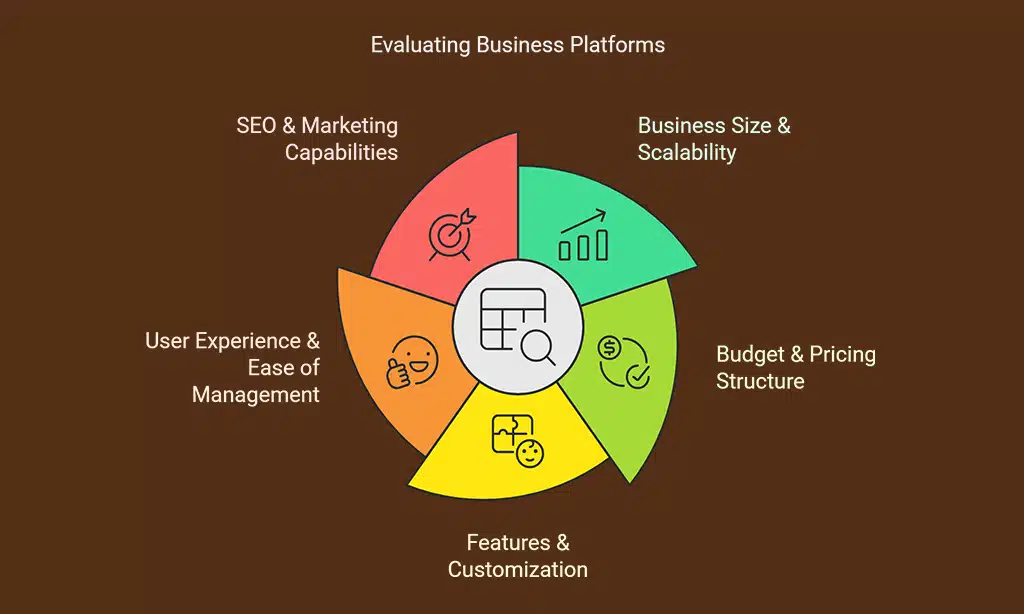
Selecting the right e-commerce platform depends on several factors. Here are key aspects to consider when comparing different options:
Business Size & Scalability
- Are you a small business, mid-sized company, or an enterprise?
- Does the platform support growth without costly upgrades?
Budget & Pricing Structure
- Does it offer a cost-effective plan for startups?
- Are there hidden transaction fees?
Features & Customization
- Do you need advanced customization options?
- Does it provide built-in marketing tools?
User Experience & Ease of Management
- Is it beginner-friendly?
- How intuitive is the dashboard and navigation?
SEO & Marketing Capabilities
- Does it support on-page SEO optimization?
- Can you integrate email marketing and social media tools?
Payment Gateway & Security
- Does it support multiple payment gateways?
- What security measures are in place for customer data protection?
The 7 Best E-commerce Platforms Compared
Choosing the right e-commerce platform is crucial for the success of an online business. Whether you’re a small business owner, a growing entrepreneur, or a large-scale retailer, selecting the best platform will determine your store’s functionality, scalability, and profitability.
In this section, we explore and compare the Best E-commerce Platforms Compared, helping you make an informed decision based on features, pricing, and overall performance.
1. Shopify
Shopify is one of the most popular e-commerce platforms, designed to help entrepreneurs set up and manage their online stores with ease. It offers a user-friendly interface, making it a great option for beginners. Shopify provides extensive customization options, a robust app marketplace, and built-in payment processing. However, it does charge transaction fees unless you use Shopify Payments. Despite its higher costs, the platform is a great choice for businesses looking for an all-in-one solution.
Key Features
- Drag-and-drop store builder
- Extensive app marketplace
- Mobile-optimized themes
Pros
- Easy to use for beginners
- Strong customer support
- Multiple payment options
Cons
- Transaction fees without Shopify Payments
- Limited free themes
2. WooCommerce
WooCommerce is a highly customizable open-source e-commerce platform that works seamlessly with WordPress. It is ideal for businesses that want complete control over their store’s design and functionality. While WooCommerce itself is free, users will need to purchase hosting, domain, and premium plugins for added functionality. It requires some technical knowledge, but it is an excellent option for those who prioritize flexibility and SEO.
Key Features
- Fully customizable open-source solution
- Works with WordPress
- Wide range of plugins and integrations
Pros
- Free to use (except hosting and extensions)
- SEO-friendly features
- High level of flexibility
Cons
- Requires some technical knowledge
- Hosting and security are user-managed
3. BigCommerce

BigCommerce is a powerful e-commerce platform designed for large businesses and enterprises. It offers extensive built-in features, eliminating the need for third-party apps. BigCommerce is well-known for its strong SEO capabilities, multi-channel selling options, and no transaction fees. However, its higher pricing and complexity may not be suitable for small businesses or beginners.
Key Features
- Built-in SEO and marketing tools
- No transaction fees
- Scalable for large businesses
Pros
- Supports multiple sales channels
- Highly customizable without coding
- Strong analytics and reporting tools
Cons
- Learning curve for beginners
- Higher pricing compared to some competitors
4. Wix eCommerce
Wix eCommerce is an intuitive and affordable option for small business owners and beginners. It features a drag-and-drop builder and AI-powered design tools, allowing users to create professional-looking stores quickly. While Wix eCommerce is user-friendly, it lacks some advanced customization features found in other platforms. It is best suited for small businesses with simpler e-commerce needs.
Key Features
- Drag-and-drop website builder
- AI-powered website design
- Built-in hosting and domain
Pros
- Simple setup for beginners
- Affordable pricing
- Good customer support
Cons
- Limited advanced customization
- Less suitable for high-volume stores
5. Magento (Adobe Commerce)
Magento, also known as Adobe Commerce, is a powerful platform best suited for enterprises and businesses that require extensive customization. It is an open-source platform, offering unlimited flexibility in terms of design and features. However, Magento requires coding knowledge and significant investment in hosting and development, making it less ideal for small businesses.
Key Features
- Advanced customization and flexibility
- Scalable for enterprise businesses
- Extensive developer support
Pros
- Powerful e-commerce capabilities
- Great for large businesses
- Strong SEO features
Cons
- Requires coding knowledge
- Expensive for hosting and development
6. Squarespace
Squarespace is an all-in-one website builder that offers visually stunning templates and built-in e-commerce tools. It is perfect for creative businesses, artists, and small brands looking for a simple yet elegant online presence. While Squarespace provides ease of use, it lacks the scalability and advanced e-commerce features of other platforms.
Key Features
- Visually stunning templates
- Built-in email marketing tools
- All-in-one website and e-commerce solution
Pros
- Beautiful, mobile-responsive designs
- Easy-to-use interface
- Good customer support
Cons
- Limited integrations compared to competitors
- Not ideal for large-scale stores
7. PrestaShop
PrestaShop is an open-source e-commerce platform offering a high level of customization for tech-savvy users. It is ideal for businesses that require flexibility without monthly fees. However, PrestaShop users need technical expertise to manage hosting, security, and customizations.
Key Features
- Open-source platform
- Multi-language and multi-currency support
- Extensive customization options
Pros
- No monthly fees
- Flexible and scalable
- Active community support
Cons
- Requires technical expertise
- Add-ons and modules can be costly
Takeaways
Choosing the best e-commerce platform is a crucial decision that depends on your business needs, technical expertise, and long-term goals. Each platform has its strengths and weaknesses, so it’s important to assess which one aligns best with your requirements.
- Best for Beginners: Shopify, Wix eCommerce
- Best for WordPress Users: WooCommerce
- Best for Large Businesses: BigCommerce, Magento
- Best for Creative Businesses: Squarespace
- Best for Tech-Savvy Entrepreneurs: PrestaShop
Before making a final decision, consider taking advantage of free trials and demos to experience the platform firsthand. With the right choice, you can create a seamless online shopping experience for your customers and set your business up for long-term success.






















