When AI joins the meeting, I want it to help us remember the discussion without quietly acquiring the authority to settle it. The decision still belongs to the person or committee authorized to make it. My concern is what happens between those two sentences: a generated recap becomes the record, the record becomes a task, and the task begins to look like evidence that everyone agreed.
I have tested AI meeting tools and encountered problems. That experience is a reason for caution, not a basis for claiming a universal failure rate. The specific limitations discussed here come from current product documentation; the management scenarios are illustrations of the risks I believe leaders should examine. I am not presenting them as a reconstruction of a particular client meeting.
As CEO of Tech Unico Solution Private Limited, I understand the appeal of shortening the work that follows a call. Nobody benefits from making an employee spend an evening reconstructing a discussion that software could help organize. But I would judge that software by a harder question than how quickly it produces a summary: can the team still establish what was actually approved?
That is the distinction I want managers to protect. A useful assistant can reduce clerical effort. It cannot supply missing consent, invent a decision owner or resolve an argument simply by leaving the argument out.
The problem I care about is the missing condition
Imagine a product meeting in which a team proposes bringing a launch forward, provided a security review is completed. The proposed date survives in the recap. The condition does not. Someone who missed the call sees a clear deadline and starts preparing customer announcements.
This is a hypothetical example. I use it because the failure is easy to understand without pretending that a particular vendor produced it in my tests. Everyone downstream could behave sensibly toward the document in front of them, while the company acts on permission that was never given.
I would be more concerned about that missing condition than an awkward sentence or a spelling mistake. A summary can be readable and still fail at the point that matters. “We could do this,” “we should investigate this,” and “we have approved this” carry different obligations. A responsible record must keep them apart.
Human minute-takers can make the same mistake. They can miss a quiet objection or favor the most senior voice. I do not want to romanticize manual notes. I want a correction process that works regardless of who—or what—wrote the first version.
There is a real benefit on the other side. A searchable, reviewable record can preserve a concern that otherwise disappears into memory. It can help an absent colleague catch up without asking the whole team to repeat the meeting. That benefit depends on keeping the record open to challenge.
The documented limits I would put in front of a team
Google Meet’s “Take notes for me” help page, checked on November 17, 2026, acknowledges that summaries can be incomplete, inaccurate or absent. It also documents support for one language at a time, rather than multiple languages spoken within the same meeting. These are vendor-stated limitations, not error rates measured in my testing.
For a team that switches languages during discussion, I would treat that second point as a deployment question. A successful English-language demonstration would not establish that the same setup can faithfully handle a mixed-language planning session. I would check the actual working language before relying on the output.
Microsoft’s Teams Facilitator documentation describes AI notes, summaries of decisions and open questions, and task-management capabilities. On the same review date, creating, updating and querying meeting tasks were identified as public-preview features, with created tasks syncing to a meeting plan. I would verify availability and configuration in the organization’s own environment.
My concern here is the permission boundary. A task appearing in a plan is not, by itself, evidence that the person with authority approved the underlying commitment. The closer a meeting assistant gets to systems that execute work, the more carefully I would separate a suggestion from an instruction.
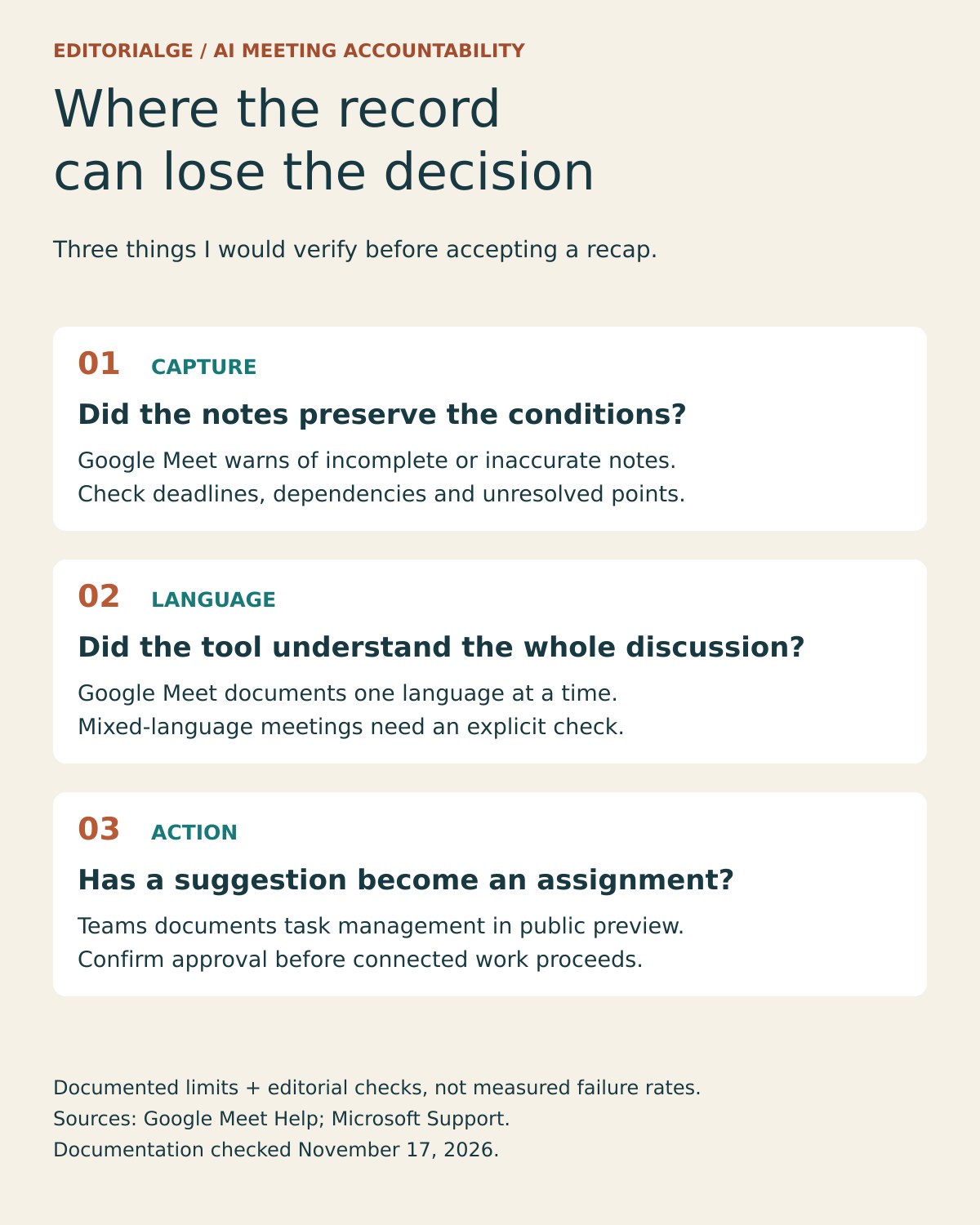
Those are the questions I would bring to a comparison of AI meeting assistants and note-takers. The best-looking recap is only one part of the buying decision. Correction rights, source access and control over follow-through deserve attention too.
When AI joins the meeting, I want a named decision owner
I find “human in the loop” an incomplete answer. Which human? The person who organized the call may be able to edit notes without having authority to approve a budget. The employee assigned a task may be responsible for delivering it without having agreed to the decision that created it.
I would separate three responsibilities: checking the record, authorizing the decision and carrying out the action. A small team may give all three jobs to one person. A larger organization may distribute them across several people. Either arrangement can work if the boundaries are explicit.
The US National Institute of Standards and Technology’s AI Risk Management Framework 1.0 calls for clear responsibilities, executive accountability for AI deployment risks and differentiated human–AI oversight roles. It is voluntary risk-management guidance. I draw a practical management lesson from it; I am not treating it as a ruling on legal liability.
Before an important item is closed, I want the approved choice, its scope, any conditions and the approving authority recorded. A limited pilot should remain a limited pilot. It should not turn into permission for a company-wide rollout because the summary describes the proposal with more confidence than the participants did.
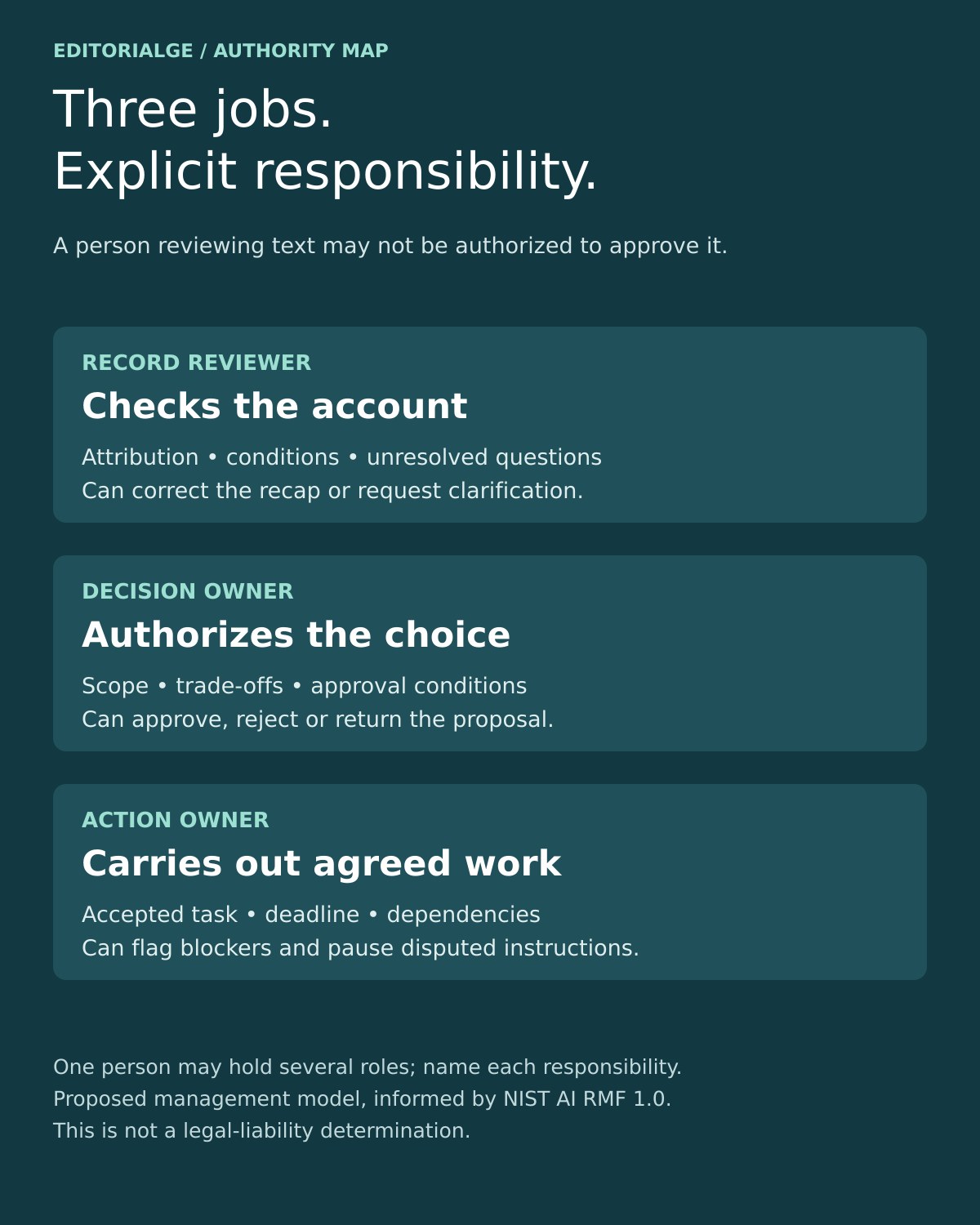
I would also make “not yet decided” a legitimate outcome. Software often gives us a satisfying sense of completion. A team needs permission to leave an unresolved issue unresolved, with a named next step, rather than converting uncertainty into an artificial consensus.
I would protect the time needed to disagree
A confirmation button is weak protection when the reviewer lacks time, context or authority. If an employee is expected to check summaries between back-to-back calls, management cannot assume that clicking “accept” means every attribution and dependency has been examined.
A CHI 2025 study by Hao-Ping Lee and colleagues surveyed 319 knowledge workers and analyzed 936 examples of generative AI use. Greater confidence in generative AI was associated with less self-reported critical thinking. The paper also described verification and oversight becoming important parts of the work. Carnegie Mellon includes the study in its CHI 2025 research listing.
I read that finding narrowly. It does not demonstrate that AI causes cognitive decline, and it did not measure meeting-summary accuracy. Microsoft Research participated in the study, which is relevant context. My takeaway is that placing a person after an AI output does not automatically produce meaningful scrutiny.
I would give reviewers a short, consequential set of questions: was the decision approved, were its conditions preserved, does the named executor accept the work, and is any material objection missing? That is more useful than asking someone to polish every sentence.
The organization must also make rejection possible. If leaders praise automatic follow-through but treat every request for clarification as resistance, they have already weakened the review process. The employee needs the power to return an item to discussion without being punished for using it.
This is where human judgment and communication at work become operational requirements. I want someone who can explain why a decision makes sense and what evidence would change it, not simply repeat the generated recap.
Disagreement needs a place in the record
I would not read silence as agreement. A participant may be outside their area of responsibility, still considering the proposal or reluctant to challenge a senior colleague. An agreement to investigate is not an agreement to implement.
Before closing a consequential item, I would ask what remains conditional and whether any objection changes the decision. The record should preserve the substance of that concern and the response. It need not become a permanent register of who challenged whom.
Access matters as much as wording. Google’s documentation makes clear that meeting-note access depends on sharing settings. I would check who can read the resulting document rather than assume that attendance, invitation and document access are identical.
My preference is a proportionate record: enough information to explain and revisit the decision, with access limited to the people who need it. I would not turn every informal conversation into an indefinitely searchable archive simply because storage and summarization are convenient.
For sensitive discussions, the organization should establish capture, access, retention and correction rules in advance. Those rules need to fit the circumstances and applicable requirements. An enthusiastic software rollout is not a substitute for that work.
The correction must reach the people already acting
The part I think managers are most likely to overlook comes after an error is found. Correcting the notes does not necessarily correct a task, a project deadline or a message drafted from an earlier version.
I would use the following operating model. It is my proposal for managing the work, not a claim that every meeting platform provides these controls automatically.
| Stage | What I would require | What may proceed |
|---|---|---|
| Draft recap | A reviewer checks attribution, conditions and unresolved points. | A provisional account goes to authorized readers. |
| Approved decision | The authorized owner confirms the choice and its scope. | The approval and conditions enter the decision record. |
| Assigned action | The executor accepts the task, deadline and dependencies. | Work proceeds within the approved scope. |
| Material correction | The owner rechecks affected approvals and alerts people using the old account. | Work resumes or changes after the correction is understood. |
For a small team, a shared decision log and a brief confirmation at the end of the call may be enough. A business connecting meeting output to customer or financial systems will need more explicit controls. I would apply the heavier checks where a mistake could create a consequential commitment.
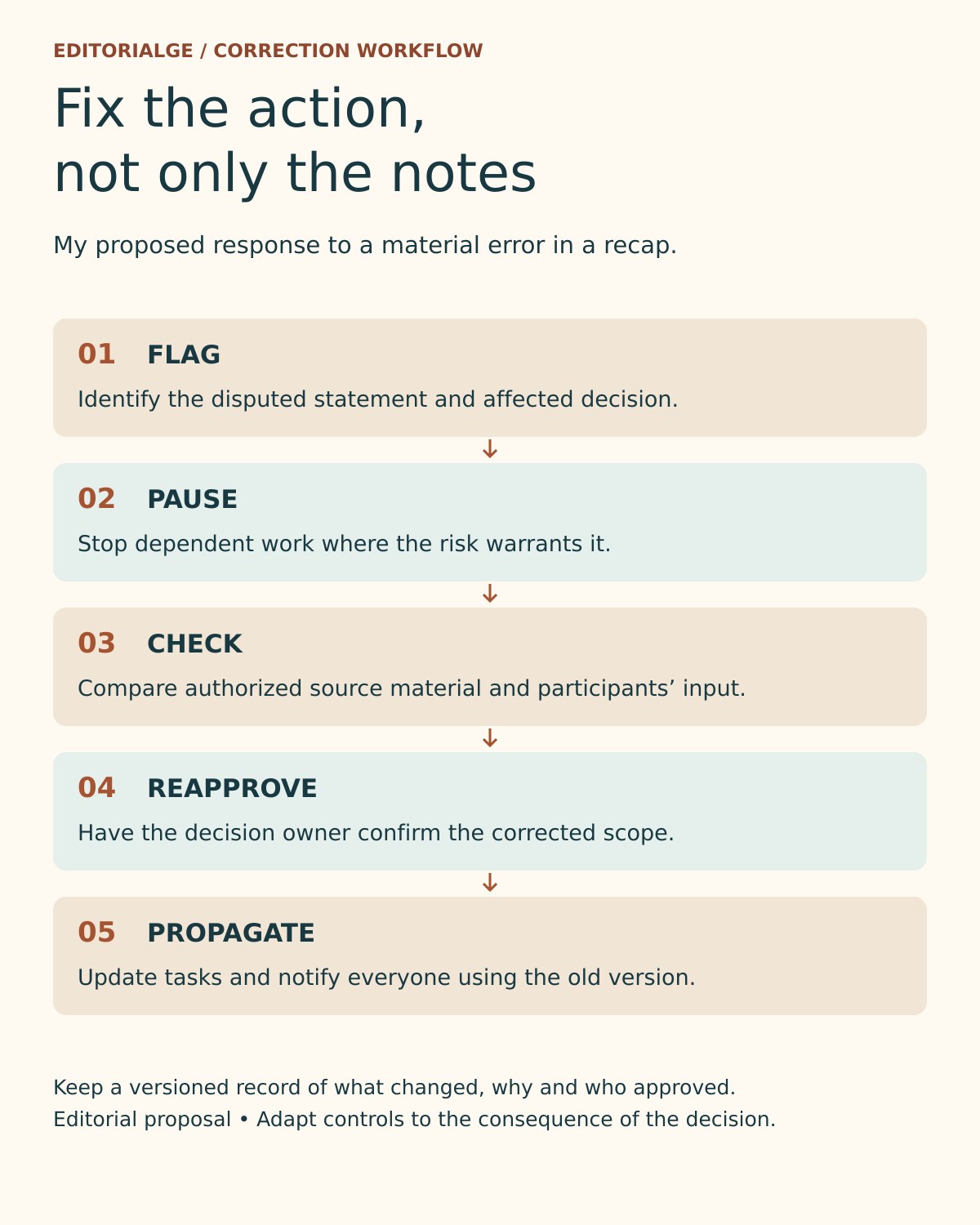
I would judge the process by whether a disputed decision can be reconstructed. Who approved it? Which conditions applied? Who acted on it? Did a later correction reach them? These questions tell me more about accountability than the number of minutes saved on transcription.
I cannot outsource the responsibility that comes with adoption
There is an unfair version of AI oversight in which management selects the software, reduces review time, encourages automatic execution and then blames the employee who accepted a faulty output. I would reject that arrangement.
As a leader, I have a responsibility to examine the conditions under which people make decisions. If the process gives them no realistic opportunity to check or challenge a recommendation, a nominal human approval offers little reassurance. Leadership cannot claim the efficiency gains while assigning all the resulting risk to the last person who clicked.
I still want AI in the meeting. I want help finding the relevant passage, remembering an unresolved question and preparing a useful first draft. I also want the organization to be able to show where assistance ended and human authorization began.
When AI joins the meeting, the final test is whether the people involved can still explain, challenge and correct the decision. If we cannot do that, we have improved the appearance of our records while weakening our ownership of what happens next.