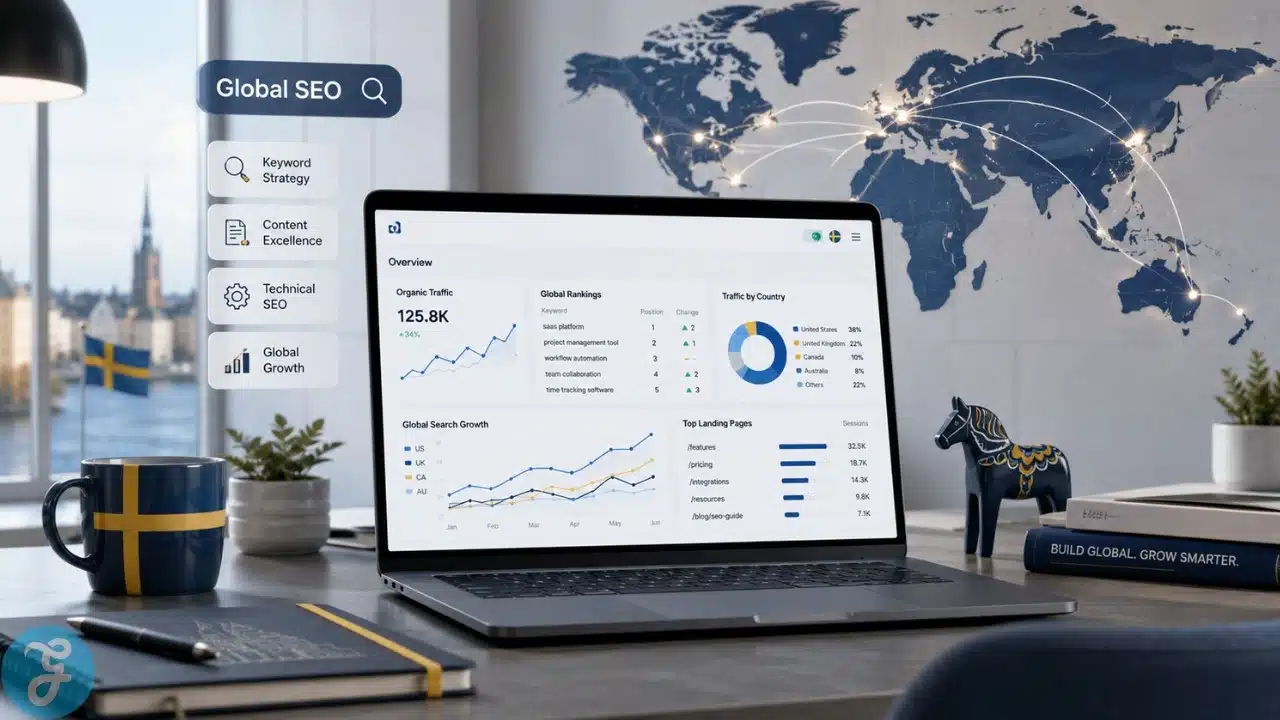
Sweden may be a small country by population, but its SaaS ambition has never been small. Swedish software companies often know from day one that their home market alone is not big enough to support global-scale growth. That reality has shaped a very specific mindset: build in Sweden, communicate in English, sell internationally, and use search demand as a growth engine. This is where English-Language SEO for Global Reach becomes more than a marketing tactic. For many Swedish SaaS companies, it is part of the export strategy.
Sweden also has structural advantages. The country has high English proficiency, a mature startup ecosystem, and a strong base of SaaS companies. StartupBlink ranked Sweden’s startup ecosystem 6th globally in 2025, while Stockholm ranked 24th among global startup ecosystems and 1st in Sweden. Latka’s Sweden SaaS database also listed hundreds of SaaS companies based in Sweden in May 2026, showing how deep the software ecosystem has become.
How We Selected Our 10 Essential Facts About Swedish SaaS SEO
To understand how Swedish SaaS companies use English-language SEO globally, I looked beyond generic “write blogs and rank on Google” advice. The focus here is on how SaaS companies from a smaller domestic market build international visibility, trust, and qualified demand through English-first content.
Here is the selection logic used for this guide.
| Selection Factor | Why It Matters |
|---|---|
| Global SaaS Relevance | Swedish SaaS companies often need international customers early |
| English-Language Advantage | High English proficiency makes global content creation easier |
| Search Intent Fit | SaaS buyers use search to compare tools, solve problems, and validate vendors |
| Product-Led SEO | Strong SaaS SEO connects content directly to product use cases |
| Technical SEO | Global SaaS sites need clean structure, speed, indexing, and conversion paths |
| Localization Strategy | English may lead, but regional adaptation still matters |
| Trust Signals | International buyers need proof, not just polished content |
| Commercial Value | SEO must support pipeline, not vanity traffic |
The facts below are written for founders, SaaS marketers, content strategists, and SEO teams that want to understand why Swedish SaaS brands often punch above their weight internationally.
Whom This Is For
This guide is useful for Swedish SaaS founders, B2B marketers, startup operators, SEO teams, and international growth managers.
It is especially relevant for:
- SaaS companies expanding beyond Sweden;
- early-stage startups building English-first content;
- B2B brands targeting U.S., UK, EU, and global buyers;
- founders comparing SEO with paid acquisition;
- marketers building product-led content strategies;
- content teams trying to turn technical expertise into global search visibility.
Now let’s break down the essential facts that explain how Swedish SaaS companies use English-language SEO to go global.
10 Essential Facts About English-Language SEO for Global Reach in Swedish SaaS
Swedish SaaS companies do not win global search visibility by accident. The strongest ones combine English fluency, niche positioning, clear product education, technical content, and international trust-building.
1. Swedish SaaS Companies Think Internationally Earlier Than Many Local-Market Startups
Swedish SaaS companies often operate with a “small home market, big global ambition” mindset. Sweden’s population is not large enough for most B2B SaaS companies to rely only on domestic demand, so international growth becomes a strategic necessity rather than a late-stage luxury. This makes English-language content more important from the beginning.
This mindset also explains why many Swedish SaaS websites prioritize English over Swedish when targeting global buyers. The goal is not only to be visible in Stockholm or Gothenburg. The goal is to show up when a buyer in London, Toronto, Berlin, Singapore, or New York searches for a product category, comparison, integration, or workflow solution.
Best for:
- Swedish SaaS startups planning international expansion
- Founders who want SEO to support early global demand
Why We Chose It:
- Sweden’s domestic market is limited compared with the U.S. or UK
- SaaS products often scale better when positioned internationally
- English content helps Swedish companies reach larger buyer pools
- Early global positioning reduces later rebranding and content migration work
Things to consider:
- Global SEO requires more competitive keyword research
- English-first content should still reflect product clarity, not generic international buzzwords
2. Sweden’s English Proficiency Gives SaaS Teams a Real Content Advantage
One of Sweden’s underrated SaaS advantages is language readiness. EF’s English Proficiency Index tracks countries and regions by English skills, and Sweden consistently appears among high-performing European markets. This matters because SaaS SEO depends heavily on clear educational content, product explainers, landing pages, comparison pages, developer documentation, and sales enablement copy.
For Swedish SaaS companies, English-language SEO is not always a massive linguistic leap. Many founders, marketers, engineers, and customer-facing teams can communicate effectively in English, making it easier to produce credible global content without sounding like a translated brochure.
Best for:
- SaaS teams with internal subject-matter experts
- Companies building English-first blogs, guides, and landing pages
Why We Chose It:
- Strong English skills reduce friction in global content production
- Technical teams can contribute to documentation and thought leadership
- Sales and marketing alignment becomes easier across English-speaking markets
- Content can feel native enough for international B2B buyers
Things to consider:
- Good English is not the same as strong SEO writing
- Swedish directness may need adaptation for markets that expect more persuasive sales copy
3. Product-Led SEO Helps Swedish SaaS Brands Compete Without Massive Ad Budgets
Many SaaS buyers search because they have a workflow problem, not because they want to read a company’s “vision.” Swedish SaaS companies that understand this use product-led SEO to connect search queries directly to use cases, templates, integrations, and practical solutions.
For example, a SaaS company should not only target broad keywords like “project management software” or “data platform.” It should also build pages around specific jobs users need to complete, such as “how to automate customer onboarding,” “best tools for revenue reporting,” or “CRM integration for SaaS support teams.”
Best for:
- B2B SaaS companies with clear product use cases
- Teams that want organic traffic to support trials, demos, and pipeline
Why We Chose It:
- Product-led SEO turns content into a sales-support asset
- Use-case pages attract buyers with stronger intent
- It helps smaller SaaS companies compete against larger brands
- It reduces overdependence on paid ads
Things to consider:
- Product-led content must be genuinely useful, not disguised sales copy
- SEO teams need close input from product, sales, and customer success
4. Swedish SaaS Companies Use English to Own Category Education
When a SaaS category is new, confusing, or technical, the company that explains it well often earns trust before the sales call begins. This is especially important for Swedish SaaS companies selling internationally from outside the buyer’s home market.
English-language educational content helps SaaS brands define their category, explain why the problem matters, and show how their product fits into a wider workflow. This is valuable for companies in areas such as fintech, cybersecurity, customer support, analytics, productivity, HR tech, and developer tools.
Best for:
- SaaS companies in complex or emerging categories
- Brands that need to educate buyers before they convert
Why We Chose It:
- Category education builds trust before a demo request
- English content gives Swedish brands access to global search demand
- Educational assets can support sales, onboarding, and investor visibility
- Clear explanations reduce buyer confusion
Things to consider:
- Category content can become too top-of-funnel if not linked to product pages
- Companies must update educational content as markets and terminology evolve
5. Global Search Intent Matters More Than Literal Keyword Translation
One of the biggest mistakes in international SEO is assuming that a Swedish keyword can simply be translated into English and used globally. That rarely works well. English-speaking SaaS buyers may use different terms, search patterns, comparison phrases, and problem language.
A Swedish SaaS company targeting global markets must research how buyers actually search in English. That includes:
- problem-aware queries;
- product-category queries;
- comparison searches;
- alternative-to searches;
- integration searches;
- pricing-related searches;
- template and workflow searches;
- “best software for” searches.
This is where English-Language SEO for Global Reach becomes strategic. The goal is not to speak English. The goal is to match global buyer intent in English.
Best for:
- SaaS companies entering the U.S., UK, Canada, Australia, or international B2B markets
- SEO teams rebuilding content for global demand
Why We Chose It:
- Search behavior differs across markets
- Literal translation often misses commercial intent
- Global buyers compare tools before contacting sales
- Better intent mapping improves content ROI
Things to consider:
- U.S. and UK keyword language may differ
- Search intent should be validated with SERP analysis, not assumptions
6. Swedish SaaS SEO Works Best When Content Is Built Around Use Cases, Not Just Keywords
A keyword alone does not create a strong SaaS page. A useful SaaS page needs to answer the buyer’s real question, show the workflow, explain the pain point, and connect the reader to a next step.
For Swedish SaaS companies, this means creating content clusters around use cases. A customer support SaaS company might build pages around ticket routing, AI agents, help desk automation, customer satisfaction, and support analytics. A data SaaS company might build around reporting automation, data pipelines, attribution, dashboards, and integration workflows.
Best for:
- SaaS companies building topic clusters
- Teams trying to rank beyond branded keywords
Why We Chose It:
- Use-case clusters build topical authority
- They support both SEO and sales enablement
- They help explain product value in business language
- They make internal linking more natural
Things to consider:
- Use-case content requires real product knowledge
- Thin keyword pages can hurt trust and conversion
7. Swedish SaaS Brands Need International Proof Signals to Convert Global Traffic
Ranking is only half the battle. International buyers may still ask: “Why should I trust a Swedish SaaS company I have never heard of?” This is why proof signals are crucial.
Strong Swedish SaaS websites often need visible trust elements such as:
- recognizable customer logos;
- case studies from multiple markets;
- security and compliance pages;
- integration partner pages;
- review platform ratings;
- funding or investor credibility;
- transparent pricing or demo expectations;
- localized customer stories where relevant.
Sweden’s startup ecosystem has strong global credibility, but individual SaaS brands still need to prove they can support international customers. StartupBlink’s 2025 ranking gives Sweden a strong ecosystem position, yet buyers still judge each vendor by product proof, customer outcomes, and market relevance.
Best for:
- Swedish SaaS brands targeting enterprise or mid-market buyers
- Companies getting traffic but struggling with conversion
Why We Chose It:
- International traffic needs trust signals
- Case studies reduce perceived vendor risk
- Compliance pages matter in B2B SaaS buying
- Proof improves demo and trial conversion
Things to consider:
- Generic testimonials are weaker than specific outcomes
- Proof should match the target market, not only the Swedish customer base
8. Technical SEO Is Critical Because SaaS Sites Grow Complicated Fast
SaaS websites often become messy. Product pages, blog posts, changelogs, documentation, help centers, comparison pages, glossary pages, integration pages, and localization folders can create indexing problems if not managed carefully.
Swedish SaaS companies targeting global traffic need strong technical SEO foundations. That includes:
- clean site architecture;
- fast loading pages;
- crawlable documentation;
- proper canonical tags;
- structured data where useful;
- clean URL structures;
- internal linking between product and content pages;
- clear indexation rules for help-center content;
- strong conversion paths from informational content.
This matters because SaaS SEO is not only about publishing more pages. It is about making sure Google can understand which pages matter and users can move from learning to evaluating.
Best for:
- Scaling SaaS websites with blogs, docs, and integrations
- Companies expanding into multiple regions or languages
Why We Chose It:
- SaaS websites can become technically complex
- Poor structure weakens rankings and conversions
- Documentation can become an SEO asset if managed well
- Technical SEO supports both discoverability and user experience
Things to consider:
- Help centers can create duplicate or low-intent traffic if unmanaged
- International SEO requires careful URL and hreflang planning when localization begins
9. Swedish SaaS Companies Often Blend English-First SEO With Selective Localization
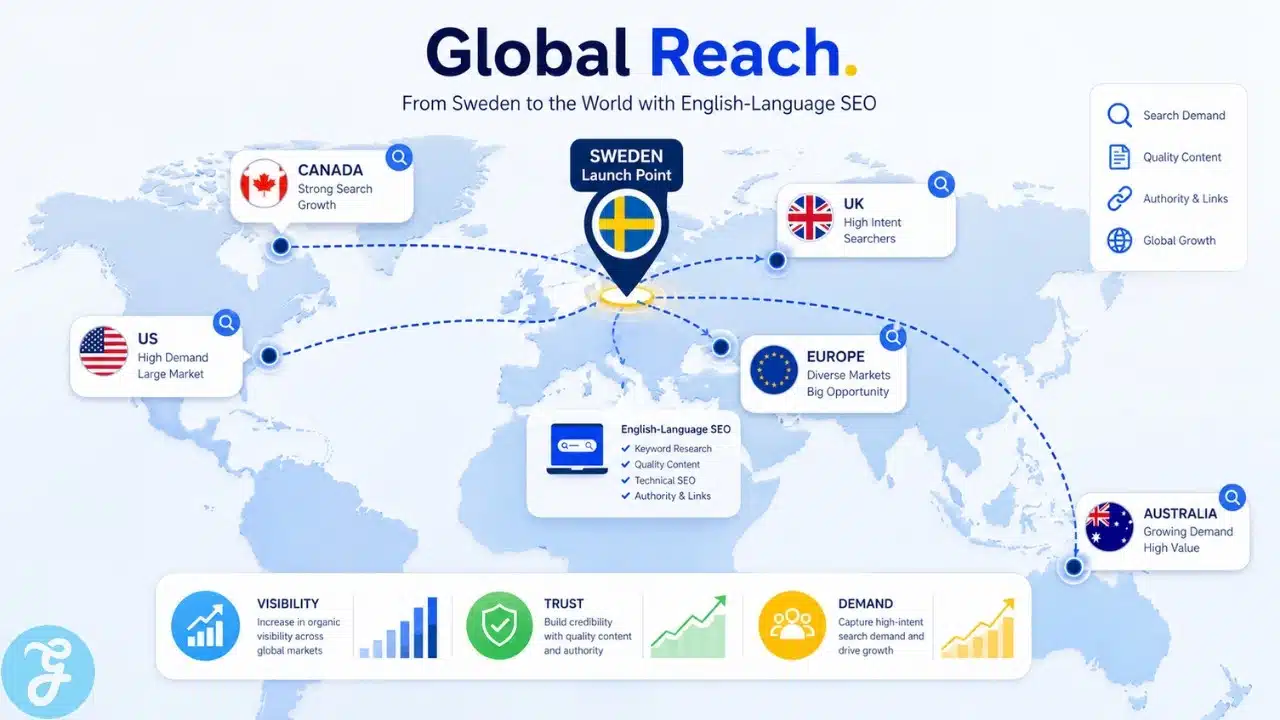
English may be the main global growth language, but it should not always be the only language strategy. Once a Swedish SaaS company sees traction in Germany, France, Spain, Japan, or another priority market, selective localization can improve conversion.
The smart approach is not translating everything. It is localizing the pages that matter most:
- homepage variants;
- product pages;
- high-converting landing pages;
- pricing pages;
- case studies;
- demo pages;
- help content for active customers;
- market-specific comparison pages.
This avoids the common trap of creating thousands of translated pages that nobody maintains.
Best for:
- Swedish SaaS companies with proven demand in specific non-English markets
- Teams moving from global English SEO to regional growth
Why We Chose It:
- English-first SEO helps companies test global demand
- Selective localization improves conversion in priority markets
- Localized proof can increase buyer trust
- It prevents translation overload
Things to consider:
- Poorly maintained localized pages can damage trust
- Localization should include search intent, not just language translation
10. The Best Swedish SaaS SEO Connects Organic Search to Revenue, Not Just Traffic
The final fact is the most important: global SEO must be measured by business outcomes. Swedish SaaS companies do not need traffic for the sake of traffic. They need qualified trials, demo requests, product signups, pipeline influence, expansion opportunities, and brand visibility in the right markets.
This means measuring:
- organic signups;
- demo requests from SEO pages;
- assisted conversions;
- product-qualified leads;
- branded search growth;
- content influence on sales cycles;
- conversion by country;
- content performance by funnel stage;
- rankings for commercial and comparison terms.
Sweden’s SaaS market has been valued in the billions by industry research, with projections showing continued growth through 2032. That growth makes SEO more competitive, not less. Swedish SaaS brands that connect search strategy to revenue will have a stronger advantage than those only chasing blog traffic.
Best for:
- SaaS leaders who want SEO tied to business growth
- Marketing teams reporting to founders, boards, or revenue leaders
Why We Chose It:
- Traffic alone does not prove SEO success
- Revenue-connected SEO earns more internal support
- Commercial pages often matter more than high-volume blogs
- Global growth needs country-level and funnel-level reporting
Things to consider:
- Attribution can be imperfect in long B2B sales cycles
- SEO should be evaluated alongside brand, sales, product, and customer success data
An Overview Of 10 Essential Facts About English-Language SEO for Global Reach
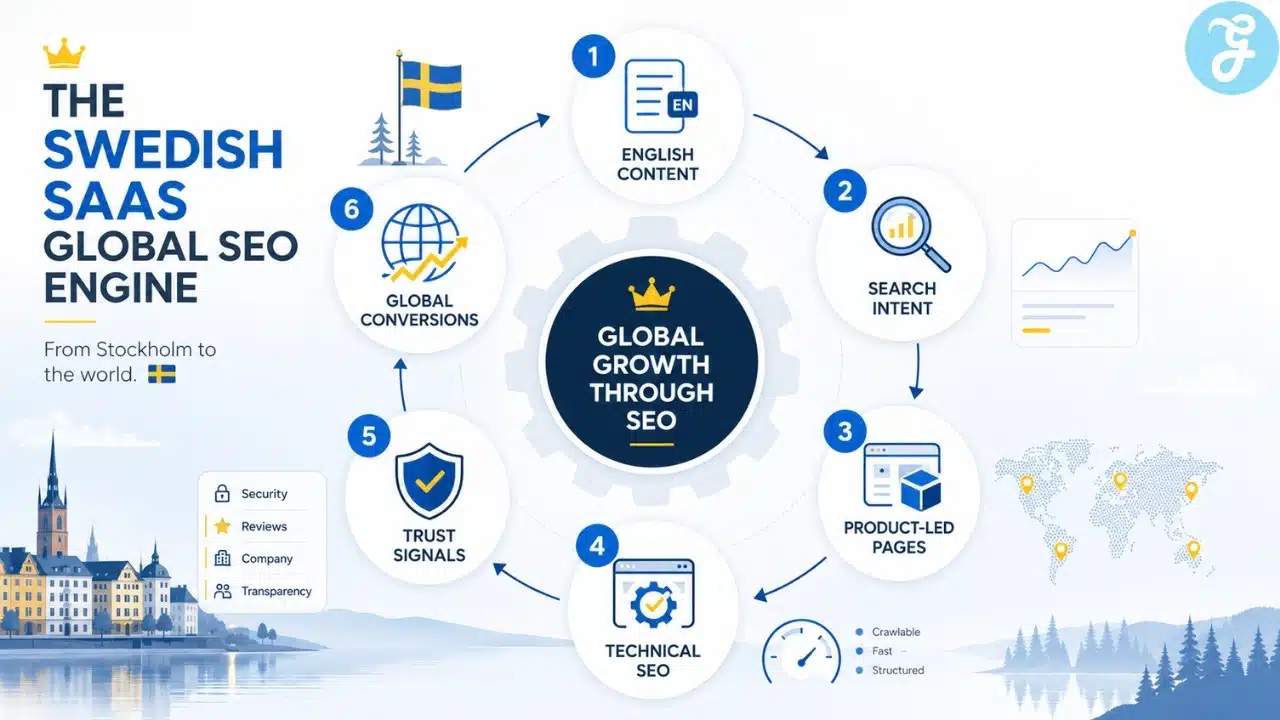
Swedish SaaS companies succeed globally when they treat English SEO as a growth system, not just a content calendar. The strongest approach combines international intent research, product-led content, technical SEO, trust-building, and selective localization.
Overview Comparison Table
Here is a quick comparison to help readers understand how each fact contributes to global SaaS growth.
| Fact | Main SEO Lesson | Business Impact |
|---|---|---|
| 1 | Think internationally early | Reduces dependence on the local market |
| 2 | Use Sweden’s English advantage | Makes global content easier to produce |
| 3 | Build product-led SEO | Turns content into pipeline support |
| 4 | Own category education | Builds trust in complex markets |
| 5 | Study global search intent | Avoids weak translation-based SEO |
| 6 | Build use-case clusters | Improves topical authority |
| 7 | Add proof signals | Converts international visitors |
| 8 | Strengthen technical SEO | Helps SaaS sites scale cleanly |
| 9 | Localize selectively | Improves conversion in priority markets |
| 10 | Tie SEO to revenue | Keeps SEO commercially meaningful |
The Bigger Lesson For Swedish SaaS Growth
Swedish SaaS companies have a natural reason to think globally. The domestic market is not usually enough, the startup ecosystem is strong, and English proficiency gives teams a real communication advantage. But global success does not come from writing English content alone.
The deeper lesson is that English-Language SEO for Global Reach works when it is connected to product strategy, buyer intent, technical execution, and proof. A company that explains its category clearly, ranks for real buyer problems, builds trust across markets, and guides visitors toward demos or trials can compete far beyond its home country.
The uncomfortable truth is that English SEO is also getting harder. AI-generated content has made generic SaaS blogs cheaper and noisier. That means Swedish SaaS companies cannot win with shallow listicles, keyword stuffing, or translated content that feels detached from the product. They need sharper expertise, better product education, stronger comparison pages, and clearer evidence.
The future belongs to SaaS companies that use English not just as a language, but as an international growth infrastructure.
Frequently Asked Questions (FAQs) About English-Language SEO For Global Reach
Why Do Swedish SaaS Companies Use English For SEO?
Swedish SaaS companies often use English because their target markets extend far beyond Sweden. English helps them reach global buyers, especially in B2B SaaS categories where international search demand is much larger than Swedish-language demand.
Is English-Language SEO Enough For Global SaaS Growth?
No. English-language SEO is a strong starting point, but companies may still need selective localization, regional proof, sales alignment, and market-specific landing pages once they enter priority countries.
What Type Of SEO Content Works Best For SaaS Companies?
Product-led content usually works best. This includes use-case pages, comparison pages, integration pages, templates, guides, and educational content that connects directly to product value.
Should Swedish SaaS Companies Translate Their Entire Website?
Not usually. A better approach is to start with English, validate market demand, and then localize high-value pages for specific countries where there is proven commercial opportunity.
How Should SaaS Teams Measure Global SEO Success?
They should measure demo requests, signups, product-qualified leads, pipeline influence, branded search growth, country-level conversions, and rankings for commercial keywords. Traffic matters, but revenue relevance matters more.