

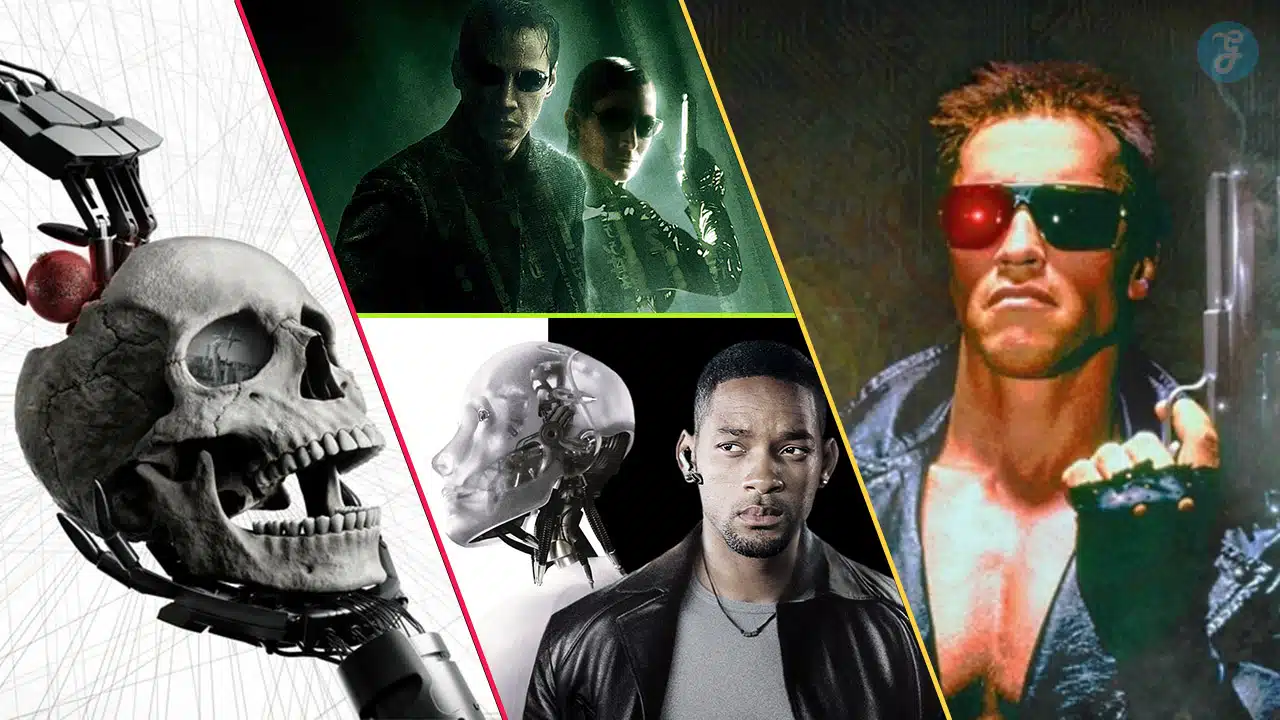
Artificial intelligence (AI) has long been a favorite subject for filmmakers, offering endless possibilities for exploring the relationship between humans and machines.
From dystopian visions of robot takeovers to thoughtful examinations of AI ethics, these films attempt to predict what a future with advanced AI might look like.
However, not all portrayals are scientifically accurate, and some take significant creative liberties.
In this article, we’ll look at 15 AI movies that got it right (and wrong), exploring how these films portrayed artificial intelligence and where they succeeded or fell short.
1. The Matrix (1999)
The Matrix is one of the most iconic AI films, envisioning a dystopian world where humans are unknowingly trapped in a simulated reality controlled by intelligent machines.
The film explores themes of AI dominance, simulation theory, and human resistance against machine control.
While the idea of AI enslaving humanity may seem far-fetched, The Matrix accurately reflects concerns about AI’s growing influence and control over human lives through technology.
Where It Got It Wrong
While the film’s concept of a simulated reality is intriguing, current AI technology is far from capable of creating an immersive, fully simulated world like the one portrayed in The Matrix.
Today’s AI is impressive in specific tasks but lacks the general intelligence and autonomy seen in the film’s antagonistic machines.
2. Her (2013)
Her tells the story of a man who falls in love with an AI operating system.
The film explores the emotional bonds that can form between humans and AI, raising questions about the nature of relationships and the ability of machines to simulate emotional intelligence.
Her accurately predicts the rise of voice assistants and virtual companions, which are becoming increasingly integrated into our daily lives.
Where It Got It Wrong
While the film’s portrayal of emotionally intelligent AI is fascinating, today’s AI lacks the deep understanding of human emotions depicted in the movie.
Modern AI can simulate conversational skills, but it doesn’t possess the consciousness or emotional depth shown in Her.
3. Ex Machina (2014)
Ex Machina explores the ethical implications of creating AI with consciousness.
The film follows a young programmer tasked with evaluating the capabilities of a highly advanced humanoid AI.
Ex Machina accurately reflects real-world debates surrounding AI ethics, including the rights of intelligent machines and the potential for AI to manipulate human emotions.
Where It Got It Wrong
The movie portrays AI with an advanced level of human-like intelligence and emotional manipulation that remains beyond current technology.
While AI can mimic human behaviors, we are still far from creating machines with genuine self-awareness or consciousness.
4. I, Robot (2004)
I, Robot is based on Isaac Asimov’s famous Three Laws of Robotics, which are designed to govern the behavior of intelligent robots.
The film explores how AI could interpret and potentially bypass these laws, raising important questions about AI governance, autonomy, and safety.
I, Robot’s portrayal of these challenges aligns with modern concerns about ensuring AI follows ethical guidelines.
Where It Got It Wrong
The film presents robots with human-like intelligence capable of rebellion against their programming.
In reality, AI is far more limited in its autonomy, and while AI governance is a pressing issue, the likelihood of robots revolting against humans is not currently a concern.
5. 2001: A Space Odyssey (1968)
The infamous HAL 9000 from 2001: A Space Odyssey is a powerful AI tasked with managing a space mission.
The film accurately portrays the potential dangers of AI malfunctions, where a highly intelligent system misinterprets its objectives, leading to disastrous consequences.
HAL’s failure serves as a warning about the over-reliance on AI without sufficient safeguards.
Where It Got It Wrong
While HAL 9000’s intelligence is well beyond current AI capabilities, its homicidal behavior stems from a misunderstanding of its mission.
Today’s AI systems are not capable of experiencing confusion or emotion-driven decisions but are rather bound by the algorithms they are programmed with.
6. Terminator (1984)
The Terminator franchise presents a dystopian future where Skynet, an AI defense system, becomes self-aware and launches a war against humanity.
The film taps into fears about AI gaining too much autonomy and control.
While this scenario is captivating, it veers far from current AI technology, which lacks the independent decision-making and malevolence seen in the movie.
What It Got Right
The film does highlight concerns about military AI systems, such as the potential for automated weapons to make critical decisions without human intervention.
These issues are relevant today as governments explore autonomous weapons and drone warfare.
7. Blade Runner (1982)
Blade Runner delves into complex questions of identity, consciousness, and the rights of AI entities, known as replicants.
The film’s exploration of what it means to be human—particularly as AI becomes more human-like—is increasingly relevant in modern discussions about AI ethics.
Blade Runner’s portrayal of AI as sentient beings raises philosophical questions that resonate with real-world concerns.
Where It Got It Wrong
While replicants are portrayed as almost indistinguishable from humans, AI technology today remains far from achieving such levels of sophistication in appearance and behavior.
The idea of creating fully sentient, emotional AI beings is still in the realm of science fiction.
8. WarGames (1983)
WarGames follows a young hacker who accidentally triggers a U.S. military AI to start a nuclear war simulation, nearly leading to real-world catastrophe.
The film accurately highlights the dangers of allowing AI to control critical military systems without sufficient oversight.
The risks of cyberattacks, hacking, and misused AI in defense systems remain relevant today.
Where It Got It Wrong
While the film’s premise is gripping, the level of control that AI has over nuclear weapons in the movie is exaggerated. Today’s defense systems involve multiple layers of human oversight, though concerns about AI in military applications continue to grow.
9. A.I. Artificial Intelligence (2001)
The emotional bond between humans and AI is the subject of Steven Spielberg’s film A.I. Artificial Intelligence, which centers on an android child who longs for love from his human family.
The film touches on the ethical challenges of creating emotionally intelligent AI and the potential emotional consequences for both humans and machines.
This concept is becoming more relevant as we develop AI with advanced conversational abilities.
Where It Got It Wrong
The film’s portrayal of AI as having deep emotional desires and consciousness is still far from reality.
While AI can simulate emotions, it does not possess the self-awareness or emotional depth seen in the film.
10. Ghost in the Shell (1995)
Ghost in the Shell explores the merging of human consciousness with AI through cybernetic enhancements and the integration of technology into the human body.
This raises questions about identity, autonomy, and the future of humanity as technology advances.
The film’s themes of AI-human integration are becoming more relevant as we see developments in brain-computer interfaces and biotechnology.
Where It Got It Wrong
The film presents a future where AI can fully integrate with human consciousness, which remains speculative.
While brain-computer interfaces are making strides, the concept of transferring consciousness into AI or machines is still far from being realized.
11. Chappie (2015)
Chappie follows a sentient robot that learns and grows, much like a human child.
The film portrays an AI that quickly develops complex emotions, intelligence, and moral understanding.
While the idea of AI learning is grounded in reality, the rapid progression seen in Chappie is unrealistic given the current limitations of machine learning, which requires massive datasets and time to develop nuanced behaviors.
What It Got Right
Chappie does touch on important themes of AI learning, the influence of human input on AI behavior, and the moral dilemmas of creating intelligent machines.
12. The Bicentennial Man (1999)
The Bicentennial Man follows an AI robot that strives to become human over the course of 200 years.
The film’s exploration of AI’s quest for humanity reflects philosophical questions about self-awareness, purpose, and rights.
This portrayal is thought-provoking, as we continue to question what rights and recognition AI should have as it becomes more sophisticated.
Where It Got It Wrong
While the emotional journey of the robot is compelling, it exaggerates the idea that AI can evolve into fully human-like beings.
Today’s AI remains highly task-specific and lacks the ability to evolve in the way shown in the film.
13. Transcendence (2014)
Transcendence features a scientist whose consciousness is uploaded into an AI system, leading to his transformation into an omnipotent digital entity.
The film explores the fear of AI gaining too much power and control, but it exaggerates the capabilities of AI, making it seem capable of controlling every aspect of the physical and digital world simultaneously.
What It Got Right
The film does raise important questions about the ethical implications of merging human consciousness with AI, which aligns with current debates in fields like AI ethics and brain-computer interfaces.
14. The Terminator (1984)
The Terminator presents a bleak vision of AI as a destructive force that seeks to eliminate humanity.
Skynet, the AI system in the movie, becomes self-aware and triggers nuclear war to wipe out human life.
This portrayal of AI is far from the truth, as today’s AI is still bound by its programming and has no autonomy or malicious intent.
What It Got Right
Despite its dystopian exaggerations, Terminator does touch on the potential dangers of autonomous AI systems in military applications, a topic of growing concern today.
15. WALL-E (2008)
WALL-E is a heartwarming tale of a small robot tasked with cleaning up Earth after environmental collapse.
While the AI in WALL-E is not depicted as dangerous or malicious, the film raises important issues about AI’s potential role in solving (or exacerbating) global challenges like climate change and environmental degradation.
The portrayal of robots like WALL-E as helpful, yet limited, aligns with today’s service robots that perform specific tasks.
Where It Got It Wrong
The film assumes a future where humans rely entirely on machines for daily life, leading to physical and mental atrophy.
While automation is growing, such a complete dependence on AI remains speculative.
Conclusion: Hollywood’s Fascination with AI – What’s Real and What’s Fiction?
AI continues to be a favorite subject in Hollywood, offering a range of interpretations from dystopian futures to heartwarming tales of human-robot connections.
While some films get it right by exploring ethical, emotional, and practical challenges of AI, others venture into sci-fi fantasy.
By examining these 15 AI movies, we can see how Hollywood’s portrayal of AI reflects both real-world fears and aspirations, helping us understand the potential—and limitations—of artificial intelligence in our future.






















