
Let’s get one thing straight right away: a spreadsheet full of article titles isn’t a content strategy.
I see this mistake constantly. A team builds a calendar, assigns a few writers, ships a post every week, and calls it a day. A few months later? The cracks start showing. Rankings flatline. Lead quality is abysmal. The blog looks incredibly busy, but it lacks any real focus. Suddenly, stakeholders are breathing down your neck for “thought leadership,” the SEO team is begging for clusters, sales desperately needs bottom-funnel assets, and leadership just wants to see ROI.
A real Content Strategy Guide does a hell of a lot more than just organize publish dates. It’s the connective tissue between audience needs, search demand, technical SEO, brand voice, internal linking, and performance tracking.
Sounds like a heavy lift, right? But the system actually gets incredibly streamlined once you put the right pieces in place. It all boils down to one practical question: what exactly does this piece of content need to do for both the business and the reader?
A vague answer guarantees a vague plan. A clear answer makes editorial planning remarkably easy. You instantly know what deserves a massive pillar cluster content model, where writers need stricter briefs, which aging articles require a refresh, and which pitches belong in the trash.
Google’s guidance points in a crystal-clear direction: create useful content for people first, not just to manipulate the algorithm. SEO is still vital, but it needs to amplify your usefulness, not replace it.
This guide is built for the teams that need an operating system to survive beyond a single quarterly campaign—strategists, publishers, SEO leaders, copywriters, and marketing directors.
What a Content Strategy Guide Should Actually Solve
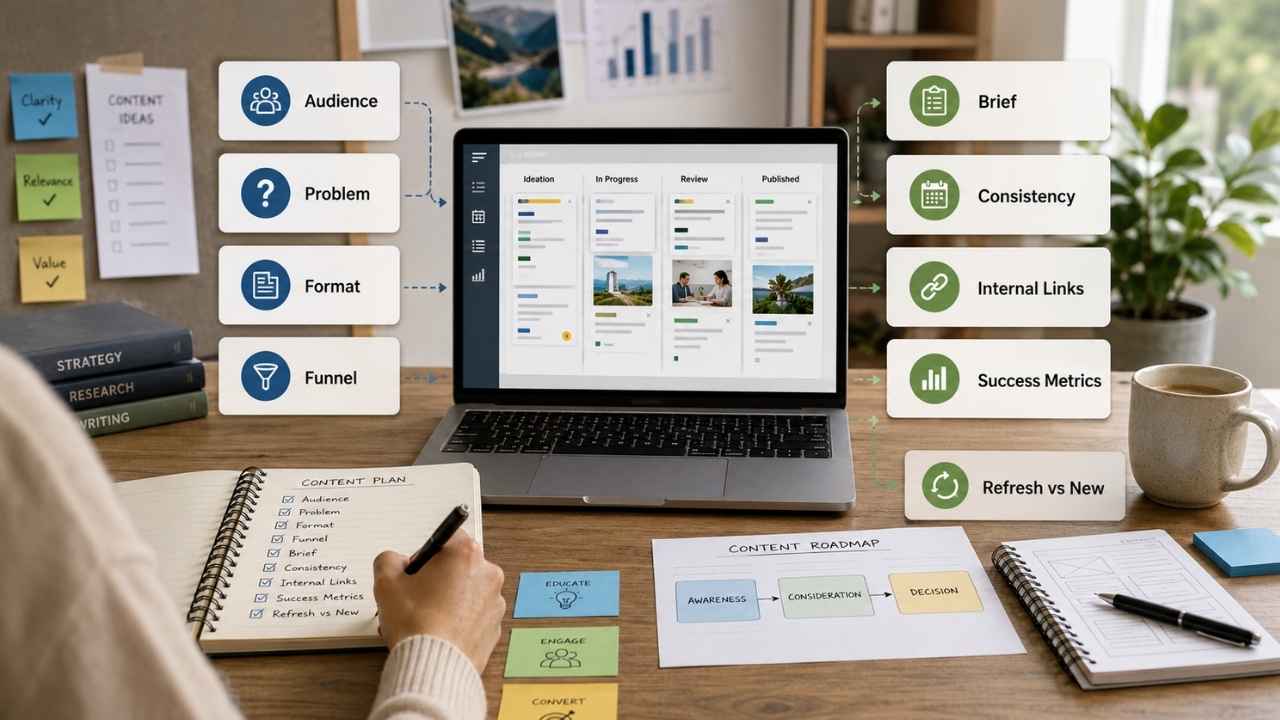
Your strategy needs to answer the hard questions long before a writer ever opens a blank document.
Without that upfront clarity, teams just spin their wheels. Strategists build massive keyword maps that are impossible to execute. Operations managers push out content just to hit deadlines, watching quality slowly tank. Writers get handed terrible briefs and have to guess what the editor actually wants. Stakeholders end up judging the work based on the wrong metrics entirely.
A solid strategy fixes all of this by tackling a few core questions first:
- Who are we publishing for?
- What exact problem are they trying to solve?
- Which topics require pillar pages, quick templates, or deep-dive comparisons?
- Where does this page sit in the marketing funnel?
- How will the writers know exactly what to produce?
- How do we maintain ruthless editorial consistency?
- How will internal links weave this all together?
- How are we actually measuring success?
- When is it smarter to update an old post rather than write a new one?
Treat your editorial planning like infrastructure. The calendar is just the tip of the iceberg. Beneath the surface, you need robust audience research, topic validation, style guidelines, and a strict approval workflow. As Google’s SEO Starter Guide points out, SEO is about helping search engines and users understand your site. Make it easy for crawlers to parse, absolutely—but make damn sure it’s worth the reader’s time once they click.
Start With Audience Persona Development, Not Keywords
Keyword research is great, but it shouldn’t run the show.
Before you even think about mapping out topics, you need to understand exactly who’s reading. And no, I don’t mean those fluffy marketing personas with stock photos and made-up hobbies. I’m talking about the practical, on-the-ground details that actually dictate how you plan a page.
For a high-level topic like this, you’re usually dealing with four distinct groups:
- The Strategists and SEO Leaders: These folks care about authority, search visibility, and technical health. They don’t want a pep talk; they want a system that ties editorial output directly to rankings, Core Web Vitals, and internal link architecture.
- The Operators and Publication Owners: Media managers and niche publishers care about scaling output without burning out their teams. They need to know what to publish, how to dodge keyword overlap, and when to clean up their archives. For them, strategy is just workload management.
- The Executioners (Creators and Copywriters): Writers and designers need crystal-clear direction. Hand them a weak brief, and they’ll guess. Give them proper audience notes, search intent breakdowns, and tone guidelines, and they’ll produce magic.
- The Stakeholders (Marketing Directors): They want pipeline impact and brand authority. While they probably don’t care about the nuances of schema markup, they absolutely need to understand why you’re dedicating budget to a massive pillar page or spending a week updating old posts.
Proper audience persona development ensures your content actually does its job. An “editorial calendar guide” could be a tactical checklist for a writer, or a high-level ROI framework for a CMO. If you try to write for both at the same time, you’ll help neither.
Build the Strategy Around Search Intent and Business Intent
Search intent dictates what the reader expects to see. Business intent dictates why you’re paying to publish it. You absolutely need both.
Most pillar content starts with informational intent. If someone searches for a Content Strategy Guide, they’re looking for frameworks, processes, and actionable steps. But that doesn’t mean it can’t drive revenue. A great informational guide builds immense trust, funnels readers toward your services, and captures email subscribers.
Commercial intent kicks in when they start comparing software or agencies. Your page needs to seamlessly support that buying journey without shoving a disruptive CTA down their throat.
Don’t forget navigational intent, either. If someone searches for your brand name plus “style guide,” they should find it instantly. I always force my team to answer three things before greenlighting a topic:
- What is the searcher actually trying to accomplish? (Are they buying, fixing, learning, or comparing?)
- What’s the logical next step we want them to take? (Reading another guide? Booking a demo?)
- What business goal does this support?
Traffic for the sake of traffic is a vanity metric. If the page isn’t driving leads, retention, or sales enablement, why are we writing it?
Use Topic Research Methods That Go Beyond Search Volume
Obsessing over search volume is a fantastic way to prioritize the wrong things.
Some of your most valuable pages will never have high search volume. They exist to support the sales team, anchor your internal links, or remove friction for high-intent buyers. When I’m digging into topic research, I look way beyond the basic keyword tools.
- SERP behavior: Actually look at page one. Is Google rewarding 5,000-word guides, quick templates, or video tutorials? If the SERP wants a spreadsheet template, your philosophical essay doesn’t stand a chance.
- Audience questions: Dig through customer support tickets, sales call transcripts, and Reddit threads. That’s where the real pain points live.
- Competitor gaps: Stop copying your competitors. Look for what they missed. Did they use lazy, outdated screenshots? Is their formatting a mess? Exploit those gaps.
- Existing content data: Jump into Search Console. You’ll often find your pages snagging impressions for lucrative terms you barely mentioned. That’s a signal to expand, not to awkwardly stuff the keyword into a header.
- Business priority: I’ll take a low-volume keyword that drives high-ticket revenue over a vanity keyword that attracts unqualified traffic every single time.
That’s the difference between simple SEO research and real editorial judgment.
Structure the Site With a Pillar Cluster Content Model
A solid pillar cluster content model gives your site a logical backbone.
The pillar page handles the 10,000-foot view, while the clusters dive deep into the hyper-specific weeds. You tie them all together with internal links so users can navigate naturally from a broad concept to a specific execution.
Take this strategy guide, for example. The pillar explains the overall system. The clusters break down the granular details: how to build the calendar, write the briefs, manage approvals, or optimize your images.
But please, don’t treat clusters like lazy keyword variations. Each one needs to solve a distinct problem. A cluster on internal linking shouldn’t just regurgitate the pillar; it needs to get into the trenches of anchor text, orphan pages, and crawl paths. A guide on Core Web Vitals publishers should speak directly to the massive ad scripts and layout shifts that plague media sites.
Google’s recent guidance on generative AI search doubles down on this exact concept: AI engines rely on Google’s core quality systems. If your cluster content is unique, technically sound, and deeply valuable, it’ll survive the AI shift.
Turn Strategy Into an Editorial Calendar Guide
Your calendar isn’t just a list of due dates. It’s the living, breathing operational view of your entire strategy.
A truly functional editorial calendar guide shows exactly what’s in the pipeline, who owns it, and how it ladders up to the big picture. Keep it practical. Track the working title, target intent, funnel stage, the writer, the editor, internal link targets, and the scheduled refresh date.
Honestly, the software doesn’t matter. You can use Airtable, Asana, Monday, or a basic Google Sheet. What matters is discipline and keeping your content mix balanced.
If you only publish top-of-funnel fluff, you’ll never convert anyone. If you only publish hard-sell product pages, nobody will trust you. B2B content budgets are increasing, and video/thought leadership investments are surging. But throwing more money at a messy calendar just creates louder noise.
Write Better Content Briefs Before Blaming Writers
Bad drafts are usually the result of bad briefs.
If you just toss a writer a keyword and a word count, you’re forcing them to guess. Nine times out of ten, they’ll give you generic introductions, fluff, and missed search intent. A stellar content briefs guide gives the writer strict guardrails while leaving room for their creative judgment.
At a bare minimum, spell out:
- Primary keyword and secondary topics
- Search intent and target audience
- Business goal and editorial angle
- Mandatory headers and questions to answer
- Internal link opportunities
- Examples to include (and absolutely avoid)
If the piece is about measuring content performance, tell them to avoid surface-level metrics. Give them the context that SEOs care about rankings, while the CMO cares about pipeline. When you make the strategy specific upfront, generic writing disappears.
Use Style Guides for Content Teams to Protect Quality

A style guide is so much more than a list of grammar rules.
It’s the ultimate protector of your brand’s voice, formatting, and editorial standards. Without one, every freelancer on your roster is going to interpret “approachable expert” completely differently.
Your style guide for content teams needs to be brutally practical. Should they use the first person? How aggressive should the opinions be? How do we format bullet lists and screenshots? Do we capitalize our product features?
Give your team side-by-side examples of great writing versus terrible writing. Show them exactly what makes a draft feel “off-brand.” This is non-negotiable in the age of AI. Everyone is using LLMs to outline and summarize, which is fine, but the human editorial layer has never been more critical. AI can handle the heavy lifting of research, but your style guide ensures the final published piece actually has a pulse, real context, and original judgment.
Build Content Approval Workflows That Do Not Kill Momentum
A clunky approval process will completely destroy your publishing velocity.
A good content approval workflows catches factual errors, brand risks, and SEO gaps. A bad one traps your draft in endless Google Doc comment loops and committee rewrites. Keep it streamlined.
- Strategy Approval: Get the angle and business goal locked before drafting begins.
- Draft Review: The editor reviews for flow, clarity, and tone.
- SEO Review: Check the technicals—headings, internal links, schema, and intent alignment.
- Stakeholder Review: Review for brand safety and legal risks (not to rewrite the author’s voice).
- Final QA: Nail the formatting, metadata, and mobile view.
When everyone stays in their designated lane, the content ships faster and reads better.
Do Not Separate Editorial Planning From Technical SEO
Treating technical SEO like it’s strictly the development team’s problem is a massive mistake.
You could write the best guide on the internet, but if the page takes five seconds to load, shifts aggressively on mobile, or is buried six clicks deep in your site architecture, it’s going to bomb. This is especially true for digital publishers.
Core Web Vitals (LCP, INP, CLS) aren’t just abstract engineering metrics; they directly dictate the reader’s experience. A bloated, ad-heavy template will drag down the performance of an entire topic cluster. That’s exactly why optimizing Core Web Vitals publishers should be baked into the editorial planning phase, not treated as a frantic cleanup job when traffic tanks. Proactive page speed optimization guarantees that your readers actually stick around long enough to read your best work.
Writers don’t need to learn how to code, but they do need to know the basics. Compress visuals, avoid chaotic templates, write descriptive alt text, and check the mobile preview before hitting publish. Technical health is a core pillar of content quality.
Treat Image SEO Alt Text as Part of Editorial Quality
Images aren’t just there to break up large walls of text; they need to earn their real estate.
Your strategy must dictate how images are selected, compressed, and labeled. Writing proper image SEO alt text is an editorial task. It exists to describe the image clearly for visually impaired users and to feed search crawlers accurate context. It is not a dumping ground for keywords.
Don’t write: “content strategy guide SEO editorial planning.” Write: “Content strategist reviewing an editorial calendar and performance dashboard.”
It’s descriptive, natural, and actually helpful. Whether it’s a screenshot of a project management tool or a custom diagram showing site architecture, the visual has to actively support the page’s narrative. If it doesn’t add value, scrap it.
Internal Linking Fundamentals for Content Strategy
Internal links are easily the most underutilized weapon in editorial planning.
They seamlessly guide readers down the funnel while showing Google exactly how your site is structured. The rules are simple: pillars link down to clusters, clusters link back up to the pillar, and related clusters link horizontally to each other.
I highly recommend mapping out your links before the writing even begins. Pinpoint the primary parent page, grab a few supporting cluster links, identify the main conversion link (like a service page), and note which older posts need to be updated to point to this new asset. It should never feel forced. If an internal link actually helps the reader navigate, it belongs.
Refreshing Old Content Belongs in the Calendar
Everyone loves the dopamine hit of hitting “publish” on a brand-new post, but your biggest growth levers are usually sitting in your archives.
A mature strategy treats content refreshing as a core, recurring workflow. Publishing more volume isn’t always the answer; sometimes, you just need to fix what’s broken. Keep a close eye on old guides that are losing impressions, listicles mentioning defunct software, or posts that have slipped to page two.
When you update outdated cluster pages, you instantly strengthen the pillar they support. Your editorial calendar absolutely must balance net-new production with historical optimization. Without a dedicated refresh schedule, your archive is just going to rot.
Measuring Content Performance Without Chasing Vanity Metrics
Stop obsessing over raw pageviews.
Traffic is great, but it’s only a fraction of the story. You need to measure success based on the specific job of that specific page.
A top-of-funnel educational guide should be judged by organic impressions, email signups, and how well it funnels traffic to your cluster pages. A bottom-funnel commercial page? Judge that strictly on qualified leads, demo requests, and assisted pipeline revenue. If you’re running a digital publication, you’re looking at engaged sessions, scroll depth, and ad viewability.
You don’t need a massive, convoluted dashboard tracking 50 different KPIs. Just track the specific metrics that align with why you published the page in the first place.
A Practical Editorial Planning Workflow
A strategy is totally useless if your team can’t replicate it smoothly. If you want a serious, scalable editorial engine, you need a locked-down process.
- Define the business goal: Traffic, leads, authority? Pick one, and let it dictate the topic.
- Map the audience: Lock in on their pain points and expertise level.
- Research the universe: Blend keyword tools, SERP analysis, and customer interviews.
- Build the map: Decide what gets a massive pillar and what gets a targeted cluster.
- Prioritize: Balance the business upside against the production cost.
- Write the brief: Give the writer an ironclad blueprint.
- Draft: Execute based on strict intent and style guidelines.
- Review: Push it through your streamlined, role-specific approval workflow.
- Publish: Nail the internal links, metadata, and mobile QA.
- Measure & Refresh: Check the data in a few months and update as needed.
It’s not glamorous, but it drastically reduces the guesswork.
How to Keep the Strategy Human in an AI-Heavy Content Market
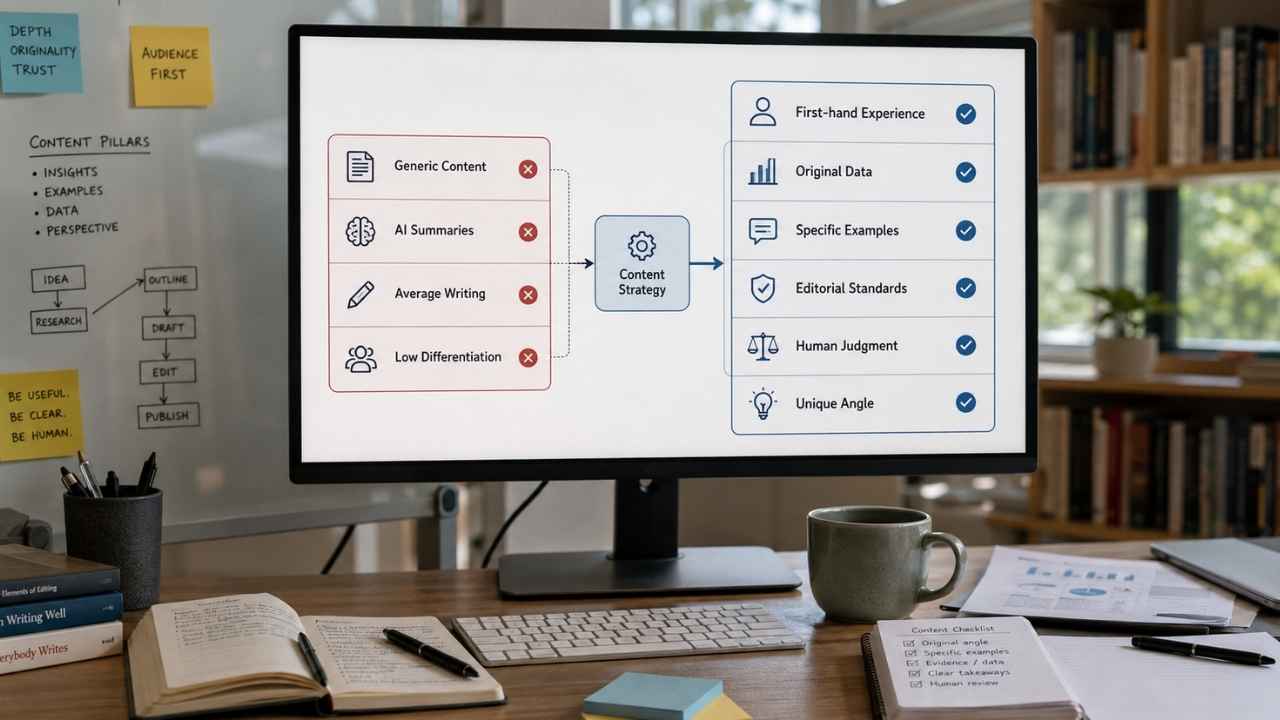
Generative AI has completely commoditized average writing.
Because mediocre articles are so incredibly cheap to produce now, their value has completely tanked. If your strategy relies on churning out generic, surface-level answers, you’re going to get steamrolled by AI search summaries.
Google is practically begging publishers to focus on unique, people-first content. The only way you win now is through sheer human advantage: first-hand experience, proprietary data, highly opinionated angles, and incredibly specific examples. Your strategy shouldn’t mandate higher output; it needs to mandate higher editorial standards.
That is the fundamental difference between running a content mill and building a sustainable content system.
Strong Content Strategy Requires Saying No
The absolute hardest part of managing an editorial calendar is killing bad ideas.
You have to get comfortable saying no. Not every shiny new keyword needs a 2,000-word guide. Not every random request from the sales team deserves priority. I routinely reject pitches if the search intent is muddy, if it cannibalizes an existing URL, or if it only exists because an SEO tool flagged it as “low difficulty.”
Protecting the calendar is how you protect your brand’s authority. A bloated, unfocused calendar spreads your team way too thin. A ruthlessly curated one builds an impenetrable moat around your niche.
The Bottom Line
A Content Strategy Guide isn’t a simple publishing checklist. It’s the entire operating system that ensures your content is actually measurable, useful, and sustainable.
The best operations start by obsessing over the audience, not the search volume. They rely on a smart pillar cluster content model to structure the site. They translate big ideas into an editorial calendar guide that the team can seamlessly execute. When you combine rigid briefs, a practical style guide, efficient approvals, technical SEO, and a religious habit of refreshing old content, you stop feeling like you’re trapped on a production treadmill.
Give every single page a distinct job, assign clear roles to your team, and measure what actually matters. Do that, and your blog stops being a random pile of URLs and transforms into an undeniable growth engine.
FAQs About Content Strategy Guides and Editorial Planning
What is a Content Strategy Guide?
It’s the master playbook that dictates who you’re writing for, what topics you’ll tackle, and how you’ll measure success. It encompasses audience research, SEO, editorial workflows, and performance tracking.
How is content strategy different from an editorial calendar?
The strategy is the “why” and the “what.” The calendar is just the “when” and the “who.” The calendar is merely a tool to execute the broader strategic vision.
Why is audience persona development important for content planning?
If you don’t know who you’re talking to, you’ll write generic fluff. Nailing down the persona ensures your tone, depth, and search intent match exactly what the reader needs to take the next step.
What is a pillar cluster content model?
It’s a structural framework. A massive pillar page covers a broad topic from a bird’s-eye view, while smaller cluster pages dive deep into hyper-specific subtopics. You interlink them all to build massive topical authority.
What should a content brief include?
Everything a writer needs to succeed: target keywords, search intent, required headings, internal link targets, tone guidelines, and exactly what to avoid.
How often should editorial teams refresh old content?
Constantly. Build it into your monthly workflow. Focus on high-value pages that are slowly bleeding traffic, suffering from outdated examples, or stuck at the top of page two.
How does internal linking help content strategy?
It passes link equity around your site, helps search engines crawl your pages efficiently, and keeps readers trapped in your ecosystem by pointing them to the exact next resource they need.
Why do Core Web Vitals matter for publishers and content teams?
Because nobody is going to read your brilliant article if the page takes six seconds to load or jumps around due to heavy ad scripts. Technical performance is directly tied to editorial quality.
What role does image SEO alt text play in editorial planning?
It ensures your site remains accessible to visually impaired readers while giving Google context about the image. Write descriptive, natural sentences—don’t keyword stuff.
How should content performance be measured?
Match the metric to the page’s intent. Track organic impressions and email signups for top-of-funnel guides, and monitor demo requests and pipeline revenue for bottom-funnel commercial pages.
What makes a content approval workflow effective?
Strict lane discipline. Editors edit for clarity, SEOs check the technical intent, and stakeholders review for brand safety. Don’t let everyone rewrite the draft.
Can AI be used in content strategy without hurting quality?
Absolutely, if used correctly. Leverage LLMs to organize research, generate outlines, or summarize data. Just never let it replace human editorial judgment, unique examples, or your brand’s specific point of view.