
Keeping a brand’s voice consistent is one of the hardest challenges modern marketing teams face. For startups, B2B SaaS companies, fintech firms, and digital agencies, a sloppy or shifting tone does more than dilute your message—it confuses your audience and damages your SEO performance. That is why a dedicated style guides for content teams is indispensable.
It isn’t just a static list of rules; it’s the operational roadmap for how your brand communicates across every channel. A strong guide standardizes editorial decisions, gets writers and designers on the same page, and helps you scale without losing your identity. When properly integrated into your broader content strategy, it reinforces topical authority and keeps your SEO objectives on track.
This guide covers exactly how to build, implement, and maintain an effective editorial style guide. We will break down the core elements, practical workflows, common traps to avoid, and advanced tips for scaling your operations so your team can consistently produce professional, high-performing content.
Why Style Guides for Content Teams Are Essential
In highly competitive, technical verticals, an editorial style guide is no longer optional. Even minor inconsistencies in punctuation, formatting, or terminology can chip away at user trust. Here is why documenting your standards matters:
- Ensures Consistency Across Channels: Brands publish across blogs, social media, email newsletters, and whitepapers. A documented guide aligns your terminology and tone, preventing the kind of mixed messaging that frustrates readers.
- Strengthens Brand Voice: A well-defined brand voice outlines your exact personality and vocabulary. This makes your content instantly recognizable, fostering reader loyalty and building long-term trust.
- Improves Efficiency: Writers and editors shouldn’t waste time debating Oxford commas or heading capitalization. With clear rules in place, your team can focus on strategy and substance rather than stylistic friction.
- Supports SEO and Content Strategy: Consistent formatting, structured headings, and predictable metadata directly impact search engine optimization. When paired with a solid editorial plan, your style rules help maintain targeted keyword usage and internal linking hygiene.
- Reduces Errors and Confusion: In multi-author environments, a shared playbook prevents sloppy mistakes—like shifting citation styles or jarring tone changes—that compromise your professionalism.
The Bottom Line: A style guide guarantees clarity and efficiency. It is the only reliable way to manage multi-channel campaigns and project a cohesive voice in crowded markets.
Core Elements of a Content Style Guide

Building a comprehensive editorial style guide requires you to lock down several key areas. Here are the critical components you need to define:
-
Brand Voice and Tone: Outline exactly how your brand sounds. Include personality descriptors (e.g., authoritative but approachable), tone variations for different channels (formal for whitepapers, conversational for social), and strict dos and don’ts for language.
-
Grammar, Punctuation, and Mechanics: Consistency here projects a polished image. Set definitive rules for capitalization, Oxford commas, hyphenation, and how to format dates and numbers.
-
Vocabulary and Terminology: Maintain a glossary of preferred terms and a blacklist of banned phrases. Clarify how to handle product names, industry jargon, competitor references, and common abbreviations.
-
Formatting and Structure: Visual consistency matters just as much as the writing. Detail your heading and subheading hierarchy, bullet point formats, preferred paragraph lengths, and rules for blockquotes and image captions.
-
Style for Digital Content: Your guide must address search visibility. Include SEO best practices for meta descriptions, keyword placement, internal linking syntax, URL structures, and image alt text for accessibility.
-
Visual Elements: Text and design should work together. Document your brand colors, approved font families for various text levels, and rules for image styling and iconography.
-
Review and Approval Process: Establish accountability. Clearly map out who drafts the content, who holds editing and approval rights, and how feedback is managed and implemented.
How to Build a Style Guide for Content Teams
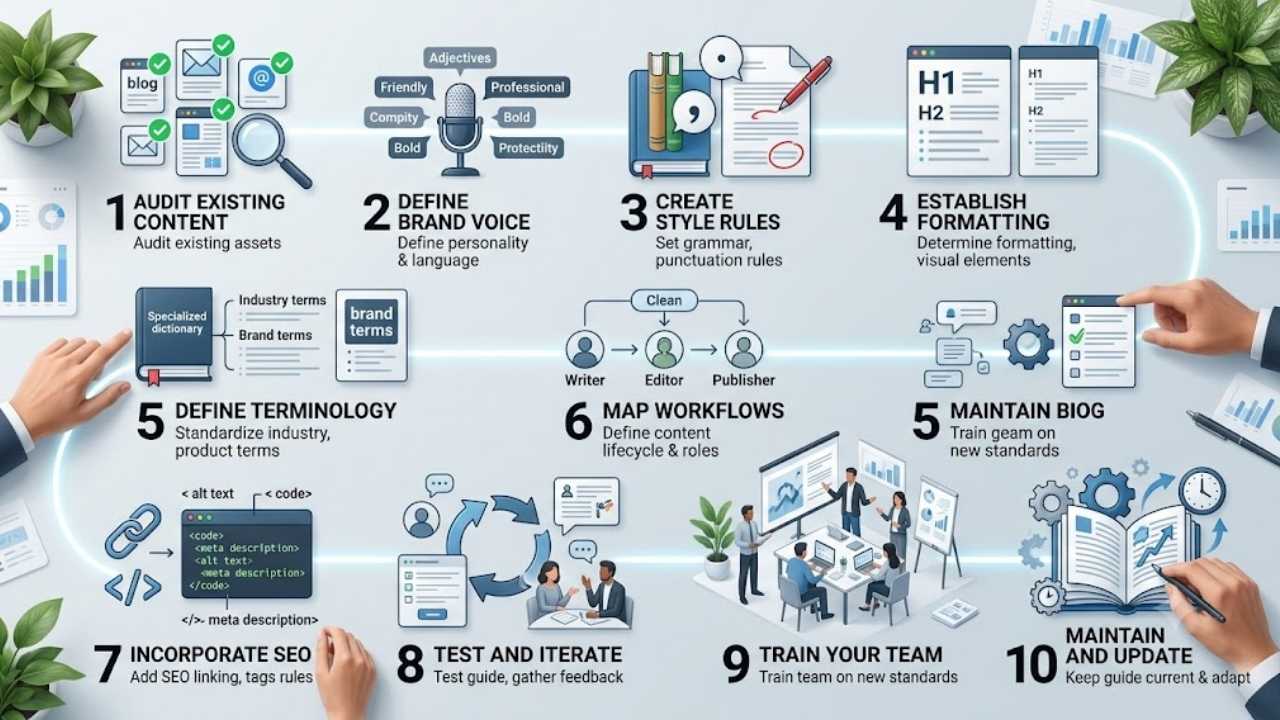
Creating a standard from scratch takes work. Follow this step-by-step process to build a guide your team will actually use:
Step 1: Audit Existing Content: Review your current assets across all channels. Look for glaring inconsistencies in tone, formatting, and grammar to identify exactly what needs fixing.
Step 2: Define Your Brand Voice: Document your personality and language style. Provide concrete examples of acceptable phrasing alongside examples of what to avoid.
Step 3: Create Content Style Rules: Lay down the law on grammar, punctuation, and mechanics. Decide once and for all how your brand handles numbers, capitalization, and citations.
Step 4: Establish Formatting Guidelines: Determine exactly how headings, lists, tables, and visual elements should look on the page.
Step 5: Define Terminology: List your preferred industry terms, exact product spellings, and standardized abbreviations.
Step 6: Map Workflows and Responsibilities: Define the lifecycle of a piece of content. Clarify who writes, edits, and publishes, as well as who owns updates to the style guide itself.
Step 7: Incorporate SEO Guidelines: Add rules for linking structures, meta tags, and alt text, ensuring your style choices actively support your search engine strategy.
Step 8: Test and Iterate: Roll the guide out to a small group first. Gather their feedback to spot ambiguities and refine the rules before a company-wide launch.
Step 9: Train Your Team: Do not just email a document and expect compliance. Host a workshop to walk writers, editors, and freelancers through the new standards.
Step 10: Maintain and Update: A style guide is a living document. Review it regularly to adapt to new platforms, shifting SEO requirements, or evolving brand goals.
Tools and Templates for Content Style Guides
The right tools make creating and enforcing your guidelines much easier:
- Google Docs / Sheets: Ideal for smaller operations that need simple, live collaboration.
- Notion: A highly customizable workspace perfect for housing rules, templates, and live examples in one hub.
- Trello / Asana: Great for tracking style-related tasks and managing workflow updates.
- Airtable: Powerful for large teams that need database-style management of complex editorial rules.
- Canva / Figma: Essential for defining visual parameters alongside your text rules.
Pro Tip: Don’t rely solely on text. Use color coding, screenshots, and side-by-side “Do this / Don’t do this” examples to make the guide intuitive.
Common Mistakes to Avoid
Even well-intentioned style guides fail if they are poorly executed. Avoid these common traps:
- Being too vague: Ambiguity leaves room for interpretation, which defeats the purpose of the guide.
- Overcomplicating the guide: If the rules read like a 100-page academic textbook, your writers will ignore them. Keep it practical.
- Ignoring SEO integration: Writing style and search optimization must work in tandem, not in silos.
- Neglecting updates: Outdated rules quickly lead to rogue publishing habits.
- Poor adoption: If you skip training your team, the guide will gather dust on a shared drive.
Practical Examples and Case Studies
Here is how structured guidelines look in practice:
- SaaS Startup: By building a centralized guide focusing on tone and formatting, a growing SaaS company aligned its blog content with its email newsletters, resulting in a cleaner reader experience and a 45% boost in audience engagement.
- Ecommerce Brand: An online retailer baked SEO rules directly into its editorial style guide. By standardizing formatting and keyword usage, they cut content production time by 20% while steadily increasing organic traffic.
- Digital Agency: A marketing firm created a strict brand voice playbook for all client deliverables. This immediately aligned their internal teams, drastically reducing client revisions and speeding up the publishing calendar.
Advanced Tips for Scaling Content Style Guides
If you are managing a large or rapidly growing team, you need to think bigger:
- Assign a Style Champion: Designate one editor to monitor adherence, answer formatting questions, and keep the document updated.
- Incorporate Multilingual Guidelines: If you operate globally, account for cultural nuances and regional language variations.
- Create Cross-Platform Examples: Show exactly how your core style translates across a long-form blog post, a short LinkedIn update, and a landing page.
- Use Automation Tools: Build your approved templates and checklists directly into your CMS to enforce formatting automatically.
- Review Regularly: Book quarterly audits to ensure your guidelines reflect your current operational reality.
Final Thoughts
A carefully crafted style guide is the foundation of high-quality, professional content. When integrated tightly with your broader strategy, it ensures every piece of media—written or visual—supports your marketing goals, sounds authentically like your brand, and performs well in search.
For startups, SMEs, and digital agencies, this documentation is the difference between a messy, amateur operation and a streamlined publishing machine. By keeping the rules clear, providing real-world examples, and actively training your team, you empower your writers to scale your content output without ever losing your voice.
Frequently Asked Questions (FAQs) About Content Style Guide
1. What is a content style guide?
It is a rulebook for your brand. It tells your team exactly how to write, format, and design content so that every blog post, email, and social media update looks and sounds like it comes from the same company.
2. Why does my team need a style guide?
It eliminates guesswork. A guide prevents writers from wasting time debating grammar rules or formatting, speeds up the editing process, and ensures your brand always looks professional and consistent.
3. Who should use the style guide?
Everyone who creates or publishes content for your brand. This includes in-house writers, editors, social media managers, designers, and any freelance creators you hire.
4. What should a basic style guide include?
Start with the essentials: a description of your brand’s tone of voice, basic grammar rules (like whether to use the Oxford comma), formatting preferences for headings, and a list of approved industry terms.
5. How often should we update our style guide?
You should review it at least once a year. It should also be updated whenever your company launches a major new product, shifts its marketing strategy, or adopts new digital platforms.