
Gaming loves to dress exhaustion up as passion. Every studio documentary has the same soft lighting, the same emotional music, the same proud developer talking about how much the team cared. And I believe that part. Developers do care. That is exactly why this industry keeps getting away with squeezing them until “dream job” starts sounding like a warning label.
That is the crunch culture coverup. It is not some mystery hidden in a locked boardroom. It is right there in front of us, wrapped in trailers, award speeches, collector’s editions, and PR lines about dedication.
Games are hard to make. Nobody serious denies that. Big games especially are chaos machines. Systems break, features get cut, bugs pile up, engines fight back, and release dates start breathing down everyone’s neck. But there is a difference between a rough production cycle and a studio culture that quietly treats burnout as part of the schedule.
That is where I stop giving studios the benefit of the doubt.
When crunch becomes the plan, not the emergency, it stops being passion. It becomes leadership failure with better branding.
The Word Passion Is Doing Too Much
The industry uses “passion” like a magic cloth to wipe fingerprints off bad management.
Long nights? Passion. Weekend work? Passion. Six-day weeks? Passion. People missing family time, losing sleep, and dragging themselves through production because the date cannot move? Still passion, apparently.
I am tired of that trick.
Passion is why people enter game development. Crunch is what happens when that passion gets exploited. The two are not the same, and pretending they are is how game dev crunch keeps surviving every public controversy.
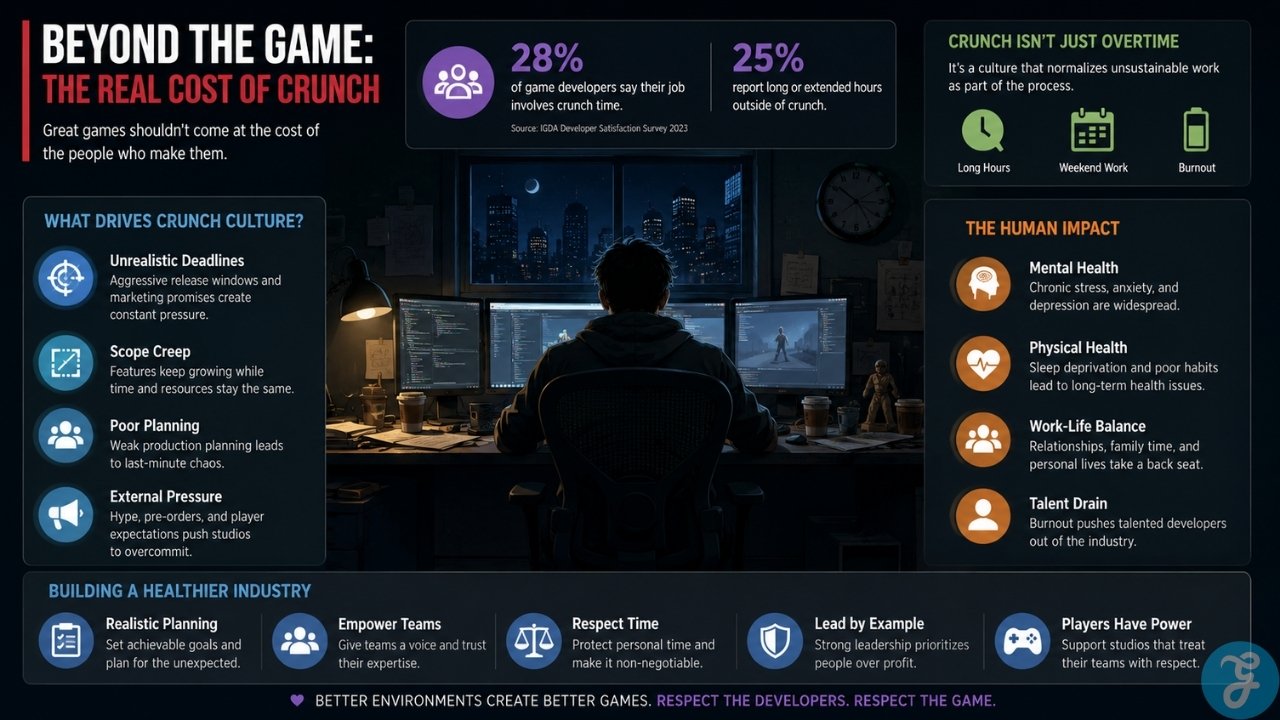
The International Game Developers Association’s 2023 Developer Satisfaction Survey found that 28 percent of respondents said their job involved crunch time. Another 25 percent said their job required long or extended hours that were not described as crunch. That second number is the part that says everything. Sometimes the industry does not even need to remove crunch. It just renames it.
And once the wording gets softer, everyone can pretend the problem got smaller.
A studio does not have to say, “We scoped this badly and now everyone has to suffer.” It can say the team is pushing hard. It can say everyone is committed. It can say the project is entering the final stretch. That sounds cleaner. Less ugly. More LinkedIn-friendly.
But people do not magically get their nights, weekends, or health back because the studio found a nicer phrase.
AAA Hype Hides the Exhaustion
AAA crunch culture survives because the public-facing side of gaming is beautiful.
The trailer looks expensive. The gameplay showcase looks smooth. The marketing campaign makes the game feel inevitable. The studio appears confident. Everyone smiles. Everyone says they are proud. Everyone talks about the love that went into the project.
And behind that, there may be a team trying to hold the whole thing together with late nights, emergency fixes, and a production schedule that probably should have been questioned months earlier.
Players rarely see that side because trailers do not show tired people trying to rescue bad planning.
We do not see the QA teams buried under unstable builds. We do not see engineers cleaning up technical debt created by decisions made far above them. We do not see artists reworking assets because direction changed again. We do not see designers trying to make cut systems feel intentional.
And then, after all that, someone in a nice jacket stands on stage and thanks “the team.”
That phrase always sounds nice. The team.
Conveniently vague. Very useful when credit needs to be shared but responsibility needs to stay blurry.
Rockstar, Cyberpunk, and the Same Old Excuse
We have seen enough examples to stop acting shocked.
Rockstar’s Red Dead Redemption 2 became a major crunch flashpoint in 2018 after Dan Houser mentioned 100-hour weeks, then clarified that he was referring to a small senior writing group and not the whole studio. But the wider reporting that followed still described a culture where current and former employees talked about nights, weekends, and long hours across parts of production.
The annoying part is that Red Dead Redemption 2 is also brilliant.
That is where the conversation gets messy. Players loved it. Critics loved it. I loved plenty about it too. But a great game does not automatically prove a healthy process. Sometimes the final product is excellent and the process behind it still deserves criticism.
Cyberpunk 2077 made the argument even harder to ignore. CD Projekt Red had already built a reputation on quality and player goodwill, then Cyberpunk became one of the most hyped games of its generation. Before launch, reports said the studio moved into mandatory six-day workweeks despite earlier promises to avoid mandatory crunch.
And after all that pressure, the game still launched in a terrible state, especially on older consoles.
This is the part crunch defenders never know what to do with. They talk about crunch like it is some brutal but necessary road to greatness. Then a game ships broken anyway.
So what exactly did all that pressure buy? A burned-out team and an apology cycle?
Cyberpunk eventually recovered. I am not pretending otherwise. The updates, the rework, and Phantom Liberty helped rebuild the game’s reputation. But the launch still happened. The crunch reports still happened. The player trust damage still happened.
The patched version does not erase the production story.
Prestige Makes Burnout Easier to Excuse
Naughty Dog is another uncomfortable case because prestige changes how people talk about crunch.
The studio has made some of the most technically impressive games in the industry. The level of animation, cinematic direction, performance capture, environmental detail, and narrative polish in its best work is insane. I respect the craft. I respect the talent.
But prestige can become a trap.
Kotaku’s reporting around The Last of Us Part II described developers working nights and weekends during production. And when a studio becomes famous for delivering at that level, people start treating the pressure as part of the magic. Fans call it dedication. Executives call it excellence. The brand gets stronger. The workers carry the cost.
That is how a bad habit starts looking like studio identity.
Nobody wants to be the person who “doesn’t care enough.” Nobody wants to be seen as the weak link on a legendary team. Nobody wants to question the process when the games keep winning awards.
But awards do not make exhaustion noble. They just make it easier for the industry to avoid asking who paid for all that polish.
Crunch Does Not Even Guarantee Better Games
The most embarrassing part of the crunch myth is that it does not even reliably produce better launches.
BioWare’s Anthem had years of messy development behind it, and reporting after release described severe production stress, confusion, and what some sources called “stress casualties.” Fallout 76 also became tied to reports of mismanagement, crunch, and a rough launch that players absolutely did not forget.
These are not tiny examples from some obscure corner of the industry. These are major names. Big budgets. Famous brands. Experienced studios. The kind of projects that should have enough structure around them to avoid turning production into a survival test.
And yet, here we are.
I cannot take the “crunch is necessary” argument seriously when the results are this inconsistent. If crunch guaranteed quality, it would still be a grim argument, but at least people could pretend the business logic made sense. Instead, we keep seeing the same loop: teams get squeezed, games launch messy, players get angry, executives apologize, and then the next project somehow repeats the lesson nobody learned.
After enough examples, calling it bad luck starts sounding generous.
Gamers Feed the Pressure Too
I do not blame players for crunch. Let’s not be stupid about this. Players do not control staffing, scope, budgets, release dates, outsourcing, engine choices, or milestone planning.
But player culture still feeds the pressure.
We want bigger maps, better graphics, deeper systems, constant updates, shorter waits, perfect performance, no delays, and somehow no trade-offs. Then when a game gets delayed, a loud part of the internet acts like the studio personally betrayed them.
Publishers know hype has a short fuse. They know delays create backlash. They know pre-orders, marketing beats, influencer cycles, and holiday windows all feed into the machine. So when players lose their minds over delays, it gives the suits one more excuse to push harder.
Again, this does not make players responsible for corporate decisions. But we should be honest about the environment we help create.
If we want better games and healthier teams, we need to stop treating every delay like a crime. A delayed game is annoying. A broken game made by burned-out people is worse. I would rather wait than watch another studio pretend a tortured launch was somehow noble.
Stop Calling Burnout a Dream Job
The phrase “dream job” does a lot of damage in gaming.
It makes exploitation easier to sell. It tells people they should feel lucky to be there. It turns boundaries into weakness. It makes unpaid or underpaid sacrifice sound like proof of love. And when studios add “we are like a family” on top of that, my alarm bells start screaming.
A studio is not a family. It is a workplace.
A good one can still have trust, care, friendship, loyalty, and creative obsession. I am not dismissing that. Great teams matter. Shared belief matters. You can feel when a game was made by people who cared.
But care should not become a leash.
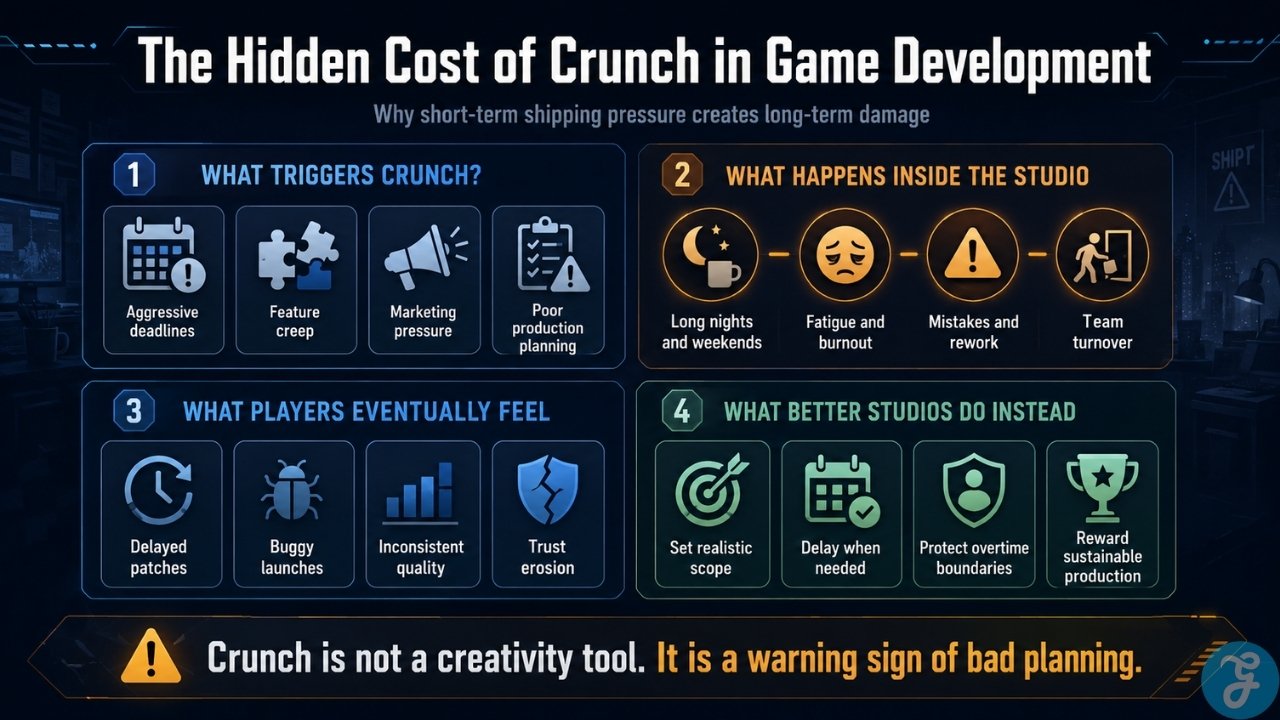
If a studio needs people to keep sacrificing evenings, weekends, health, and basic stability just to survive production, the issue is not that people lack passion. The issue is that the plan was dishonest.
And no amount of “we love our team” PR can cover that forever.
What Crunch in Gaming Really Means
Crunch in gaming is often described like a natural disaster. It just happens. Production gets hard. The deadline arrives. Everyone pushes. What else could be done?
A lot, actually.
Scope could be controlled earlier. Features could be cut before they become production sinkholes. Release dates could be set with more honesty. Leadership could stop letting marketing promise things the build cannot support yet. Publishers could delay games without treating it like public humiliation. Producers could have real authority instead of becoming professional disaster trackers.
None of that sounds exciting. It will not fit nicely into a trailer. It will not get fans cheering at a showcase.
But boring production discipline is exactly what keeps people from being crushed at the end.
Real leadership is not giving a speech after everyone survives the fire. Real leadership is preventing the fire from becoming the production model.
The Industry Needs Better Incentives
The fix is not some ancient puzzle locked behind a boss fight. Studios know what has to change. They just hate what it would cost.
Studios need clearer overtime policies, better compensation, stronger production planning, healthier staffing, and leaders who are willing to protect teams from impossible promises. They need cultures where saying “this is not ready” is treated as useful information, not betrayal.
And honestly, I have no patience left for studios acting like basic planning is some impossible luxury. If a project needs months of panic work to survive, maybe the problem started long before the final stretch.
Publishers need to stop using release dates like religious prophecies.
Players have a role here too, whether we like admitting it or not. Support games that delay when they need to. Support developers who speak honestly about production. Stop treating every polished trailer like proof that the game is almost finished. Stop worshiping brands so hard that the workers disappear behind the logo.
Because the fantasy keeps working only when everyone keeps buying it.
No More Crunch Culture Coverup
The crunch culture coverup works because gaming is built on love.
Players love games. Developers love making them. Studios love telling us how much love went into them. Publishers love turning all that love into revenue. Somewhere in that chain, love gets twisted into permission to overwork people.
I am not buying that anymore.
Developers do not need to prove they care by burning themselves out. Most of them already care too much, which is exactly why this industry knows how to push them.
So no, I do not want another emotional studio video about passion if the production model behind it still runs on exhaustion. I do not want another award speech about “the team” if leadership keeps treating burnout like an acceptable shipping cost.
A studio that can only finish a game by grinding people down is showing us something. Not passion. Not excellence. Not some beautiful sacrifice for art.
It is showing us the bill, and too many people are pretending not to see who paid it.