


Content bottlenecks rarely start with bad writers. More often than not, they start with muddy approval rules.
Implementing effective Content Approval Workflows can significantly enhance productivity and streamline the process.
A writer hands a draft to an editor. Next, a product manager drops in with a few comments, legal flags a couple of changes, and a founder decides to completely rewrite the introduction. By the time the SEO specialist checks the structure, the article is supposedly “done”—until someone spots a brand issue the day before it’s scheduled to go out. Suddenly, your launch date is pushed back Again.
That isn’t just a quality control issue; it’s a glaring workflow problem.
Strong content approval workflows help teams publish exceptional material without turning every single article, landing page, email, or campaign asset into a grueling internal negotiation. The goal isn’t to stack up more review stages. Rather, it’s about strategically deciding who reviews what, exactly when they review it, what their specific responsibilities are, and who ultimately holds the pen for final sign-off.
With proper Content Approval Workflows in place, teams can minimize the chances of miscommunication and delays.
For teams trying to build a serious, high-impact content strategy, getting this right matters just as much as keyword research or editorial planning. After all, even the most brilliant content strategy falls flat if every piece gets permanently stuck in review.
Understanding the nuances of Content Approval Workflows is essential for ensuring all stakeholders are aligned.
What Content Approval Workflows Actually Do

At its core, a content approval workflow is simply the agreed-upon path a piece of content follows before it sees the light of day. It maps out the exact stages between a raw idea and a live page.
Adopting streamlined Content Approval Workflows can help maintain project timelines and quality.
Depending on your organization, that journey might include briefing, drafting, editorial edits, an SEO pass, subject-matter review, legal scrutiny, brand alignment, final approval, publishing, and finally, post-publication checks.
The absolute best workflows accomplish three things:
Integrating Content Approval Workflows into your process aids in delivering high-quality outputs.
- Protect quality
- Reduce confusion
- Keep publishing moving
Weak workflows do the exact opposite. They drag too many people into the mix far too late in the process, usually without establishing clear authority. Everyone leaves a comment; nobody actually makes a decision.
By refining Content Approval Workflows, organizations can address critical issues before they escalate.
A scalable workflow shouldn’t slow your content down—it should force decisions to happen earlier. For instance, if a highly technical article requires product accuracy, your product expert needs to review the outline or the very first draft, not the final polished proof. If legal language is a dealbreaker, your legal team should review the core claims before the design team spends days building out the landing page. If SEO structure dictates the format, getting SEO input before the writer spends ten hours on a draft is just common sense.
Good approval workflows deliberately move the right checks upstream.
Why Approval Breaks as Teams Grow
As teams grow, the importance of robust Content Approval Workflows becomes even more apparent.
Small teams can usually survive on informal review habits. One person writes, another edits, a founder gives a quick thumbs-up, and the page goes live.
That breezy system works wonderfully—until the content program expands. Suddenly, new channels appear. A simple blog strategy morphs to include product pages, newsletters, video scripts, industry reports, webinars, case studies, social campaigns, and sales enablement assets. More people start caring about the output simply because more departments rely on it.
This is exactly when informal approval starts buckling under the pressure.
The symptoms of a broken workflow are incredibly easy to spot:
- Drafts rot in someone’s inbox for days.
Regularly assessing your Content Approval Workflows can prevent potential pitfalls and enhance efficiency.
- Reviewers leave feedback on issues completely outside their area of expertise.
- Legal or compliance teams are brought in way too late.
- The same article gets rewritten by three different people.
- Nobody is entirely sure which version is the “final” one.
- Urgent assets bypass the system entirely, resulting in sloppy, avoidable mistakes.
- Published content requires rapid-fire corrections because the review was rushed.
- Writers stop trusting the initial brief because they know approvals will wildly change the direction anyway.
The underlying problem isn’t that more people are involved—growing teams absolutely need diverse expertise. The real issue is that the workflow was never fundamentally redesigned to handle scale. A two-person habit simply cannot support a ten-person content machine.
Incorporating flexible Content Approval Workflows is crucial for adapting to changing project demands.
Content Approval Workflows Need Clear Ownership
Every workflow demands a single owner.
That doesn’t mean one person does all the heavy lifting. It means one specific individual is responsible for ushering the content through the process and ensuring that necessary decisions are actually made. In many organizations, this falls to a managing editor, content lead, content operations manager, or project owner. For smaller companies, the marketing manager might wear this hat.
The designated owner must always know:
Clearly defined Content Approval Workflows foster accountability and expedite the review process.
- What stage the content is currently in.
- Who is actively reviewing it.
- What specific feedback is blocking progress.
- When the deadline is.
- Who holds final approval.
- Whether the content is ready to publish.
When implemented correctly, Content Approval Workflows guide projects from conception to completion.
Without a clear owner, your approval process turns into a waiting room.
A great owner also shields the process from random, chaotic intervention. If a stakeholder parachutes in late and tries to pivot the entire angle of an article, the owner is there to ask whether the request is truly essential, if it belongs in this specific piece, and how it impacts the publish date.
It might sound overly strict, but it’s entirely necessary. Content quality plummets when every passing opinion is treated like a non-negotiable requirement.
The Main Stages of a Scalable Content Review Process
A well-structured Content Approval Workflow prevents misalignment and boosts collaborative efforts.
A scalable review process doesn’t have to be a labyrinth. Most teams can get a lot of mileage out of a few distinct, clear stages. While the exact order depends on the content type, risk level, and your company’s structure, this model is a solid baseline for many editorial teams.
Having comprehensive Content Approval Workflows in place can enhance clarity across teams.Content Approval Workflows serve as the backbone of effective content management.Utilizing Content Approval Workflows can streamline the journey from draft to published content.Incorporating rigorous Content Approval Workflows solidifies the foundation of your editorial strategy.
| Stage | Main Purpose | Best Reviewer | Common Mistake |
| Brief approval | Confirm angle, audience, goal, and scope | Content lead, SEO lead, campaign owner | Starting the draft before the direction is clear |
| Draft review | Check structure, usefulness, accuracy, and depth | Editor, subject expert | Treating the draft review like a proofread |
| Specialist review | Check SEO, product, legal, compliance, or brand | Relevant specialist | Inviting every specialist to review every piece |
| Final edit | Clean up language, flow, formatting, consistency | Editor or managing editor | Reopening strategy decisions at the final stage |
| Content sign-off | Confirm the asset is ready to publish | Final approver | Having multiple final approvers with equal power |
| Post-publish check | Catch formatting, links, metadata, tracking issues | Editor, publisher, SEO | Assuming approval ends before the page is live |
Remember, this table is a starting point, not an unbending rulebook. A low-risk blog post might never need to cross legal’s desk, whereas a regulated fintech landing page absolutely does. A social post launching a new feature needs a product review; a generic thought-leadership essay does not.
Always match the workflow to the risk.
The Brief Is the First Approval Gate
An enormous amount of approval friction starts before a single word is even drafted.
When the brief is vague, disaster follows. The target reader isn’t defined, the keyword is dropped in without context, the product angle is flimsy, and the business goal is merely assumed. Because the expert reviewer isn’t explicitly named, the writer does their best to fill in the blanks—only for reviewers to vehemently disagree a week later.
That kind of misalignment is expensive.
Implementing a strict brief approval step prevents a mountain of downstream edits. It forces stakeholders to get on the same page before the draft exists. A rock-solid brief should answer:
Leveraging Content Approval Workflows can help manage expectations among various stakeholders.
- Who is the intended audience?
- What exact problem is this content solving?
- What is the search intent or primary channel goal?
- What should the reader understand—or do—after reading?
- What specific topics must be covered?
- What topics must be explicitly avoided?
- Which claims will require hard proof?
- Which internal pages need to be linked?
- Who is reviewing this for technical accuracy?
- Who gives the final green light?
Ultimately, solid Content Approval Workflows empower creators to deliver their best work.
- What are the hard deadlines for each stage?
That “topics to avoid” section? It’s often the unsung hero of a good brief. It actively prevents overlap with your existing content library and stops the draft from mutating into a bloated, do-everything article. For example, a cluster article about content approval workflows shouldn’t waste space explaining the A-to-Z of content strategy—that belongs in a broader guide. Keeping those boundaries firm helps both the writer and the editor stay focused.
Not Every Asset Needs the Same Workflow
Forcing every single piece of content through the exact same review gauntlet is one of the fastest ways to break your system.
A 900-word blog update doesn’t require the intense scrutiny of a compliance-heavy product page. A standard LinkedIn post shouldn’t follow the same path as an annual industry benchmark report.
Instead of a one-size-fits-all approach, create workflow levels. A straightforward model might look like this:
Revisiting and refining your Content Approval Workflows is essential for continuous improvement.Implementing effective Content Approval Workflows can enhance overall team morale and efficiency.Content Approval Workflows should adapt to the unique needs of each project for maximum impact.
| Content Type | Risk Level | Suggested Approval Path |
| General blog article | Low to medium | Writer → Editor → SEO/editorial sign-off |
| Technical guide | Medium | Writer → Editor → Subject expert → Final editor |
| Product page | Medium to high | Writer → Product → Brand/editor → SEO → Final approver |
| Legal/finance content | High | Writer → Editor → Subject expert → Legal/compliance → Final approver |
| Social media post | Low (unless sensitive) | Creator → Brand/editor → Scheduler |
| Case study | Medium to high | Writer → Customer/contact owner → Legal (if needed) → Final approver |
| Email campaign | Medium | Writer → Campaign owner → Brand/editor → Final approver |
Tiering your workflows prevents over-reviewing minor assets. More importantly, it prevents under-reviewing critical ones. A customer quote, pricing statement, or security promise shouldn’t glide through the same breezy process as a top-of-funnel awareness piece. Keep things light where the risk is low, and buckle down where the risk is real.
Roles Matter More Than Job Titles
Workflows often collapse because people are looped in based on their corporate title rather than their actual responsibility to the piece.
A VP, founder, or department head might need visibility, but that doesn’t automatically mean they need line-editing rights on every single draft. Your workflow needs to define functional roles, not just drop names on a calendar invite.
Highly effective roles include:
- Content owner: Keeps the asset moving, enforces deadlines, and resolves process disputes.
- Writer: Drafts the piece based on the approved brief and executes feedback.
- Editor: Elevates structure, clarity, accuracy, tone, and overall editorial quality.
- SEO reviewer: Optimizes search intent, headings, internal links, metadata, and schema.
- Subject-matter reviewer: Verifies technical details and product accuracy.
By refining and optimizing Content Approval Workflows, teams can achieve more streamlined operations.
- Brand reviewer: Ensures voice, positioning, messaging, and visual consistency are on point.
- Legal or compliance reviewer: Audits for risk, disclaimers, regulated phrasing, and required approvals.
- Final approver: Makes the definitive call that the content is ready to publish.
In a lean team, one person might juggle three of these roles. That’s perfectly fine—as long as the roles themselves are clearly defined. The real danger strikes when five different people all believe they are the “final approver.”
Usually, there should be exactly one ultimate decision-maker per asset. Other reviewers are there to advise, block for specific compliance risks, or request targeted changes. Unless the content is unusually sensitive, final sign-off shouldn’t be handled by a committee. Committees rarely move quickly.
Separate Feedback From Approval
There is a massive difference between feedback and approval, and mixing the two is a guaranteed way to paralyze production.
Feedback is a suggestion: “This section could be punchier.”
Approval is a green light: “This meets our standards and is ready to publish.”
When reviewers blur those lines, a piece that is functionally ready to go live will get stuck in endless revision loops simply because someone prefers a different stylistic flair. To fix this, a scalable review process relies on clear comment categories:
Regularly reviewing Content Approval Workflows offers opportunities for scaling productivity.
- Must fix: Inaccuracies, legal risks, broken logic, missing brief requirements.
- Should fix: Clarity issues, weak examples, clunky transitions, uneven tone.
- Nice to have: Personal preferences, optional word choices, ideas for future updates.
- Out of scope: Great ideas that belong in a completely different asset or campaign.
Training your reviewers to explicitly tag their comments with these categories can save days of back-and-forth. If every piece of feedback sounds like an emergency, nothing is treated like one.
Content Sign-Off Should Be Explicit
Final approval shouldn’t be a guessing game. A casual Slack emoji, a muttered “looks fine,” or three days of total silence isn’t a solid foundation for a mature content operation. Final sign-off needs to be clear enough that anyone could audit it six months later.
This doesn’t have to be bogged down in bureaucracy. It just needs to be definitive:
- Approved via a status change in your project management tool.
- Approved natively in the CMS.
Effective Content Approval Workflows protect the integrity of your content throughout its lifecycle.
- Approved via a direct email confirmation.
- Approved in a documented Google Doc comment.
The golden rule here is consistency. A proper approval record shows who approved it, when they did it, exactly which version they looked at, and if there were any final conditions attached.
For a low-stakes blog post, this might feel like overkill. But as your team scales, these records are what prevent arguments. When a published claim, quote, or product spec is questioned down the road, you’ll be incredibly glad you can point to exactly who vetted it.
Build Approval Around Risk, Not Ego
Stakeholders insert themselves into workflows for all sorts of reasons. Some care deeply about the work. Some have been burned by bad content in the past. Some simply don’t trust the process yet.
A well-oiled workflow respects legitimate business concerns without turning every senior manager into a bottleneck. The key is to anchor the approval path firmly to risk.
Before assigning reviewers, ask:
- Could this expose us legally or from a compliance standpoint?
- Are we making definitive product claims?
Balancing flexibility and structure in Content Approval Workflows can enhance collaborative efforts.
- Does it explicitly mention pricing, security, health, finance, or guarantees?
- Are we quoting real customers or partners?
- Does it shift our core brand positioning?
- Could confusing wording actively mislead a user?
- Is this page a major conversion driver?
- Is the topic highly visible or socially sensitive?
If the answer is yes, bring in the right specialist. If the answer is no, leave senior leadership off the review roster. Executive review should be fiercely protected and saved for high-stakes positioning and major campaigns. If your C-suite is proofreading weekly blog posts, your workflow is fundamentally broken.
The Editorial Workflow Should Catch Quality Before Specialists Do
Specialists are not your backup editors.
Your product manager shouldn’t be untangling paragraph structure. Legal shouldn’t be the first to catch a wildly unsupported claim. Your SEO lead shouldn’t receive a “final” draft that completely ignores search intent.
Comprehensive Content Approval Workflows are key to a successful editorial process.
The core editorial review must catch overarching quality issues before the piece is handed over to specialists. That means fixing:
- Weak or meandering introductions
- Repetitive arguments
- Poor section flow
- Missing context or examples
- Unsupported claims
- Inconsistent brand tone
- Flabby, passive writing
- Broken formatting
- Keyword stuffing
- Misaligned headings
Creating effective Content Approval Workflows is essential for any thriving content team.
Specialist review time is expensive and limited. If subject-matter experts constantly receive messy, half-baked drafts, they will lose faith in the process and start over-commenting out of frustration. A rigorous editorial pass keeps the entire system healthy and maintains stakeholder trust.
Use Fewer Review Rounds, But Make Them Better
Adding more review rounds rarely results in better content. Mostly, it just creates fatigue. A streamlined workflow typically leans on two major intervention points:
- Substantive review: This happens when the draft is fully fleshed out and ready for serious critique. Reviewers evaluate the overarching direction, depth, technical accuracy, structural integrity, and any missing details.
- Final review: This occurs after major revisions are completed. The only goal here is to verify that required changes were made and that the asset is unequivocally ready to publish.
The final review is not the time to pivot the strategy. If a reviewer suddenly introduces a massive strategic objection at the eleventh hour, the content owner has to make a tough call: is this a fatal flaw that blocks publication, or is it an idea for Q3’s update?
A clearly defined workflow gives content owners the authority to protect the deadline and say “no” to late-stage scope creep.
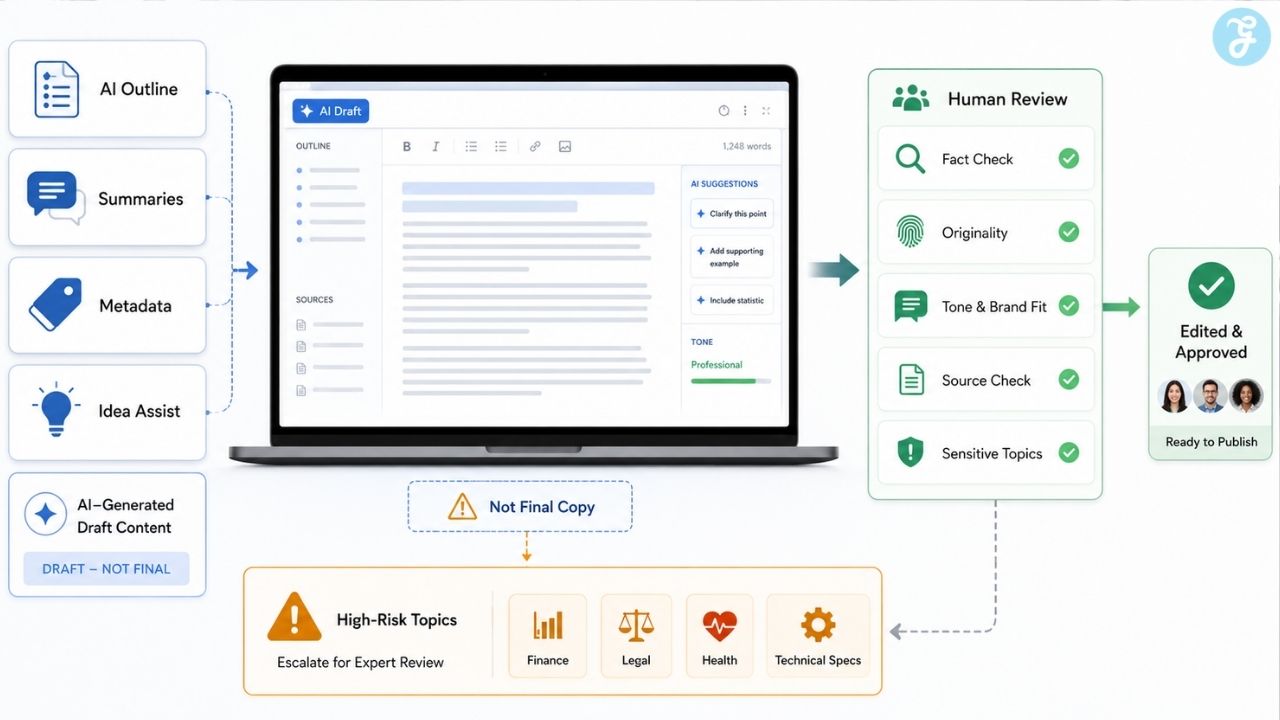
Where AI Drafting Fits in Approval Workflows
Understanding the role of Content Approval Workflows can significantly impact project outcomes.
AI is deeply embedded in modern content production, whether teams use it for outlining, summarization, metadata generation, or rapid ideation. But while AI can accelerate the drafting phase, it absolutely does not remove the need for review. In many ways, it amplifies it. Teams now have to be hyper-vigilant about checking for factual accuracy, originality, tone, and brand fit.
If AI is part of your stack, your workflow must establish clear rules of engagement:
- Which AI applications are permitted?
- Do certain content types require internal AI disclosure?
- Who is responsible for verifying AI-generated claims?
- Who manually checks the sourcing?
- Which topics are strictly off-limits for AI drafting due to sensitivity?
Never treat AI output as final content. Treat it as raw, unrefined material. This is critically true for YMYL (Your Money or Your Life) topics like finance, legal, health, or deep technical product specs. An LLM can write a beautifully polished paragraph that is entirely, dangerously wrong.
Furthermore, AI naturally leans toward the generic. If an SEO draft sounds exactly like every other article on page one, an editor needs to push back and ask, “What unique value are we actually adding here?”
Tools Can Help, But They Do Not Fix a Bad Process
Investing in strong Content Approval Workflows will yield substantial benefits for your organization.
Project management platforms, CMS approval flows, and collaborative docs are incredible assets. They track status, notify teams, and centralize communication.
But software cannot fix a broken culture. A tool won’t give someone authority. It can’t decipher vague feedback, stop an executive from derailing a final draft, or magically turn a terrible brief into a winning strategy. Always finalize your workflow before you buy the software.
For a small, agile team, a lightweight stack is plenty:
- Google Docs or Word for collaborative drafting.
- Trello, Notion, or Asana for Kanban-style tracking.
- A shared pre-publish checklist.
- Slack for nudges and quick alignments.
Larger teams will likely benefit from the gated approval features built into robust CMS platforms or content operations software, keeping the entire review cycle contained within the publishing environment.
A great litmus test: if your project management tool crashed tomorrow, would your team still know how to get an article approved? If the answer is no, your process isn’t mature enough yet.
A Simple Approval Matrix for Growing Teams
Incorporating feedback into Content Approval Workflows allows teams to learn and adapt over time.
An approval matrix is exactly what it sounds like: a clear chart detailing who reviews what. It eliminates the need to debate the review roster every single week. Here is a practical framework to build upon:
Identifying and addressing issues within Content Approval Workflows is vital for continuous improvement.Well-designed Content Approval Workflows enhance team collaboration and accountability.With strong Content Approval Workflows, teams can navigate the complexities of content production.Adapting Content Approval Workflows to your unique project needs can lead to better outcomes.
| Asset Type | Editorial Review | SEO Review | Subject Expert | Legal/Compliance | Final Approver |
| Blog article | Required | Required (if organic) | Optional | Rare | Content lead |
| Product article | Required | Required | Required | Sometimes | Product marketing lead |
| Landing page | Required | Required | Required | Sometimes | Marketing lead |
| Case study | Required | Optional | Account owner | Often | Customer marketing lead |
| Help article | Required | Optional | Product/Support | Rare | Support or product lead |
| Regulated content | Required | Required (if organic) | Required | Required | Compliance owner |
| Social post | Light review | Rare | Optional | Sometimes | Social/content lead |
Your matrix doesn’t have to be flawless on day one, but it does need to be unambiguous. Review it every quarter. As your company evolves, your workflows should evolve in tandem. The scrappy process that worked for a seed-stage startup will choke a Series C marketing department.
Effective Content Approval Workflows play a critical role in maintaining content quality.
Approval Deadlines Need Rules
A workflow without enforced deadlines is just a wish list.
Every single review stage needs an agreed-upon service-level expectation (SLA). It doesn’t have to feel corporate, it just needs to be respected. A standard timeline might look like this:
- Brief review: 1 business day
- Draft editorial review: 2 business days
- Subject-matter review: 2 business days
- Legal review: 3 to 5 business days (depending on complexity)
- Final approval: 1 business day
- Live-page QA: Same day or next business day
Ensure these timelines map to reality. Don’t mandate a 24-hour turnaround for legal if your legal team is chronically understaffed.
Streamlined Content Approval Workflows can help manage the flow of information effectively.
If reviewers habitually blow past deadlines, the content owner needs clear escalation protocols. Depending on the culture, that could mean pushing the publish date, moving forward without the non-essential feedback, alerting a manager, or deprioritizing the asset entirely. While silence shouldn’t equal approval on high-risk content, many teams successfully employ a “review by Friday, or we move forward” rule for low-stakes pieces.
Version Control Is Not a Small Detail
When nobody knows which document is the current draft, chaos ensues.
This usually happens when feedback gets scattered across a Google Doc, an email chain, a PDF export, a staging link, and direct messages. One stakeholder leaves notes on an old version, a designer copies outdated text into Figma, and the editor misses a crucial correction while trying to manually merge it all together.
Version control requires boring, relentless discipline. Stick to these rules:
- Establish one undisputed single source of truth for the working draft.
- Never review copied text in separate, isolated files.
- Use standard, clear naming conventions for versions.
- Lock editing permissions during the final proofing stage.
- Use the “suggesting” or comment features rather than silently rewriting text.
- Document major strategic pivots in the main project card.
- Clearly archive or watermark outdated drafts.
Integrating technology into Content Approval Workflows can enhance efficiency and clarity.
Whether you rely on a high-end CMS or a simple shared folder, the root of version control issues is rarely the software—it’s a lack of team alignment.
What Reviewers Should Check
A major reason workflows stall is because reviewers simply don’t know what they are supposed to be looking for. Give them a specific checklist tied to their role.
An editor checks for quality:
- Is this actually useful to our target audience?
- Is the logical flow sound?
- Are the claims backed by evidence?
- Is the tone consistent with our brand guidelines?
- Did we avoid fluff and repetition?
Regular audits of Content Approval Workflows can reveal areas for improvement and growth.
An SEO reviewer checks for discoverability:
- Does the page satisfy the primary search intent?
- Are keywords incorporated naturally?
- Is the heading hierarchy (H1, H2, H3) optimal?
- Are internal links strategically placed?
- Is the metadata (title tag, description, URL slug) dialed in?
A subject-matter expert (SME) checks for accuracy:
- Are the product features described correctly?
- Are the technical walkthroughs accurate?
- Are the examples grounded in reality?
- Are we making any overly broad or false claims?
Emphasizing the importance of Content Approval Workflows will foster a culture of quality.
Legal or compliance checks for risk:
- Are our performance claims legally defensible?
- Do we need specific disclaimers?
- Is our pricing and guarantee language safe?
- Do we have the right to use these customer quotes?
Providing this clarity makes the review process highly efficient and far less personal. When people know their exact lane, they stay in it.
How Approval Workflows Support Topic Clusters
If your content strategy relies on the topic cluster model, rigorous workflows are non-negotiable.
Engaging all stakeholders in the Content Approval Workflows is key to aligning goals.
Topic clusters thrive on tight consistency. Pillar pages and their supporting cluster pages need aligned terminology, distinct search intents, and seamless internal linking. Without a strong editorial gatekeeper, these clusters quickly unravel. One writer might define a core concept differently than another. A cluster page might cannibalize the pillar page’s primary keyword, or simply forget to link back to it altogether.
To keep your architecture intact, add cluster-specific checkpoints to your review:
- Does this page directly support the correct pillar?
- Does the search intent overlap with an existing page?
- Is the internal link to the pillar page natural and prominent?
- Does the CTA accurately match this specific stage of the reader’s journey?
A strategy document can map out a brilliant cluster, but only a strict workflow ensures it actually gets built correctly.
When Legal and Compliance Review Is Needed
Sending every piece of content to your legal team is a fantastic way to grind your publishing calendar to a halt. However, skipping legal on a high-risk piece is a fast track to a lawsuit.
Generally, you need legal or compliance eyes on content that includes:
By focusing on clear Content Approval Workflows, teams can enhance communication and efficiency.
- Financial claims or guarantees
- Medical, health, or legal advice
- Strict security or data privacy promises
- Customer quotes or case studies
- Aggressive competitor comparisons
- Sweepstakes, promotions, or contest rules
The secret to working well with legal is bringing them in early. If legal flags a foundational premise as a risk during the final review, you’re looking at a total rewrite. A smarter workflow highlights sensitive claims in the brief phase, allowing legal to sign off on the boundaries before the writer even starts typing.
How to Keep Stakeholder Feedback Useful
Stakeholder feedback is pure gold when it is specific, but it’s an absolute nightmare when it’s vague.
Leaving a comment that says, “Make this pop,” helps no one. Conversely, commenting, “Let’s swap this agency example for a mid-market SaaS scenario to better align with our Q3 targets,” is incredibly actionable.
Ultimately, successful Content Approval Workflows contribute to a strong content strategy.
Content owners must proactively train reviewers on how to leave good feedback.
Great feedback is:
- Highly specific.
- Rooted in the original brief.
- Focused entirely on the reader’s experience.
- Confined to the reviewer’s actual domain of expertise.
- Delivered on time.
Terrible feedback is:
Driven purely by personal stylistic taste.
Delivered days after the approval deadline.
Prioritizing effective Content Approval Workflows is essential for meeting deadlines without compromising quality.
- A silent, untracked rewrite of a major section.
- A brand-new strategic direction introduced at the finish line.
When a stakeholder drops vague or out-of-scope feedback, the content owner must step in and ask for clarification before passing the confusion down to the writer.
The Pre-Publish Checklist
An asset isn’t fully approved until it’s ready to face the public. A meticulous pre-publish QA catches the tiny, embarrassing errors that undermine great writing.
For a standard web page, check the following:
- Final H1 and title tag
- Meta description and clean URL slug
- Proper heading hierarchy
- Functional internal and external links
Content Approval Workflows must evolve to meet the changing demands of content creation.
- Image formatting and alt text
- Correct author attribution and categories
- Visibility and function of the CTA
- Mobile vs. desktop rendering
- Canonical tags and tracking parameters
- Zero placeholder text (e.g., TK insert link here)
For email campaigns, verify subject lines, preview text, segmentation logic, dynamic personalization fields, and the all-important unsubscribe link.
These checks aren’t glamorous, but they are the final safety net. Never assume that “approved copy” translates flawlessly to a “perfect live page.”
Post-Publication Review Is Part of the Workflow
A world-class editorial workflow doesn’t end the moment you hit “publish.”
By refining and adapting Content Approval Workflows, teams can achieve a competitive edge in their market.
Once an asset is live, someone needs to verify the final product in its native environment. CMS previews lie. Tables break, images compress weirdly, CSS shifts, and mobile displays often reveal glaring formatting issues that were invisible on a desktop screen.
Run a quick live-page review shortly after launch:
- Does the page render smoothly?
- Are all links routing correctly?
- Is the analytics tracking firing?
- Is the page properly indexed (or no-indexed, if intentional)?
Following the technical check, schedule a performance review. For evergreen SEO content, you might need to wait a few months for meaningful Search Console data. For social or email, the feedback loop is immediate. Tying performance data back into your workflow ensures your team actually learns from what they publish.
How to Fix a Workflow That Is Already Broken
If your current process is a tangled mess, do not attempt to rip it down and rebuild it all at once. Big, sweeping process mandates usually fail.
Instead, find your single biggest bottleneck. Ask yourself:
Incorporating effective Content Approval Workflows will help teams navigate complex projects successfully.
- Where do drafts stall the longest?
- Which specific reviewer consistently causes delays?
- What type of content requires the most painful rework?
- Which avoidable mistakes keep slipping through to the live site?
Fix that one specific thing. If your briefs are terrible, overhaul the briefing stage. If legal is always late, move their review earlier in the timeline. If version control is a nightmare, lock down your document rules. Small, surgical fixes compound into massive efficiency gains.
A Practical Workflow for Small Teams
Agile, lean teams need lightweight processes. Keep it simple:
- Brief: The content lead locks in the angle, keyword, audience, and designates the final reviewer.
- Draft: The writer executes based on the brief.
- Editorial review: The editor polishes structure, clarity, tone, and flow.
Consistency in Content Approval Workflows ensures that all outputs meet high standards.
- Specialist check (Conditional): Product, SEO, or legal reviews only if the topic demands it.
- Final approval: One single person gives the definitive green light.
- Publish & Check: The piece goes live and is QA’d in the real world.
The golden rule here: Do not add a reviewer unless they actively reduce risk or tangibly improve the final product.
A Practical Workflow for Larger Teams
Enterprise teams need robust guardrails that don’t strangle creativity. A scalable enterprise flow looks more like this:
- Intake: Requests are centralized via a form capturing the goal, audience, deadline, and risk level.
- Triage: A content manager accepts, delays, merges, or rejects the request.
- Brief approval: Stakeholders align on strategy before a single word is written.
- Production: The creative team (writers, designers, video editors) builds the asset.
Elevating Content Approval Workflows is vital for maintaining a creative and productive environment.
- Editorial review: Quality control catches structural and tonal issues.
- Specialist review: Designated experts review strictly within their domain.
- Revision: The creator resolves the feedback.
- Final sign-off: One final approver confirms the piece is launch-ready.
- Publishing QA: The technical publisher verifies the live environment.
- Performance review: The team analyzes the data to inform the next brief.
Because this model relies on triage and risk-tiering, it remains remarkably flexible. Not every asset goes through every step, which is precisely why it scales.
Metrics That Show Whether Approval Is Working
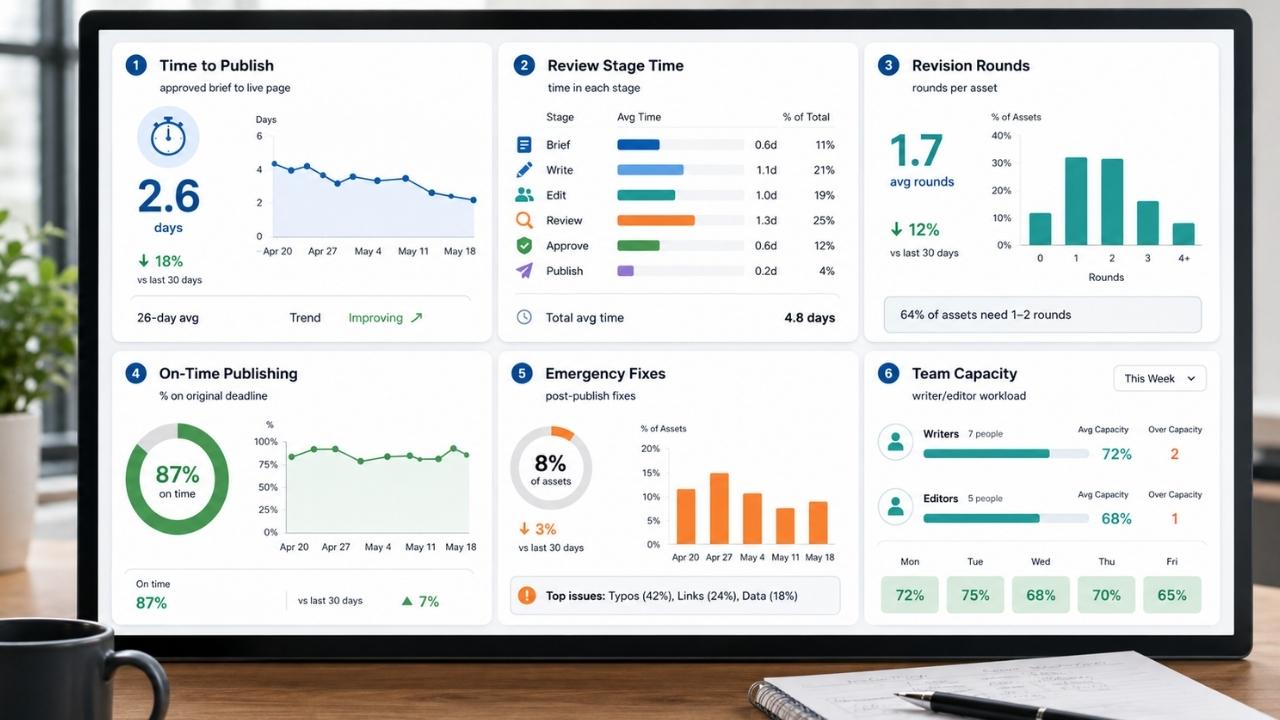
You can’t improve a workflow you aren’t measuring. To see if your process is actually working, track:
Carefully constructed Content Approval Workflows can significantly reduce delays and rework.
- Average time from approved brief to published page.
- Average time spent sitting in each review stage.
- Number of revision rounds per asset.
- Percentage of assets published on their original deadline.
- Frequency of post-publication emergency fixes.
- Writer and editor capacity levels.
Don’t weaponize these metrics just to force people to work faster. A process that rushes content out the door only to require three rounds of live-site revisions is highly dysfunctional. The goal is controlled speed—moving efficiently because the path is clear, not because you’re skipping the guardrails.
Warning Signs Your Approval Workflow Is Too Heavy
Sometimes, a team makes one high-profile mistake and overcorrects by adding three permanent layers of bureaucratic review.
Your process is likely too heavy if:
Ultimately, robust Content Approval Workflows are foundational for every content-driven organization.
- Low-stakes social posts require VP approval.
- Every reviewer feels entitled to comment on every aspect of the piece.
- Final approvers routinely blow up the foundational premise of the draft.
- Writers spend more hours adjudicating comments than they do writing.
- Publish dates are treated as mild suggestions because review always runs long.
- You require a full re-approval loop for fixing a minor typo.
Heavy workflows absolutely drain the morale of a creative team. If a specific review stage hasn’t caught a meaningful error in three months, eliminate it or make it conditional.
Warning Signs Your Approval Workflow Is Too Loose
Conversely, a loose workflow feels amazing—right up until the mistakes start hitting the public domain.
Watch out for these red flags:
Commitment to refining Content Approval Workflows ensures long-term success in content management.
- You frequently have to correct core product details after launch.
- Major SEO plays go live missing title tags and internal links.
- Legal is constantly asking you to pull pages down.
- The brand voice sounds completely different depending on who wrote the post.
- Nobody can confidently say who approved a specific landing page.
- Old, unedited drafts are accidentally published.
Loose workflows usually plague fast-growing startups that prize speed above all else. But moving fast and breaking things doesn’t work well in content publishing. The solution isn’t to grind everything to a halt—it’s to place the right gates at the exact right moments.
Final Thoughts
Strong content approval workflows turn chaotic content operations into reliable, predictable engines. They safeguard your quality standards, eliminate last-minute panic, and empower teams to publish at a sustainable, high-volume pace.
Remember, the best approval process is rarely the longest one. It is simply the clearest one.
Establishing clear Content Approval Workflows cultivates a culture of accountability and excellence.
Name your content owner. Lock in your briefs before drafting begins. Tailor your review stages to the actual risk of the asset. Keep feedback firmly separated from final approval, and limit that final sign-off to one person. By doing so, approval stops being a dreaded bottleneck and simply becomes a natural step in a healthy editorial machine.
FAQs About Content Approval Workflows
What is the difference between content review and content approval?
Content review is the collaborative process of refining and improving an asset. Reviewers check for clarity, SEO, technical accuracy, and legal risk. Content approval, on the other hand, is the definitive executive decision that the asset is ready to be published. Mixing the two causes endless delays.
Who should give final content sign-off?
Ideally, one named individual per asset. Depending on the content, this could be the content lead, product marketing manager, or campaign owner. While multiple stakeholders should review specific components, the final go/no-go decision should not be handled by a committee.
How many review rounds should content have?
Most standard content requires one substantive review (for heavy edits and fact-checking) and one final review (to confirm the changes were made). High-risk enterprise assets might require more; low-risk social posts require less. If your standard blog posts are going through five rounds of review, your initial briefs are likely failing.
Should legal review every piece of content?
No. Legal review should be strictly dictated by risk. Content discussing financial guarantees, health claims, data security, regulated terminology, or contractual promises definitely requires legal oversight. Standard top-of-funnel educational blogs generally do not.
Can AI tools be used in content approval workflows?
Yes, but they should assist human reviewers, not replace them. AI is excellent for summarizing feedback, drafting metadata, or running a first-pass check for passive voice. However, humans must still take full responsibility for verifying factual accuracy, brand voice, originality, and legal compliance.





















