The global food production system is currently facing a profound structural crisis. While public discussions surrounding ecological degradation frequently focus on heavy industrial manufacturing, aviation, and fossil fuel extraction, scientific assessments reveal that agricultural systems are equally disruptive to the planetary equilibrium.
The simple act of selecting daily meals shifts immense global supply chains, requiring vast land clearings, massive freshwater extractions, and complex chemical processes. Analyzing the environment impact of plant-based diet systems compared to conventional livestock models highlights how dietary choices function as primary drivers of planetary transformation.
For individuals driven by animal welfare, conservation, and personal ethics, understanding these relationships is essential for making informed ecological choices. Traditional agricultural models treat animal life not as interconnected ecological components, but as intensive thermodynamic conversion units. Shifting away from this high-input paradigm toward direct plant cultivation fundamentally alters how natural resources are distributed. This guide provides an expert sustainability analysis of how dietary shifts mitigate greenhouse gas production, minimize resource depletion, and alleviate the structural strain placed on fragile ecosystems worldwide.
The Thermodynamic Inefficiency of Livestock Systems
To understand why the meat environment footprint is disproportionately high, you must examine the basic physics of energy transfer within food webs. When humans cultivate crops like soy, wheat, or legumes for direct consumption, the metabolic energy loss between harvest and ingestion is minimal. The food goes straight from the field to the plate, maximizing nutritional efficiency per square meter of agricultural land.
Livestock farming introduces a massive metabolic detour that drains the vast majority of nutritional value out of the system. Animals must ingest immense volumes of plant protein and calories simply to maintain their biological functions, grow bones, generate body heat, and develop muscle tissue. The rate at which livestock converts plant feed into edible human protein is highly inefficient across all major sectors:
Beef Production: Cattle require roughly 25 kilograms of plant feed to produce just one single kilogram of edible beef tissue, representing a massive net loss of food security.
Pork Production: Pigs consume approximately 6 to 9 kilograms of feed grain per kilogram of meat produced.
Poultry Systems: Chickens are relatively more efficient but still require roughly 2 to 3 kilograms of grain feed for every kilogram of meat yields.
This thermodynamic reality means that millions of hectares of arable land are not used to grow food for human populations. Instead, they are dedicated to intensive monoculture cultivation of feed crops like dent corn and genetically modified soybeans. This structural loop magnifies global habitat destruction, requiring massive applications of synthetic fertilizers and intensive transport networks just to keep animal feed supplies moving.
Greenhouse Gas Dynamics: Plant vs. Animal Production
The global food system is responsible for approximately one-third of all human-caused greenhouse gas emissions. The structural composition of these agricultural emissions varies dramatically depending on whether the primary output is plant-based or animal-derived. Livestock management produces immense amounts of highly potent atmospheric warming gases, whereas plant cultivation operates on a significantly lower chemical baseline.
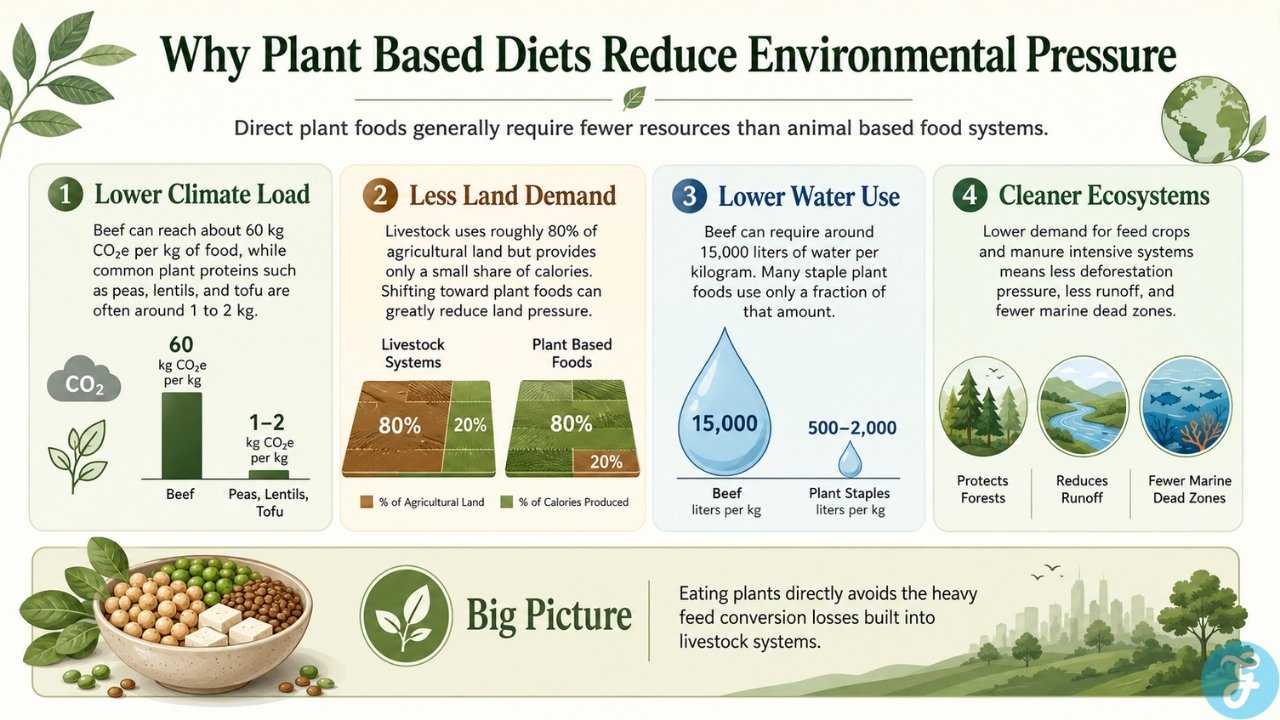
As illustrated by global agricultural data, the atmospheric footprint of beef production towers over every other food category, releasing roughly 60 kilograms of carbon dioxide equivalents per kilogram of finished product. In stark contrast, staple plant proteins like peas, tofu, and lentils generate less than one to two kilograms of carbon dioxide equivalents for the same weight of food.
Methane and Enteric Fermentation
Ruminant animals, including cattle, sheep, and goats, possess a specialized stomach chamber called a rumen. Inside this chamber, anaerobic microbes break down tough cellulose plant fibers through a biological process known as enteric fermentation. A primary byproduct of this metabolic fermentation is methane gas, which the animals expel continuously into the surrounding atmosphere.
Methane is a major concern for short-term climate stability. Over a twenty-year timeline, a single metric ton of methane traps up to 84 times more atmospheric heat than an equivalent ton of carbon dioxide. This means that even though methane breaks down faster in the atmosphere, its immediate warming impact accelerates global temperature shifts far more aggressively than industrial emissions.
Nitrous Oxide from Waste and Fertilizers
Beyond methane, livestock systems generate immense quantities of nitrous oxide, another highly destructive greenhouse gas with a warming potential nearly 300 times greater than carbon dioxide. Nitrous oxide emissions stem from two main agricultural sources: the decomposition of concentrated animal waste stored in open manure lagoons, and the heavy application of synthetic nitrogen-based fertilizers used to stimulate feed crop growth. When these nitrogen compounds interact with soil bacteria, they volatilize into the air, creating a long-term warming effect that far outweighs the carbon impact of machinery fuel.
Impact of Plant-Based Diet on Nature
The spatial requirements of global meat production are the primary cause of terrestrial biodiversity loss. Agriculture occupies nearly half of all habitable land on the planet, and within that massive footprint, livestock management consumes the vast majority of spatial resources.
The Spatial Disparity of Global Diets
When evaluating plant diet sustainability, the primary advantage is spatial efficiency. Livestock utilizes roughly 80 percent of all global agricultural land, including both grazing pastures and dedicated feed crop fields. Despite consuming four-fifths of global farming spaces, animal agriculture delivers only 18 percent of total caloric supplies and 37 percent of global protein resources for human consumption.
This spatial disparity explains why global dietary shifts have an immediate impact on wilderness conservation. If human populations transition toward direct plant consumption, the total amount of land required to feed the global population drops by roughly 75 percent. This structural contraction would reclaim billions of hectares of land, allowing natural wilderness areas to recover.
The Destruction of Key Global Carbon Sinks
To keep up with the global demand for beef and animal feed, vast swathes of critical ecosystems like the Amazon rainforest and the Cerrado savanna are systematically cleared. Tropical forests act as massive planetary carbon sinks, locking billions of tons of carbon within their dense wood structures and subterranean root networks.
When these forests are cleared via heavy machinery or open burning, that stored carbon is instantly oxidized and released into the atmosphere. This transformation inflicts a double blow to planetary stability: it eliminates an active carbon-absorption system while simultaneously releasing centuries of accumulated carbon storage into the atmosphere. For animal lovers and conservationists, this land clearing represents the single largest driver of global species extinction, fracturing migratory corridors and destroying the habitats of millions of native organisms.
Water Scarcity and Marine Ecosystem Disruption
The food system shapes global hydrology, altering freshwater availability and driving the chemical degradation of marine environments.
The Deep Freshwater Footprint of Animal Agriculture
Freshwater is a finite planetary resource, and modern agriculture consumes roughly 70 percent of all global freshwater extractions. The volume of water required to produce individual food items highlights a stark division between plant and animal systems:
Beef: Producing one kilogram of industrial beef requires roughly 15,000 liters of water, with the vast majority used to sustain feed crop irrigation over multiple years.
Pork and Poultry: Pig and chicken production require between 4,000 and 6,000 liters of water per kilogram of meat.
Plant Staples: Crops like lentils, potatoes, and tomatoes require a small fraction of that volume, typically falling between 300 and 1,800 liters per kilogram.
This means that a standard omnivorous diet draws heavily on declining underground aquifers, accelerating water crises in vulnerable, arid agricultural zones.
Agricultural Runoff and Marine Dead Zones
Once fertilizers and animal waste leave the farm, they create severe downstream pollution. Rainstorms wash excess nitrogen and phosphorus compounds out of agricultural fields and manure lagoons into local river networks, which eventually empty into coastal ocean basins.
This concentrated nutrient influx triggers a process known as eutrophication. The sudden spike in nitrogen and phosphorus causes massive, uncontrolled blooms of surface algae. These algae blocks sunlight from reaching underwater plants, and when the blooms eventually die and sink to the bottom, marine bacteria consume immense volumes of oxygen to decompose the organic mass.
This biological oxygen depletion creates vast marine dead zones, or hypoxic regions, where the water contains insufficient oxygen to support marine life. The dead zone in the Gulf of Mexico, fueled entirely by agricultural runoff from the central United States farm belt, covers thousands of square miles every summer, killing bottom-dwelling fish, crabs, and shrimp, and disrupting complex marine food webs.
Analyzing Plant Diet Sustainability Challenges
While the overall vegan environmental impact is significantly lower than that of animal-based models, a comprehensive expert analysis requires looking closely at the unique sustainability frictions present within plant-based supply chains. No agricultural system is entirely free of ecological impacts, and scaling up plant production introduces its own management challenges.
The Monoculture Dilemma and Soil Degradation
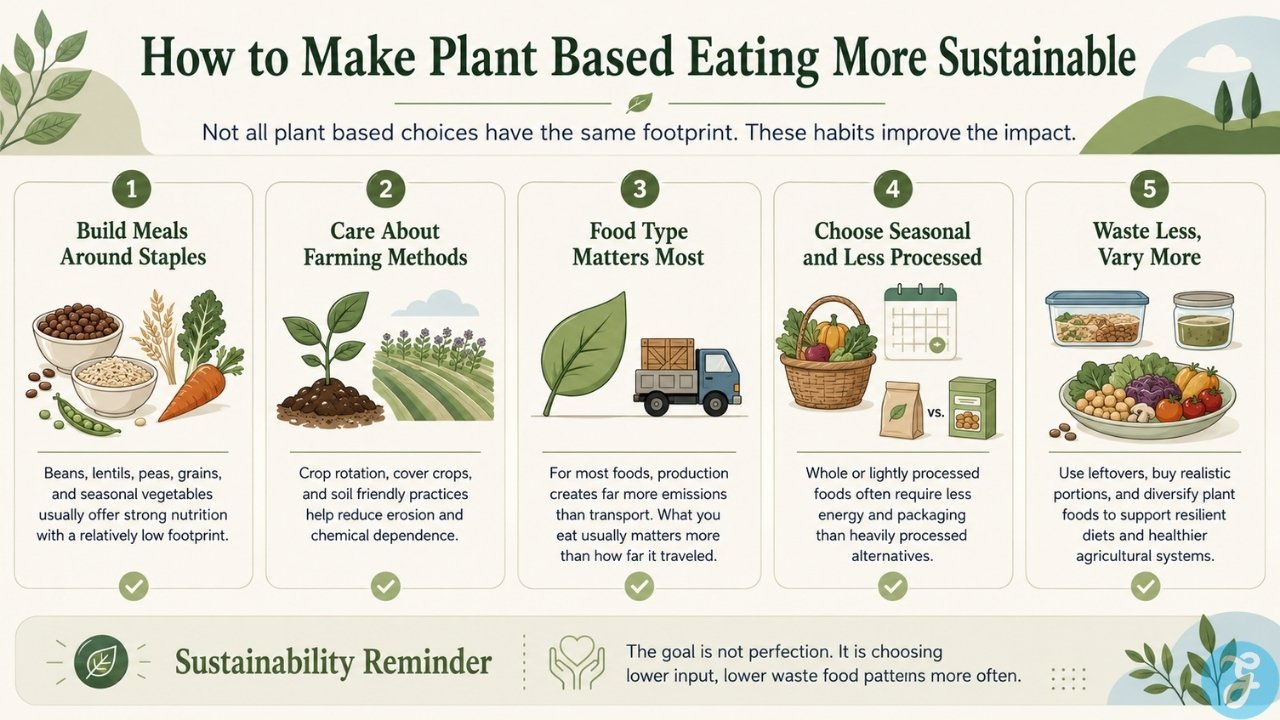
Large-scale industrial farming of staple plant crops like wheat, corn, and soy often relies on intensive monoculture practices—growing a single crop variety over thousands of acres year after year. This lack of crop diversity depletes specific soil nutrients, forcing farmers to rely on continuous chemical interventions to maintain crop yields.
Continuous mechanical tilling and heavy chemical applications destroy the living microscopic networks within the soil, reducing its organic matter and rendering it highly vulnerable to wind and water erosion. To achieve true long-term sustainability, plant agriculture must transition toward regenerative methods, including multi-crop rotation, no-till farming, and the use of cover crops to restore natural soil fertility without synthetic inputs.
The Nuance of Food Miles vs. Food Type
A frequent criticism of plant-based products is the environmental cost of long-distance transport, often referred to as food miles. Critics argue that importing exotic fruits or out-of-season vegetables from another continent cancels out the ecological benefits of avoiding local meats.
However, comprehensive greenhouse gas lifecycle assessments demonstrate that this assumption is incorrect. For the vast majority of food products, the transport stage accounts for less than 10 percent of the item’s total lifetime emissions. The overwhelming majority of greenhouse gas production happens during the active on-farm production phase.
For example, shipping a container of Spanish tomatoes across an ocean generates a tiny fraction of the carbon footprint created by a local cattle farm producing beef on nearby pastures. What you eat matters far more than where it traveled from, though sourcing seasonal, locally grown plants remains the most sustainable choice.
Quantifying the Scale of the Vegan Environmental Impact
Shifting toward a plant-based diet provides a major, quantifiable reduction in an individual’s personal environmental footprint. This dietary adjustment is one of the most effective lifestyle changes a consumer can make to lower their ecological impact.
When an individual eliminates animal products from their diet, their personal food-related carbon footprint drops by up to 73 percent almost immediately. This shift also relieves systemic ecological pressure by drastically reducing the daily demand for global land clearing, freshwater extraction, and ocean-degrading chemical runoff. For animal lovers and sustainability enthusiasts, these numbers show that moving toward a plant-based model is not just an ethical choice for animal welfare; it is a structural necessity for protecting the broader biosphere.
Final Thoughts
The environmental data surrounding global food production points to a clear conclusion: the environment impact of plant-based diet choices is consistently lower across every key ecological metric, including greenhouse gas emissions, spatial requirements, freshwater depletion, and marine pollution. While industrial meat production strains planetary boundaries through resource-intensive conversion loops, direct plant cultivation offers a highly efficient path forward.
Achieving global environmental stability does not require flawless, universal perfection overnight. Instead, it relies on a steady, collective shift toward low-input agricultural models. By understanding the thermodynamic realities of the food supply chain and choosing direct plant resources, modern consumers can actively reduce their personal ecological footprints. This individual choice helps protect threatened habitats, preserves vital freshwater resources, and supports long-term planetary health.
Frequently Asked Questions About the Environment Impact of Plant-Based Diet Choices
Is the soy grown for plant-based diets causing rainforest deforestation?
The vast majority of soy-driven deforestation is caused by animal agriculture rather than direct human consumption. Approximately 75 to 80 percent of global soy harvests are crushed into high-protein animal feed for livestock like pigs, chickens, and cattle. Transitioning to a plant-based diet actually reduces total global soy demand by bypassing this resource-intensive animal feeding loop.
Does a plant-based diet save more water than cutting down on household water use?
Dietary adjustments conserve significantly more freshwater than standard domestic water-saving measures. Producing one kilogram of beef requires roughly 15,000 liters of water, primarily due to the continuous irrigation of feed crops over several years. Shifting to plant proteins can lower your personal food-related water footprint by up to 50 percent, far outweighing shorter showers.
Is grass-fed beef better for the environment than a plant-based diet?
No, lifecycle assessments show that grass-fed beef still carries a much higher environmental burden than plant proteins. While pasture grazing can support localized soil health, grass-fed cattle require vastly more land and live longer before slaughter, which increases their lifetime methane emissions. Plant alternatives consistently produce fewer emissions per gram of protein regardless of the farming style.
Do transport emissions from imported plant foods cancel out the ecological benefits?
Transport usually accounts for less than 10 percent of a food product’s total lifetime greenhouse gas footprint. The overwhelming majority of agricultural emissions are generated during the active on-farm production phase rather than during shipping. Because of this, eating an imported plant staple still results in a significantly lower carbon footprint than consuming locally raised meat.
How does a plant-based diet compare to driving an electric car for carbon reduction?
Both lifestyle choices are highly effective, but they target completely different sectors of global emissions. Switching to a plant-based diet reduces your food-related emissions by up to 73 percent while actively lowering global land clearings and marine pollution. Combining low-emission transportation choices with dietary shifts provides the maximum possible reduction in your personal ecological impact.