I do not hate sequels. Let’s clear that up before someone starts yelling about how their favorite sequel changed their life, fixed their posture, and paid their taxes. Some sequels are incredible. Some sequels are better than the original. Some sequels take a rough idea, sharpen it, expand it, and turn it into something unforgettable.
The problem is not sequels.
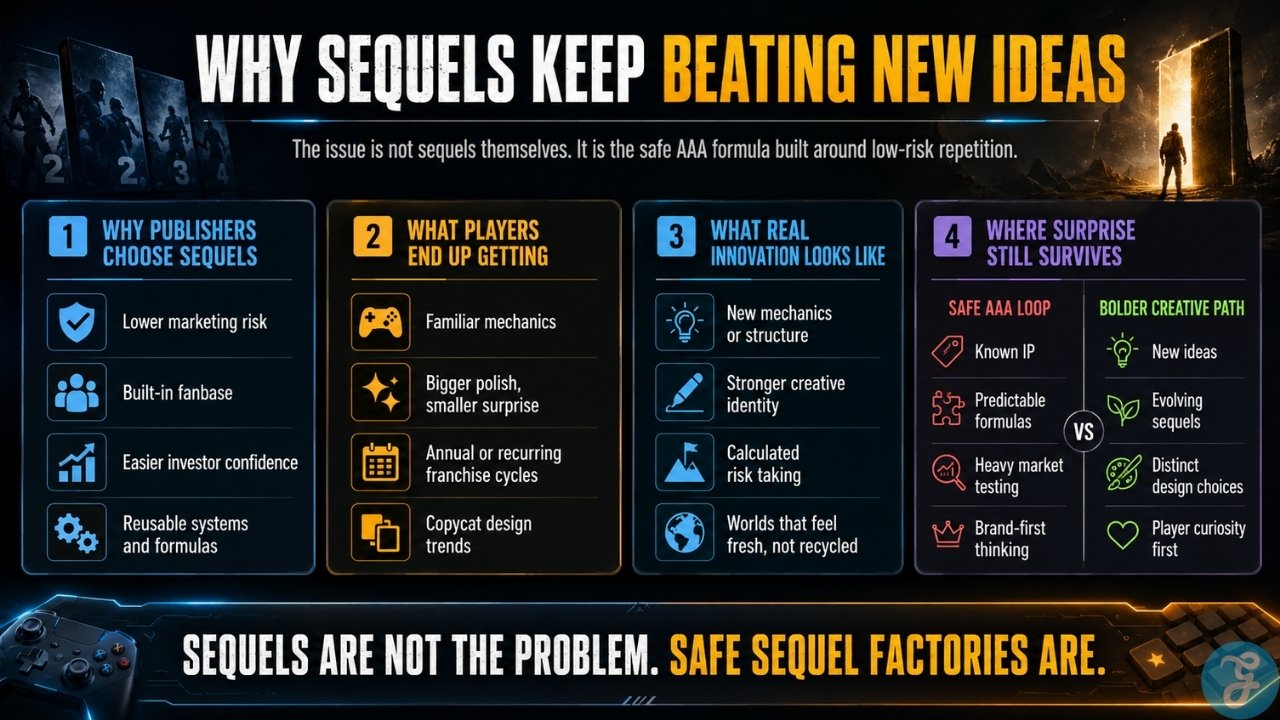
The problem is that sequels replaced innovation in too many corners of AAA gaming. Not because every sequel is lazy, but because publishers learned that familiar logos are easier to sell than new ideas. A known franchise lowers risk. A recognizable character calms investors. A numbered title makes marketing simpler. A remake, reboot, or “spiritual return” gives everyone just enough nostalgia to ignore how little surprise is actually left.
And yes, I know games are expensive. AAA budgets are absurd now. A 2023 report cited during the Microsoft-Activision review described blockbuster budgets moving from roughly $50 million to $150 million in the previous console generation toward more than $200 million for major upcoming games. Some top franchises were reported even higher.
That explains the fear.
It does not excuse the creative cowardice.
Sequels Replaced Innovation but Who’s Fault is It?
A sequel can be the best thing in gaming when it earns the number on the box.
A good sequel does not just repeat. It understands what worked, cuts what dragged, adds something meaningful, and respects the player enough to risk change. That is how a sequel becomes evolution instead of recycling.
The problem starts when a sequel exists mostly because the brand already has an audience.
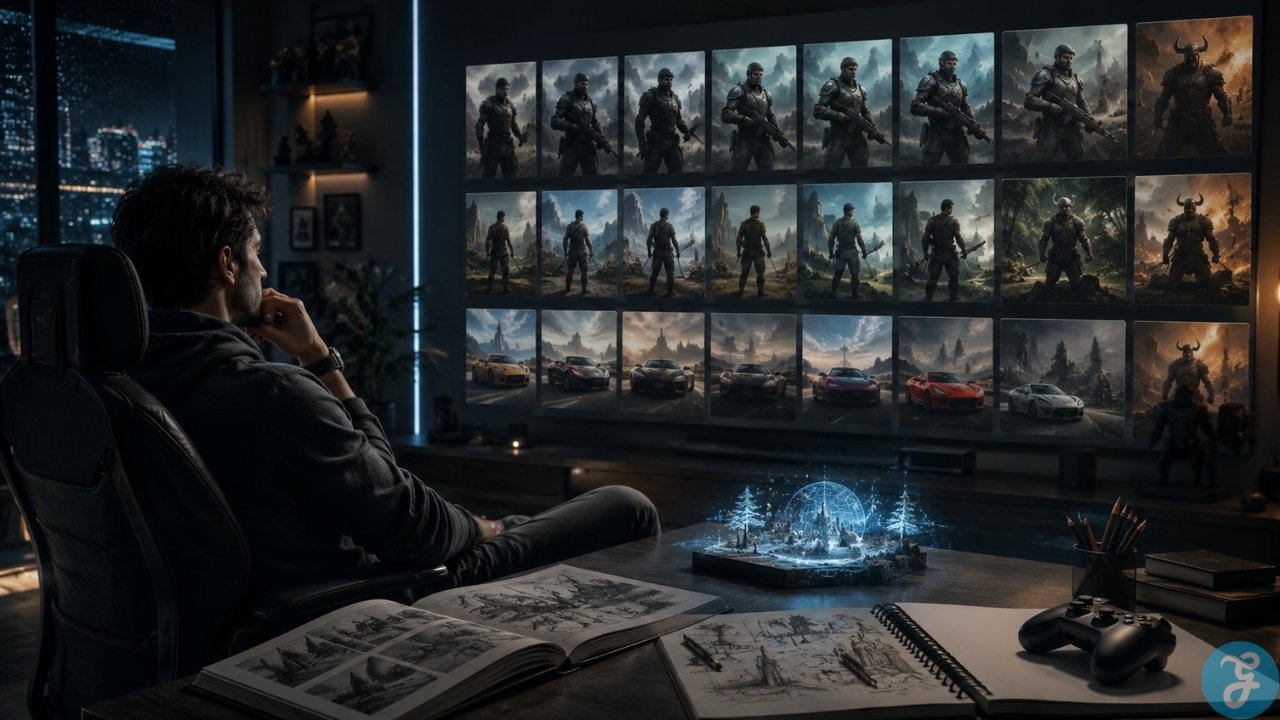
That is the AAA sequels problem. Too many games now feel like they were greenlit by a spreadsheet before anyone asked whether the idea deserved another entry. The pitch is not “we have something new to say.” The pitch is “people recognize this name.”
Very inspiring. Truly the stuff creative revolutions are made of.
And once that mindset takes over, the game may still be polished. It may still be fun. It may still sell millions. But it starts feeling like a product line, not a creative leap.
The Safe Franchise Machine
AAA publishers love safety because safety is easier to explain to investors.
New IP is messy. New mechanics are scary. New worlds require trust. New characters need time. Original ideas can fail in ways that sequels usually do not, because a sequel already comes with memory, loyalty, search demand, pre-orders, fan theories, YouTube breakdowns, and a built-in army of people ready to argue online for free.
That is why the sequel machine keeps moving.
Call of Duty is the cleanest example. Black Ops 6 launched worldwide on October 25, 2024, and Black Ops 7 followed as a premium Activision release on November 14, 2025. I am not saying every Call of Duty is identical. Some entries do make mechanical changes. Some campaigns work better than others. Zombies has its own loyal ecosystem. Multiplayer tuning matters.
But the broader rhythm is obvious. The machine cannot stop because the machine is the business.
EA Sports works similarly, just with football boots and player ratings instead of killstreaks. EA Sports FC 26 launched worldwide on September 26, 2025, and Madden NFL 26 launched worldwide on August 14, 2025. Annual sports games are not shocking by themselves. Sports seasons change. Rosters change. Licenses matter. But let’s not pretend yearly releases are some grand artistic mystery. They are reliable revenue rituals.
And that is the point. Once a publisher finds a ritual that prints money, innovation becomes optional.
Copycat Games Are the Rot
Sequels are one thing. Copycat games are worse.
At least a sequel has a reason to exist inside its own lineage. Copycats just chase whatever worked last quarter. One game succeeds, and suddenly everyone discovers the same genre, the same camera angle, the same crafting loop, the same skill tree, the same loot color system, the same live-service roadmap, the same tired “seasonal content” language.
Gaming has always borrowed ideas. That is normal. That is how genres evolve. But there is a difference between influence and creative photocopying.
Influence says, “That worked. How can we build on it?”
Copycat design says, “That worked. How can we wear its skin?”
That is where gaming innovation decline becomes obvious. Not because nobody has ideas, but because too many big games are forced to behave like other successful games before they even become themselves.
The result is a market full of expensive déjà vu.
The Marketing Lies Are Getting Tired
AAA marketing has a language problem.
Every sequel is apparently a “new era.” Every reboot is “rebuilt from the ground up.” Every franchise entry is “our most ambitious game yet.” Every remake is “faithful but modern.” Every live-service pivot is “built with the community in mind.”
Sure. And every suspiciously familiar open world is apparently a bold new vision because the grass has better lighting.
I am not saying marketing teams should walk on stage and say, “Here is another safe bet because the board panicked.” But the gap between the language and the product has become ridiculous.
Players can feel when a sequel is actually trying.
They can also feel when a game is the same skeleton with a new subtitle, a longer progression bar, and a trailer edited like it cured boredom itself.
Players Helped Build This
Here is the part gamers do not always want to hear.
We helped create the sequel factory.
Publishers did not invent nostalgia out of thin air. They noticed what we clicked, bought, defended, pre-ordered, and replayed. We keep saying we want originality, then half the market runs back to the same brands the second a familiar logo appears on screen.
I am guilty of this too. Most of us are.
A new IP has to fight for attention. A sequel just has to show up with the right music cue. We say we want risk, but we often reward familiarity. We complain about formula, then buy the next formula because maybe this one will finally feel fresh again.
And publishers are not stupid. Cynical, sure. But not stupid.
They looked at the data and learned the obvious lesson: players say innovation, but they often spend sequel.
The Budget Trap
The modern AAA budget trap makes this worse.
When a game costs hundreds of millions to build and market, every creative decision becomes a financial anxiety attack. Executives start asking safer questions. Can we attach this to an existing IP? Can we reuse a system players already understand? Can we make it live-service? Can we add co-op? Can we turn it into a platform? Can we avoid scaring the audience?
And suddenly the weird idea is gone.
Not because developers lack imagination. I do not believe that for a second. Developers are full of strange, sharp, risky ideas. The issue is that those ideas have to survive budget meetings, brand strategy, monetization planning, shareholder expectations, market forecasts, and leadership teams that would rather greenlight the eighth familiar thing than take a real swing.
That is how innovation gets killed.
Not with one villain. Not with one bad decision. Slowly. Politely. In meetings.
Franchise Fatigue Is Real
The funny thing about playing it safe forever is that safety eventually becomes boring.
A franchise can only recycle its core trick so many times before the player starts seeing the machinery. The movement feels familiar. The mission structure feels familiar. The UI feels familiar. The progression feels familiar. The “new” feature feels like an old feature wearing a hat.
That is franchise fatigue.
And it hits harder when publishers keep pretending each sequel is a revolution. If you want to sell me comfort food, fine. I like comfort food. Just do not put it on a silver plate and tell me it is experimental cuisine.
Some franchises understand this better than others. The best sequels know when to evolve. They keep the identity but change the energy. They take risks with structure, combat, storytelling, exploration, or tone. They risk annoying some fans because standing still would be worse.
The lazy ones just polish the formula and hope nostalgia fills the cracks.
Indies Are Carrying More of the Risk
This is why indie games feel more alive in the innovation conversation.
Not because every indie game is good. Let’s not romanticize the whole space like everything with pixel art is automatically genius. Indie games can be derivative too. There are plenty of copycats there as well.
But indie developers still take more visible risks because they often have to.
They cannot always compete on scale, so they compete on ideas. Strange mechanics. Smaller stories. Weird art direction. Focused design. Unusual genres. Shorter games that actually respect the shape of the idea. Sometimes they miss completely. But at least the swing feels real.
AAA gaming, meanwhile, keeps acting like surprise is a liability.
That is the part that frustrates me. AAA has money, talent, technology, and reach. It should be where some of the boldest experiments happen. Instead, too often, it becomes the place where good ideas go to become committee-approved content pillars.
Great Sequels Still Prove the Point
The existence of great sequels actually makes the lazy ones look worse.
A great sequel proves that familiarity does not have to mean creative sleepwalking. It can deepen the world. It can rebuild systems. It can challenge the audience. It can take the original idea somewhere it could not go before.
That is what I want from sequels.
Not endless nostalgia maintenance. Not safer versions of old ideas. Not another “return to form” that mostly returns to the same problems. Not another entry that exists because the brand has quarterly obligations.
A sequel should answer a simple question:
Why does this need to exist now?
If the answer is “because the last one sold well,” that is not enough. That may satisfy the business case, but it does not satisfy the player who has seen this trick before.
Gaming Innovation Decline Is a Choice
The saddest part is that gaming innovation decline is not inevitable.
It is a choice. Or more accurately, a thousand small choices.
Choosing the known brand over the strange pitch. Choosing the market-tested mechanic over the risky one. Choosing the familiar progression system over a cleaner design. Choosing content volume over identity. Choosing safer monetization over sharper experience. Choosing to protect the franchise instead of pushing it somewhere uncomfortable.
That does not mean every game needs to reinvent the medium. I hate that argument. Not every game has to be some earth-shattering artistic event. Sometimes a solid sequel is enough. Sometimes a familiar formula is exactly what the player wants.
But when the biggest part of the industry keeps choosing familiarity by default, the whole medium starts feeling smaller than it should.
Bigger budgets. Smaller surprises.
That is a bad trade.
Stop Calling Repetition a New Era
So yes, sequels replaced innovation because AAA gaming became too expensive, too risk-averse, and too addicted to familiar brands.
But sequels are not killing gaming.
Safe sequel factories are killing surprise.
There is a difference. A sequel made with purpose can be brilliant. A sequel made because the franchise calendar needs feeding is just content maintenance with louder trailers. And I am tired of pretending every recycled formula becomes brave because someone added “next generation” to the marketing copy.
Players deserve better than endless brand management.
Developers deserve the chance to build something stranger than another predictable sequel loop.
And gaming deserves more than a future where every major announcement feels like a logo we already know, a mechanic we already played, and a promise that this time, somehow, the familiar thing is secretly innovation.
Maybe it is.
Usually, it is just the same machine asking us to clap because it changed the paint.