

Shopping for an essential oil diffuser sounds simple, until you realize how many completely different products share that name. One diffuser releases a faint scent beside your bed. Another can fill a large living room in minutes. Some require water and regular cleaning, while others use undiluted oil, scent pucks, or no electricity at all.
Choose the wrong type, and you may end up with weak fragrance, surprisingly high oil consumption, or yet another attractive appliance gathering dust.
While researching these aromatherapy products and diffusers, one point became clear: there is no universally “best” diffuser. The right choice depends on how much scent you want, where you plan to use it, how often you are willing to clean it, and whether children, pets, or people with respiratory sensitivities share the space.
In this guide, the ten options cover those different needs without leaning on exaggerated promises about sleep, immunity, stress, or “air purification.”
What Actually Matters When Choosing a Diffuser
After comparing different aromatherapy products and diffusers, I found that everyday usability matters more than decorative covers or ambitious room-size claims.
A good diffuser should suit your scent preference, space, and maintenance habits. Ultrasonic models offer a gentler aroma but need regular tank cleaning. Nebulizers produce stronger fragrance but consume oil faster, while passive and mistless options require less upkeep but provide more localized scent.
Small details also make a noticeable difference: quiet operation, independent light controls, automatic shutoff, an accessible reservoir, and affordable oil use.
That is why the products below are not ranked by scent strength alone. Each one is matched to a practical need, whether you want long runtime, portable aromatherapy gear, powerful waterless diffusion, or a simple option that will not become another unused appliance.
Quick Comparison of Our Top Picks
| Product | Type | Best for | Main advantage | Consider before buying |
| ASAKUKI 500 mL | Ultrasonic | Everyday value | Large reservoir and long runtime | Bulky for small tables |
| Vitruvi Stone | Ultrasonic | Design-conscious homes | Attractive ceramic cover | Small reservoir |
| Saje Aroma Om Deluxe | Ultrasonic | Extended operation | Up to 22-hour runtime | Premium price |
| MUJI Large | Ultrasonic | Minimalist spaces | Simple controls and understated design | Three-hour maximum runtime |
| NEOM Wellbeing Pod Luxe | Ultrasonic | Large rooms | Large tank and remote control | Expensive |
| Organic Aromas Raindrop 3.0 | Nebulizing | Strong fragrance | No water or heat | Uses oil quickly |
| Aromatherapy Associates Atomiser | Nebulizing | Portable use | Rechargeable and waterless | Stronger than some users need |
| Canopy Aroma Diffuser | Evaporative | Low-maintenance scenting | Mistless and waterless | Gentler scent distribution |
| Plant Therapy Passive Lotus | Passive | Desks and small spaces | No electricity required | Limited coverage |
| Mountain Rose Herbs Classic Kit | Essential oil set | New aromatherapy users | Five versatile single oils | Not every oil suits every household |
1. ASAKUKI 500 mL Premium Essential Oil Diffuser
The ASAKUKI 500 mL diffuser is a practical choice for someone who wants long operation without repeatedly refilling a small tank.
Its official specifications list approximately 10 hours on the stronger mist setting and up to 18 hours on the weaker setting. It also includes a remote control, multiple timer options, adjustable mist output, colored lighting that can be switched off, and automatic shutoff when the water runs out.
The large reservoir is convenient in a bedroom, office, or open living area. However, the device occupies more surface space than compact diffusers, and its appearance is functional rather than luxurious.
Choose it if: You prioritize capacity, controls, and runtime over decorative materials.
2. Vitruvi Stone Essential Oil Diffuser
Many essential oil diffusers look like small plastic humidifiers. The Vitruvi Stone Diffuser avoids that appliance-like appearance with a matte ceramic cover designed to blend into home décor.
It has a 70 mL reservoir and offers four hours of continuous diffusion or eight hours of intermittent operation. The indicator light can be turned off, and the diffuser automatically stops when its programmed cycle ends or the tank is empty.
The ceramic shell feels more substantial than molded plastic, but it also needs to be handled carefully. Its smaller tank makes sense on a bedside table or home-office shelf, although frequent users may prefer a larger reservoir.
Choose it if: You want aromatherapy gear that looks intentional in a thoughtfully decorated room.
3. Saje Aroma Om Deluxe Stone Diffuser
The Saje Aroma Om Deluxe is made for people who dislike constantly checking and refilling their diffuser.
Saje advertises up to 22 hours of operation and coverage of up to 700 square feet. Room-coverage figures should always be treated as estimates because airflow, ceiling height, oil choice, and personal scent sensitivity can noticeably change the experience.
Its stone-style cover, optional light, and long runtime make it particularly suitable for larger living areas or an open-plan workspace. The main drawback is cost: this is a premium ultrasonic model, and someone diffusing only occasionally may not benefit from the additional capacity.
Choose it if: You want long, intermittent diffusion in a larger shared space.
4. MUJI Large Ultrasonic Aroma Diffuser
The MUJI Large Ultrasonic Aroma Diffuser keeps controls and decoration deliberately simple.
Its 300 mL tank supports timer settings of 30, 60, 120, or 180 minutes. MUJI recommends it for spaces of approximately 200 to 250 square feet and suggests using three to six drops of essential oil. Two light levels allow it to double as a soft ambient lamp.
The three-hour maximum runtime is shorter than several less expensive competitors. That can be a limitation for all-day use, but it may appeal to people who prefer defined scent sessions instead of leaving a diffuser running for long periods.
Choose it if: You value simple controls, restrained design, and moderate scent sessions.
5. NEOM Wellbeing Pod Luxe
The NEOM Wellbeing Pod Luxe combines a 350 mL reservoir with remote operation and several timed settings.
It can run for one to four hours or use a 12-hour intermittent cycle, alternating approximately 30 seconds on and 30 seconds off. The light includes an optional breathing-style mode, while automatic shutoff prevents the unit from continuing after its water is depleted.
NEOM markets the Pod Luxe for very large areas, but as with all coverage claims, real-world performance will depend on the room. It is also one of the more expensive ultrasonic choices.
Choose it if: You want remote control, refined styling, and enough output for a large living area.
6. Organic Aromas Raindrop 3.0 Nebulizing Diffuser
The Organic Aromas Raindrop 3.0 does not mix oil with water. Instead, it uses pressurized air to turn undiluted essential oil into a fine airborne mist.
That produces a much more concentrated aroma than most ultrasonic models. Its intensity can be adjusted, and the operating cycle runs for two minutes before pausing for one minute. The diffuser shuts off after two hours.
The glass reservoir and wooden base give it a distinctive appearance, but nebulizers have trade-offs. They consume oil faster, require regular cleaning with alcohol, and may feel overwhelming to scent-sensitive users. The glass components are also less forgiving if knocked from a table.
Choose it if: You want noticeable fragrance in a larger room and accept higher oil use and maintenance.
7. Aromatherapy Associates The Atomiser
The Atomiser from Aromatherapy Associates offers concentrated, waterless diffusion in a rechargeable format.
There is no reservoir to fill or water to spill, which makes it easier to move between a home office, bathroom, hotel room, or other temporary space. Because it atomizes undiluted oil, the fragrance is stronger and more immediate than the output from a passive diffuser.
That strength will not suit everyone. Nebulizing devices generally use oils more quickly, and the compact format does not remove the need for cleaning. Buyers should also verify bottle compatibility before assuming every bottle or blend will attach correctly.
Choose it if: You want portable diffusion without carrying water or positioning the device beside an outlet.
8. Canopy Aroma Diffuser
The Canopy Aroma Diffuser uses evaporative diffusion instead of creating a visible water mist.
Users can place two to five drops of oil on a removable scent puck or use the diffusion well for a longer-lasting aroma. Because there is no standing water, there is no reservoir to empty, scrub, or descale.
The trade-off is gentler output. Evaporative models usually suit personal areas and moderately sized rooms better than people seeking a powerful, room-filling scent. Replacement pucks and brand-specific fragrance options may also add to long-term costs.
Choose it if: You dislike cleaning water tanks and prefer a subtle, mist-free aroma.
9. Plant Therapy Passive Lotus Diffuser
The Plant Therapy Passive Lotus Diffuser may be the simplest product on this list.
Its unglazed lotus-shaped surface absorbs four to six drops of essential oil and gradually releases the aroma. It requires no water, power cord, battery, fan, or electronic controls.
This makes it useful beside a desk, in a small bathroom, or in another personal space where an active diffuser would be excessive. The porous material can stain and retain previous fragrances, however, so switching between dramatically different oils may create unintended blends.
Passive does not mean risk-free. The oil remains concentrated on the diffuser’s surface, so it still needs to stay out of reach of children and animals.
Choose it if: You want quiet, localized scent with no equipment to operate.
10. Mountain Rose Herbs Classic Essential Oil Kit
A diffuser is only useful when you have suitable oils to put in it. The Mountain Rose Herbs Classic Essential Oil Kit provides five 5 mL bottles: eucalyptus, lavender, peppermint, sweet orange, and tea tree.
The kit also includes storage, blending, dilution, and aroma information. Single oils give beginners more flexibility than heavily fragranced proprietary refills because they can be used individually or combined in small, controlled amounts.
However, “natural” does not automatically mean universally safe. Peppermint, eucalyptus, and tea tree oils require particular care around young children and pets. Essential oils should not be swallowed, applied undiluted to skin, or used simply because a social media recipe says they are harmless.
Choose it if: You want to learn which individual aromas you enjoy before purchasing larger bottles.
Understanding the Main Diffuser Types
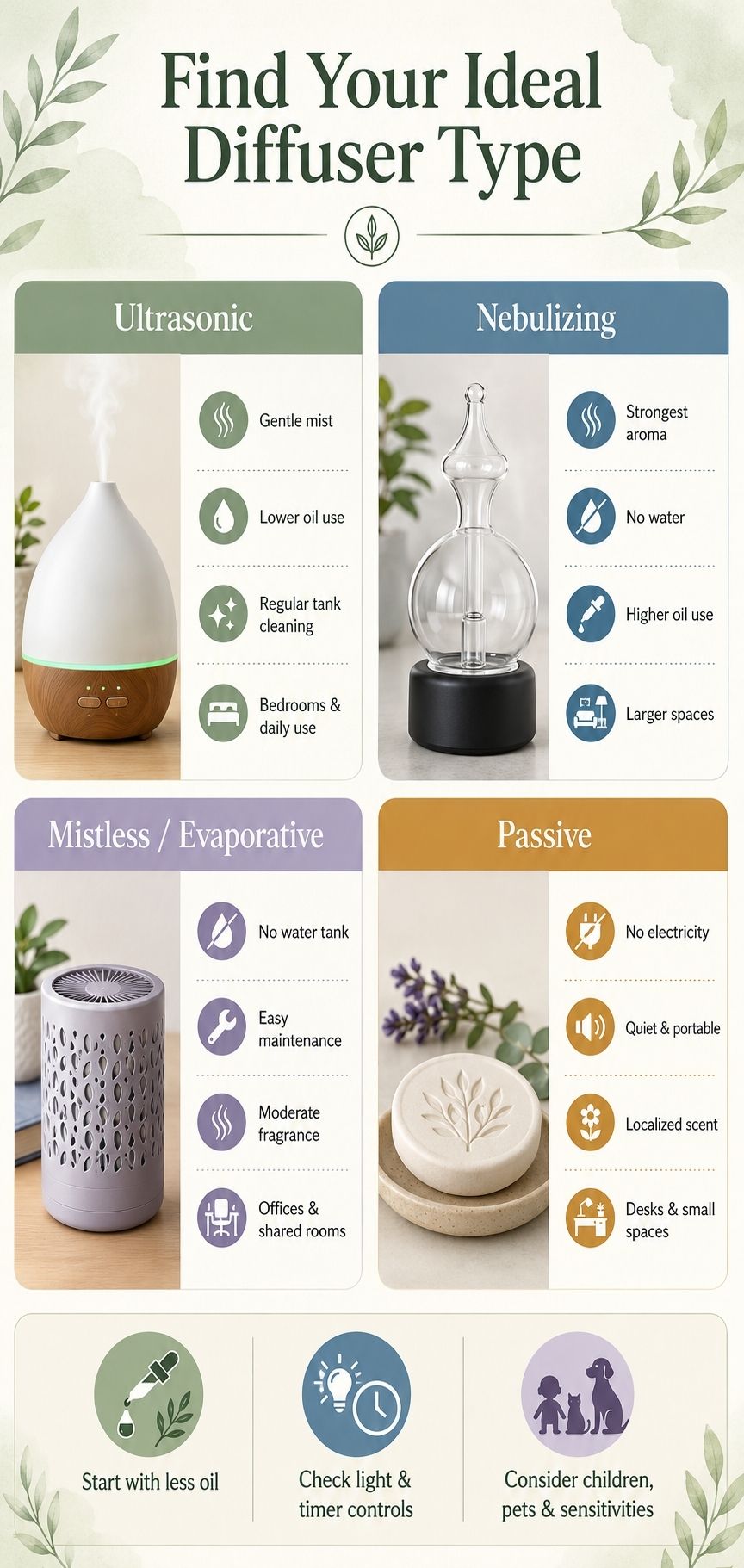
Choosing between essential oil diffusers becomes easier once you understand how they release fragrance.
Ultrasonic diffusers
These combine water and essential oil, using vibration to create a cool mist. They generally use less oil and produce a gentler aroma, but their reservoirs need regular cleaning.
Nebulizing diffusers
These atomize undiluted essential oil without water or heat. They offer the strongest output but consume oil faster and require more careful maintenance.
Evaporative diffusers
A fan or natural airflow moves fragrance from an oil-soaked surface into the room. They are simple and mistless, although their scent tends to be less intense.
Passive diffusers
Porous ceramic, plaster, wood, or another absorbent material slowly releases the aroma. These work best in personal spaces rather than across an entire room.
How to Choose the Right Aromatherapy Gear
Before buying, consider how you will actually use the product.
- Start with the room: A small bedroom rarely needs an aggressive nebulizer, while a passive scent stone will struggle in an open-plan living area.
- Think about maintenance honestly: If you know you will not empty and wipe a water reservoir regularly, a mistless or passive model may serve you better.
- Check the light controls: A glowing diffuser can be irritating in a dark bedroom. Look for lighting that operates independently from the mist.
- Consider ongoing costs: Nebulizers use undiluted oil, while some smart and evaporative systems encourage proprietary refills or replacement scent components.
- Prioritize automatic shutoff: This is especially important for ultrasonic models that rely on a water reservoir.
- Avoid buying by coverage claims alone: Square-footage estimates do not account for ventilation, ceiling height, room layout, oil strength, or individual scent sensitivity.
Essential Oil Diffuser Safety
Aromatherapy should make a room more pleasant, not make anyone in it cough, wheeze, develop a headache, or feel overwhelmed.
The American Lung Association notes that inhaled essential oils can irritate the respiratory tract, particularly in people with asthma or chronic lung conditions. Poison Control also warns that some oils are poisonous when swallowed and can cause skin reactions.
For safer use:
- Follow the diffuser and oil manufacturer’s instructions.
- Begin with fewer drops and a short session.
- Keep the room ventilated.
- Stop use if anyone develops coughing, breathing discomfort, nausea, headache, or irritation.
- Do not swallow essential oils.
- Keep bottles and oil-covered components away from children.
- Never add carrier oils to a diffuser unless its manufacturer specifically permits them.
- Clean water reservoirs frequently to prevent residue and buildup.
- Ask a healthcare professional before use if someone has asthma, allergies, epilepsy, is pregnant, or has another relevant medical condition.
Pet owners should be particularly careful. The ASPCA recommends preventing pets from accessing or overturning diffusers and using extra caution with animals that have breathing problems. Cats and birds can be especially sensitive. Consult a veterinarian before diffusing oils around them.
Final Thoughts
The best diffuser is not necessarily the strongest, largest, or most expensive one. It is the model that fits your room, scent tolerance, cleaning habits, and household.
For uncomplicated everyday value, the ASAKUKI 500 mL is a sensible starting point. Vitruvi and NEOM offer more design appeal, while the Raindrop 3.0 and Atomiser suit users who specifically want concentrated, waterless fragrance. If maintenance is the reason your previous diffuser went unused, Canopy or Plant Therapy’s passive lotus may be the more realistic choice.
Start with less oil than you think you need. A gentle aroma that stays pleasant is far better than a powerful one everyone wants to escape.
Frequently Asked Questions About Aromatherapy Products and Diffusers
1. What type of essential oil diffuser is best for beginners?
An ultrasonic diffuser is usually the easiest place to start. It provides adjustable, diluted fragrance, uses relatively little oil, and often includes timers and automatic shutoff. Choose one with a reservoir that is easy to reach and clean.
2. Which diffuser produces the strongest scent?
Nebulizing diffusers generally produce the strongest fragrance because they disperse undiluted essential oil. That intensity also means faster oil consumption and a greater chance of overwhelming scent-sensitive people.
3. How many drops of essential oil should I use?
Follow the instructions supplied with your diffuser. A common starting point for ultrasonic models is approximately three to five drops per 100 mL of water, but tank designs and oil strengths vary. Starting low is safer than trying to correct an overpowering blend.
4. Can I leave an essential oil diffuser running overnight?
Automatic shutoff reduces equipment risk, but it does not guarantee that continuous exposure is comfortable or appropriate. A short or intermittent timer is usually a more cautious choice, especially in a closed bedroom.
5. How often should an ultrasonic diffuser be cleaned?
Empty and wipe the reservoir regularly rather than leaving old water inside. A deeper clean may be needed after several uses or when changing oils. Always follow the manufacturer’s method, since harsh cleaners can damage some reservoirs and ultrasonic plates.
6. Are essential oil diffusers safe around pets?
Not automatically. Some oils can be harmful to cats, dogs, birds, and other animals, while active diffusers may spread droplets that settle on fur or surrounding surfaces. Speak with a veterinarian, provide ventilation and an exit route, and never assume a product labeled “natural” is pet-safe.






















