A polished first draft used to suggest that someone had put in the work. Now, it may only show that someone knows which button to press. That is not a criticism of AI. I use AI tools, and I understand why people are eager to make them part of their work. They can clear away hours of tedious research, formatting, summarizing, and drafting.
The uncomfortable question comes afterward: if everyone can produce decent-looking work faster, what makes one person more valuable than another? The answer is not simply “learn better prompts.”
Once routine execution becomes easier, more responsibility shifts to the person reviewing the work. Someone has to notice that a statistic is outdated, that the recommendation ignores an important customer group, or that the efficient option will create a legal, ethical, or reputational mess.
While reviewing the latest labor-market research, I found little support for the dramatic idea that entire professions will disappear neatly, one after another. The evidence points to something messier. Tasks are being redistributed. Some are automated, some are accelerated, and others become more important precisely because technology is handling the predictable parts.
These are the human skills in the age of AI that help people operate in that messier space.
Why the Value of Human Work Is Moving, Not Disappearing
The International Labour Organization estimates that one in four workers worldwide is employed in an occupation with some exposure to generative AI. Only 3.3% of global employment falls into its highest exposure category.
That difference is easy to overlook. Being exposed to AI does not necessarily mean losing a job. It often means the mix of tasks inside the job will change.
The World Economic Forum expects 39% of workers’ core skills to change by 2030. Yet analytical thinking remains the leading skill identified by employers. Creative thinking, leadership, resilience, curiosity, and lifelong learning are also expected to remain important or grow.
PwC found an even clearer shift when it analyzed more than one billion job advertisements for its 2026 Global AI Jobs Barometer. New tasks appearing in AI-exposed roles were 2.5 times more likely to require empathy, judgment, and creativity. Highly exposed junior roles were also seven times more likely to request traditionally senior abilities such as leadership and strategic thinking.
The pattern is becoming difficult to ignore. AI may reduce the time spent producing work, but it raises expectations around what people do with the result.
11 Human Skills in the Age of AI That Matter More
None of these skills offers permanent protection from technological change. Parts of them can already be assisted or imitated by AI. Their value lies in helping people direct work, interpret context, manage consequences, and take responsibility when there is no perfect answer.
1. Critical Thinking and Verification
AI has made it remarkably easy to receive a confident answer. It has not made that answer automatically correct.
Imagine receiving an attractive market report with clear headings, realistic figures, and a convincing recommendation. One cited study is several years out of date. Another figure has no identifiable source. The conclusion may still look professional enough to pass through a rushed review.
Critical thinking is what prevents fluency from being mistaken for accuracy. It involves checking evidence, finding unsupported assumptions, comparing sources, and noticing what the answer has left out.
A Microsoft Research and Carnegie Mellon study found that greater confidence in generative AI was associated with less reported critical thinking. People who felt more confident in their own knowledge reported putting more effort into evaluating and applying AI responses.
The study relied on self-reported behavior, so it does not prove that AI permanently damages our ability to think. It does reveal a practical risk: when an answer arrives quickly and looks complete, checking it starts to feel optional.
It is not.
2. Problem Framing and Intelligent Questioning
One of the easiest ways to waste AI is to ask it to solve the wrong problem more efficiently.
A company worried about customer churn might request fifty retention emails. The emails could be polished and personalized, yet completely useless if customers are leaving because onboarding is confusing or the product does not deliver what the sales page promised.
Problem framing happens before the prompt. It means working out what is actually wrong, who is affected, what constraints exist, and what a successful outcome would change.
I see this as more durable than prompt engineering alone. Prompting can improve an answer, but it cannot rescue a mistaken objective.
Before using AI for a meaningful task, write two sentences:
- The problem we need to solve is…
- We will know it is solved when…
If either sentence is vague, generating more output will probably create more noise rather than more value.
3. Judgment Under Ambiguity
Some decisions cannot be reduced to a clean set of rules.
A manager may have to choose between releasing a product quickly and delaying it for additional testing. A healthcare administrator may have to balance efficiency against patient access. A small business may need to cut costs without damaging the customer relationships keeping it alive.
AI can organize the available information and suggest options. The difficult part is deciding which trade-off the situation can tolerate.
A Harvard Business School experiment involving 758 consultants shows why this judgment matters. On tasks within GPT-4’s capability range, participants completed 12.2% more work and finished 25.1% faster. On a complex task outside that range, however, AI users were 19% less likely to reach the correct solution.
The researchers called this uneven boundary the “jagged technological frontier.” AI may handle one assignment brilliantly and stumble on another that appears equally manageable.
Good judgment includes recognizing that you may have crossed that boundary before the mistake becomes someone else’s problem.
4. Domain Expertise and Systems Thinking
A general-purpose AI tool can know a great deal about an industry without understanding how one particular organization actually works.
It may not know that a supplier regularly misses deadlines, that a customer segment reacts badly to a certain policy, or that changing one approval step will create three new bottlenecks elsewhere. These details often live in experience, relationships, and organizational memory rather than formal documents.
A peer-reviewed study of 5,172 customer-support agents found that AI assistance increased productivity by 15% on average. Less experienced workers gained the most. The most experienced agents saw smaller improvements and, in some cases, slight declines in quality.
That does not make expertise obsolete. It shows that AI can spread some routine expert knowledge quickly. What remains scarce is the ability to recognize unusual cases, understand downstream effects, and know when the standard recommendation should not be followed.
As ordinary answers become easier to obtain, handling the exception becomes more valuable.
5. Creativity and Original Synthesis
I would not build this argument around the claim that AI cannot be creative. It can generate images, stories, designs, campaign ideas, and product concepts. Some are bland. Others are genuinely surprising.
The issue is abundance. If everyone can generate one hundred ideas, generating idea number 101 is not much of an advantage.
The valuable work shifts toward selection and direction. Which concept fits the audience? Which one reflects something the company genuinely believes? What can be borrowed from another discipline without becoming a gimmick? What deserves to be developed rather than added to the growing pile of synthetic content?
Creative thinking remains one of the fastest-rising skills in the World Economic Forum’s employer research. PwC also found it appearing more frequently in newly added tasks within AI-exposed roles.
A simple way to protect your own thinking is to develop an initial idea before asking AI for alternatives. You can still use the tool to challenge, expand, or test the concept. You are less likely to let its first suggestion quietly become your entire creative direction.
6. Emotional Intelligence and Empathy
Workplace automation rarely feels neutral to the people affected by it.
A new system may save the company money while making an employee wonder whether their role will exist next year. A manager can deliver a technically accurate presentation about “efficiency gains” and still lose the room because they have ignored the anxiety sitting in front of them.
Emotional intelligence involves noticing those reactions, managing your own, and adjusting the conversation without becoming dishonest or defensive. It also means understanding when someone needs an explanation, when they need to be heard, and when reassurance would be misleading.
Workday’s global workforce research found that 83% of respondents believed greater AI use would increase the importance of human skills. Ethical decision-making, empathy, relationships, and conflict resolution ranked among the abilities participants considered most valuable.
That survey captures perception rather than proving a direct performance effect. Even so, the management problem is real. Organizational change fails when leaders communicate only with workflows and forget the people expected to live with them.

7. Communication and Meaning-Making
AI can produce a thirty-page report before lunch. The person making the decision may need three paragraphs and one honest recommendation.
Good communication is not the ability to generate more words. It is knowing what this audience needs to understand, what might confuse them, and what they should do next.
A technical team may need the assumptions behind an AI-generated forecast. Senior leadership may need the financial risk. Customers may simply need to know whether the change will affect their price, privacy, or access to support.
Meaning-making connects the information to its purpose and consequences. It also requires listening closely enough to notice what has not been said. A hesitant agreement during a meeting can reveal more than another page of automated sentiment analysis.
AI can help organize a message or remove unnecessary jargon. It cannot guarantee that the message is appropriate for the relationship, the moment, or the stakes involved. That responsibility stays with the person pressing send.
8. Collaboration, Conflict Resolution, and Trust
Faster individual output can create slower team decisions.
Marketing may use AI to produce a personalized campaign in hours. Legal may see privacy risks. Product may worry that the message promises a feature that is not ready. Finance may reject the cost. Each team can arrive with its own AI-supported evidence and still be no closer to agreement.
Collaboration requires people to understand interests beyond their own department. Conflict resolution requires separating the actual concern from the position being defended.
Research discussed by the CFA Institute shows financial-services employers placing greater emphasis on adaptability, empathy, coaching, creativity, relationship management, and teamwork. The reported demand gap for behavioral skills had moved ahead of the gap for technical skills.
Trust becomes particularly important when automated systems influence a decision. Employees and customers will want to know where the recommendation came from, whether anyone checked it, and who is answerable if it causes harm.
Those are reasonable questions, not resistance to innovation.
9. Ethical Judgment and Accountability
There will always be a gap between what technology can do and what an organization should allow it to do.
An automated hiring system may reduce screening time while disadvantaging qualified applicants whose backgrounds do not resemble previous hires. A personalized sales system may improve conversions by targeting emotional vulnerabilities. An employee-monitoring tool may produce more data while destroying trust.
These are not only technical decisions. They involve fairness, consent, privacy, power, and the possibility of harm.
Ethical judgment begins by asking who benefits, who carries the risk, and who can challenge the outcome. Accountability determines who has the authority to stop the process when those answers are unsatisfactory.
“The model recommended it” cannot become a convenient way for people to avoid responsibility. If an AI-supported decision affects someone’s livelihood, finances, education, healthcare, or safety, a clearly identified person or organization must remain responsible for the result.
10. Leadership and Responsible Influence
Leadership is often confused with seniority. AI-exposed work may force us to separate the two.
PwC found that highly AI-exposed junior roles were seven times more likely to request skills traditionally associated with senior positions, including leadership and strategic thinking. This suggests that early-career workers may be expected to exercise judgment sooner, not simply produce more work.
A junior analyst might need to explain why an automated forecast is unreliable. A marketer may have to challenge a recommendation that conflicts with customer evidence. A project coordinator may need to decide when an AI-supported action requires management approval.
None of these employees needs a large team to demonstrate leadership. They need enough confidence and evidence to raise the issue, explain the risk, and help move the work toward a responsible decision.
As execution becomes easier to automate, quiet ownership matters more.
11. Adaptability and Learning Agility
Learning one AI platform is useful. Building a professional identity around it is risky.
Products change. Features move between paid and free plans. A tool that feels essential today may be replaced, restricted, or absorbed into another platform next year. The underlying ability to learn is more durable than familiarity with a particular interface.
Adaptability does not mean chasing every new release. It means recognizing when a change matters, testing it against a real need, and adjusting your habits when the evidence supports doing so.
LinkedIn’s Work Change Report estimates that 70% of the skills used in most jobs will change by 2030, with AI accelerating the shift. That is a projection rather than a promise about every occupation, but it reinforces the direction already visible in employer research.
The people best prepared for that change will not know every tool. They will know how to learn without surrendering everything they already understand about their work.
Human Skills Do Not Replace AI Literacy
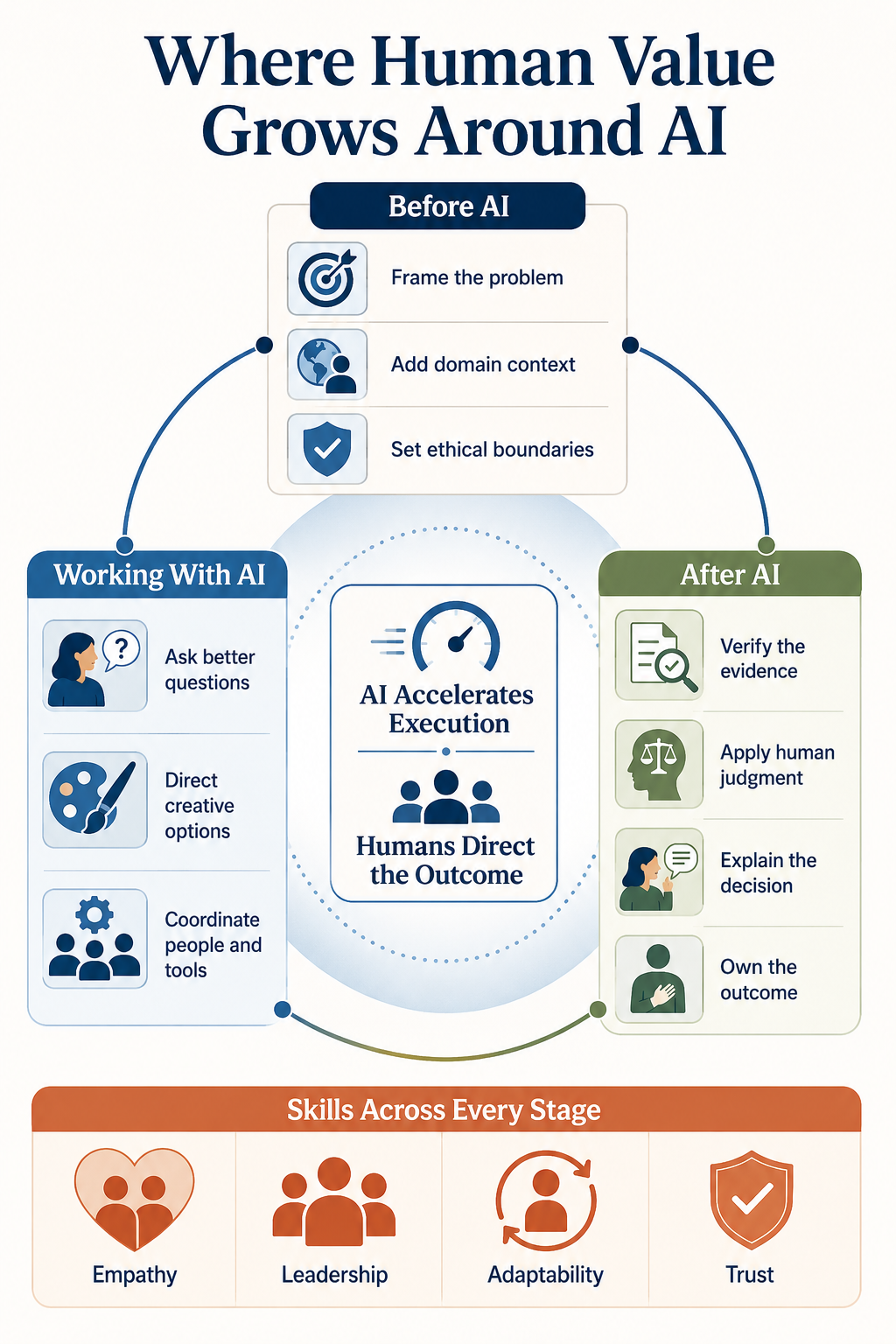
It would be a mistake to read this list as an argument against technical ability. A strong communicator who refuses to understand AI may struggle in the same way as a technically confident AI user who cannot evaluate evidence or earn trust. Employers increasingly need both.
The useful combination looks like this:
- AI literacy to understand what the system can and cannot do
- Domain knowledge to recognize when its answer does not fit reality
- Judgment to choose an appropriate response
- Communication skills to explain the decision
- Accountability to own what happens next
The goal is not to beat AI at routine production. It is to use the technology without allowing speed to replace thought.
Make Invisible Skills Visible at Work
Human skills are often difficult to prove because people describe them with empty phrases. “Excellent communicator,” “team player,” and “strategic thinker” appear on countless résumés without showing what the person actually did.
Evidence is more convincing:
- Document an incorrect assumption you caught before it reached a customer.
- Explain how reframing a problem changed the proposed solution.
- Record a disagreement you helped resolve and what happened afterward.
- Show where you accepted, revised, or rejected an AI recommendation.
- Include measurable outcomes such as time saved, risk reduced, complaints prevented, or adoption improved.
- In portfolio work, separate the tool’s contribution from the judgment you added.
This is especially important for early-career professionals. If basic output becomes easier to generate, employers need other ways to see how you think.
A Better Way to Practise Human-AI Collaboration
For work that carries real consequences, I recommend a simple routine:
- Assess the task before opening the AI tool.
- Write down your initial assumptions and concerns.
- Use AI to suggest alternatives or challenge your reasoning.
- Verify important claims through independent sources.
- Decide what to accept, change, reject, or escalate.
- Keep a short record of what improved the final result.
This process is slower than copying the first answer. That is partly the point. Judgment develops in the space between receiving an answer and deciding what to do with it.
The Advantage Is Knowing What to Own
AI will continue to improve at producing drafts, summaries, plans, forecasts, and recommendations. Competing with it on routine speed is not much of a career strategy.
What remains valuable is knowing which problem deserves attention, when an answer should not be trusted, how a decision will affect people, and who must take responsibility for the result.
That is where human skills in the age of AI earn their value. Not by keeping technology out of the work, but by making sure the work still has judgment behind it.
Frequently Asked Questions on Human Skills in the Age of AI
1. What human skills are most valuable in the age of AI?
Critical thinking, problem framing, judgment, domain expertise, creativity, emotional intelligence, communication, collaboration, ethical reasoning, leadership, and adaptability are especially valuable. They help people guide, evaluate, and take responsibility for AI-assisted work.
2. Which skills can AI not replace?
No skill should be treated as permanently protected from technological change. Current AI has greater difficulty with real-world accountability, context-heavy judgment, ethical trade-offs, trust, complex relationships, and decisions involving unclear consequences. It can still assist with parts of these activities.
3. Are human skills more important than technical skills?
Neither is sufficient alone. Technical and AI skills help someone use modern systems, while human skills determine whether those systems are applied appropriately. The stronger career position combines AI literacy with domain knowledge, communication, and judgment.
4. How is AI changing entry-level work?
AI is taking over more basic drafting, summarizing, research, and analysis. New employees may become productive faster, but they may also have fewer opportunities to learn through foundational tasks. As a result, verification, communication, and strategic thinking may be expected earlier.
5. How can employees prove they have strong human skills?
Use specific workplace evidence. Describe a risk you identified, a decision you improved, a conflict you resolved, or a process you redesigned. Explain your actions and the outcome instead of merely listing communication, leadership, or critical thinking as personal qualities.
6. What should I learn first to remain valuable as AI advances?
Start with critical thinking, practical AI literacy, communication, and knowledge of your field. Together, these skills help you use AI effectively, identify weak outputs, understand real-world context, and explain your decisions clearly.