The first wave of crypto gaming sold a very tempting dream: play games, earn assets, and turn time into value. Then reality arrived. Token prices fell, weak game design got exposed, and many players learned that a game economy can collapse much faster than a fantasy kingdom. That is why the next generation of Play to Earn Models in the United States looks more cautious, more infrastructure-heavy, and much more focused on ownership, rewards, player economies, and long-term engagement instead of just “earn money by grinding.”
Our Selection Criteria
This list started with the country decision. I compared the United States, the United Kingdom, and Singapore because all three have strong activity in Web3 gaming, player-owned economies, blockchain game infrastructure, and reward-based gaming models. Then I narrowed the list to companies that could be verified as U.S.-based SMEs, startups, or private gaming companies with a clear link to play-to-earn, play-and-earn, digital ownership, tokenized rewards, tradable assets, or gaming economies.
The companies were selected using these filters:
- Headquartered, incorporated, or strongly operationally rooted in the United States.
- SME, startup, private gaming company, Web3 game studio, or gaming economy infrastructure company.
- Clear relevance to Play to Earn Models, player-owned economies, crypto rewards, tradable in-game assets, NFT-based game economies, blockchain gaming, or game reward infrastructure.
- Publicly visible website, company profile, app listing, product page, or credible third-party verification.
- Useful for players, game studios, Web3 gaming ecosystems, developers, creators, guilds, or reward-based gaming communities.
- Excluded large public gaming publishers, pure crypto exchanges, generic NFT marketplaces, and companies where gaming was only a small side feature.
Why the United States and not the United Kingdom or Singapore?
The United States won because it has the largest visible company base in the Play to Earn Games category and the broadest mix of gaming studios, Web3 infrastructure companies, reward platforms, card-game economies, MMO projects, and player-owned economy builders. The U.K. has strong Web3 finance and gaming talent, while Singapore is an important GameFi and crypto hub, but the U.S. has more verified company depth for a full SME list.
Here is how the country comparison shaped the final choice:
| Country Considered | Strength in Play to Earn Models | SME/Startup Depth | Final Assessment |
|---|---|---|---|
| United States | Strongest visible company count, deep Web3 gaming capital, studios, reward platforms, and player-owned economy builders | Highest verified company density for this list | Selected |
| United Kingdom | Strong Web3 finance, gaming services, and blockchain talent | Good ecosystem, but smaller visible Play to Earn Games company count | Not selected |
| Singapore | Strong GameFi, crypto, and blockchain gaming hub | Strong quality and investor activity, but smaller company count than the U.S. | Not selected |
10 U.S. Gaming SMEs Using Play to Earn Models and Player-Owned Economies
The companies below are not all using the same version of play-to-earn. Some build games where players can earn tokens or tradable assets. Some build open economies where players own and trade digital items. Others provide reward rails that let game studios add real-money incentives. That distinction matters because the old “grind for token yield” model is no longer enough.
1. Gala Games
Headquarters: San Francisco, California, United States
Website: https://games.gala.com
Email: Not publicly listed
Gala Games is one of the most visible U.S.-rooted Web3 gaming ecosystems built around player ownership, tokens, and blockchain-enabled game economies. Its model goes beyond a single game, giving players access to a broader platform where game assets, rewards, and ecosystem participation matter. Gala became associated with the early Play to Earn Models conversation because it positioned players as participants in game economies rather than only consumers of locked digital goods. Its biggest strength is ecosystem breadth, although that same breadth means buyers and players need to study each individual game carefully.
Best Feature/For:
- Best for players and developers looking at a multi-title Web3 gaming ecosystem.
- Strong for digital ownership, token-enabled economies, and ecosystem-driven gaming.
Why We Chose It:
- One of the most recognizable U.S.-linked blockchain gaming platforms.
- Built around player ownership and reward economies.
- Supports multiple game experiences rather than only one title.
- Strong fit for the broader Play to Earn Models category.
Things to consider:
- Token and asset value can fluctuate heavily.
- Players should judge each game by gameplay quality, not only earning potential.
2. Faraway
Headquarters: Miami, Florida, United States
Website: https://faraway.com
Email: Not publicly listed
Faraway is a Miami-based game studio and publisher focused on open economy games, creator tools, and player-driven game ecosystems. Its work includes blockchain-based and interoperable gaming experiences where players, creators, and studios can participate in digital economies. Faraway’s strongest value is that it treats play-to-earn less like a single reward loop and more like an open economy layer around games, items, creators, and communities. That makes it one of the strongest U.S. picks for the post-hype version of Web3 gaming.
Best Feature/For:
- Best for open economy games and creator-linked player economies.
- Strong for studios and ecosystems that want interoperable assets and user-generated content.
Why We Chose It:
- Clear U.S. startup profile with Miami roots.
- Focuses on player-driven and decentralized game economies.
- Builds and publishes multiple open economy games.
- Useful example of how Play to Earn Models are evolving beyond simple grinding.
Things to consider:
- Open economies depend heavily on active communities.
- Players should understand asset utility before buying or trading items.
3. Mythical Games
Headquarters: Los Angeles, California, United States
Website: https://mythicalgames.com
Email: Not publicly listed
Mythical Games builds games and gaming technology around player-owned economies, digital assets, and marketplace-driven ownership. Its approach is more mainstream-facing than many older crypto game projects because it connects polished games with digital ownership rather than asking players to start with complicated crypto behavior. Mythical’s ecosystem has supported titles and marketplace experiences where players can own, trade, and interact with digital assets. For readers studying Play to Earn Models, Mythical is important because it shows how ownership and earning mechanics can be packaged for wider gaming audiences.
Best Feature/For:
- Best for mainstream-style Web3 gaming and player-owned digital economies.
- Strong for studios and players interested in ownership without overly technical crypto friction.
Why We Chose It:
- U.S.-based gaming technology company with strong Web3 economy positioning.
- Focuses on player ownership, digital assets, and secondary markets.
- Has a larger operational footprint than many early-stage Web3 game studios.
- Shows how blockchain economy design can move closer to mainstream games.
Things to consider:
- It is not a pure “earn by grinding” model.
- Buyers should evaluate whether the asset economy improves the game experience.
4. Splinterlands
Headquarters: Media, Pennsylvania, United States
Website: https://splinterlands.com
Email: support@splinterlands.com
Splinterlands is a blockchain-based trading card game where players own cards as digital assets and can battle, trade, rent, and participate in a broader game economy. It is one of the more proven U.S.-rooted play-to-earn style games because it has survived multiple market cycles and still has a recognizable community. Its model fits card-game players who already understand collecting, rarity, deck-building, and competitive play. Splinterlands also shows one of the most practical uses of blockchain gaming: making digital cards ownable and tradable rather than trapped inside a publisher-controlled account.
Best Feature/For:
- Best for blockchain trading card game players who want asset ownership and competitive earning loops.
- Strong for players who understand card rarity, rentals, tournaments, and market-driven gameplay.
Why We Chose It:
- Clear U.S. company registration and support contact.
- Directly tied to play-to-earn style card ownership and rewards.
- Has a long operating history compared with many newer Web3 games.
- Strong example of player-owned game assets in a familiar genre.
Things to consider:
- Competitive earning depends on card strength, strategy, and market conditions.
- New players should understand card rental and purchase risks before spending.
5. Laguna Games
Headquarters: San Francisco, California, United States
Website: https://laguna.games
Email: Not publicly listed
Laguna Games is the studio behind Crypto Unicorns, a blockchain game universe built around NFTs, land, farming, battles, and player-owned economic systems. Its strength is in designing a themed ecosystem where digital pets, land, crafting, and social gameplay connect to an economy. Laguna represents the more simulation-driven side of Play to Earn Models, where players do not only battle for rewards but also manage assets, production loops, and in-game systems. That makes it different from simple token-drop games.
Best Feature/For:
- Best for blockchain simulation, pet collecting, land ownership, and farming-style game economies.
- Strong for players interested in slower, asset-driven Web3 game loops.
Why We Chose It:
- U.S.-based game development studio with blockchain specialization.
- Built a recognizable NFT-powered game ecosystem through Crypto Unicorns.
- Strong fit for player-owned land, crafting, and simulation economies.
- Useful example of P2E moving into management and strategy-style gameplay.
Things to consider:
- Asset-heavy games can become hard for casual players to evaluate.
- Token and NFT utility should be checked before investing time or money.
6. Star Atlas by ATMTA
Headquarters: Delaware, United States
Website: https://staratlas.com
Email: Not publicly listed
Star Atlas, developed by ATMTA, is an ambitious space exploration MMO built around a player-driven economy, digital assets, faction conflict, ships, resources, and tokenized ownership. Its pitch is larger than a simple play-to-earn game: it wants to create a deep economy inside a sci-fi metaverse. That ambition makes Star Atlas one of the most interesting U.S.-rooted projects in this category, but also one of the more execution-heavy. Big virtual economies are exciting, but they only work if the gameplay, incentives, community, and long-term development all hold together.
Best Feature/For:
- Best for players watching ambitious MMO-scale Web3 economies.
- Strong for sci-fi fans interested in ships, factions, territory, resources, and player-driven markets.
Why We Chose It:
- U.S.-linked company profile through ATMTA and Star Atlas.
- Strong focus on player-driven economy and earn-oriented gameplay.
- More ambitious than simple casual P2E projects.
- Useful case study for large-scale Web3 game economy design.
Things to consider:
- MMO-scale blockchain games are difficult and expensive to execute.
- Players should separate long-term vision from currently playable reality.
7. Revolving Games
Headquarters: San Francisco, California, United States
Website: https://revolvinggames.com
Email: Not publicly listed
Revolving Games is a San Francisco-headquartered Web3 gaming company building scalable MMOs, strategy games, and decentralized gaming ecosystems. The company’s work focuses on long-term in-game economies, player ownership, and Web3 infrastructure rather than short-lived token incentives. Its RCADE ecosystem and decentralized gaming direction make it relevant for readers studying where Play to Earn Models are heading after the first hype cycle. Revolving Games is especially interesting because it combines traditional game development experience with Web3 economy design.
Best Feature/For:
- Best for Web3 strategy and MMO-style player economy development.
- Strong for investors, studios, and players watching scalable decentralized gaming ecosystems.
Why We Chose It:
- Verified San Francisco headquarters.
- Focuses on Web3 gaming and long-term in-game economies.
- Backed by major gaming and crypto investors.
- Represents the infrastructure-plus-game studio side of this market.
Things to consider:
- Not every project may be immediately playable for general users.
- Long-term economies need active players, strong content, and careful incentive balance.
8. ZBD
Headquarters: Hoboken, New Jersey, United States
Website: https://zbdpay.com
Email: Not publicly listed
ZBD is not a traditional game studio; it is a gaming payments and rewards infrastructure company. It helps games embed real-money rewards, Bitcoin rewards, and value-transfer features into gameplay and engagement loops. That makes it highly relevant to Play to Earn Models because many studios may not want to build a full blockchain economy from scratch but still want reward mechanics that increase retention and loyalty. ZBD’s biggest strength is turning earning into infrastructure rather than making every developer become a crypto economist.
Best Feature/For:
- Best for game studios adding real-money or Bitcoin-based reward systems.
- Strong for reward infrastructure, player engagement, and payment-enabled gaming loops.
Why We Chose It:
- U.S.-based gaming and payments company.
- Directly supports earning through games and reward mechanics.
- Useful for studios that want reward rails instead of full NFT economies.
- Shows how P2E can evolve into embedded reward infrastructure.
Things to consider:
- It is infrastructure, not a single game title.
- Studios need to design rewards carefully so they improve retention without attracting only reward hunters.
9. Azra Games
Headquarters: Sacramento, California, United States
Website: https://azragames.com
Email: Not publicly listed
Azra Games is a U.S. mobile RPG studio associated with Web3 game development and digital ownership ideas. Its early Legions & Legends direction connected NFTs, RPG progression, and asset ownership to a broader game world. Azra is not the simplest “play for token rewards” company on this list, but it matters because the future of Play to Earn Models may depend on higher-quality games that make ownership feel natural. Its biggest strength is experienced RPG leadership paired with Web3 experimentation.
Best Feature/For:
- Best for RPG-style digital ownership and collectible game economies.
- Strong for readers watching premium mobile RPGs with Web3 asset layers.
Why We Chose It:
- U.S.-based game studio with Web3 RPG positioning.
- Led by experienced mobile RPG talent.
- Strong fit for asset ownership and collectible game economies.
- Represents a more game-first approach to blockchain-based earning models.
Things to consider:
- Its model is more ownership-driven than classic play-to-earn grinding.
- Players should wait for clear gameplay proof before judging long-term economy strength.
10. Burn Ghost
Headquarters: Ontario, California, United States
Website: https://burnghost.com
Email: Not publicly listed
Burn Ghost is a Web3 casual gaming platform built around skill-based games, competition, prizes, and rewards. It is a useful inclusion because not every play-to-earn model needs to look like a sprawling RPG, card economy, or metaverse. Casual games, trivia, tournaments, and prize systems can also turn play into reward-driven participation. Burn Ghost’s model points toward a lighter, more approachable branch of Web3 gaming where the earning loop is tied to competition and simple gameplay rather than complex asset management.
Best Feature/For:
- Best for casual Web3 gaming, skill games, tournaments, and prize-based play.
- Strong for players who want lighter reward experiences instead of complex NFT economies.
Why We Chose It:
- U.S.-based funded Web3 gaming startup.
- Focuses on casual games, competitions, prizes, and rewards.
- More accessible than many complex blockchain games.
- Shows how P2E can move toward simple, social, and skill-based play.
Things to consider:
- Prize-based gaming may face regulatory and regional restrictions.
- Players should understand rules, eligibility, and reward terms before participating.
An Overview Of United States Play to Earn Models
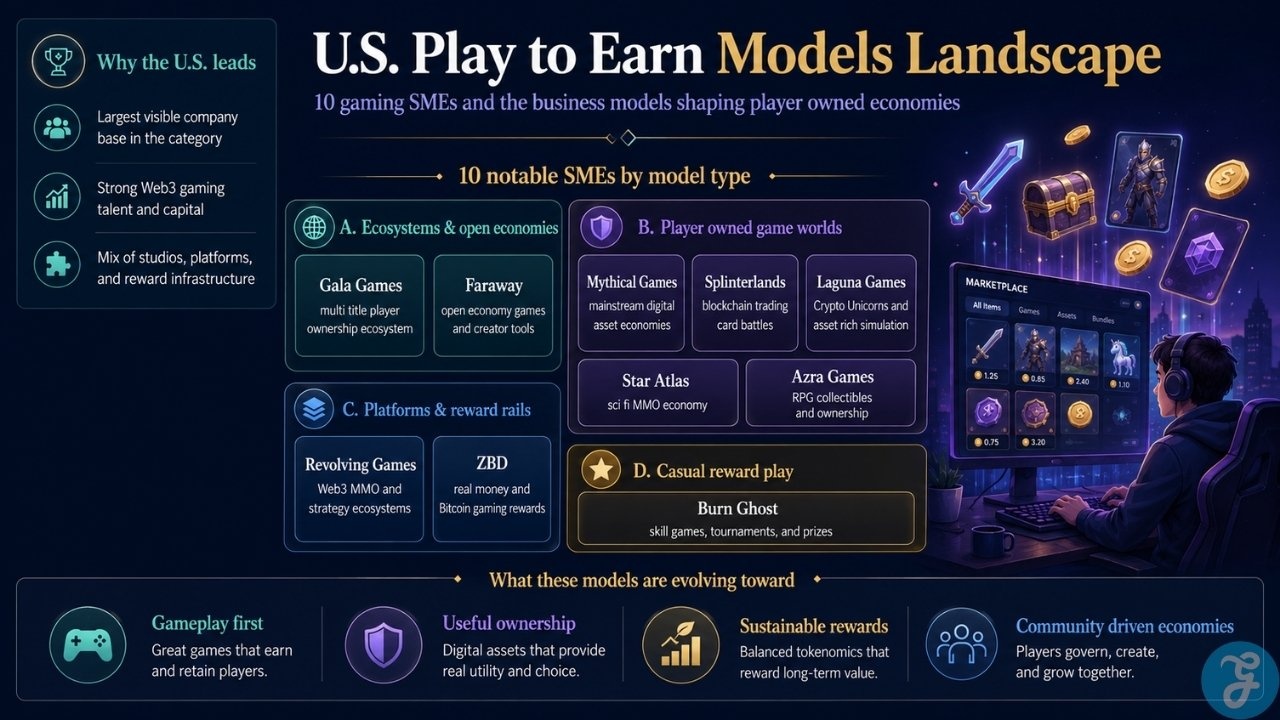
The U.S. market is useful because it does not rely on one version of play-to-earn. Some companies build full blockchain games. Some focus on player-owned economies. Some create reward infrastructure. Others experiment with card games, RPGs, MMOs, casual competitions, or creator-linked economies. That diversity is why the United States stood out during the country selection.
The comparison below separates the companies by their strongest model so readers can see the difference between game studios, reward platforms, and broader player-owned economy builders.
| Company | Best Fit | Core Strength | Strongest Buyer/User |
| Gala Games | Multi-title Web3 gaming ecosystem | Player ownership, tokens, and blockchain-enabled game economies | Web3 gamers, developers, ecosystem participants |
| Faraway | Open economy games | Player-driven economies, creator tools, and interoperable assets | Players, creators, game communities |
| Mythical Games | Mainstream Web3 games | Player-owned assets, marketplaces, and digital scarcity | Players, developers, game economy partners |
| Splinterlands | Blockchain card game | NFT cards, trading, rentals, battles, and rewards | Card game players, collectors, competitive users |
| Laguna Games | Simulation economy games | NFT land, pets, crafting, battles, and player-owned systems | Strategy, farming, and pet-collection players |
| Star Atlas by ATMTA | Sci-fi MMO economy | Ships, assets, factions, resources, and tokenized economy | MMO and sci-fi Web3 players |
| Revolving Games | Web3 strategy and MMO ecosystems | Long-term in-game economies and decentralized game infrastructure | Studios, players, ecosystem builders |
| ZBD | Gaming reward infrastructure | Real-money and Bitcoin rewards for games | Game studios, mobile game teams, reward-driven players |
| Azra Games | Web3 RPG ownership | RPG collectibles, asset ownership, and premium mobile game design | RPG fans, collectors, Web3 game watchers |
| Burn Ghost | Casual reward gaming | Skill games, tournaments, prizes, and Web3 casual play | Casual players, competition-focused users |
Our Top 3 Picks and Why?
The best pick depends on what a reader means by “play-to-earn.” A player looking for an active game, a studio looking for reward infrastructure, and an investor studying player-owned economies are not looking for the same thing.
| Rank | Pick | Why It Stands Out |
| 1 | Splinterlands | Best proven play-to-earn style game because it has a long-running card economy with ownership, rentals, battles, and rewards. |
| 2 | Faraway | Best open economy studio because it builds player-driven ecosystems across multiple games and creator-linked assets. |
| 3 | ZBD | Best reward infrastructure pick because it helps games add earning mechanics without building a full blockchain economy from scratch. |
What Play to Earn Models Buyers and Players Should Notice
The most important distinction is whether the company is selling a game, an economy, or infrastructure. A game can be fun but have weak tokenomics. An economy can look exciting but lack gameplay depth. An infrastructure company can add rewards, but rewards alone will not make a weak game worth playing.
Why are Play to Earn Models Booming in the United States
Play to Earn Models are booming in the United States because the country has the right mix of game development talent, venture capital, crypto infrastructure, digital payment systems, creator economy culture, and players already familiar with virtual goods. The U.S. also has a long history of marketplace-driven gaming behavior, from skins and card trading to esports rewards and creator monetization.
What’s their secret sauce?
The secret sauce is not simply “blockchain.” The stronger U.S. companies are combining game design, payment rails, NFT ownership, marketplaces, token systems, creator tools, player identity, and community-driven economies. That mix creates more flexible models than the early version of play-to-earn, which often depended too much on token price growth.
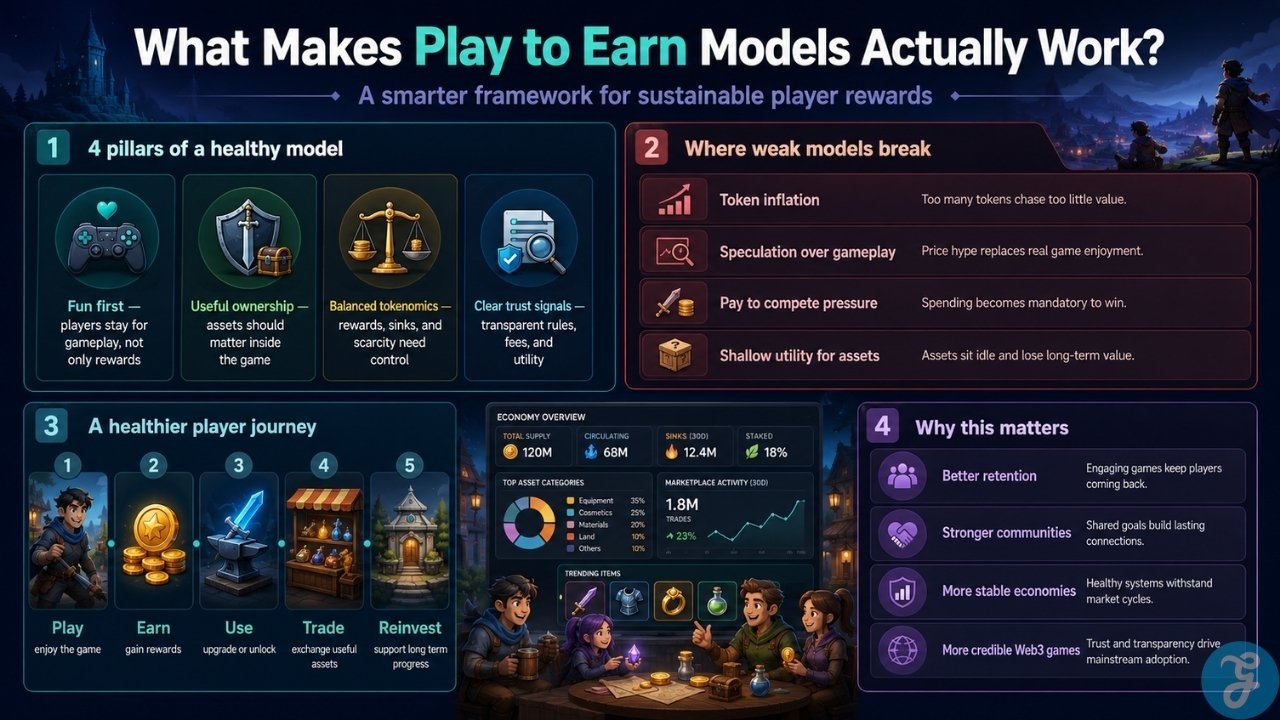
The best companies are also learning a hard lesson: earning cannot be the only reason to play. If players arrive only for rewards, the economy becomes fragile. If the game is fun, rewards can deepen engagement. That difference decides whether a project feels like a real game or a disguised spreadsheet with character art.
The Money Cannot Be the Whole Game
My honest view is that play-to-earn needed its crash. The hype forced the industry to confront an uncomfortable truth: many early projects were better at selling economic dreams than building lasting games. Players were promised ownership, earnings, and freedom, but some economies depended on new buyers entering faster than old players left.
The future of Play to Earn Models in the United States will probably be less loud and more practical. The phrase “play-to-earn” may even keep fading as companies use softer language like player-owned economies, play-and-earn, open economies, creator rewards, or embedded incentives. That is not just branding. It reflects a real shift away from treating players like yield farmers and toward treating them like participants in a digital economy.
The winners will be the companies that put gameplay first, make ownership useful, control inflation, explain risks honestly, and design rewards that strengthen the game instead of replacing it. Earning can add meaning to play. But when money becomes the whole game, the game usually loses.
Frequently Asked Questions (FAQs) About Play to Earn Models
What are Play to Earn Models?
Play to Earn Models are game economy systems where players can earn tokens, digital assets, rewards, or tradable items through gameplay or participation. Many use blockchain, NFTs, crypto rewards, or player-owned marketplaces.
Why was the United States selected for this list?
The United States was selected because it has the highest visible company count in the Play to Earn Games category and a strong mix of Web3 studios, reward infrastructure companies, game economy builders, and player-owned asset platforms.
Are play-to-earn games still popular?
They still exist, but the market has changed. The early hype has cooled, and stronger projects now focus more on gameplay, ownership, rewards, and sustainable economies rather than simple token grinding.
Are Play to Earn Models risky for players?
Yes. Token prices, NFT values, reward rates, and game economies can change quickly. Players should treat earning claims carefully and avoid spending money they cannot afford to lose.
What should players check before joining a play-to-earn game?
Players should check whether the game is actually fun, how rewards are earned, whether assets have real utility, how inflation is controlled, what fees apply, and whether the team has a long-term development plan.