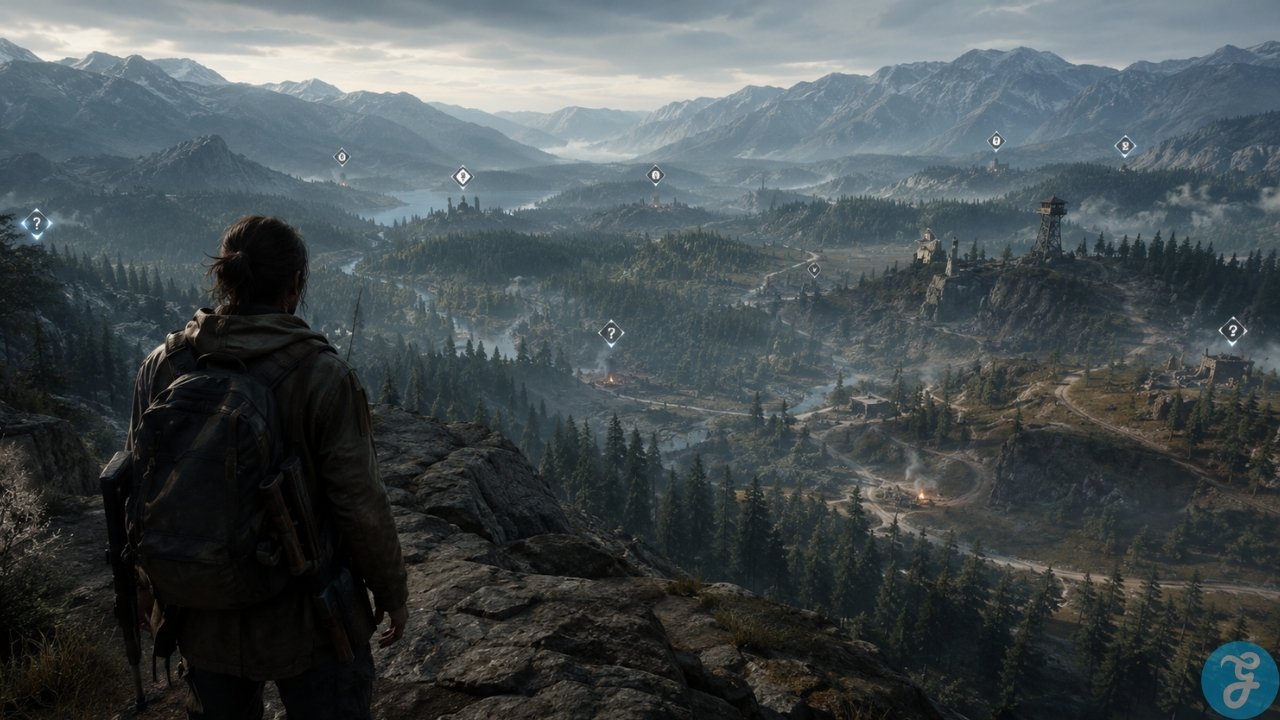
I used to get excited when a game promised a massive open world. Now I hear “our biggest map ever” and immediately wonder how many identical bandit camps, crafting materials, question marks, towers, collectibles, upgrade currencies, side errands, and emotionally bankrupt fetch quests I am about to be punished with.
That is open world fatigue. It is not players suddenly hating freedom. It is players realizing that a lot of modern open worlds are not built around discovery anymore. They are built around retention, padding, and the sacred corporate belief that bigger equals better.
It does not.
A huge map can be incredible when it has purpose. A huge map can feel alive when exploration leads to surprise, danger, mystery, or real player choice. But too many open worlds now feel like someone turned a spreadsheet into terrain and then scattered icons across it until the marketing department could brag about “100 hours of content.”
Congratulations. I unlocked 47 question marks and none of them respected my time.
That is not adventure. That is unpaid admin work with a horse.
Open World Fatigue Is Not Anti Open World
Let me get this out of the way before someone starts defending every bloated map like I insulted their family.
I do not hate open worlds. I love good open worlds. Some of my favorite gaming memories come from getting lost, ignoring the main quest, finding something strange, and realizing the game trusted me enough to wander.
The problem is lazy open world design.
There is a massive difference between a world that invites exploration and a map that assigns chores. One makes me curious. The other makes me feel like I opened a project management dashboard with combat mechanics.
That is why open world fatigue is not really about size. It is about design philosophy. If the world is huge but empty, it becomes tiring. If the world is packed but repetitive, it becomes noise. If every activity feels like a reskinned version of the last one, the game stops feeling generous and starts feeling desperate.
At that point, “content” becomes a threat.
Too Many Open Worlds Feel Like Checklists
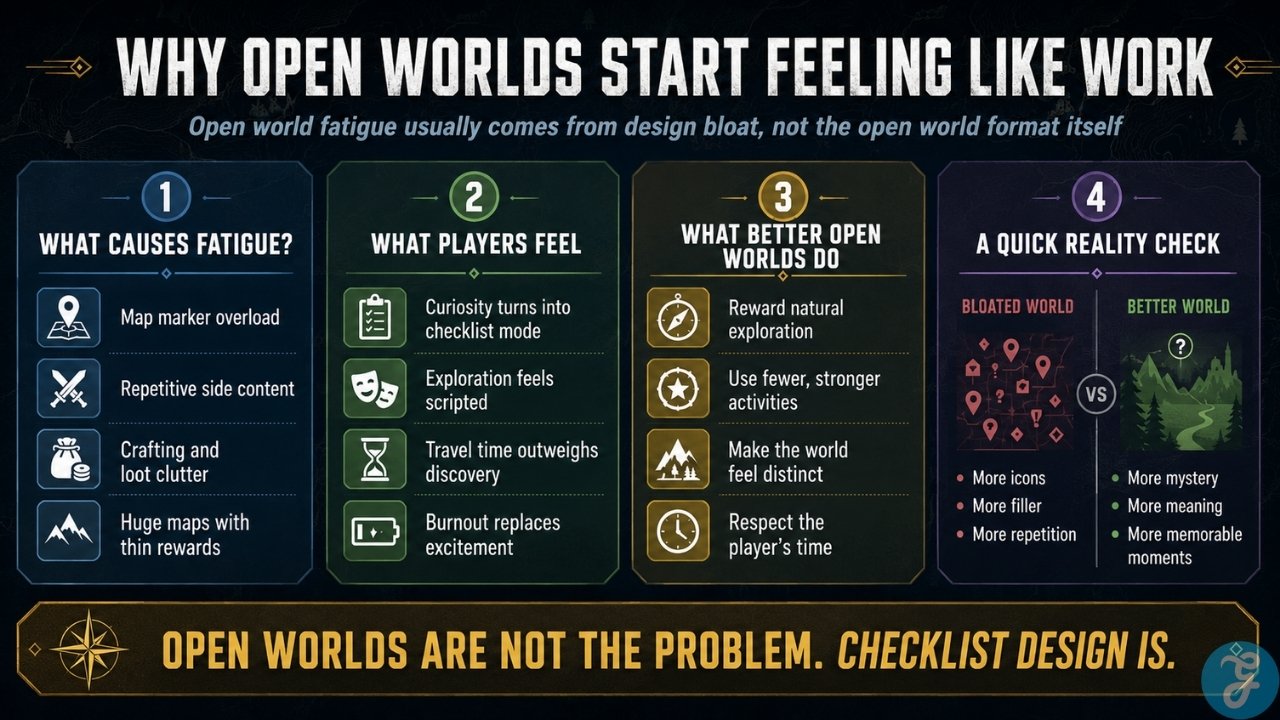
The most obvious symptom of open world burnout is the checklist map.
You know the one.
Climb the tower. Reveal the region. Clear the camp. Pick up the collectible. Follow the glowing trail. Craft the pouch. Hunt the animal. Scan the area. Unlock the fast travel point. Clear another camp. Pick up another collectible. Repeat until either the credits roll or your soul quietly uninstalls itself.
This design has been copied so many times that players can feel it within the first hour. The exact skin changes, but the structure is familiar. Historical assassin. Post-apocalyptic survivor. Space explorer. Fantasy warrior. Tactical operator. Different outfit, same errands.
This is where too many open worlds start blending together.
The worst part is that these games often have strong ingredients. Good art direction. Good combat. Good music. A decent story buried somewhere under all the map clutter. But the moment the world turns into a checklist, I stop exploring and start processing tasks.
And once I start processing tasks, the magic is gone.
Bigger Maps Are Not Better Games
The industry still has a weird obsession with map size.
Every few years, some studio acts like landmass is a personality. Bigger world. More regions. More biomes. More planets. More settlements. More everything. Starfield, for example, officially marketed the promise of exploring more than 1,000 planets, which sounds impressive until you remember that scale only matters when the experience inside that scale is consistently interesting.
This is not just a Starfield problem. It is a mindset problem.
A big world is not automatically immersive. Sometimes it just means longer travel time between mediocre activities. A massive map does not impress me if most of it exists to make the game look expensive in trailers. If the most exciting thing about a world is the number of square miles, the design has already started losing the argument.
I would rather have a smaller world that feels dense, strange, and intentional than a giant one full of filler pretending to be value.
Players do not remember landmass. They remember moments.
The Ubisoft Map Problem
It is impossible to talk about open world critique without talking about the “Ubisoft map” reputation.
That does not mean Ubisoft has never made good open worlds. It has. Assassin’s Creed, Far Cry, Watch Dogs, and other Ubisoft games have delivered plenty of memorable settings, mechanics, and moments over the years. I am not pretending otherwise.
But the formula became so recognizable that “Ubisoft open world” almost became shorthand for icon overload.
Assassin’s Creed Valhalla is a useful example because even people who enjoyed it often admit it was a lot. Ubisoft promoted it as a Viking open world built around raids, settlement growth, enemy territories, and expansion across England. Polygon later described Valhalla as “infamously too much game” and noted that HowLongToBeat placed an average playthrough around 100 hours, with completionist runs closer to 150 hours.
That is not automatically bad. Some players want that. Some players love living in one game for months.
But for many of us, there is a point where length stops feeling like value and starts feeling like homework. When a game keeps adding territories, activities, currencies, gear systems, and side objectives without enough meaningful variety, the player does not feel free. The player feels managed.
And nothing kills an open world faster than making me feel like I clocked in.
The Question Mark Problem
Map markers are useful. I am not going to pretend every game should throw players into a forest with no guidance and whisper, “Good luck, idiot.”
But modern open worlds often overcorrect.
They do not trust curiosity. They replace it. Every secret gets marked. Every activity gets categorized. Every mystery becomes an icon. The player does not discover the world as much as clear it.
That subtle difference matters.
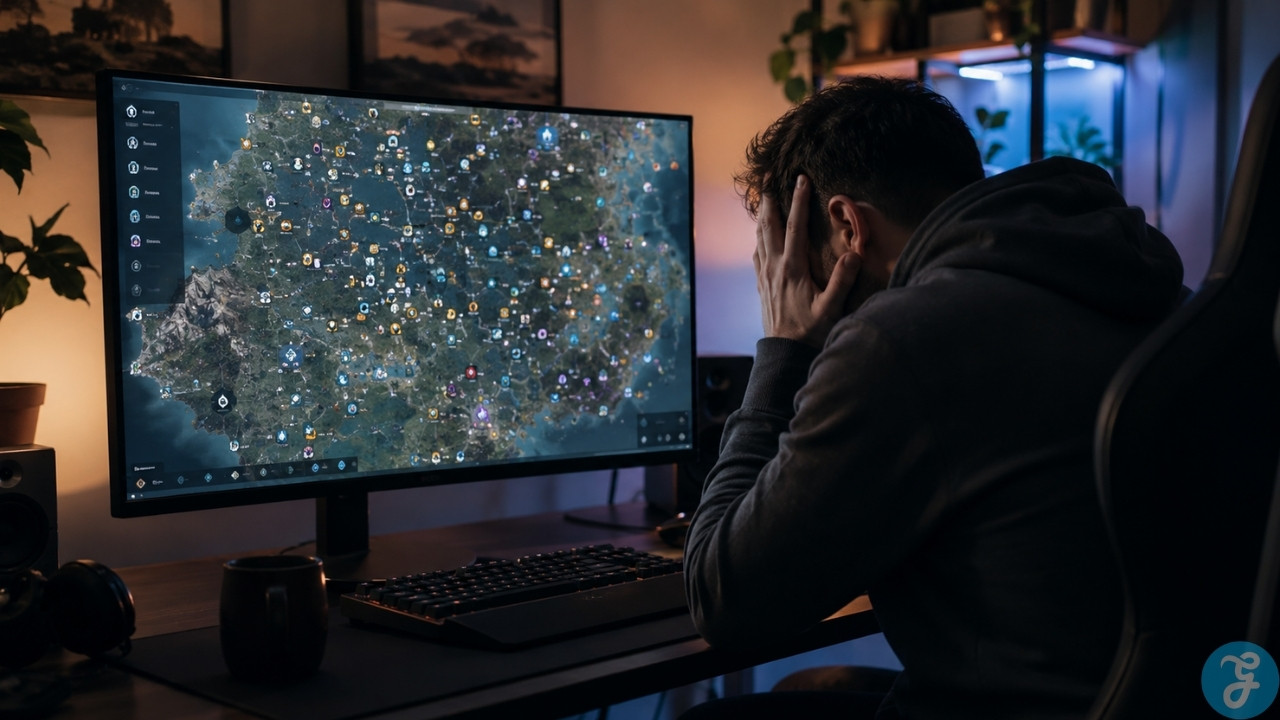
A question mark on a map can be exciting once. Maybe twice. But when the whole map is infected with icons, the question mark stops being a mystery. It becomes a work order. The game is not asking, “What could be here?” It is saying, “Go here because the completion percentage is judging you.”
That is not exploration. That is obedience with scenery.
Open worlds work best when the player feels like they found something, not when they feel like they followed instructions.
Open World Burnout Comes From Repetition
Open world burnout usually does not hit because a game is too long. It hits because the game shows its pattern too early.
The first enemy camp can be fun. The second can still work. The third starts to feel familiar. By the seventh, I am not thinking tactically anymore. I am just recognizing the layout, tagging enemies, looting the same boxes, and waiting for the game to reward me with another tiny stat increase I will forget in ten minutes.
Same with side quests.
A good side quest can make a world feel human. A lazy side quest makes the world feel like a vending machine for XP. Go there. Kill that. Collect this. Return for dialogue that sounds like it was written while the writer’s chair was already on fire.
The issue is not optional content. Optional content can be amazing. The issue is filler wearing the costume of depth.
If a game has 200 activities but 160 of them feel like the same idea wearing different boots, that is not abundance. That is clutter.
Players Helped Create This Monster
Here is the uncomfortable part.
Players helped reward this nonsense.
For years, the industry trained us to measure value in hours. How long is it? How big is the map? How much content is there? Is it worth the price? And somewhere along the way, a 20-hour focused game started sounding “short,” while a bloated 90-hour game sounded like a bargain even if half of that time was spent chasing icons like a tired delivery driver.
We did this to ourselves a little.
Not entirely. Publishers absolutely pushed the “more content” arms race because it looks good in marketing and helps justify higher prices. But players also ate it up. We treated hour counts like nutrition labels. We complained when games were concise. We rewarded bloat when it came with enough screenshots and trailer music.
Now we are shocked that so many AAA games arrive looking like someone tried to maximize playtime before asking whether the content was actually worth playing.
Brilliant work from everyone involved.
Good Open Worlds Still Exist
The reason this whole issue annoys me so much is that open worlds can still be incredible.
The Legend of Zelda: Tears of the Kingdom works because the world is not just big. It is playful. It gives players tools, space, and systems that let exploration become personal. The New Yorker praised the game’s open-ended structure for encouraging experimentation and improvisation instead of pushing players down predetermined paths.
That is the difference.
A good open world does not just ask you to visit places. It gives you reasons to care about how you get there, what you notice, and what you decide to do when something unexpected happens.
Elden Ring also understood something a lot of checklist games forgot: mystery has value. It lets the world feel hostile, strange, and discoverable. Not every cave needs to announce itself like a sponsored post. Not every reward needs a glowing trail. Not every player needs to be treated like they will collapse if the game does not put an icon on everything.
Red Dead Redemption 2, for all the valid criticism around pacing and production culture, also shows how a world can feel lived-in because of atmosphere, detail, and small interactions rather than pure icon density.
So no, open worlds are not dead.
Bad open worlds are just loud.
Stop Selling Empty Scale
The most tired marketing phrase in gaming might be “our biggest world yet.”
At this point, that does not excite me. It makes me suspicious.
Bigger than what? Better how? More alive in what way? Does the world react? Does exploration change how I understand the game? Are side quests meaningful? Are systems deep enough to create stories? Or did someone just stretch the map, add crafting resources, and call the result ambitious?
This is the question more players should ask.
Because scale is easy to advertise. Density, pacing, surprise, and restraint are harder to explain in a trailer. You cannot put “we respected your time” on a collector’s edition box and charge extra for it, although honestly, at this point, maybe someone should try.
I would buy that before another map with 600 things to clear.
The Future Needs Better Open World Design
The next stage of open world design does not need to be bigger.
It needs to be smarter.
Give me fewer icons and better reasons to explore. Give me smaller maps with stronger identity. Give me side quests that do not feel like the same errand with a new NPC. Give me worlds where movement, discovery, and consequence matter. Give me activities that exist because they belong there, not because someone needed to pad the back of the box.
And for the love of every exhausted completionist, stop pretending collectibles are content just because there are 300 of them.
Open worlds should make me curious, not tired.
They should make me want to wander, not optimize a route. They should make me feel like I am inside a place, not inside a content management system with weather effects.
Open World Fatigue Is the Industry’s Own Fault
Open world fatigue is real because the industry spent years teaching players to associate open worlds with bloat.
Too many studios confused scale with ambition. Too many publishers confused playtime with value. Too many games confused icons with discovery. And yes, too many players rewarded hour counts without asking whether those hours were actually good.
But open worlds are not the enemy.
The checklist open world is.
A good open world still has the power to surprise, absorb, and completely derail my plans in the best possible way. That is why the format is worth saving. But if the future of open worlds is just larger maps, longer task lists, more crafting junk, and another ocean of icons, then no, I am not burned out because I lack attention span.
I am burned out because I have already played that game.
Probably five times.
Probably with a different horse.