
Poor content calendars rarely collapse from a lack of ideas; they fail because teams treat every idea as equal. A raw keyword export masquerades as a strategy, or a fleeting trend becomes an “urgent” draft before anyone asks: Does our audience actually need this? Do we have the authority to cover it?
This is exactly where robust Topic Research Methods for Publishers save the day.
For digital media teams, topic research goes far beyond basic brainstorming. It is the rigorous, sometimes ruthless editorial discipline of deciding which subjects demand immediate attention, which need a sharper angle, and which belong in the trash. A solid framework pulls your team out of the chaos of random ideation, building a publishing engine that boosts search visibility, establishes authority, and drives real business goals.
Forget gimmicky growth hacks. This guide relies purely on battle-tested editorial expertise to help content strategists, SEO leads, and managing editors evaluate topics with strict discipline before assigning that next piece.
Start With the Reader Problem, Not the Content Idea

The single biggest mistake in topic research? Starting with the packaging.
- “Let’s write a massive guide.”
- “Let’s pump out a listicle.”
- “Let’s publish a comparison chart.”
Those are formatting choices, not research. Before a publisher even thinks about what to create, the team has to figure out what the reader is actually trying to solve.
A highly practical topic research workflow starts with one deceptively simple question: What specific problem, decision, fear, curiosity, or task is driving someone to this topic?
Answering that instantly elevates your ideation. It strips away vague, floating concepts and leaves you with concrete editorial opportunities.
Take a broad phrase like “content strategy.” On its own, it’s practically useless. You could write about content calendars, SEO audits, topic clusters, audience research, editorial governance, AI workflows, or refreshing old posts. They all live in the same neighborhood, but they serve completely different reader needs.
A content manager might search that phrase because their team’s output is an unorganized mess. An SEO lead might search it because traffic is tanking despite high volume. A founder? They’re probably searching because the company blog has morphed into a giant cost center with zero ROI. Same topic family. Entirely different pain points.
That is why publishers must define the reader’s exact situation before locking in an angle. Breaking the topic down into four layers makes this incredibly easy:
| Research Layer | Editorial Question | Example |
| Audience | Who needs this? | Content manager, SEO lead, founder |
| Situation | What is happening? | The team has too many ideas and zero prioritization. |
| Need | What decision must they make? | Which topics should actually make it onto the calendar? |
| Outcome | What should the article help them do? | Build a repeatable, scalable research process. |
This might look basic, but it prevents a cardinal sin of publishing: churning out content that targets a keyword but lacks any real reader tension.
A topic packed with reader tension has a pulse. It answers a pressing question, helps someone avoid a costly mistake, compares viable options, or walks them through a complex task. Conversely, a topic devoid of tension is just filler. It spits out obvious definitions, parrots what competitors already published, and fails to build trust because there’s no genuine problem anchoring it.
For publishers, the best starting point is never, “What can we write about?” It’s, “What is our audience desperately trying to figure out?” Nail that down, and your keyword research suddenly becomes infinitely more useful.
Separate Ideas, Topics, Keywords, Angles, and Articles
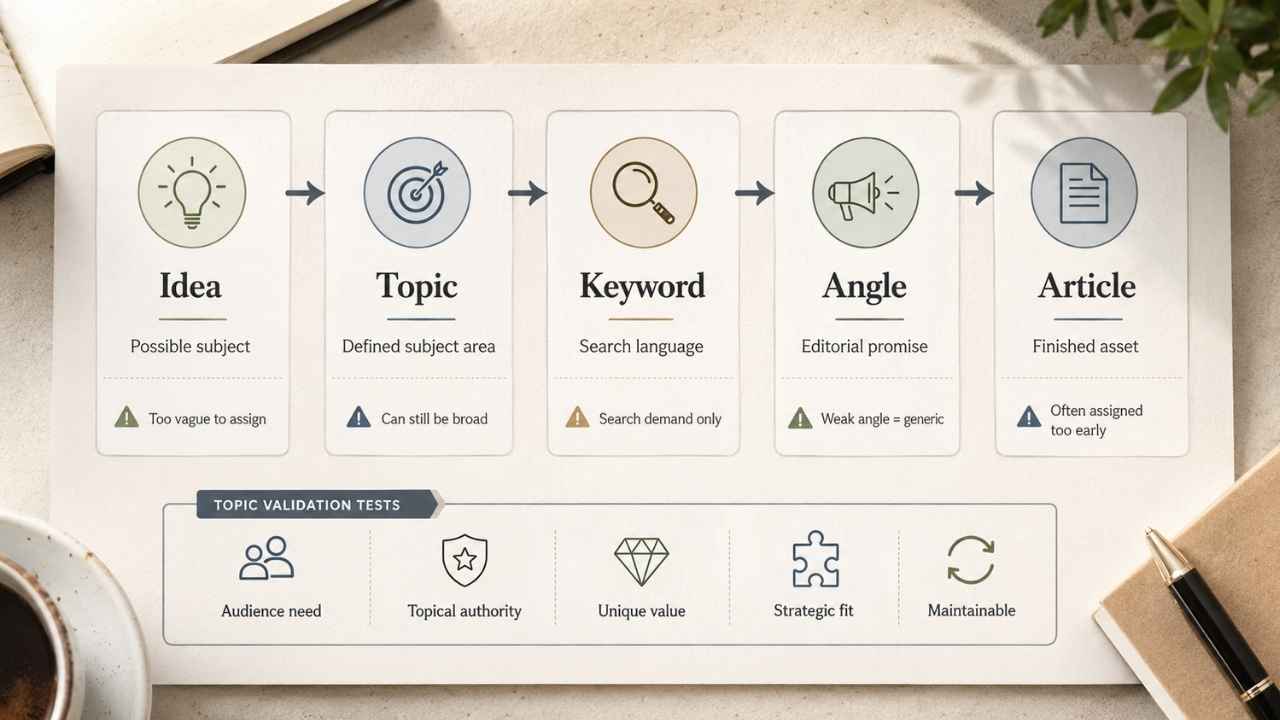
Editorial planning usually turns into a trainwreck because teams use the words “idea,” “topic,” “keyword,” and “article” interchangeably.
They aren’t the same thing. Not even close.
An idea is a raw possibility. A topic is a defined subject area. A keyword is the exact language people use to express demand in a search engine. An angle is your specific editorial promise to the reader. And the article is the final, polished asset.
Mix these concepts up, and weak assignments inevitably slip through the cracks. A keyword like “content ideation,” for example, isn’t an article by itself. It could evolve into a beginner’s guide, a workflow breakdown, a tool comparison, a list of fatal mistakes, or an op-ed on why modern brainstorming is broken. The keyword merely proves demand exists. It doesn’t dictate the job to be done.
Here is a cleaner way to categorize them:
| Term | What It Means | Editorial Risk If Misused |
| Idea | A possible subject. | Way too vague to assign to a writer. |
| Topic | A defined area of reader interest. | Can still be far too broad. |
| Keyword | The search language people use. | Tempts teams into writing purely for search bots. |
| Angle | The specific promise or point of view. | A weak angle guarantees generic, boring content. |
| Article | The finished content asset. | Often assigned before research is actually complete. |
This distinction matters. Topic discovery isn’t just hunting for what people search for; it’s identifying what your publication can cover with clarity, utility, and unmatched credibility.
You might unearth a high-volume keyword and still pass on the article. Maybe your site lacks the topical authority to rank. Maybe the SERP is completely dominated by massive government or academic domains. Or maybe the topic requires a subject matter expert you don’t have, leaving your brand without a unique point of view.
Walking away isn’t a failure. It’s good editorial judgment.
Strong topic research methods empower teams to say “no” much earlier. It’s a vastly underrated skill. Many editorial teams greenlight ideas simply because rejecting them feels unproductive. But a publishing strategy grows significantly stronger when you mercilessly filter out weak ideas before writers waste hours drafting them.
A viable topic should pass at least five tests:
- There is a clear, proven audience need.
- The topic aligns with the site’s current (or planned) authority.
- Your team can add something substantially more useful than a basic summary.
- The topic actively supports a cluster, product, brand, or audience goal.
- The content can be updated and maintained if freshness is a factor.
If a topic fails three of those five tests, keep it off the calendar. That doesn’t mean it’s dead forever. It might just need a narrower angle, a different format, original data, or a tighter connection to your core pillar content.
Use Search Data as a Signal, Not as the Whole Strategy
Search data is incredibly useful, but it’s dangerously easy to misread.
A keyword tool highlights search volume, but it can’t explain audience urgency. Google Trends maps relative interest across regions and seasons, but it can’t replace nuanced editorial interpretation. Search Console shows which queries currently drive traffic to your site, but it only reflects your existing visibility—not the untapped opportunities your brand could realistically dominate.
Treat search data as a signal, not a strict command. For publishers, the most robust content research process synthesizes multiple streams of evidence:
- Search demand (volume and trends)
- Existing site performance and analytics
- SERP analysis
- Direct audience questions
- Sales, customer success, or support conversations
- Competitor coverage gaps
- Social media and video engagement behavior
- Newsletter replies and reader feedback
- Internal editorial priorities
Every single source has its blind spots. Search Console is fantastic for spotting topics where Google already trusts your site, but it won’t show demand for a subject you’ve never touched. A rising query in Google Trends might just be a temporary news blip that is ultimately too broad for your niche. Analytics will show you what users do post-click—but if a topic brings in thousands of visits with zero newsletter signups, zero scroll depth, and a 95% bounce rate, you have to ask if that topic is actually valuable, or just highly visible.
A practical, well-sequenced research flow looks like this:
- Use audience and business goals to define the broad topic area.
- Use search tools to understand the specific language and demand.
- Use Search Console to identify existing visibility and gaps.
- Use analytics to check how users engage with related content.
- Use the SERP to decipher search intent and evaluate the competition.
- Use editorial judgment to decide if your site can genuinely add value.
- Turn only the absolute strongest opportunities into actual assignments.
The sequence here is critical. Start by hunting for high keyword volume and trying to reverse-engineer an audience meaning into it, and you’ll almost always end up with generic, soulless content. A much better approach is to start with the audience’s problem, and then use data to validate, sharpen, or challenge your idea.
Study the SERP Like an Editor, Not a Copycat
SERP (Search Engine Results Page) analysis is one of the most powerful topic research methods available, yet publishers routinely do it in the laziest way possible.
The standard approach? A team searches a keyword, opens the top five ranking pages, scrapes the common H2 headings, tacks on one extra section, and calls it “research.” That isn’t a strategy. That’s just imitation with slightly different formatting.
A true SERP review asks deep, probing editorial questions: What specific intent is Google trying to satisfy? Are the winning results beginner guides, listicles, templates, news briefs, or official documentation? Are the pages fresh, or years out of date? Are they written by subject matter experts, aggressive affiliates, or media publishers? Do they actually solve the reader’s problem, or do they just satisfy the surface-level keyword?
Search intent isn’t always obvious just by glancing at a keyword. A phrase might look informational, but the SERP reveals users actually want to compare software. Another might look commercial, but the results show users desperately need definitions and use cases before they’re ready to pull out a credit card.
For publishers, SERP research should confidently answer seven questions:
- What content format is currently winning?
- What knowledge level do the top results assume the reader has?
- What is glaringly missing from the existing coverage?
- What kind of evidence, data, or media do the trusted pages include?
- Is this topic evergreen, seasonal, or driven by breaking news?
- Does our publication have a credible, unique angle to offer?
- What would make our article genuinely more useful?
That last question is the kicker. If your only answer is, “we’ll make it 1,000 words longer,” the topic isn’t ready. Word count does not equal value, and adding more headings doesn’t magically manufacture expertise.
SERP analysis should also protect publishers from false confidence. If the top five spots are held by the CDC, official government portals, and massive academic institutions, a standard blog post is going to struggle to rank. You’ll need to offer a completely different kind of value—like a regional adaptation, a simplified breakdown for beginners, or exclusive expert commentary. Copying the SERP won’t get you there. Deep editorial analysis will.
What Most People Get Wrong About Topic Research Methods
The most common misconception in publishing is that topic research simply means finding keywords with high search volume and low competition.
That view is wildly incomplete. Keyword difficulty and search volume matter, but they don’t tell the whole story. A keyword can look amazing in Ahrefs or Semrush and still be a terrible publishing decision for your brand. Conversely, a topic might show zero search volume but be incredibly valuable because it aids sales conversations, builds deep industry authority, or perfectly bridges a gap in your topic clusters.
Publishers stumble when they confuse discoverability with usefulness.
Just because people are searching for a topic doesn’t automatically mean your publication should cover it. The better question is: Can we help the reader better than the existing options on the internet?
To avoid becoming a mechanical, generic content mill, publishers should categorize opportunities into three distinct buckets:
| Opportunity Type | What It Means | Example |
| Search opportunity | People are actively looking for the topic in search engines. | “content research process” |
| Editorial opportunity | Existing coverage is weak, shallow, outdated, or poorly framed. | Most articles focus on SEO tools, completely ignoring editorial decision-making. |
| Strategic opportunity | The topic builds authority, drives conversion, retains readers, or builds trust. | Helps connect a sub-cluster to a massive core content strategy guide. |
The absolute best topics sit right in the middle of that Venn diagram—where all three overlap.
What many teams also miss is that topic research includes determining the level of coverage. Not every idea deserves a 3,000-word ultimate guide. Some should be a quick 500-word explainer. Some should just be a comparison table, a checklist, or a dedicated newsletter issue. Some shouldn’t be published at all.
Good publishers don’t ask, “Can we write something about this?” They ask:
- Should this be a standalone article?
- Should it be a small section inside a larger pillar page?
- Should it be assigned to a specialized expert?
- Should we wait until we have proprietary data?
Asking these questions slows the process down at the very beginning, but it saves immense amounts of time and money later. A weak topic approved too quickly becomes a lingering problem. It requires heavy editing, earns zero trust, attracts the wrong traffic, and creates long-term content debt.
A Better Way to Turn Topic Research Methods Into Publishing Strategy
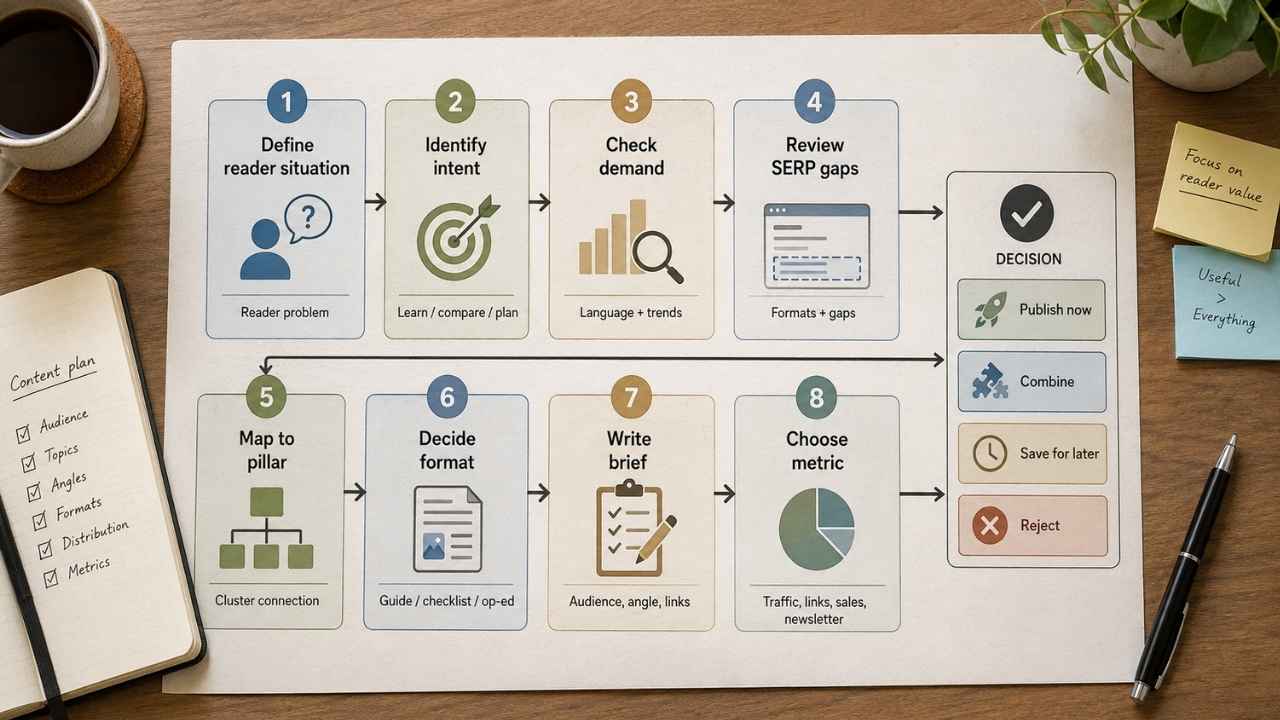
A highly functional topic research process should always end with a firm decision, not just a bloated spreadsheet.
That decision might be “publish now,” “combine with an existing topic,” “save for Q3,” or “reject entirely.” This is exactly where content strategy and editorial planning intersect.
Here is a practical, 8-step framework publishers can use before assigning any topic:
Define the reader situation
Write a single sentence explaining the reader’s core problem.
Weak: “This article is about topic research.”
Strong: “This article helps content managers and SEO leads filter out weak ideas so they can build a stronger editorial calendar.”
That single sentence should anchor the entire article brief.
Identify the intent behind the demand
Look past the keyword. Does the reader want to learn, compare, troubleshoot, plan, buy, or validate an assumption?
Check current and adjacent demand
Use search data to understand the exact language your audience uses, not just the volume. Compare related terms, check Search Console for existing traction, and see if interest fluctuates by season or region.
Review the SERP for formats and gaps
Look at what already ranks, and then actively look for what is missing. Are the current articles too focused on software tools? Do they lack templates? Do they lack real-world judgment? That gap becomes your editorial angle.
Map the topic to a pillar
Every article should support a larger reader journey. If you are writing about topic research, ensure it connects logically to your broader pillar content on “Content Strategy” or “Editorial Planning.”
Decide the best format
The format must match the reader’s need. An opinion piece won’t help someone who desperately needs a workflow template, and a checklist won’t help someone looking for deep, analytical thought leadership.
Write the assignment brief before drafting
A bulletproof topic brief should include the target reader, search intent, primary/secondary keywords, the specific reader problem, the editorial angle, required internal links, and expert sources. Crucially, it should also include a “what not to include” section. Telling a writer not to turn a strategy piece into a basic listicle of SEO tools prevents them from drifting into generic territory.
Choose a success metric before publishing
Not every topic is destined to drive massive organic traffic. Some are meant to support internal linking architectures. Some are meant to close enterprise sales deals. Some are meant to drive newsletter engagement. Define the specific job of the piece before it goes live.
Final Thoughts
At the end of the day, topic research methods should bring absolute clarity to your publishing choices, not just generate an overwhelmingly long list of disjointed ideas.
If your editorial team is already drowning in ideas, your first step shouldn’t be brainstorming more of them. Your first step should be filtering them much harder. Before you assign your next piece of content, run it through three uncompromising questions: What specific reader problem does this solve? What unique value can we add that currently doesn’t exist? And how does this directly support our broader publishing strategy?
If the answers are vague, the topic simply isn’t ready. But if the answers are sharp, clear, and specific, your article brief will practically write itself. That is the true power of topic research—not to make you look busy, but to ensure you only publish work that actually deserves to exist.
FAQs
What is the difference between keyword research and topic research?
Keyword research focuses on the exact language, phrases, and search volume people use in search engines. Topic research is much broader. It focuses on the overarching subject matter, the reader’s underlying problem, and how that concept fits into your overall editorial and business strategy.
How do I know if a topic is actually right for my publication?
A topic is a strong fit if it passes the overlap test: it addresses a proven audience need, it aligns with your site’s current or planned topical authority, and you have the expertise to create something significantly better than what currently exists on page one of Google.
Can I do effective topic research without expensive SEO tools?
Absolutely. While tools like Ahrefs or Semrush are incredibly helpful for scaling, some of the best topic research comes from analyzing your Google Search Console data, talking directly to your sales and support teams, reading community forums, and critically analyzing the gaps in current SERP results.
Should every topic idea eventually become an article?
No. Many ideas are better served as a section within a larger pillar page, a quick social media post, an infographic, or an email newsletter. Part of good topic research is having the restraint to choose the right format, which sometimes means not writing a full article at all.