

Buying greener technology is harder than reading a sustainability page. A phone may use recycled materials but still be expensive to repair. A cloud provider may sign major clean-energy deals while its data centers keep growing. A laptop may be repairable on paper, but spare parts may not be easy to get where you live.
That is the practical problem behind this list. The strongest eco-friendly tech companies are not perfect companies. They are the ones making visible progress where it matters: repairability, longer product life, cleaner energy, circular design, lower power use, better materials, and more responsible end-of-life programs.
The order here is not based only on company size or brand popularity. Smaller repair-first companies rank highly because they challenge throwaway electronics directly. Larger companies appear where their scale can influence supply chains, energy systems, business IT, cloud infrastructure, or product efficiency.
Why Eco-Friendly Tech Companies Need a Tougher Standard
The world does not have an electronics shortage. It has a lifespan problem.
The Global E-waste Monitor 2024 reported that 62 million tonnes of e-waste were generated in 2022, while only 22.3% was documented as properly collected and recycled. That is why repair, software support, take-back programs, and longer ownership matter more than a nice recycled-cardboard box.
A company should not get a free pass because it buys renewable electricity or uses recycled plastic in some products. Those steps help, but they do not cancel out the environmental cost of mining, manufacturing, shipping, charging, replacing, and disposing of electronics.
For consumers, the better question is often, “Can I keep this device longer?”
For businesses, it may be, “Will this vendor help reduce energy waste, manage IT assets responsibly, and provide sustainability data we can actually use?”
That is the lens used for this list.
1. Fairphone
Fairphone is the clearest consumer example of sustainable tech design because repairability is built into the product, not added later as a support feature.
The Fairphone Gen. 6 is designed with modular hardware, spare parts availability, long software support, and a five-year warranty when registered. Fairphone says the device will be supported until at least 2033 with regular security patches, software updates, spare parts availability, and at least seven Android upgrades.
That is a serious ownership promise in a market where many phones are replaced because the battery weakens, the screen cracks, or software support runs out. Fairphone’s strongest argument is simple: a phone that can be repaired and safely used longer is usually better than a new phone with slightly greener packaging.
This is the best fit for buyers who care more about longevity, repair, and ethics than having the fastest chip or the most polished camera system. It is not the best fit for someone who wants a flagship Android experience with the strongest zoom camera, the brightest premium display, or the most powerful gaming performance.
The main practical issue is availability. Before buying one, readers should check warranty coverage, network compatibility, repair parts, and service options in their country. A repairable phone is much less useful if parts and support are hard to access locally.
Fairphone ranks first because its environmental value is visible in the product itself.
2. Framework
Framework applies the same repair-first thinking to laptops, a category where many devices become waste because one part becomes too expensive or too difficult to replace.
The Framework Laptop 13 is built around customization and repair. Users can swap expansion cards, upgrade memory and storage, replace parts, and access repair guides. In some configurations, even larger component upgrades are possible. That changes the ownership model. Instead of treating the laptop as a sealed object, Framework treats it as a machine that can be maintained.
This matters for students, developers, Linux users, repair-minded buyers, and small teams that do not want to replace an entire laptop because of a weak battery, damaged port, limited storage, or aging mainboard.
Framework is not the only repairable laptop option anymore, and that is good for the market. Some business laptops from mainstream brands have also improved repairability. Framework still stands apart because modularity is not a side note. It is the product philosophy.
There is some friction. Framework asks more from the buyer than a standard MacBook or mainstream Windows laptop. Choosing parts, operating system options, ports, and upgrade paths requires a little more confidence. Some people will enjoy that control. Others will prefer a simpler off-the-shelf purchase with a large retail service network.
For people willing to think about long-term ownership, Framework is one of the most convincing eco-friendly tech companies in personal computing.
3. Schneider Electric
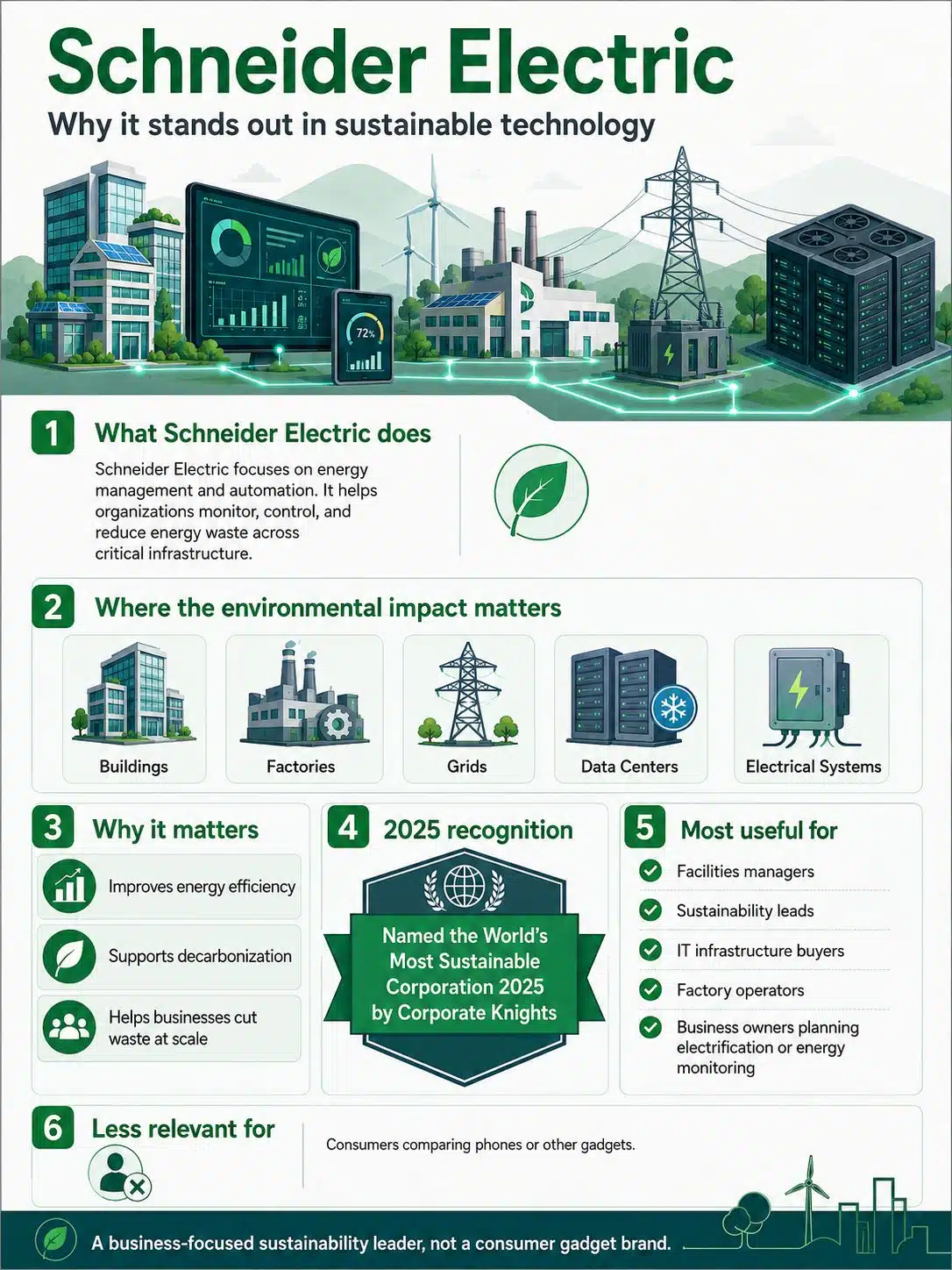
Schneider Electric is not a gadget company, and that is exactly why it deserves a high place.
A large share of technology’s environmental footprint sits inside buildings, factories, grids, data centers, and electrical systems. Schneider Electric works in energy management and automation, helping organizations monitor and reduce energy waste across infrastructure that ordinary consumers rarely see.
This makes Schneider more relevant to green businesses than to someone comparing phones. A commercial building that improves its energy management, a factory that reduces waste, or a data center that becomes more efficient can deliver environmental benefits at a scale much larger than one individual device purchase.
Schneider also has strong sustainability recognition, including being named the world’s most sustainable corporation by Corporate Knights in 2025. Rankings are not proof that every project is perfect, but they do support the company’s position as a serious player in energy efficiency and business sustainability.
The practical reader here is a facilities manager, sustainability lead, IT infrastructure buyer, factory operator, or business owner planning electrification or energy monitoring. A household shopping for a greener smartphone should skip this section. A business planning an office, data-center, or industrial upgrade should not.
4. Apple
Apple belongs on this list, but not for the same reason as Fairphone or Framework.
Its strongest environmental advantage is product longevity at scale. Many iPhones, iPads, and Macs remain useful for years, receive long software support compared with much of the consumer electronics market, and hold resale value well. A device that is used for six or seven years, resold, passed down, or traded in is usually a better environmental choice than a device replaced every year.
Apple also reported that 30% of the material across products shipped in 2025 came from recycled content, its highest level to date. That matters because Apple’s supply chain is enormous. Improvements in recycled cobalt, rare earth elements, aluminum, gold, tin, and other materials can influence large parts of the electronics industry.
The repair story is less simple. Apple has expanded Self Service Repair and provides access to genuine parts, tools, and manuals for eligible devices. But Apple states that the program is intended for people with the knowledge and experience to repair electronic devices. That is not the same as easy repair for ordinary users.
There is also a buying mistake to avoid: under-specifying a Mac or iPad because the base model looks cheaper. Since memory and storage are not easily upgradeable on many Apple devices, choosing too little at purchase can shorten the useful life of an otherwise durable product.
Apple is a strong choice for buyers who keep devices for a long time. It is a weaker choice for people who want maximum repair freedom or frequent hardware upgrades.
5. Google
Google has one of the most ambitious clean-energy stories in big tech, but it also shows why cloud sustainability is difficult to judge.
The company has matched its global electricity use with renewable energy purchases since 2017 and is pursuing 24/7 carbon-free energy by 2030 across the grids where it operates. That hourly goal is more demanding than matching electricity use across a full year.
Google also reports strong data-center efficiency, including a 2024 average annual power usage effectiveness of 1.09 across its global fleet. In 2024, it reduced data-center energy emissions by 12% even as data-center electricity consumption increased 27% year over year.
That last point is the messy reality. Google is improving parts of its energy profile while demand keeps rising. Search, YouTube, Android services, Workspace, Google Cloud, and AI products all depend on physical infrastructure. AI growth adds pressure through servers, chips, cooling, water, construction, and electricity demand.
For consumers, switching email or search providers will not be the main climate decision in life. For businesses using Google Cloud, the more useful questions are practical: Which cloud region will host the workload? What emissions data is available? Can workloads be made more efficient? Is the service reducing a real operational burden, or just adding more compute?
Google is one of the most important eco-friendly tech companies to watch because its infrastructure supports a huge part of digital life. It should not be treated as a zero-impact cloud.
6. Microsoft
Microsoft’s climate goals are bold: carbon negative, water positive, and zero waste across its direct waste footprint by 2030. The company has invested in renewable energy, carbon removal, data-center innovation, circular hardware, and sustainability software for enterprise customers.
Its challenge is just as big. Microsoft’s total emissions have increased from its 2020 baseline, with AI and cloud expansion cited as major growth-related factors. That does not make the company’s sustainability work meaningless. It does mean the claims need to be read with care.
Microsoft is most relevant for businesses already inside its ecosystem. A company using Microsoft 365, Azure, Surface devices, Teams, Copilot, and enterprise software may benefit from sustainability reporting tools, cloud emissions data, repairability improvements, and better infrastructure planning.
The mistake is treating cloud migration or AI adoption as automatically greener. A workload moved to the cloud still runs on servers. An AI feature still uses data-center capacity. The better question is whether the tool reduces waste, improves reporting, consolidates systems, or helps the business make smarter energy and IT decisions.
Microsoft is not a clean little sustainability brand. It is a huge enterprise technology provider trying to reduce the impact of a rapidly expanding footprint. That makes it important, but not uncomplicated.
7. Dell Technologies
Dell is less glamorous than Framework, but it may be more practical for companies buying hundreds or thousands of devices.
Business IT has a different sustainability problem from personal tech. Procurement teams need warranty support, secure data handling, repair options, parts availability, asset recovery, leasing support, and recycling documentation. Dell’s Asset Recovery Services are built for that world, helping organizations retire, resell, recycle, or return IT equipment more responsibly.
Dell has also been moving more commercial devices toward circular design. Its sustainability materials highlight recycled and renewable materials, easier repairs, and design changes such as modular USB-C ports in selected commercial devices. Small details like ports matter because common failure points often decide whether a laptop stays in service or becomes waste.
The warning is model variation. Not every Dell product is equally repairable, equally efficient, or equally strong from a sustainability perspective. A procurement team should check the specific product line, service manual, warranty, parts access, packaging claims, and asset recovery terms before treating the purchase as a green decision.
Dell earns its place because it can make greener IT easier within normal business purchasing systems.
8. Samsung Electronics
Samsung makes the list because of scale. The company sells smartphones, TVs, monitors, memory chips, displays, and home appliances across many markets. When a company that large improves energy use or materials, the impact can spread across millions of products.
Samsung’s 2025 sustainability reporting includes several useful details. Its Device eXperience Division reached a 93.4% renewable energy transition rate by the end of 2024. The company also reported a 31.5% average power-consumption reduction across major product models compared with 2019, and said 31% of plastic components used in products incorporated recycled materials.
Those details matter most in categories such as TVs, monitors, and appliances, where energy use over time can become a major part of the product’s footprint.
The problem is product churn. Samsung releases many products across many price points. A budget phone, flagship phone, refrigerator, TV, monitor, and memory chip should not all be judged by the same corporate sustainability paragraph.
For consumers, Samsung is a realistic global option because products and service channels are widely available. It is not automatically the greenest choice in every category. Check the exact model, energy label, software support period, repair options, and whether a refurbished or longer-lasting alternative makes more sense.
Quick Comparison: Which Company Fits Which Reader?
| Company | Strongest Green-Tech Angle | Best Fit |
|---|---|---|
| Fairphone | Repairable smartphones and long support | Buyers who want to keep a phone longer |
| Framework | Modular, repairable laptops | Developers, students, Linux users, repair-minded buyers |
| Schneider Electric | Energy management and automation | Businesses, buildings, factories, and data centers |
| Apple | Long device life, recycled materials, resale value | Mainstream users who keep devices for many years |
| Clean-energy procurement and efficient cloud infrastructure | Businesses using cloud services and emissions reporting | |
| Microsoft | Enterprise sustainability tools and data-center innovation | Companies already using Microsoft and Azure |
| Dell Technologies | Circular IT and asset recovery | Procurement teams and business IT departments |
| Samsung Electronics | Energy-efficient products and large-scale materials progress | Global consumers comparing phones, TVs, monitors, and appliances |
Use this table as a shortcut, not a final answer. Repair access, trade-in programs, warranties, energy labels, recycling options, and software support vary by country.
What Buyers Usually Miss
The most sustainable tech decision is often boring. It is the product you keep using.
Before buying from any “green” technology brand, check these points:
- Can the battery be replaced at a reasonable cost?
- Will the device receive software and security updates long enough?
- Are spare parts available in your country?
- Does the company offer trade-in, take-back, or recycling where you live?
- Is the device efficient during everyday use, not only in marketing claims?
- Can you buy refurbished instead of new?
- Are you replacing a device that still works?
That last question is uncomfortable, but useful. A greener product is still a product. Buying less often remains one of the strongest sustainability choices.
Final Thoughts
The best eco-friendly tech companies solve different problems. Fairphone and Framework push against throwaway device design. Schneider Electric helps businesses reduce energy waste. Apple, Dell, and Samsung matter because their scale can influence materials, repair, resale, efficiency, and asset recovery. Google and Microsoft matter because cloud and AI infrastructure now sit at the center of modern technology’s environmental footprint.
The right choice is not the brand with the most polished sustainability page. It is the product or service that helps you buy less often, use energy more wisely, repair when possible, and avoid turning working technology into waste.
Eco-Friendly Tech Companies are worth watching, but the real environmental gain comes when better corporate practice meets more careful buying.
FAQs about Eco-Friendly Tech Companies Leading Greener Technology
Are eco-friendly tech companies really sustainable?
Some are making meaningful progress, but no technology company is impact-free. Electronics require mining, manufacturing, transport, electricity, packaging, repair systems, and end-of-life handling. The better companies are usually the ones that help products last longer, support repair, reduce operational emissions, use more recycled materials, and publish enough data for their claims to be checked.
Which eco-friendly tech company is best for consumers?
For repairable phones, Fairphone is the clearest choice where it is available. For repairable laptops, Framework is one of the strongest consumer options. For mainstream buyers, Apple and Samsung can be reasonable choices when devices are kept for many years instead of replaced casually.
Is refurbished tech better than buying new from a greener brand?
Often, yes. Refurbished devices extend the life of products that already exist. The main checks are battery health, warranty, software support, seller reputation, and whether replacement parts are still available.
What should businesses check before choosing a greener tech vendor?
Businesses should look beyond climate pledges. Check emissions reporting, repairability, warranty terms, asset recovery services, packaging, product energy use, cloud region data, supplier standards, and whether the vendor can provide documentation for internal sustainability reporting.






















