Squeezed by volatile energy prices and mounting pressure from stakeholders, modern businesses are quickly realizing that sustainable practices are no longer optional. Today, corporate renewable energy adoption represents a strategic financial decision essential for continuous viability and lasting competitive advantage.
Fortunately, clear tools now exist to transform unpredictable utility costs into stable operating expenses. Advanced technologies like onsite solar installations, battery storage systems, and comprehensive power purchase agreements offer practical solutions for the commercial sector.
Moving from initial interest to tangible action requires evaluating the fundamental business case, navigating common regulatory roadblocks, and conducting thorough energy audits. By implementing these concrete steps, organizations can successfully modernize their infrastructure, reduce environmental impact, and build a highly resilient, highly profitable operational model.
What is Renewable Energy?
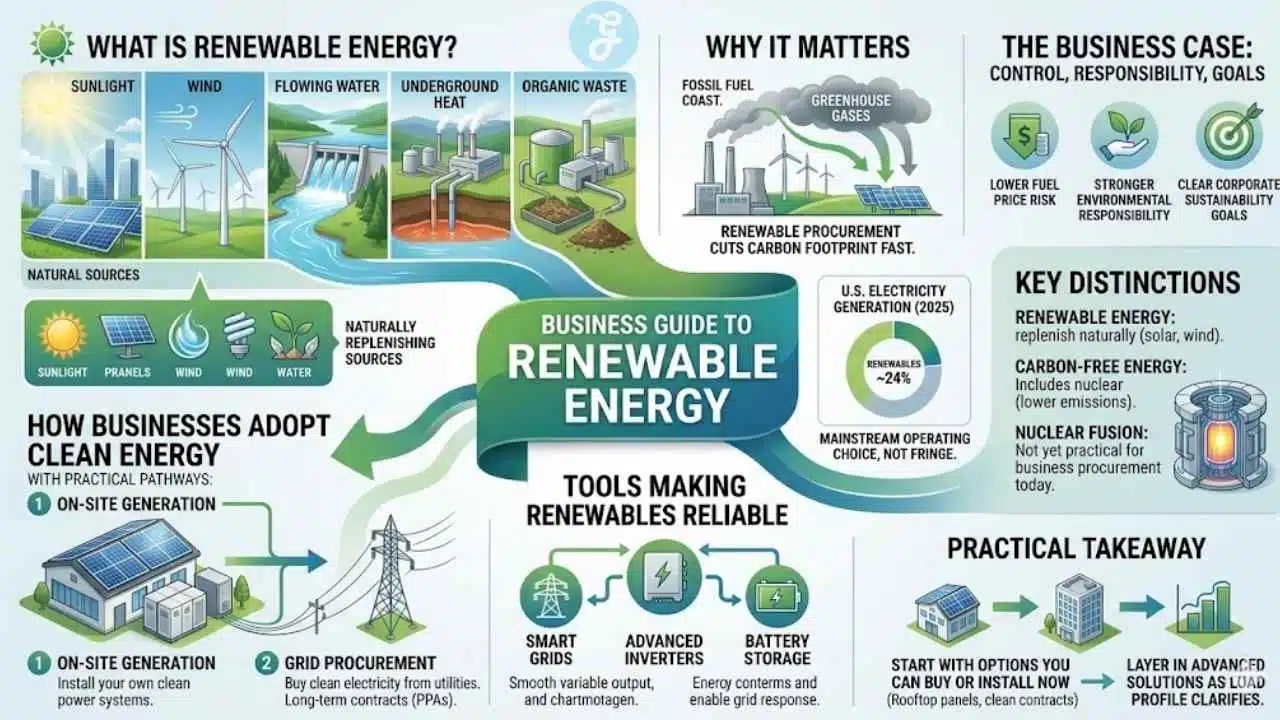
Renewable energy comes from sources that naturally replenish, such as sunlight, wind, flowing water, underground heat, and organic waste streams. For businesses, that usually means buying clean electricity from the grid, signing long-term contracts, or generating some of it on site.
That matters because fossil fuels still drive a large share of power generation and remain a major source of greenhouse gas emissions linked to climate change. If your company wants to cut its carbon footprint without waiting for the whole grid to change, renewable procurement is one of the fastest levers you can pull.
In the latest U.S. electricity data, renewables supplied about 24% of utility-scale generation in 2025. That makes clean energy a mainstream operating choice, not a fringe pilot.
For most companies, renewable energy is less about ideology and more about control: lower exposure to fuel price swings, stronger environmental responsibility, and a clearer path to corporate sustainability goals.
It also helps to separate a few terms. Renewable energy refers to sources that replenish naturally. Carbon-free energy is broader and can include nuclear. Nuclear fusion energy is promising, but it is not yet a practical procurement option for companies today, so it should not sit at the center of a current transition plan.
Tools such as smart grids, advanced inverters, and battery storage make renewable energy easier to use because they smooth variable output and help facilities respond to grid conditions in real time. For a reader trying to make this practical, the takeaway is simple: start with the options you can buy or install now, then layer in more advanced solutions as your load profile becomes clearer.
Common Renewable Energy Sources
Most U.S. businesses focus on five options: solar power, wind energy, hydropower, geothermal energy, and bioenergy. The right mix depends on your building type, your load pattern, your lease terms, and how much capital you want to commit up front.
Before you choose, it helps to compare these sources by how they behave in the real world.
| Source | Best fit for businesses | Main advantage | Main watch-out |
|---|---|---|---|
| Solar power | Warehouses, offices, retail, schools, plants with roof or land | Modular, familiar, strong U.S. tax support | Output changes with daylight and weather |
| Wind energy | Large buyers using PPAs or campuses in windy areas | Large-scale output and strong overnight generation in some regions | Siting, transmission, and permitting can be harder |
| Hydropower | Large buyers seeking firm carbon-free supply through contracts | Reliable output and grid support | Limited new project availability, environmental review |
| Geothermal energy | Facilities in resource-rich areas or firms seeking firm clean power | Steady baseload-style generation | Geography and drilling costs matter |
| Bioenergy | Food, agriculture, wastewater, landfill-linked operations | Turns waste into useful energy | Feedstock quality and emissions accounting need care |
Solar Power
Solar power is usually the first stop because it scales well, from a small rooftop array to a multi-site program. It works especially well for buildings with broad daytime loads, such as distribution centers, retail stores, schools, and office campuses.
In the U.S., the tax case remains strong. As of May 2026, the IRS guidance for the clean electricity investment credit lists a base credit of 6% and a potential 30% credit when prevailing wage and apprenticeship rules are met. That can change the payback math fast, especially for companies with good roof conditions and high daytime rates.
The practical move with solar is to pair it with load data. If your building uses the most power between late morning and early evening, solar often offsets your highest-value kilowatt-hours first.
Solar also plays well with battery storage. A battery can keep excess midday production on site for late-afternoon use, reduce demand charges, and give critical loads a short resilience buffer during outages.
- Use rooftop solar when you control the site and expect to stay for years.
- Use a solar PPA or lease when you want savings with less upfront spending.
- Add storage if demand charges or outage risk are a meaningful part of your bill.
- Check roof age before signing anything, because reroofing after installation is expensive.
Wind Energy
Wind energy usually makes the most sense through off-site procurement rather than a turbine behind your building. That is why large buyers often access wind through long-term power purchase agreements.
The U.S. Department of Energy says wind is the nation’s largest source of renewable energy, with more than 150 gigawatts installed across 42 states. For a business, that scale matters because it creates a deeper project market and more counterparties for long-term deals.
Wind can complement solar nicely because production often peaks at different hours. If your company runs data centers, cold storage, or overnight manufacturing, that diversity can make a blended portfolio more stable than relying on one source alone.
Google, Amazon, and Meta all used long-term contracts to secure large volumes of wind and solar rather than depending only on unbundled certificates. That is a useful signal for smaller buyers too: if your load is large enough, contract structure matters as much as the technology.
Hydropower
Hydropower does not get as much attention as solar and wind, but it still matters. The U.S. Department of Energy says hydropower accounted for about 27% of total U.S. utility-scale renewable electricity generation in 2024, and pumped storage hydropower still provides most utility-scale energy storage in the country.
For companies, hydropower is valuable because it is steadier than solar or wind and can support 24-hour operations. That makes it attractive for heavy industry, food processing, and data-rich operations that cannot afford frequent swings in supply.
A good recent example is Google’s 2025 hydro framework with Brookfield, which can deliver up to 3,000 megawatts of carbon-free hydropower in the U.S. The lesson is not that every company should chase hydro. It is that mature assets can still be part of a modern renewable energy strategy when reliability matters.
The limit is availability. New dam development is slow and sensitive, so most businesses will access hydropower through utility programs or long-term contracts rather than new project ownership.
Geothermal Energy
Geothermal energy taps heat from below the earth’s surface to produce electricity or useful building heat. It is attractive because it can provide steady output around the clock rather than only when the sun shines or the wind blows.
The Department of Energy describes geothermal as a competitive domestic source for reliable baseload electricity. If your company has round-the-clock operations or needs cleaner firm power to support an electrification plan, geothermal deserves a closer look.
Geothermal is especially relevant in parts of the western U.S., where the resource base is stronger. It is also gaining attention from large power buyers that want a cleaner complement to solar and wind, especially as electricity demand grows from AI and data center expansion.
- Consider geothermal when you need steady power, not just annual renewable matching.
- Ask developers about project maturity, drilling risk, and commercial operation dates.
- If power is not the fit, geothermal heat pumps may still cut building energy use.
Biomass Energy
Biomass and bioenergy work best when a company already has an organic waste stream to manage. In U.S. business settings, that usually means wood waste, food waste, wastewater biogas, agricultural residues, or landfill gas, not generic fuel switching for every site.
The strongest use case is often waste-to-value. If you pay to haul away organic material, a bioenergy project can reduce disposal costs and create useful heat, power, or renewable gas at the same time.
EPA landfill gas project data shows why this category stays relevant: captured landfill gas can cut methane emissions and supply energy for business parks and industrial users. For food processors, farms, breweries, and wastewater facilities, anaerobic digestion can do something similar on site.
The caution here is accounting. Biomass projects need careful feedstock, emissions, and air-permitting review, so they are best treated as a targeted industrial strategy, not a blanket recommendation for every company.
The Business Case for Renewable Energy Adoption
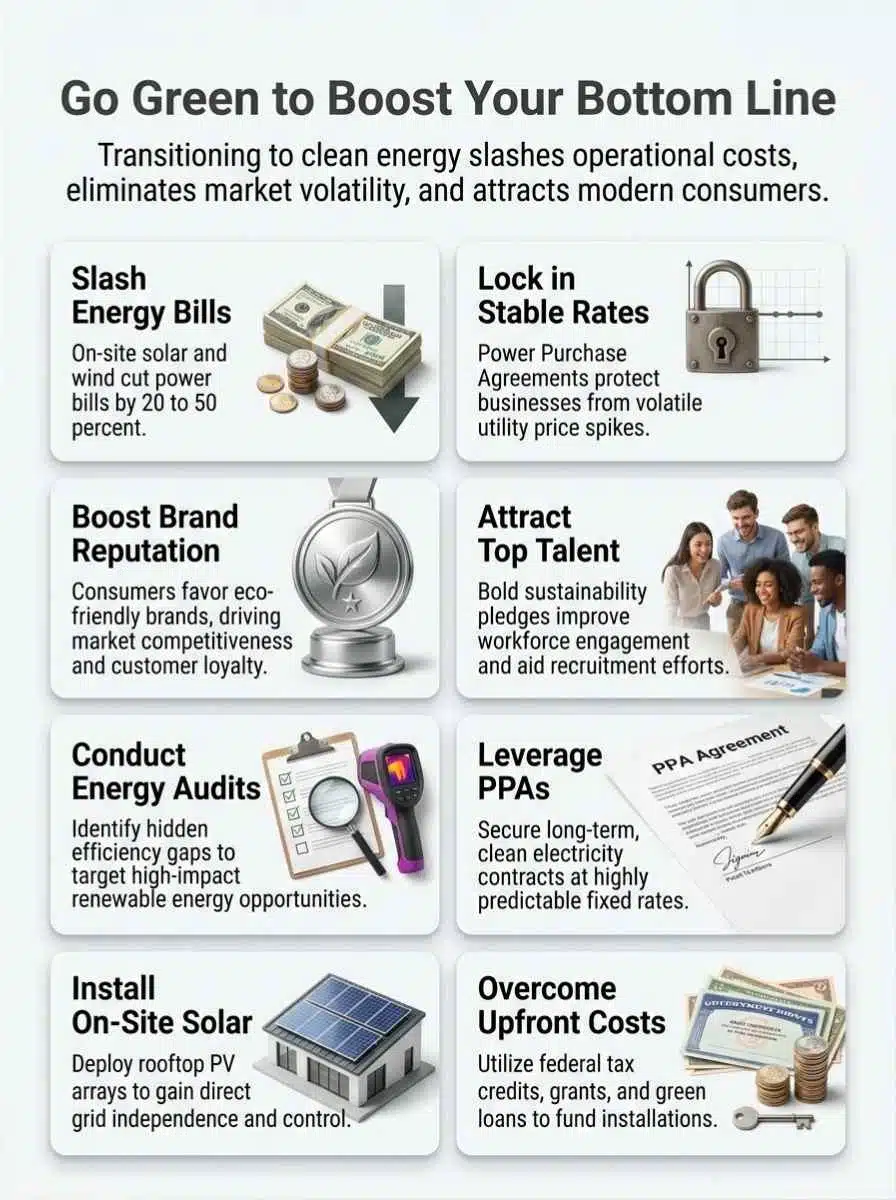
The strongest business case for renewable energy is not a single benefit. It is the stack of benefits you get when lower energy costs, more predictable budgeting, emissions reduction, and brand credibility all move in the same direction.
That stack gets even stronger if you start with energy efficiency. The cheapest clean kilowatt-hour is usually the one you never have to buy.
Cost Savings and Price Predictability
Energy cost control is usually the first reason leadership teams pay attention, and for good reason. Long-term renewable contracts can replace some exposure to volatile market prices with a clearer fixed-price structure.
That is especially useful now. The IEA expects U.S. electricity demand to grow at an average annual rate of 2% from 2025 through 2027, which adds pressure to future procurement decisions. If your company waits until a lease renewal, plant expansion, or data center build-out is already underway, your options usually get narrower and pricier.
Federal incentives help too. In the latest IRS business guidance, clean electricity investment credits can materially lower project cost for eligible solar, storage, geothermal, and other zero-emissions technologies. That can move a project from “interesting” to “financeable.”
| Approach | How savings show up | Best for |
|---|---|---|
| On-site solar | Lower purchased electricity, lower demand exposure in some cases | Owner-occupied buildings with usable roof or land |
| Off-site PPA | Long-term price visibility and budget planning | Large multi-site buyers or energy-intensive firms |
| Efficiency plus renewables | Smaller system size and better project economics | Most companies, especially older facilities |
Risk Mitigation Against Energy Volatility
Renewable adoption is also a risk management tool. If your company relies entirely on spot-priced electricity or fuel-linked utility costs, you stay exposed to swings you cannot control.
PPAs, on-site generation, and storage reduce that exposure in different ways. A PPA can stabilize part of your long-term cost. On-site solar can offset midday load. Storage can shave peaks, support critical loads, and help you ride through short disruptions.
Companies like Microsoft and Google have pushed beyond annual matching and focused on hourly or region-specific carbon-free supply because reliability matters as much as headline targets. That is a smart lesson for any business with mission-critical operations: match your procurement design to your operating risk, not just your sustainability report.
- If outages hurt revenue, prioritize resilience and storage.
- If energy budget volatility hurts planning, prioritize fixed-price contracts.
- If investor pressure is highest, prioritize traceable procurement with measurable emissions reduction.
- If you have leased sites, prioritize utility green tariffs or off-site agreements.
Enhanced Brand Reputation and Market Competitiveness
Brand value matters, but buyers are getting more skeptical. A vague “green” message does less than a specific action, such as signing a renewable contract, publishing a target date, or reporting annual progress.
Deloitte’s consumer research keeps pointing to the same pattern: trust rises when people see concrete proof rather than broad claims. For businesses, that means a smaller number of specific moves usually beats a long page of soft language.
Apple is a good example of specificity. Its 2025 environmental reporting says suppliers in its clean energy program helped avoid 21.8 million metric tons of greenhouse gas emissions in 2024. That kind of detail gives customers and investors something they can actually evaluate.
Competitive pressure works the same way. Once a few firms in your category start reporting renewable electricity use, laggards stand out fast. In sectors where procurement teams, enterprise customers, or public agencies score suppliers on sustainability, that can turn into lost bids rather than bad headlines.
Talent Attraction and Retention
People notice whether a company acts on climate change or just talks about it. That is especially true for younger employees and candidates comparing employers with similar pay and role scope.
Deloitte’s workforce research has consistently found that climate concerns influence how many Gen Z and millennial workers judge employers. For hiring teams, that makes renewable energy adoption more than a facilities story, it becomes part of employer credibility.
The biggest win here is internal, not external. Teams respond better when they can point to real projects, like a rooftop solar build, a building retrofit, or a clear renewable electricity target, rather than a broad promise buried in a report.
A practical move is to connect energy projects to internal communication. Show employees what changed, what it saves, and what comes next. That helps turn a capital project into a culture signal.
Success Stories: Companies Leading the Way
Big brands matter here because they show how different procurement models work in practice. The right lesson is not to copy their scale. It is to copy their structure.
Google: Pioneering 100% Renewable Energy Since 2017
Google became widely known for matching 100% of its annual electricity use with renewable energy purchases starting in 2017. That milestone matters because it helped normalize corporate clean power buying at scale.
What is more interesting now is Google’s next step. Its recent sustainability reporting focuses on 24/7 carbon-free energy, which means matching demand with cleaner supply by hour and location rather than only on an annual basis.
That shift gives businesses a useful takeaway: annual renewable matching is a strong start, but hourly reliability becomes the bigger question as your operations grow. In 2025, Google and Brookfield also announced a U.S. hydro framework that can deliver up to 3,000 megawatts of carbon-free hydropower, showing how mature assets can support that next stage.
Amazon: Targeting 100% Renewable Energy by 2025
Amazon moved its original 2030 goal forward and said it matched 100% of the electricity consumed by its global operations with renewable energy in 2023, seven years early. That is a strong example of using procurement scale to accelerate results instead of stretching the timeline.
Its portfolio has kept growing. Amazon recently said it has supported more than 600 wind and solar projects globally and remains the largest corporate purchaser of renewable energy worldwide by BloombergNEF’s ranking.
The practical lesson is phased expansion. Amazon did not rely on one project type or one geography. It built a portfolio, which is exactly how larger multi-site businesses should think about their own transition.
IKEA: Achieving 100% Renewable Electricity Across Operations
IKEA’s approach stands out because it combines on-site systems, owned renewable assets, and purchased electricity strategies. That blended model is often more realistic than betting everything on one tool.
As of May 2026, Ingka Group reported that 94.8% of its annual electricity consumption was matched with renewable sources in FY25, while IKEA stores and Ingka Centres in 25 countries sourced 100% renewable electricity backed by certificates. That tells you two things: large portfolios take time, and a mixed approach can still produce strong operational progress.
For retailers, logistics operators, and multi-site businesses, IKEA offers a practical template. Start where you control the roof, add contracted supply where you do not, and treat the portfolio as a long-term operating system.
Microsoft: Committed to Carbon Negativity by 2030
Microsoft has tied clean electricity procurement to a bigger carbon negative by 2030 goal, which makes energy strategy part of a broader operating model. That includes renewable matching, supplier expectations, and investment in emerging low-carbon technologies.
In a February 2026 update, Microsoft said it had achieved its goal to match 100% of its annual global electricity consumption with renewable energy by 2025. It also said it had contracted 40 gigawatts of new renewable energy supply across 26 countries.
The useful business lesson is this: companies with complex operations do better when procurement, cloud growth, facilities, and supplier standards all point in the same direction. Renewable energy works best when it is part of strategy, not a side program.
Challenges in Renewable Energy Adoption
Renewable energy is easier to buy than it used to be, but companies still run into three stubborn issues: capital, infrastructure, and policy. Knowing where those problems show up helps you avoid expensive false starts.
Upfront Investment Costs
Even when lifetime economics look good, the first question is usually cash. A rooftop solar project, battery system, or deep retrofit can compete with every other capital request on the CFO’s desk.
That is why project structure matters so much. Direct ownership can maximize long-term value, but PPAs, leases, green loans, and energy-as-a-service models can reduce the upfront burden.
In the U.S., the tax layer is still important. The current IRS business guidance for Section 48E gives companies a clearer framework for estimating after-tax project cost. If you skip that modeling early, you can misjudge payback by a wide margin.
- Ask for both pre-incentive and post-incentive economics.
- Model roof repairs, interconnection, and maintenance, not just panel cost.
- Compare ownership against a PPA, because the cheaper-looking option on day one is not always cheaper over 15 years.
- Bundle efficiency upgrades first if they let you install a smaller renewable system.
Infrastructure and Technological Barriers
Grid constraints are real, especially for larger projects. Some markets have long interconnection queues, transmission bottlenecks, or local capacity limits that delay projects long after the sales deck says they should be running.
This is where storage, controls, and phased deployment help. Instead of waiting for a perfect site-wide project, some companies start with efficiency upgrades, then add on-site solar, then layer in storage once the operating profile is clearer.
There is also a simple truth many teams learn late: a building with poor controls wastes the value of clean power. DOE guidance on commercial buildings keeps stressing audits, benchmarking, and control improvements because those steps often unlock faster savings than generation alone.
If your facility is inefficient, adding renewable energy can feel like pouring clean water into a leaky bucket.
Regional Policy and Regulatory Constraints
Policy still changes by state, utility territory, and building type. Net metering rules, interconnection timelines, demand charges, and permitting requirements can make the same solar project look brilliant in one market and average in another.
That is why regional screening should happen before vendor selection, not after. A quick review of tariffs, interconnection rules, roof rights, and tax treatment can save months of rework.
For multi-state businesses, a phased rollout is usually smarter than a national one-size-fits-all plan. Start in the markets with the strongest business case, build internal confidence, then expand.
Key Steps for Businesses to Transition to Renewable Energy
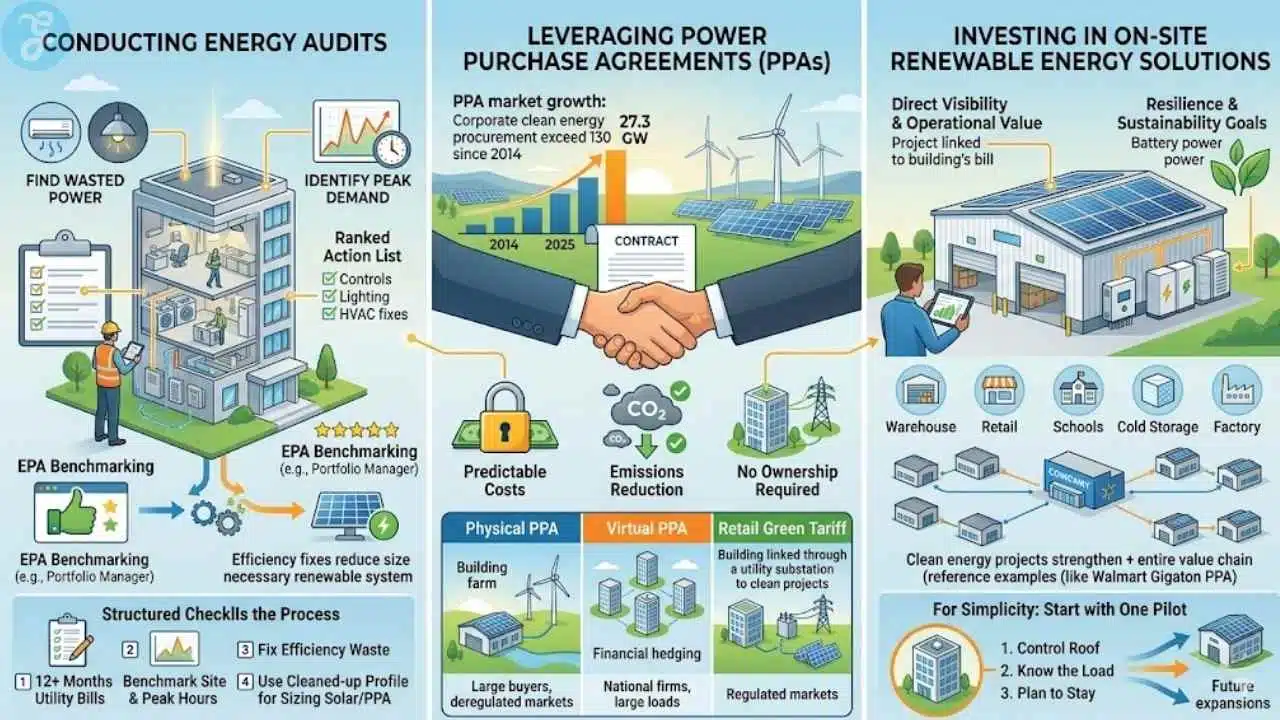
A good transition plan does not start with panels. It starts with data. Once you understand where your energy goes and what your costs actually look like, the right mix of efficiency, contracts, and on-site generation gets much easier to choose.
Conducting Energy Audits
An energy audit shows you where power is wasted, when your peaks happen, and which upgrades should come first. That prevents a common mistake: overspending on generation before fixing the building itself.
The Department of Energy recommends audits for commercial buildings before major efficiency improvements. EPA data also shows how widespread benchmarking has become, with more than 330,000 buildings using Portfolio Manager to track energy, water, and waste.
Audits are especially useful because they turn a broad sustainability conversation into a ranked action list. In many buildings, controls, lighting, and HVAC fixes lower the renewable system size you need later.
- Pull at least 12 months of utility bills before the audit starts.
- Benchmark the site, then identify peak demand hours.
- Fix obvious efficiency waste first, especially HVAC scheduling and lighting.
- Use the cleaned-up load profile to size solar, storage, or a PPA.
Leveraging Power Purchase Agreements (PPAs)
Power purchase agreements let a company buy electricity at agreed terms for years into the future. They work well when a business wants cost visibility and emissions reduction without owning generation assets directly.
This market is far from niche. CEBA’s latest U.S. deal tracking says corporate clean energy procurement has now exceeded 130 gigawatts since 2014, with 27.3 gigawatts added in 2025 alone. That scale tells you PPAs are a mainstream corporate tool.
PPAs come in a few forms. A physical PPA delivers power in a relevant market. A virtual PPA is a financial contract that settles against wholesale prices. A retail green tariff runs through a utility. The best choice depends on your load size, market access, and risk tolerance.
| PPA type | Why companies use it | Best fit |
|---|---|---|
| Physical PPA | Closer tie to actual electricity delivery | Large buyers in deregulated markets |
| Virtual PPA | Scalable financial hedge plus renewable attributes | National firms with large loads |
| Utility green tariff | Simpler utility-based path | Companies in regulated markets |
Investing in On-Site Renewable Energy Solutions
On-site renewable energy gives you direct visibility and direct operational value. You can see the array, measure the output, and connect the project to one facility’s bill, one resilience plan, and one set of sustainability goals.
This works especially well for warehouses, retail boxes, schools, cold storage, and factories with stable daytime demand. It can also help leased portfolios if landlords are willing to support green lease structures or shared savings models.
Walmart’s supply-chain work offers a useful example here. Its Gigaton PPA program, built with Schneider Electric and Ørsted, was designed to expand renewable energy access for suppliers that would otherwise struggle to procure it alone. That is a strong reminder that renewable energy projects can strengthen a whole value chain, not just a single headquarters building.
If you want the simplest path, start with one site where you control the roof, know the load, and plan to stay. A successful pilot makes later approvals much easier.
Final Thoughts
Renewable energy makes business sense when you treat it like an operating decision, not a branding exercise. Solar, wind, hydropower, geothermal energy, audits, PPAs, and on-site systems can cut risk, improve energy efficiency, and support real emissions reduction when they are matched to your load and your budget.
Start with an audit, compare ownership against contract options, and build from the sites where the numbers already work. That is how companies turn renewable energy into lower exposure, stronger corporate sustainability, and a cleaner growth plan.
Frequently Asked Questions (FAQs) About Corporate Renewable Energy Adoption
1. What is the business case for corporate renewable energy adoption?
The business case is simple, corporate renewable energy adoption cuts energy costs, lowers carbon, and boosts brand and investor trust.
2. How does adoption save money for a company?
Companies lock in stable prices through long term power purchase agreements, and improve energy procurement to avoid volatile fuel bills. These moves give clearer ROI, and lower operating costs over time.
3. Does renewable energy adoption reduce risk and help meet rules?
Yes, it lowers regulatory and market risk, and it supports carbon reduction targets. That can protect supply chains, and cut compliance costs.
4. How fast do firms see results from corporate renewable energy adoption?
Times vary, some firms get quick wins with certificates and green tariffs, others take months to close larger contracts. Big deals take longer, but they often bring larger, long term savings and a stronger green halo.