
The digital real estate market is booming, and domain flipping has emerged as one of the most lucrative opportunities for investors, entrepreneurs, and online business enthusiasts. A domain name is more than just a website address—it’s a digital asset with the potential for high returns.
Whether you’ve registered a domain as an investment, acquired an underutilized domain, or simply no longer need one, selling it strategically can ensure you get the best price. However, navigating the domain selling process requires a step-by-step approach to maximize returns, avoid pitfalls, and ensure a smooth transaction.
If you own a valuable domain name, understanding the right steps to successfully sell it for profit is crucial. This guide covers everything you need to know, from domain valuation and market research to secure transactions and domain transfer.
Whether you’re a beginner or an experienced investor, these expert insights, real-world examples, market trends, and best practices will help you navigate the domain selling process like a pro.
Additionally, we’ll explore emerging industry trends, case studies, and proven negotiation tactics that will help you secure the highest possible sale price while mitigating risks.
Why Selling a Domain Name Can Be Profitable?
Selling domain names has become a high-reward venture due to several compelling reasons:
- High Demand: Businesses, brands, and startups constantly seek premium domain names to establish their online presence.
- Low Maintenance Costs: Unlike physical assets, domains require minimal upkeep and only an annual renewal fee.
- High ROI Potential: Some domains sell for thousands or even millions of dollars, offering exponential returns on initial investments.
- Scalability: With the right strategies, domain flipping can be a sustainable and repeatable business model.
- Liquidity: Digital assets can be sold faster than traditional investments like real estate, provided they are priced and marketed effectively.
Notable Domain Sales and Their Impact
| Domain Name | Sale Price | Year | Buyer Purpose |
| Cars.com | $872 million | 2015 | Automotive Marketplace |
| Voice.com | $30 million | 2019 | Blockchain & AI Platform |
| Insurance.com | $35.6 million | 2010 | Lead Generation Business |
| Hotels.com | $11 million | 2001 | Hospitality Booking |
| 360.com | $17 million | 2015 | Internet Security |
| PrivateJet.com | $30.18 million | 2012 | Luxury Travel |
With the right strategies and market awareness, even mid-tier domain names can be sold for substantial profits. Additionally, niche-specific domains and keyword-rich names tend to fetch higher prices in their respective industries.
10 Steps to Successfully Sell a Domain Name for Profit
Successfully selling a domain name requires a well-planned strategy, industry knowledge, and a keen understanding of market trends.
Whether you’re a seasoned investor or a beginner, following a structured approach will help maximize your profits. Below, we outline the ten key steps to ensure a smooth and profitable domain sale.
Step 1 – Evaluate the Value of Your Domain
Understanding the value of your domain is crucial before listing it for sale. Several factors influence domain worth, including:
- Keyword Relevance: Domains with high search volume keywords tend to attract higher bids.
- Length: Shorter domains are often more valuable and brandable.
- Domain Extension: .com domains typically have higher market demand than other extensions like .net or .biz.
- Brandability: Easy-to-remember, unique domains fetch better prices.
- Existing Traffic: Domains with established traffic and backlinks have greater value.
- Market Trends: Industry demand and emerging digital trends affect domain pricing.
Free & Premium Tools for Domain Valuation
| Tool Name | Type | Features |
| GoDaddy Domain Appraisal | Free | Basic price estimation based on comparable sales |
| EstiBot | Freemium | AI-powered valuation and market data insights |
| Sedo | Marketplace-based | Valuation linked to active marketplace listings |
| Flippa | Paid | In-depth analytics and premium valuation services |
| NameBio | Free | Historical sales data for similar domains |
Actionable Tip: Consider using multiple valuation tools to get a well-rounded price estimate and compare results. Research past domain sales within the same niche to gain insights into potential pricing strategies.
Step 2 – Perform Market Research on Demand

Before selling your domain, research market trends to understand its demand thoroughly. Start by analyzing keyword trends and identifying high-traffic search terms related to your domain name. Additionally, explore past sales data of similar domains to gauge their market value.
Key Market Research Resources
| Resource | Purpose | Insights Provided |
| Google Trends | Keyword demand | Historical search trends |
| DNJournal | Domain sales database | Weekly sales updates |
| NameBio | Marketplace analytics | Domain price comparisons |
| SEMrush | SEO & traffic insights | Domain authority & keyword competition |
| Ahrefs | Backlink & traffic data | Domain ranking and authority metrics |
Step 3 – Choose the Right Selling Platform
Selecting the right marketplace to list your domain significantly impacts its visibility and potential selling price. Some platforms specialize in premium domains, while others cater to quick sales.
Comparison of Popular Domain Selling Platforms
| Platform | Best For | Commission Fee | Additional Features |
| Flippa | Quick sales & auctions | 5-10% | Extensive buyer network, bidding system |
| Sedo | Premium domain marketplace | 10-20% | Professional escrow service, domain brokerage |
| Afternic | High-value domains | 20% | Syndication across multiple platforms |
| GoDaddy Auctions | Mid-tier domains | $4.99 annual fee | Large buyer pool, fast transactions |
| Namecheap Marketplace | Beginner-friendly sales | No commission | Simple listing process |
Example Case Study: A domain investor listed a brandable .com domain on Sedo and Afternic simultaneously, allowing it to reach a global buyer base. Within two months, the domain attracted multiple offers, and the final sale price exceeded initial market estimates by 35%.
Step 4 – Set an Attractive Price and Negotiation Strategy
Pricing your domain correctly is a balance between maximizing profits and ensuring a quick sale. Consider the following pricing strategies:
- Fixed Price: Ideal for quick sales with a set price.
- Auction-Based Pricing: Creates urgency and competitive bidding.
- Make Offer: Allows negotiation flexibility with potential buyers.
Pricing Guidelines Based on Domain Type
| Domain Type | Price Range | Example |
| Short, Brandable (.com) | $5,000 – $50,000+ | Zilo.com, Nexa.com |
| Keyword-Rich (.com) | $1,000 – $100,000 | BestLoans.com, CarRentals.com |
| Local/Geo Domains | $500 – $20,000 | MiamiHotels.com, NYCPlumbers.com |
| New gTLDs (non .com) | $100 – $5,000 | Tech.io, AI.xyz |
Step 5 – Create a Compelling Sales Listing
A well-optimized sales listing is crucial for attracting serious buyers and maximizing the value of your domain. The way you present your domain can make a significant difference in how potential buyers perceive its worth.
Crafting a well-structured, persuasive, and informative listing increases credibility and helps drive interest.
Key Elements of an Effective Domain Sales Listing
| Element | Description |
| Title | A short, clear, and engaging name that highlights the domain’s best feature (e.g., “High-Traffic Travel Domain for Sale”). |
| Description | A detailed explanation of why the domain is valuable, including industry relevance, search volume, and branding potential. |
| Domain Age | Older domains often have better SEO value and credibility, making them more appealing. |
| Search Volume & CPC | Providing keyword data on monthly search volume and cost-per-click (CPC) helps show the commercial potential of the domain. |
| Existing Traffic & Backlinks | Highlighting organic traffic, Domain Authority (DA), and backlinks from high-authority sites boosts credibility. |
| Price & Negotiation Terms | Specify whether it’s a fixed price, an auction, or open to negotiation. Offering payment plans can attract more buyers. |
| Contact & Payment Options | Make communication seamless and offer secure payment methods like Escrow.com for buyer confidence. |
Real-World Case Study: A High-Value Finance Domain Sale
A premium domain related to the finance industry was listed on Flippa with well-documented keyword research and detailed organic traffic history.
The seller highlighted the domain’s brandability, high CPC, and industry demand in the description.
As a result, multiple offers were received within days, and the domain was ultimately sold for 25% more than similar domains in the niche.
Step 6 – Optimize Your Domain Listing for Maximum Visibility
Simply listing your domain name for sale isn’t enough—you need to optimize its visibility. A well-crafted listing increases the chances of attracting serious buyers.
This involves creating an attractive domain description, adding key value points, and leveraging multiple selling channels to maximize reach. A strong listing can help build trust and encourage higher offers from buyers.
Key Aspects of an Optimized Domain Listing
| Aspect | Importance |
| Keyword Inclusion | Use relevant keywords to make your listing searchable. |
| Domain Features | Highlight short length, brandability, and existing traffic. |
| Pricing Strategy | Choose between fixed price, auction, or negotiable pricing. |
| Call-to-Action | Encourage potential buyers to make an offer. |
Example of a Well-Optimized Listing
For Sale: HealthInsuranceTips.com
- Premium keyword-rich domain for the healthcare industry.
- High search volume with commercial intent.
- Perfect for lead generation or affiliate marketing.
- Asking Price: $5,000 (Negotiable).
- Secure transaction via Escrow.com.
Step 7 – Leverage Auctions and Premium Listings for Higher Exposure
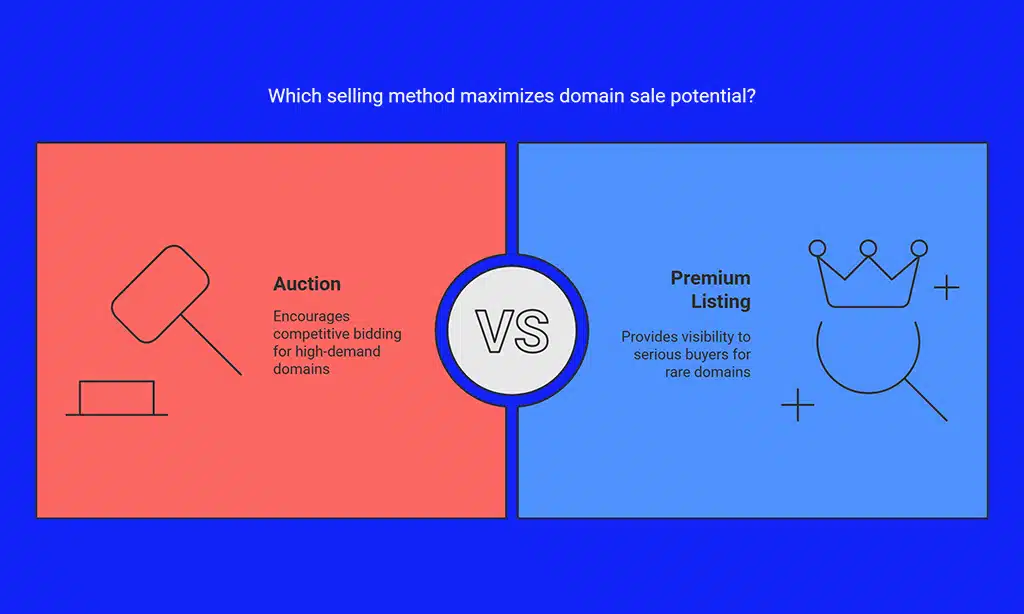
If you want to speed up the selling process, auctions and premium listings are excellent options. Auctions allow buyers to compete, potentially driving up the final sale price, while premium listings provide higher visibility to serious buyers. Platforms like Flippa, Sedo, and GoDaddy Auctions are ideal for these sales strategies.
Choosing Between Auction and Premium Listings
| Selling Method | Best For | Pros | Cons |
| Auction | High-demand domains | Potential for bidding wars, fast sale | No guarantee of high final price |
| Premium Listing | Rare and valuable domains | Exposure to serious buyers, premium pricing | Higher listing fees, slower process |
Real-World Case Study:
In 2021, the domain NFTs.com was sold for $15 million through an auction. The competitive bidding process attracted high-net-worth buyers who understood the domain’s value in the emerging NFT market.
Step 8 – Negotiate the Best Price Like a Pro
Negotiation is a crucial step in domain selling. Setting an initial price isn’t enough—you must be prepared to handle offers, counteroffers, and buyer objections. Understanding market demand, buyer psychology, and timing can help you maximize the sale price.
Key Domain Negotiation Strategies
| Strategy | Benefit |
| Start Higher Than Minimum | Leaves room for negotiation while setting value. |
| Use Sales Data | Reference similar sales to justify asking price. |
| Create a Sense of Urgency | Encourage quicker decision-making from buyers. |
| Be Willing to Walk Away | Shows confidence and prevents lowball offers. |
Negotiation Example:
A buyer offers $3,000 for your domain listed at $5,000. Instead of rejecting it outright, counter with $4,500, citing past sales of similar domains. If the buyer hesitates, offer $4,200 but emphasize a limited-time offer.
Step 9 – Secure the Transaction Using Escrow Services
Ensuring a secure transaction is critical to prevent fraud and disputes. Using escrow services guarantees both buyer and seller protection. These platforms hold the payment securely until the domain is successfully transferred.
Recommended Escrow Services
| Escrow Service | Features | Fees |
| Escrow.com | Trusted by major marketplaces | 3.25% – 6.5% |
| DAN.com | Integrated domain transfer | 5% – 9% |
| Payoneer Escrow | Supports international transactions | Varies |
How Escrow Transactions Work:
- Buyer and seller agree on a price.
- Buyer sends payment to escrow service.
- Seller transfers domain to the buyer.
- Escrow releases payment to the seller.
Step 10 – Transfer Ownership and Finalize the Sale
Once the payment is confirmed, you must transfer the domain to the buyer’s registrar. Ensuring a smooth transition builds trust and prevents post-sale issues.
Key Steps in Domain Transfer
| Step | Action |
| Unlock the Domain | Disable registrar lock to enable transfer. |
| Provide Authorization Code | Buyer uses the code to request a transfer. |
| Accept Transfer Request | Confirm the transfer from the new registrar. |
| Confirm Sale Completion | Notify escrow service and finalize the deal. |
Final Thought
A successful domain sale not only brings financial gains but also enhances your reputation in the domain investing community. By following these 10 steps, you can maximize the value of your domain sales while minimizing risks.
Each step is designed to help you attract the right buyers, negotiate effectively, and complete transactions securely.
Implementing these strategies consistently will improve your success rate and position you as a knowledgeable domain investor in the market.