

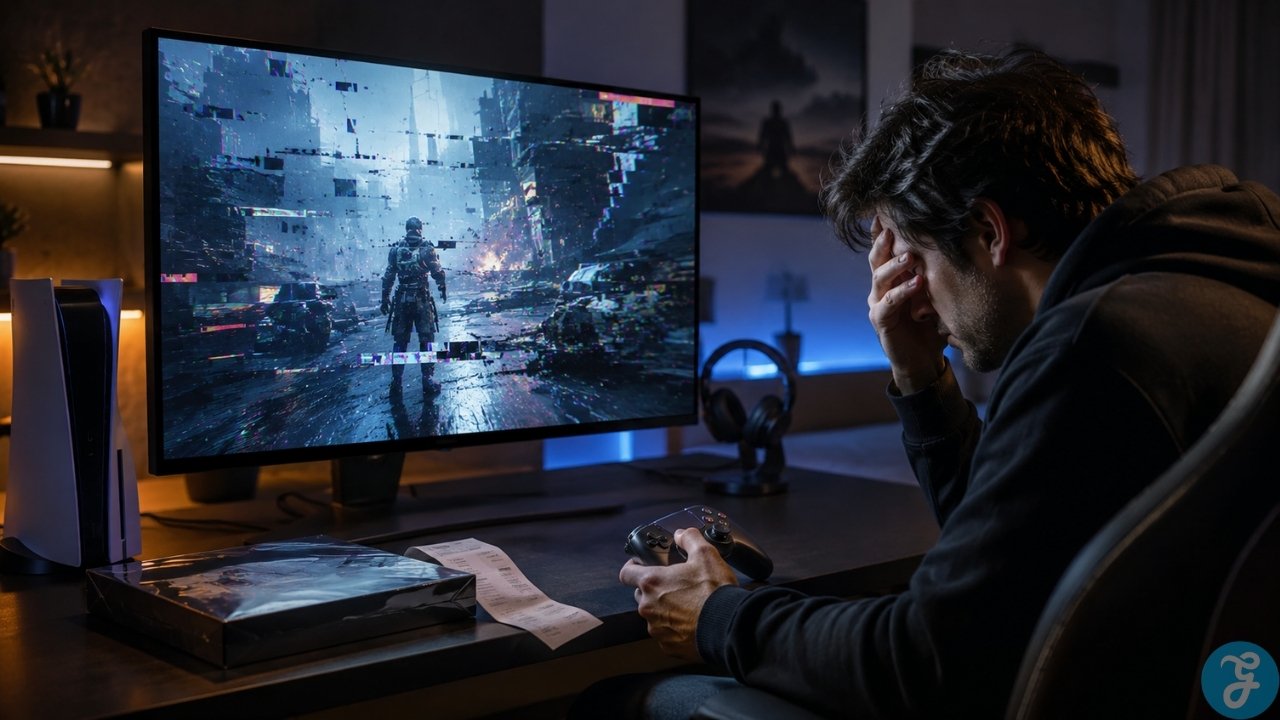
I am not against paying more for great games. Let’s get that out of the way before someone storms in wearing a collector’s edition helmet and starts defending billion-dollar publishers like they are endangered wildlife.
Some games earn the premium price. Some games launch polished, complete, confident, and respectful of the player’s time. Those games exist. They are the exceptions.
The problem is that most $70 game deals do not feel like deals at all. They feel like a tax on hype, a loyalty fee for trusting a trailer, and sometimes, if the publisher is feeling especially generous, a paid invitation to beta test a broken product on launch week.
The industry wants players to accept game price inflation as natural. Fine. Costs have gone up. Development is expensive. Teams are bigger. Hardware expectations are higher. I understand all of that. What I do not accept is being told that the base price must rise while the launch quality, content completeness, PC optimization, and respect for the buyer somehow remain optional.
That is not inflation. That is audacity with a checkout button.
The Problem With $70 Game Deals Is Trust, Not Math
The $70 standard did not appear out of nowhere. The current-generation price jump became visible around 2020, when next-gen versions of games like NBA 2K21 arrived at $69.99, with premium editions climbing higher. Microsoft later confirmed that new first-party Xbox games built for next-gen would launch at $69.99 starting in 2023. So yes, the industry moved the ceiling, and everyone was expected to nod politely.
But players are not angry because numbers changed. Players are angry because the deal changed.
A higher price should come with a higher standard. That is the part publishers keep pretending not to understand. If I pay more, I expect fewer launch-day disasters, not a 90 GB patch and a community manager telling me the team is “listening.” I expect better optimization, not a PC port that treats a high-end GPU like it personally offended the game engine. I expect a complete product, not a $70 skeleton wearing a roadmap as a disguise.
And yes, I know games are complicated. I know developers are under pressure. I know modern AAA production is a nightmare of scope creep, tech debt, shareholder expectations, marketing deadlines, and executives who probably think “performance mode” means a quarterly earnings call.
That is exactly why I do not blame the developers first.
I blame the system that ships unfinished games because the marketing calendar has more authority than the quality bar.
Cyberpunk Proved Why $70 Game Deals Can Feel Like a Scam
Cyberpunk 2077 is still the perfect wound to press on because I lived through that disappointment personally.
I pre-ordered it. My usual gaming buddies pre-ordered it too. We were not casual observers watching the chaos from a safe distance. We were ready. We planned to binge it for a month straight. We expected Night City to swallow our free time, destroy our sleep schedule, and become one of those gaming memories we would still talk about years later.
Well, we talked about it years later, just not for the reason CD Projekt Red probably wanted.
We barely had the patience to play more than six hours.
That was not because we hated ambitious RPGs. That was not because we had unrealistic expectations. We had expectations the marketing machine helped create. What we got at launch was a technical mess, especially for console players, with bugs, crashes, performance problems, and an overall sense that the game had been dragged across the finish line while still missing a shoe.
CD Projekt apologized for the state of the game on base last-generation consoles and pointed players toward refunds if they did not want to wait for fixes. Sony went further and removed Cyberpunk 2077 from the PlayStation Store while offering refunds, a rare and humiliating moment for a game of that scale.
That is not a normal bad launch. That is a historic industry-level faceplant.
And yes, Cyberpunk eventually improved. I am not blind. The game’s recovery is one of the more impressive redemption arcs in modern gaming, and Phantom Liberty plus years of updates helped turn the conversation around. But that does not erase the launch. It does not refund the hype. It does not give back the first month my friends and I had planned around a game that simply was not ready.
A game becoming good later does not make it acceptable to sell disappointment now.
That is the entire $70 game critique in one sentence.
Over-Hype and Under-Deliver Is Now a Business Model
The modern AAA cycle has become painfully predictable.
First comes the cinematic trailer that tells us almost nothing. Then the developer deep dive with carefully selected gameplay. Then previews from controlled builds. Then deluxe editions, early access bonuses, pre-order skins, battle passes, expansion passes, founder packs, and some tragic $99 version with “ultimate” in the name because apparently shame was patched out of the industry years ago.
Then launch day arrives.
Suddenly the same game that looked like the future of entertainment runs like it was assembled during a fire drill. Players find bugs in two hours that apparently escaped months of internal testing. PC users become unpaid diagnostics engineers. Console players argue over whether “quality mode” is just a polite way of saying “cinematic slideshow.” And the publisher posts the sacred ritual statement:
“We are aware of the issues.”
Of course you are aware. We paid you to become aware.
Cyberpunk is not alone here. Battlefield 2042 launched with enough missing features, bugs, and performance complaints to make long-time fans wonder if the game had forgotten what Battlefield was supposed to be. EA’s own post-launch update notes addressed large lists of fixes and quality-of-life issues soon after release.
Star Wars Jedi: Survivor had strong bones as a game, but its PC performance issues at launch were bad enough that Respawn publicly apologized and promised patches. Redfall became another cautionary tale, with Xbox chief Phil Spencer openly saying he was disappointed after its rocky launch.
This is the game pricing problem. Not that every expensive game is bad. Not that every launch is broken. Not that developers do not work hard.
The problem is that players are repeatedly asked to pay premium prices before publishers have earned premium trust.
The $70 Price Is Even Worse When the Game Still Wants More Money
The funniest part of the $70 debate is that publishers act like the base price exists in isolation.
It does not.
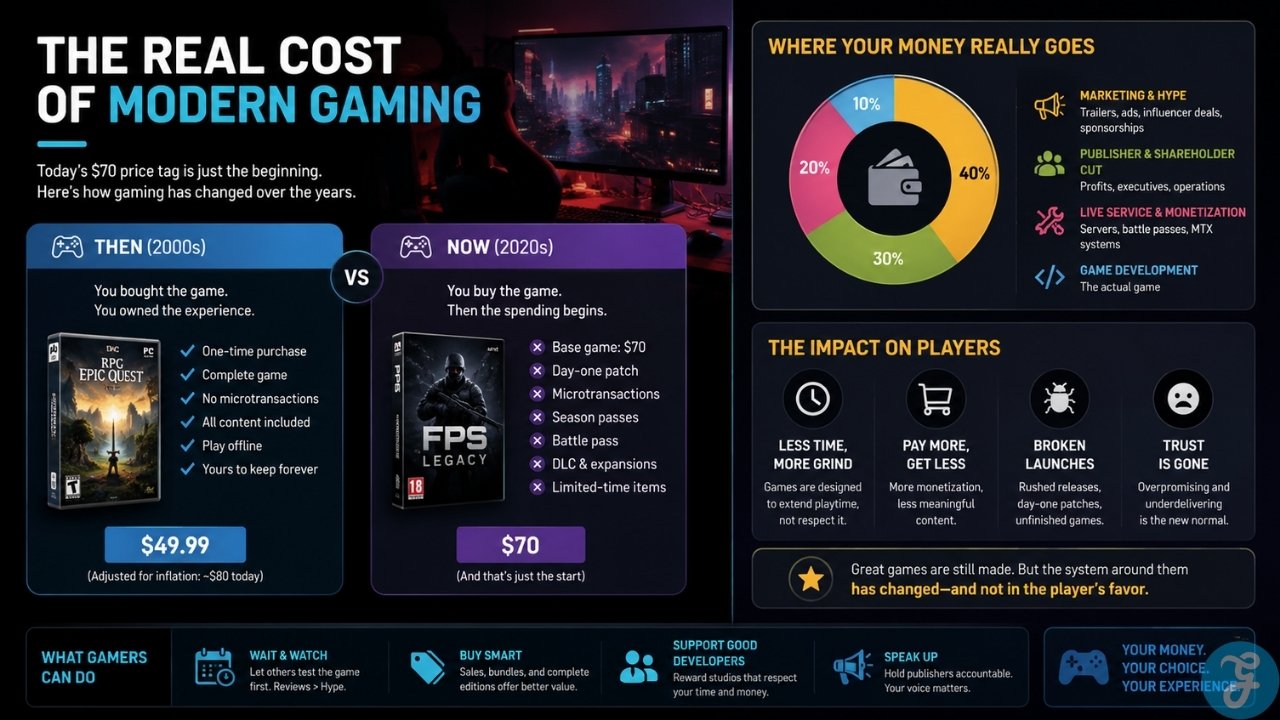
A lot of these games are not simply asking for $70. They are asking for $70, then selling a deluxe upgrade, then offering cosmetics, then launching a battle pass, then saving story content for paid DLC, then adding premium currency, then acting wounded when players ask why the “full game” has so many locked doors.
At that point, what exactly did the $70 buy?
The permission to enter the shop?
This is where the old argument about inflation becomes dishonest. If publishers only sold complete premium games with no extra monetization, the price debate would be cleaner. But the global games market is not some fragile little lemonade stand. Newzoo reported that the global games market reached $201.6 billion in 2025, while U.S. consumer spending on video game content reached $52.3 billion that same year.
So no, I am not going to cry into my controller because a publisher says development is expensive while the same industry has mastered battle passes, cosmetic stores, subscriptions, early access editions, and DLC pipelines.
The money is there. The question is whether the player gets value or just gets processed.
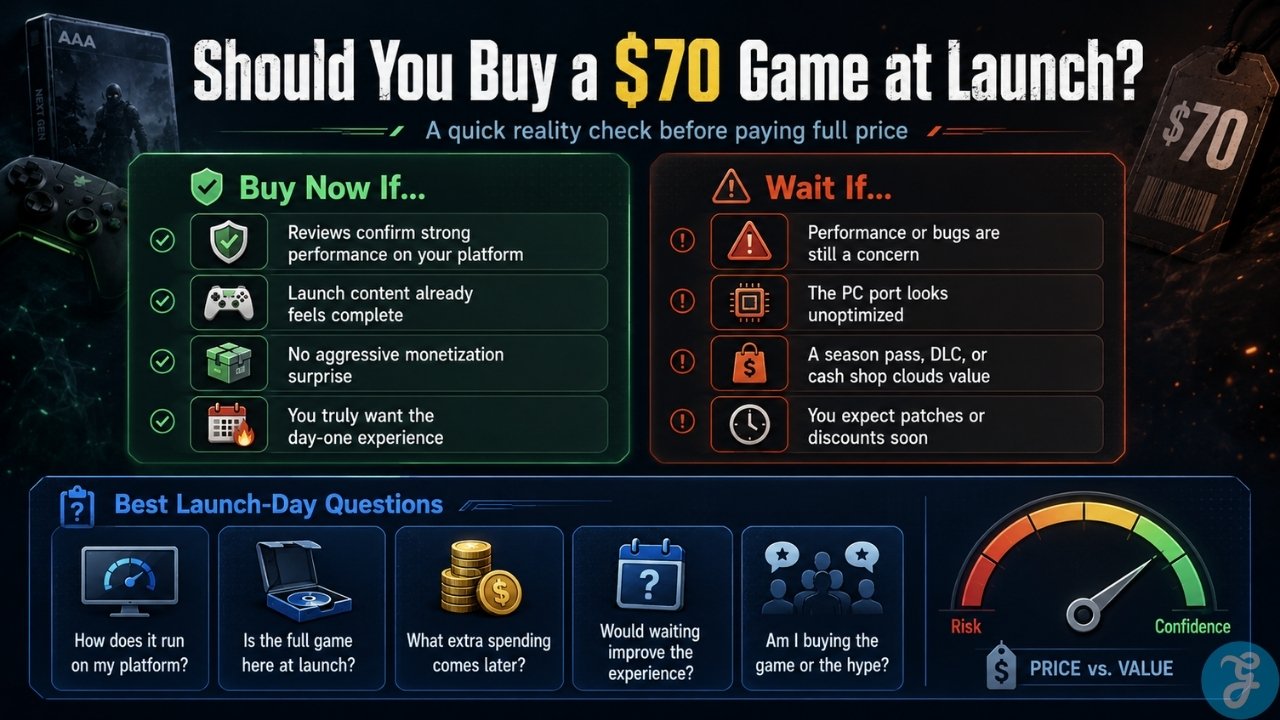
I Will Pay $70, But I Refuse to Pretend Every $70 Game Deserves It
This is where nuance matters, because I am not doing the lazy “all modern gaming is trash” routine.
Some games deserve the price. A polished, content-rich, complete game that respects the player can justify $70. I have no issue paying for quality. I have no issue paying for ambition. I have no issue paying for a game that clearly represents years of focused creative work and launches in a state that does not insult the audience.
The problem is that too many publishers want the benefit of premium pricing without the responsibility that should come with it.
If a game launches broken, it should not be priced like a finished masterpiece.
If the PC port stutters like a nervous intern giving a presentation, it should not be sold as a premium technical product.
If the best version of the game arrives six months later after patches, discounts, and community complaints, then the smart buyer was not the day-one supporter. The smart buyer was the patient gamer who waited.
And that is brutal, because day-one players are often the most loyal fans. They are the ones who believed. They followed the previews, watched the trailers, defended the delays, convinced friends to buy in, and gave the game the strongest possible launch momentum.
Then they are rewarded with disappointment and a patch schedule.
Fantastic. Very respectful. Truly next-gen.
Patient Gamers Are Winning Because the Industry Taught Them To Wait
The best $70 game deals usually happen after the hype has cooled down.
Wait six months and the game is often cheaper, patched, better optimized, bundled with extra content, and surrounded by honest player feedback instead of pre-release marketing fog. Wait a year and you might get the complete edition for less than the launch price. Wait longer and suddenly the “must-play day one” title becomes a 60 percent off weekend sale.
This is not because gamers are cheap. It is because gamers learned pattern recognition.
We learned that trailers are not proof. We learned that review embargoes matter. We learned that “day-one patch” can mean anything from small polish to emergency surgery. We learned that deluxe editions often exist to extract money before anyone knows whether the base game even works properly.
The industry created the patient gamer. Then it complains that players are waiting.
That is beautiful, in the same way a clown slipping on its own banana peel is beautiful.
The Real Game Pricing Problem Is Respect
The game pricing problem is not solved by arguing whether $60 or $70 is mathematically fair. That conversation misses the point.
Respect is the point.
Respect means showing real gameplay before launch. Respect means allowing reviewers enough time with the actual version players will buy. Respect means not hiding weak console performance behind selective PC coverage. Respect means launching a game when it is ready, not when the fiscal quarter needs a sacrifice. Respect means not selling three premium editions before proving the standard edition is worth owning.
Respect also means admitting that player trust has value.
Once trust is gone, no trailer fixes it. No roadmap fixes it. No apology post fixes it instantly. You can repair a game over time, but you cannot fully recreate the excitement players had before launch. Cyberpunk recovered as a product, but its launch still changed how many players think about pre-orders forever.
That is the part publishers never seem to price correctly.
The Price Can Go Up When the Respect Goes Up
So yes, there are exceptions. Some $70 games are worth it. Some developers deliver. Some studios still understand that a premium price should come with premium confidence.
But as a general rule, $70 game deals are mostly a bad deal because the industry keeps asking players to pay more while accepting less certainty, more monetization, and more launch-day risk.
I am not against expensive games.
I am against expensive excuses.
If a publisher wants $70, then give me a game that is complete, stable, honest, and worth buying before the apology letter. Give me a launch that does not need three emergency patches and a redemption arc. Give me a reason to trust the price instead of waiting for the inevitable discount and the “we heard your feedback” tour.
Until then, I will keep treating most $70 launches with suspicion.
Because apparently the real deluxe edition is the one that comes out a year later, works properly, includes more content, costs less, and does not require me to spend launch week pretending disappointment is part of the experience.





















