

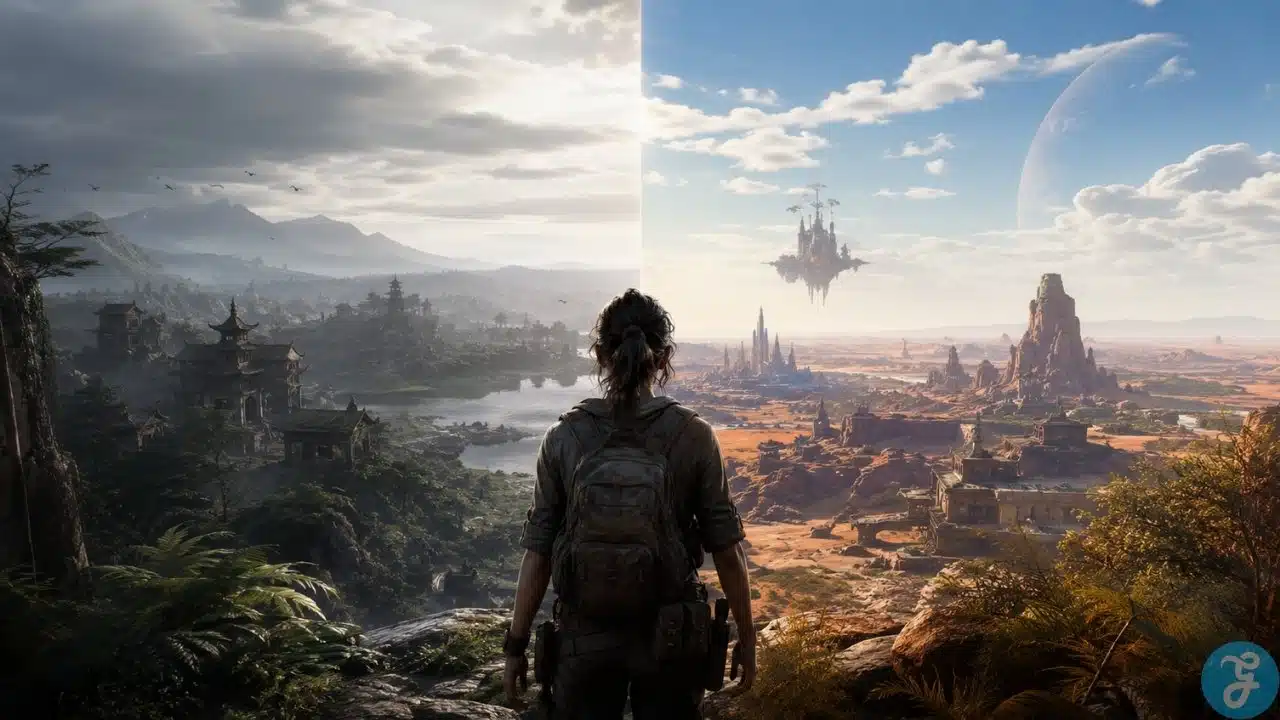
I don’t think AAA games look the same because developers ran out of imagination. I think they look the same because too many publishers have become terrified of the wrong kind of difference.
That matters because AAA games have never had more talent, more technology, or more money behind them. Studios can build massive worlds, capture tiny facial movements, fill cities with detail, and make combat feel smoother than ever. Yet a lot of big-budget games still leave me with the same strange feeling: I’ve seen this shape before.
Not the exact story. Not the exact world. The shape.
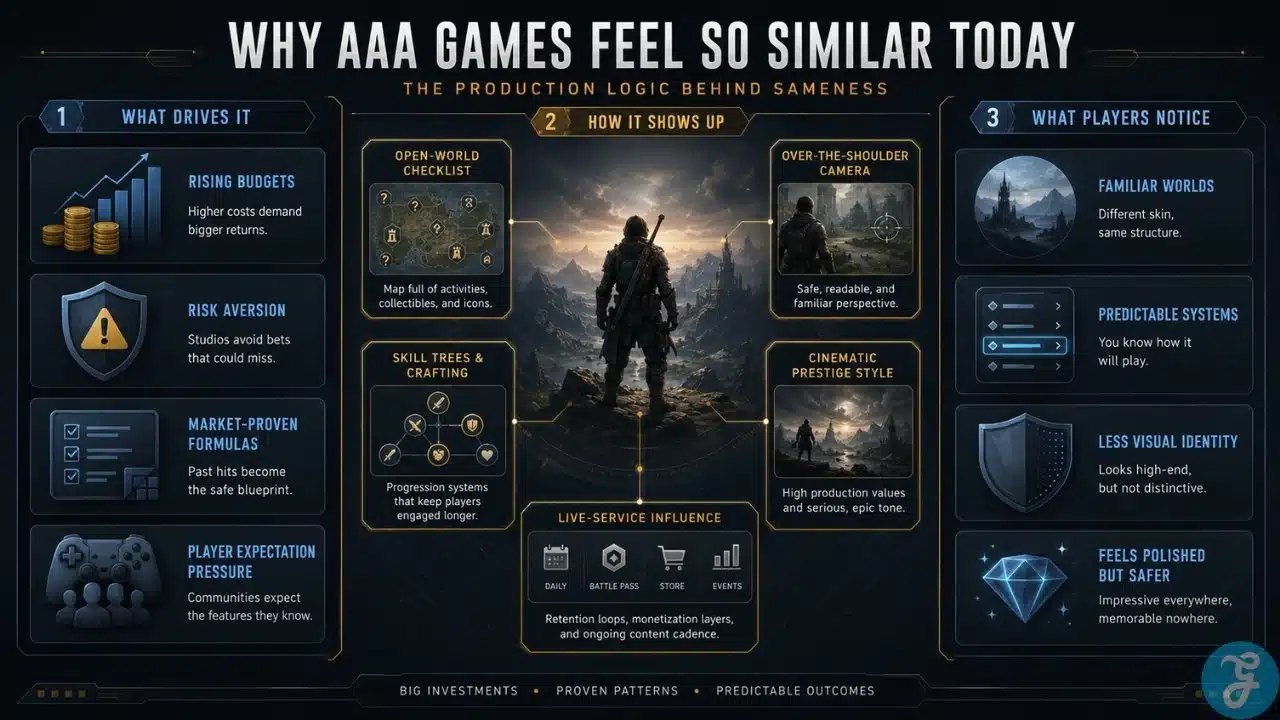
The over-the-shoulder camera. The cinematic walking sections. The serious protagonist. The open-world map that turns discovery into errands. The skill tree that adds small upgrades because every big game seems to need one now. The crafting, scanning, collecting, clearing, unlocking, and upgrading. Different worlds, same production logic.
That’s why AAA games look the same now. The sameness isn’t just visual. It’s structural. It comes from big budgets, risk-averse decision-making, market-tested formulas, and a business model that keeps rewarding familiar design over sharper creative identity.
The issue isn’t that modern AAA games are all bad. Many are polished, generous, technically impressive, and full of talented work. The issue is that too many of them feel assembled from the same approved kit.
I don’t look at this and think developers forgot how to be creative. I think the business around AAA games has become so expensive and nervous that originality keeps getting treated like a liability.
And once that happens, “If it ain’t broke, why fix it?” stops being practical advice. It becomes the reason everything starts blending together.
The Sameness Starts After the Screenshot
A lot of modern AAA games chase the same expensive version of realism: wet rocks, tired faces, dramatic forests, ruined cities, dusty light shafts, leather straps, muddy boots, cinematic fog, and the kind of lighting that makes every abandoned room look art-directed for a trailer. That style can be gorgeous. I’m not pretending otherwise. Plenty of these games look stunning on a good screen.
But visual realism alone doesn’t explain why so many games feel interchangeable.
A realistic game can still have a strong identity. Red Dead Redemption 2 doesn’t feel like The Last of Us. Alan Wake 2 doesn’t feel like Call of Duty. Death Stranding doesn’t feel like Horizon. Even when games share high-end production values, they can still carry a distinct mood, pace, and design philosophy.
The deeper problem begins when the game starts asking me to do the same things in the same way.
I climb. I scan. I crouch. I follow footprints. I gather plants. I craft a pouch upgrade. I unlock a fast-travel point. I clear a hostile camp. I open a menu full of small percentage improvements. I collect parts for a weapon I’ll replace anyway. I sit through a cinematic walk-and-talk section where the game doesn’t quite trust me to be alone with the world.
None of those mechanics are automatically bad. A skill tree can be satisfying. A map can help. Crafting can make sense in the right game. Companion dialogue can add warmth. The problem is placement. Too often, these systems feel included because the game needs to meet the expected AAA shape, not because the fantasy demands them.
That’s the part that wears me down. It isn’t one feature. It’s the rhythm.
Polish Isn’t Personality
I respect polish. I know how much invisible work goes into making a big game feel smooth. Clean animation blending, readable combat, stable traversal, responsive menus, good checkpointing, proper difficulty tuning, readable lighting, strong sound design, and a camera that doesn’t fight the player all matter. When those things fail, players complain immediately.
What bothers me is the way polish has become a substitute for personality. A game can have flawless transitions, expensive cutscenes, detailed environments, and beautifully acted dialogue while still feeling creatively limited. That phrase matters to me. “Creatively safe” sounds almost polite. “Creatively limited” gets closer to the real issue.
Some AAA games now feel designed to avoid rejection more than to create obsession.
The Approved AAA Shape
I can almost feel the checklist forming.
The combat needs melee, ranged options, stealth, crafting, light RPG progression, and maybe elemental effects. The world needs main quests, side quests, collectibles, enemy camps, upgrade materials, lore entries, puzzles, cosmetics, and enough icons to make the map look valuable. The hero needs a serious arc. The camera needs intimacy. The menus need enough tabs to prove the game has depth.
That doesn’t always make a bad game. Sometimes the formula still produces something strong. But when I can predict the design skeleton this early, the game has already lost some of its power.
A confident game can leave things out. It can decide the player won’t craft, won’t climb, won’t have a giant map, or won’t unlock fifty minor stat boosts. It can risk someone saying, “I wish there were more systems,” because it knows what kind of experience it’s trying to be.
AAA rarely gets that freedom anymore. The bigger the budget, the more the game seems pressured to justify itself through quantity.
The Budget Gets a Vote
This is the central reason why AAA games look the same now: the money has become too large for publishers to treat risk casually.
A major AAA game isn’t just a creative release. It’s a production pipeline, a marketing campaign, a platform relationship, a shareholder expectation, a licensing conversation, a merchandising opportunity, a subscription asset, a possible franchise starter, and sometimes a live-service bet. By the time a game reaches that scale, originality has to pass through people whose job isn’t always to protect the weirdest idea in the room.
I’m not saying every executive is a villain twirling a mustache over a spreadsheet. The reality is more boring and more powerful. Big companies learn from what worked. They repeat structures that feel safe. They ask for comparisons. They want predictable audiences. They want trailers that explain the product quickly. They want features they can list. They want retention. They want broad appeal.
That pressure doesn’t kill creativity in one dramatic moment. It usually happens through small, reasonable decisions.
A strange mechanic becomes easier to understand. A sparse world gets more activities. A quiet game gets more dialogue. A risky art style becomes more realistic. A focused combat system gets RPG layers. A clean map gets more icons. A single-player game gets progression loops that feel borrowed from live-service design because someone, somewhere, wants players to stay longer.
The final game may still be good. It may even be excellent. But I can often feel the compromises.
The brutal part is that the “If it ain’t broke” logic works in the short term. Familiar design lowers friction. Players understand it quickly. Reviewers can explain it easily. Marketing can package it neatly. Investors can see the resemblance to past success. A game that feels like five other successful games may look safer than a game that needs players to learn a new language.
That’s the trap. The same thinking that protects the budget also makes the game easier to forget.
Realism Became the Default Costume for Prestige
I don’t hate realism in games. I love it when it has purpose. A grounded art style can make violence feel heavier, landscapes feel harsher, and characters feel more vulnerable. Realism can serve tone beautifully.
The problem begins when realism becomes the automatic costume for “serious” AAA work.
Too many big-budget games seem afraid to look strange. They chase believable skin, believable fabric, believable mud, believable ruins, believable lighting, believable foliage, believable everything. The result is often impressive. It also narrows the imagination. If every game wants to be believable in the same way, the visual range collapses.
I miss when more big games looked aggressively like themselves.
A strong silhouette can matter more than perfect pores. A bold color palette can do more for memory than another photorealistic rock wall. A stylized world can age better than a realistic one that gets outclassed by the next hardware cycle. Some of the most memorable games in history aren’t remembered because they were the most technically realistic. They’re remembered because nobody else looked like them.
Modern AAA sometimes forgets that.
The Unreal Engine debate usually gets dragged into this conversation, and I understand why. When many studios use similar tools, similar rendering features, similar asset workflows, and similar marketplace habits, some games can start to share a certain sheen. Tooling influences taste. Pipelines shape outcomes.
But I don’t buy the lazy version of the argument that Unreal Engine is the villain. An engine isn’t a creative director. It doesn’t force a studio to build another moody, realistic, over-the-shoulder action game with wet surfaces and familiar lighting. The tool can make certain choices easier, but the sameness comes from what studios choose to reward.
If every publisher asks for the same expensive mood, even powerful tools will keep producing familiar results.
The Map Tells on the Game
I judge a lot of modern AAA games by the moment I open the map.
If I open it and immediately know the next thirty hours, the game has already given too much away. I can see the enemy camps. I can see the upgrade nodes. I can see the collectible zones. I can see the side activities. I can see the fast-travel structure. I can already predict the loop: clear this, loot that, upgrade this, reveal that, repeat until the region turns clean.
That isn’t exploration. That’s administration.
I don’t want to turn this into lazy Ubisoft-bashing, because the Ubisoft-style open-world pattern became popular for a reason. It gives players direction. It gives teams a structure they can build at scale. It makes a giant world easier to manage. It creates a steady flow of small rewards. It also helps marketing, because a huge map full of activities looks like value.
The pattern isn’t useless. It’s just everywhere.
When a World Starts Feeling Like a Content Board
Once that structure spreads across the industry, open worlds start to feel less like places and more like content boards. The mountain isn’t a mountain. It’s a route to a marker. The village isn’t a village. It’s a vendor, a quest giver, and maybe a collectible. The enemy base isn’t a tactical space with its own story. It’s the third camp in the region, with a slightly different layout and the same reward logic.
I can still enjoy this. That’s the annoying part. Clearing a well-designed outpost can be fun. Watching a map become manageable scratches the brain in a very obvious way. But fun and fresh aren’t the same thing.
AAA has become extremely good at giving me things to do. It’s less consistent at making those things feel worth remembering.
The Cinematic Third-Person Trend Has Become a Template
I’m not against cinematic third-person action games. Some of my favorite modern games live in that space. Strong performances, intimate camera work, heavy animation, grounded combat, companion relationships, and big set pieces can create powerful moments.
But I can admit when something good becomes a trend.
The Sony-style prestige action-adventure format has influenced the wider industry. I don’t mean every game is copying one studio directly. I mean a certain language has become shorthand for “premium”: close third-person camera, emotional protagonist, guided traversal, companion dialogue, environmental puzzles, cinematic combat, quiet walking sections, dramatic cutscenes, and a story that wants to feel mature through grief, trauma, parenthood, revenge, survival, or legacy.
There’s nothing wrong with those themes. There’s something limiting about treating them as the default costume for seriousness.
Games don’t need to look like prestige television to be mature. They don’t need sad dads, whispered dialogue, grounded violence, and a shoulder camera to prove they have artistic value. They can be weird, mechanical, colorful, ugly, abstract, funny, lonely, tactical, systemic, or openly ridiculous. They can be mature through design, not just through facial animation and expensive dialogue scenes.
I like cinematic games when the form fits the idea. I get tired when the form becomes an industry aspiration.
There’s also a pacing issue. Too many big games now fear silence. They fill traversal with chatter. They soften downtime with banter. They guide the eye with paint, markers, button prompts, and constant little nudges. They rarely let the player feel lost for long.
Sometimes I want the game to shut up and let the world breathe.
That doesn’t mean I want bad navigation or empty walking. It means I want trust. Trust me to notice. Trust me to miss something. Trust me to sit with the space. Trust me to learn the environment without turning every ledge into a glowing instruction.
Live-Service Thinking Leaked Into Places It Didn’t Belong
I use “affected” deliberately when I talk about live-service design. I don’t think live-service games automatically ruin anything. Some live-service titles understand their audience, support long-term mastery, and build real communities. A good one can become a hobby, not just a product.
The issue is what happens when that thinking leaks into games that don’t need it.
I see it in menus that feel like dashboards. I see it in reward tracks, currencies, gear scores, daily-style tasks, timed content, cosmetic economies, challenge tabs, and progression systems that seem designed to keep me checking in rather than deepen the core play. Even when a game isn’t fully live-service, it can still carry that smell.
A single-player game shouldn’t always feel like it wants a long-term engagement strategy.
Some games need endings. Some mechanics need limits. Some worlds are better when they don’t become platforms. A tightly designed game can respect my time in a way a bloated one rarely does. It can make one weapon matter. It can make one area memorable. It can let a story end before I resent the map.
I think players are starting to feel this more clearly. When a game arrives with a focused campaign, a strong identity, no exhausting checklist, and no obvious attempt to turn my attention into a subscription-style habit, it feels refreshing. Not because it’s old-fashioned. Because it’s confident.
AAA often mistakes retention for attachment. They’re not the same. I may spend sixty hours in a game because the systems keep feeding me small rewards. That doesn’t mean I care about it. It may just mean the machine is well tuned.
Menus Have Become Confession Booths
A game’s menu often tells me what kind of design meeting happened behind it.
Some menus feel like they belong to the world. They have mood, restraint, and purpose. Others feel like someone kept adding tabs because every department needed its system represented.
Map. Inventory. Skills. Crafting. Quests. Codex. Challenges. Collections. Cosmetics. Store. Events. Social. Loadout. Upgrades. Tutorials. News.
I don’t need every game to have a minimalist interface. Big games need organization. Players need clarity. Accessibility matters. A bad UI can bury a good game.
But there’s a difference between clarity and product sprawl.
A lot of modern AAA UI makes me feel like I’m managing an account, not inhabiting a world. The game pulls me from a dramatic scene into a screen full of currencies, percentages, rarity colors, upgrade paths, tracked challenges, and blinking reminders. It turns play into maintenance.
That’s part of why the sameness feels so strong. The games may have different settings, but their interfaces train me to think the same way.
Optimize. Track. Compare. Complete. Upgrade. Claim. Clear.
After a while, the fantasy becomes secondary to the checklist.
Indie and AA Games Feel Sharper Because They Choose Harder
I don’t worship indie games as if they’re automatically brave. Smaller games copy trends too. I’ve seen enough familiar roguelikes, cozy farming loops, retro shooters, deckbuilders, survival crafting games, and pixel-art nostalgia plays to know that imitation exists everywhere.
But indie and AA games often have one advantage AAA has slowly lost: they can’t afford to be everything.
That limitation forces identity. A smaller game needs a strong hook, a clear mood, a smart mechanic, a striking art style, or a specific audience. It can’t win by having the most realistic skin shader or the largest open world. It has to choose something and commit.
That commitment matters.
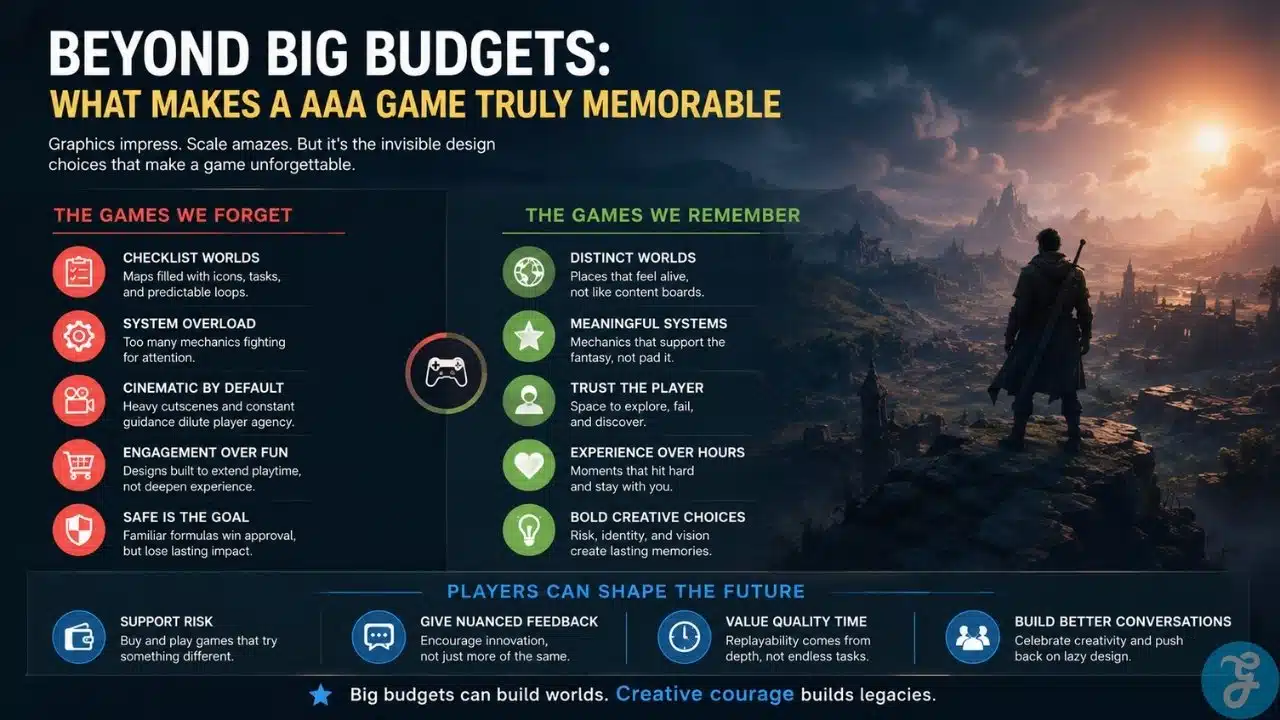
A game with one sharp idea can stay with me longer than a giant production carrying twenty safe ideas. A strange camera angle, a harsh rule, a limited inventory, a bold color scheme, a weird combat rhythm, or a writing voice with actual teeth can do more for memory than another hundred map markers.
Smaller games often keep their edges because they need those edges to survive. AAA often removes edges because edges create risk.
That’s backward. The edges are usually what I remember.
I don’t want AAA games to become indie games. I like big games. I like spectacle. I like high production values when they serve something. But I want big games to recover the courage to choose. A large budget should make a game more capable, not more afraid.
I Don’t Blame the People Building the Worlds
I keep coming back to this because it matters: I don’t think the artists, designers, writers, animators, programmers, level designers, sound teams, QA testers, and production staff are the reason AAA games feel similar.
Many of them probably see the issue more clearly than players do. They spend years inside these projects. They know when a mechanic has been softened, when a system has been added late, when an art direction has been pulled toward safer references, when a strange idea has been made more marketable, and when a game has become heavier than it needed to be.
Large production is brutal because every bold choice has consequences. A risky mechanic can break tutorials. A weird art style can complicate marketing. A sparse map can make people question value. A shorter campaign can trigger complaints. A strange structure can confuse preview coverage. A dramatic change to a franchise can anger the same audience asking for innovation.
So the safe version wins.
Not always. Some bold ideas survive. Some AAA games still feel distinct. But too often the machine takes a specific concept and slowly rounds it into something easier to sell.
That’s why this conversation shouldn’t become developer-bashing. The better target is the system that keeps treating originality as a budget threat.
Players Helped Build the Cage Too
I can’t put all of this on publishers and pretend players have clean hands.
Players say they want originality, then often punish it when it arrives in an uncomfortable shape. We complain about bloated games, then measure value by hours. We mock recycled formulas, then panic when a familiar franchise changes too much. We say we want innovation, but we also want the comfort of knowing exactly what kind of game we’re buying.
I understand the contradiction because I feel it too.
A familiar AAA game can be relaxing. I know what I’m getting. I know the controls will probably make sense. I know the map will guide me. I know the upgrade systems will feed me. I know the combat will have a rhythm I can learn quickly. Familiarity isn’t always a dirty word.
But if players only reward comfort, publishers will keep selling comfort at premium prices.
That’s why I try to be careful with my own criticism. I can’t demand risk and then reject every rough edge. I can’t ask for shorter, sharper games and then complain that they’re not 80 hours long. I can’t ask studios to surprise me and then expect every surprise to fit my existing taste.
If AAA games are going to become less same, players have to give them room to disappoint someone.
A game with a real identity won’t please everyone. That’s part of the point.
More Budget Should Mean More Nerve, Not More Padding
The most frustrating part is that AAA has never had more technical power.
Studios can build enormous worlds, detailed characters, complex animation systems, dense soundscapes, reactive combat, film-quality performances, and environments packed with tiny touches most players will never consciously notice. The craft is often incredible. I don’t want to dismiss that work.
But a bigger budget doesn’t automatically create a stronger game.
Sometimes it creates pressure to add more of everything:
- More quests.
- More collectibles.
- More biomes.
- More cutscenes.
- More skill branches.
- More gear.
- More crafting ingredients.
- More traversal tools.
- More map layers.
- More side systems.
- More ways to prove that the game is worth the asking price.
I’ve reached a point where “more” doesn’t impress me by itself.
Give me a world with fewer icons if the places mean more. Give me a smaller weapon list if each weapon changes how I think. Give me a shorter campaign if the pacing doesn’t sag. Give me one progression system that belongs to the fantasy instead of five systems that feel imported from a genre spreadsheet.
AAA needs to rediscover restraint. Not as a way to make games cheaper, but as a way to make them clearer.
A game doesn’t become memorable because it never stops giving me things. It becomes memorable because the right things hit hard.
What I Want From AAA Now
I want more big games to stop defaulting to the same expensive realism. Some should be ugly on purpose. Some should be colorful. Some should be surreal. Some should chase strong shapes instead of perfect materials. Some should understand that art direction isn’t a downgrade from realism.
Open worlds need to stop confessing everything through the map. Let me read the landscape. Let me miss things. Let the world hide. Let a mountain be a mountain before it becomes a route to an upgrade material.
Fewer systems would help too. If crafting doesn’t deepen the fantasy, cut it. If the skill tree only gives me tiny percentage bumps, make progression simpler. If collectibles exist only to fill space, I’d rather have less space.
Cinematic games need to remember that cinema isn’t the only path to maturity. Mechanics can be mature. Systems can be mature. Silence can be mature. A strange rule can say more about a world than another close-up of a tired face.
Live-service ideas belong where they actually serve the game, not everywhere. A reward track isn’t a personality. A currency tab isn’t depth. A daily loop isn’t a reason to care.
Mostly, I want AAA publishers to stop acting as if players can’t handle sharper choices.
Some players will complain. They always do. Some will say the game is too short, too weird, too slow, too hard, too focused, too different, or not enough like the last one. That can’t be the only voice publishers listen to. If every decision is made to avoid the loudest complaint, the result will keep feeling like a premium product with no pulse.
Expensive Shouldn’t Mean Interchangeable
I still care about AAA games. If I didn’t, I wouldn’t be this frustrated.
I know what the format can do when the money, talent, technology, and creative direction actually line up. Great AAA games can dominate my attention in a way few other entertainment products can. It can build a world I want to live in, deliver spectacle with weight, and combine art, sound, systems, performance, and play into something only games can do.
That’s why the sameness feels like such a waste.
My answer to why AAA games look the same isn’t that developers lack imagination. It isn’t that engines ruined art. It isn’t that players hate originality. Those answers are easy, and they’re too small.
I think AAA games look the same because the business model rewards the familiar before it rewards the strange, specific, and risky. Big budgets create fear. Fear creates templates. Templates create games that are polished enough to impress me and familiar enough to leave my memory almost immediately.
That’s the part I want the industry to take seriously.
I don’t need every AAA game to reinvent the medium. I don’t need every release to be experimental, strange, or risky for the sake of it. I just want more of them to feel impossible to mistake for anything else.
A great AAA game shouldn’t feel like a luxury checklist.
It should feel like someone made a choice and stuck with it.
That’s what I want from AAA now. Use the scale for something I can actually remember. Give me polish, yes, but give me a point of view with it. I’m tired of big games that look expensive and feel pre-approved.





















