


As we have marked another International Workers’ Day, the world stands at a critical crossroads. From the mega-corporate boardrooms of Silicon Valley to the garment factories in Bangladesh, the promise of workers’ rights has never been more visible—and yet, more elusive.
In recent years, global conversations around fair wages, unionization, gig economy protections, and workplace equity have taken center stage. The International Labour Organization (ILO) has consistently emphasized the importance of “decent work for all.” But beyond headlines and hashtags, the question remains: Are we truly progressing—or merely pretending?
This article takes a deep dive into the state of workers’ rights in 2025, exploring regional realities, tech disruptions, grassroots movements, and global contradictions. We’ll uncover what has changed, what hasn’t, and who’s still left behind in the modern workforce.
A Decade of Declarations: Have We Moved Forward?

Over the past ten years, we’ve seen an explosion in labor pledges from governments and corporations alike. Global institutions like the International Labour Organization (ILO), World Economic Forum, and UN Sustainable Development Goals have repeatedly emphasized the importance of “decent work for all.” Governments have announced minimum wage hikes, multinational brands have signed fair labor codes, and tech platforms have vowed to protect gig workers.
But promises don’t always equal progress.
In countries like India and Nigeria, new minimum wage laws were introduced with great fanfare—yet inflation and poor enforcement made them nearly meaningless. In the U.S., federal wage legislation has remained stagnant since 2009, with states patching the gap inconsistently. And while Bangladesh saw a wage increase in its garment sector, it still falls far below a living wage.
A truly fair labor system must go beyond economics. Dignity at work includes safety, rights to organize, sick leave, maternity protections, and freedom from harassment. In this regard, global progress remains deeply uneven.
Tracking the Metrics: Global Labor Index Trends
Every year, the International Trade Union Confederation (ITUC) publishes the Global Rights Index, scoring countries on workers’ freedoms. In the latest 2025 report:
-
85% of countries violated the right to strike
-
79% restricted collective bargaining
-
43 trade unionists were murdered in the past 12 months
-
Only 7 countries (including Germany, Uruguay, and Norway) offered complete worker protections
Meanwhile, global platforms like Uber, Amazon, and Shein continue operating in legal gray zones, leveraging independent contractor loopholes to avoid accountability. The illusion of progress often hides behind glossy ESG reports.
Region-by-Region: Workers’ Rights Around the World
Here we will look into how different corners of the world are faring in 2025’s labor landscape.
North America: A Tale of Two Realities
In the United States, the labor scene is undergoing a quiet revolution. After decades of decline, union activity is surging—from Amazon warehouse walkouts to Hollywood’s joint WGA-SAG strikes. In 2024, union membership among millennials jumped by 10%, according to Pew Research.
Yet, the gig economy remains a legal limbo. Uber drivers and DoorDash couriers still lack access to paid leave, health insurance, or retirement benefits in most states. California’s Prop 22 was partially struck down, but enforcement remains inconsistent.
Canada, by contrast, has made notable progress. The federal government’s right-to-disconnect law protects workers from after-hours digital burnout. Meanwhile, minimum wage adjustments are being indexed to inflation in several provinces.
Europe: Progressive Yet Pressured
Europe leads in formal labor protections—but not without friction. Countries like Germany, France, and the Netherlands have expanded paid parental leave and are piloting four-day workweeks with promising results.
But tensions simmer beneath the surface. In Eastern Europe, workers in sectors like construction and hospitality often fall outside union coverage or work informally. The influx of Ukrainian refugees has also created labor tensions, with exploitation risks rising.
Meanwhile, protests in France and the UK over pension reforms and inflation-driven wage stagnation show that even “worker-friendly” countries aren’t immune to unrest.
Asia: Fast Growth, Fragile Rights
Asia is home to both the world’s fastest-growing economies and some of its most fragile labor systems.
In India, recent labor code reforms aimed to simplify protections, but critics argue they water down worker power. In Bangladesh, the garment sector—employing over 4 million people—still faces unsafe conditions, despite improvements since Rana Plaza.
China has made tech-focused upskilling a national priority, yet independent unions remain banned, and factory workers report widespread surveillance and forced overtime, especially in the electronics sector.
Middle East: Reform vs. Reality
Gulf countries have made headlines for labor reforms, particularly Qatar, which scrapped the controversial Kafala system before hosting the FIFA World Cup. The UAE introduced new labor protections for domestic and gig workers in 2024.
Yet on the ground, migrant workers—especially from South Asia—continue to face wage theft, unsafe housing, and restricted mobility. Enforcement remains the Achilles heel of reform.
Africa & Latin America: Progress Shadowed by Instability
In Kenya, digital platforms like Ajira and WorkPay are formalizing freelance labor. South Africa has expanded labor courts to rural areas, boosting access to justice.
But in countries like Zimbabwe, Haiti, and Venezuela, economic collapse and political instability have made workers’ rights nearly impossible to uphold. Informal labor dominates the economy, and organized protests are often met with violence.
Brazil and Colombia, meanwhile, are seeing a resurgence of labor activism, with new labor ministers pushing for comprehensive reform.
Broken Promises: Where the Global System Fails Workers
Walk into any major retail store today, and you’ll likely see tags that boast “ethically sourced,” “fair trade,” or “sustainably made.” But what lies behind these labels?
The Myth of Ethical Sourcing
Investigations from watchdogs like Human Rights Watch and Clean Clothes Campaign reveal a troubling truth: many supply chains still rely on underpaid, overworked, and unsafe labor, particularly in countries like Bangladesh, Vietnam, and Ethiopia. Workers often make less than $2 per day, face illegal overtime hours, and lack collective bargaining rights.
For example, a 2024 audit found that several global fashion brands—including some known for sustainability—sourced from factories with documented child labor and verbal abuse. These companies released PR statements, but little changed on the ground.
Migrant Labor: From Opportunity to Exploitation
For millions of migrant workers, especially from the Global South, going abroad is a matter of survival. But too often, their dreams are crushed by harsh labor systems, abusive employers, and exploitative contracts.
In 2025, the Gulf region, Southeast Asia, and parts of Europe still exploit foreign labor through legal loopholes and weak protections. Migrant domestic workers, in particular, report long hours, withheld wages, and even physical abuse.
Take the case of Sabiha, a domestic worker from the Philippines employed in Lebanon:
“I worked 16 hours a day with no days off for 3 years. My employer kept my passport. I had no way to leave.”
Migrant workers contribute billions in remittances to their home economies—but face second-class treatment in their host nations.
Women and Informal Workers: The Forgotten Majority
Globally, over 60% of all workers operate in the informal economy—without contracts, benefits, or legal protection. Women make up the majority of this segment, often as caregivers, street vendors, domestic helpers, or agricultural laborers.
Despite their economic contributions, women in informal work are invisible to labor law, exposed to harassment, low pay, and zero recourse. COVID-19 deepened these inequalities, and recovery has been uneven.
In Latin America and sub-Saharan Africa, local women-led cooperatives are stepping in to offer community-based protections—but state support remains minimal.
Automation & AI: Threat or Liberation?
From robot arms on factory floors to chatbots replacing customer service agents, technology is reshaping labor at breakneck speed. By 2025, AI tools and robotic automation have eliminated thousands of routine jobs globally, especially in manufacturing, logistics, and retail.
In countries like Japan, South Korea, and Germany, automation was anticipated and integrated with strong social safety nets. But in the Global South, many workers are being displaced without retraining programs or income support.
While some tech leaders promote automation as a way to eliminate “dangerous and boring” tasks, for many workers, it simply means unemployment.
Algorithmic Bosses and the Gig Economy
For the millions working in delivery, rideshare, content moderation, or freelancing, the boss isn’t a person—it’s an algorithm.
Platforms like Uber, Fiverr, and Glovo assign work, track performance, and even issue warnings through AI systems. Workers can be suspended or de-platformed with no human appeal process.
These “independent contractors” lack benefits, pensions, or job security, even though they work full-time hours. Legal fights over gig worker classification are raging from California to India, and while a few court victories have reclassified workers as employees, big tech platforms continue lobbying to maintain the status quo.
In Spain, the 2023 “Rider Law” forced delivery companies to hire their riders as employees. In contrast, the U.S. continues to wrestle with Prop 22 and fragmented gig labor laws.
The Way Forward: Rethinking Workers’ Rights in a Changing World
What must change to ensure workers are not left behind in the global future of labor?
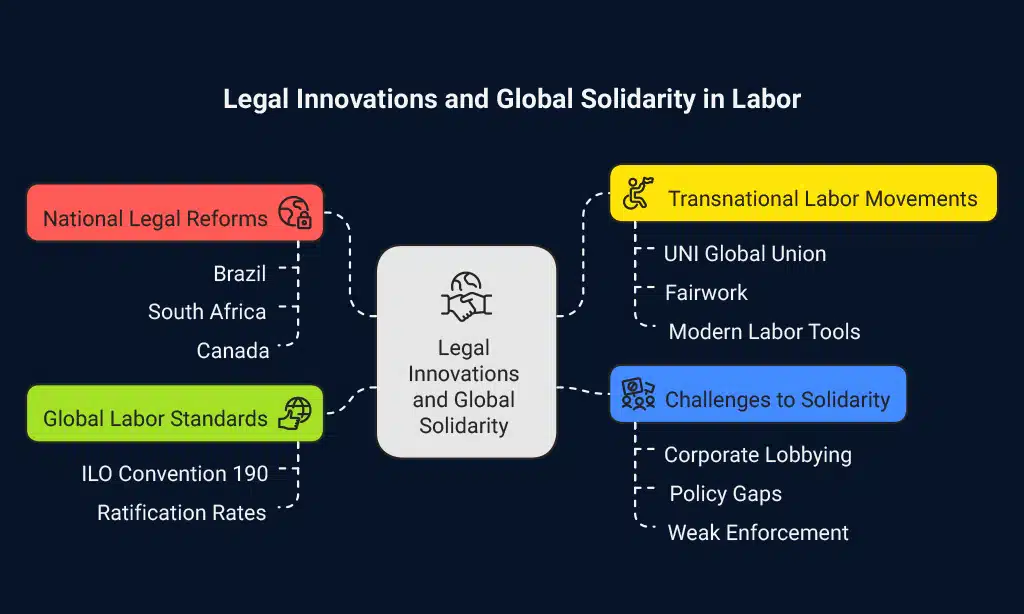
Legal Innovations and Global Solidarity
As the labor landscape evolves, some countries are taking bold steps to redefine protection frameworks:
-
Brazil is pushing new legislation to formalize domestic and gig workers, granting health benefits and pensions.
-
South Africa recently expanded legal aid for rural laborers facing wage theft.
-
Canada is experimenting with a portable benefits platform, allowing gig workers to carry healthcare and retirement savings across jobs.
On a global scale, the International Labour Organization (ILO) is urging member states to ratify Convention 190 on violence and harassment in the workplace—yet as of 2025, less than 35% of nations have done so.
Transnational labor movements are also gaining traction. Organizations like UNI Global Union and Fairwork are partnering with local unions to enforce standards for digital platform workers. Crowdfunded legal defense funds, blockchain-based whistleblower networks, and virtual strike campaigns are now part of the modern labor arsenal.
But solidarity still struggles against corporate lobbying, policy gaps, and weak enforcement mechanisms.
Imagining Future-Proof Rights for 2030
To ensure long-term progress, labor advocates are proposing transformative ideas:
-
Universal Basic Income (UBI): Tested in Finland, Kenya, and parts of the U.S., UBI offers a safety net amid automation and job insecurity.
-
Four-Day Workweeks: Pilot programs in Iceland and the UK showed improved well-being and productivity, with no pay cuts.
-
Digital Worker Bills of Rights: Advocates are calling for legislation that defines data ownership, algorithmic fairness, and remote work protections.
-
Green Jobs Revolution: Transitioning to climate-safe industries (like renewable energy, sustainable farming, and e-waste recycling) could create millions of fair jobs—if planned inclusively.
The future of work isn’t just about surviving disruption—it’s about shaping a system where fairness and dignity are guaranteed, not gambled.
Takeaways
One truth stands above all: no economy thrives without its workers. And yet, the global labor landscape remains full of contradictions. Policies are passed, reforms are promised, and ESG pledges are published—but for millions of workers, the lived reality is still one of low pay, little protection, and even less voice.
We’ve seen sparks of hope: young people reviving unions, governments testing innovative protections, and watchdogs shining a light on corporate misconduct. We’ve also seen that technology, when left unchecked, can deepen inequality instead of solving it.
The question isn’t whether workers’ rights have improved—it’s who they’ve improved for, and who is still waiting. As we move toward 2030, the challenge is no longer identifying the gaps. It’s closing them.





















