

Artificial intelligence (AI) has moved from a specialized field into a central role in business, technology, and society. For tech leaders, understanding AI isn’t just beneficial; it’s essential.
Today, AI powers everything from digital marketing and customer service to complex data analysis and automated decision-making. Leaders equipped with knowledge of AI can better guide their organizations through innovation, predict trends, manage risks, and explore opportunities for growth.
In this guide, we’ll explore 20 must-read AI books for tech leaders. These books cover AI’s technical foundations, ethical considerations, practical applications, and even philosophical questions about its future.
Each selection provides unique insights into artificial intelligence, helping leaders at all levels make informed decisions in this rapidly evolving field. Whether you’re just beginning to understand AI or have extensive experience with it, these books offer perspectives that can elevate your strategic approach to technology and business.
1. Superintelligence: Paths, Dangers, Strategies by Nick Bostrom
Nick Bostrom’s “Superintelligence” is a profound look at the future possibilities—and risks—of AI. Bostrom explores the paths that AI development could take, from human-level intelligence to superintelligence that surpasses human abilities.
This book challenges tech leaders to think about the consequences of creating machines that might one day outsmart humanity. With a focus on strategies for managing AI safely, it’s a thought-provoking read that invites tech leaders to consider long-term impacts and the ethical implications of AI.
2. Artificial Intelligence: A Guide for Thinking Humans by Melanie Mitchell
Melanie Mitchell’s accessible guide is perfect for leaders looking to understand AI without delving too deeply into technical details. She explains complex topics, such as neural networks and deep learning, in an approachable way, breaking down what AI can realistically achieve and what is still beyond its reach.
This book is particularly useful for tech leaders who want a balanced view of AI’s capabilities and limitations, making it easier to identify where AI can add value within their own organizations.
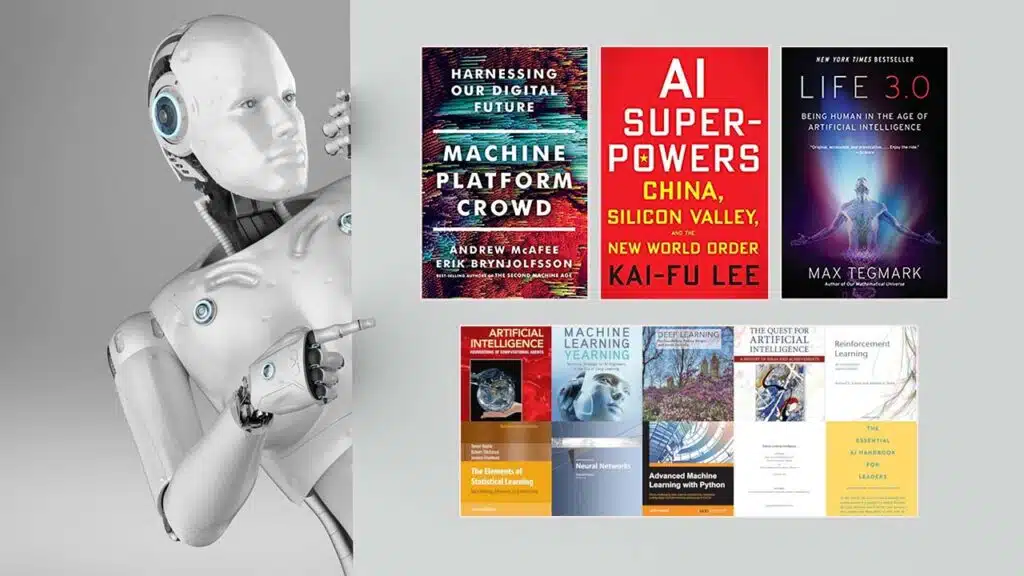
3. Life 3.0: Being Human in the Age of Artificial Intelligence by Max Tegmark
In Life 3.0, physicist Max Tegmark delves into how AI might shape the future of human civilization. He discusses scenarios for AI’s development, from job automation to AI-driven solutions to global challenges.
The book raises essential questions about human identity and purpose in an AI-dominated world. For tech leaders, Tegmark’s book is a reminder of the ethical and societal responsibilities of guiding AI development. It’s an insightful read that explores both the opportunities and risks that AI presents.
4. Machine Learning Yearning by Andrew Ng
Andrew Ng, one of the world’s leading AI experts, shares his practical insights on implementing machine learning projects. Machine Learning Yearning addresses common challenges in deploying AI, from setting realistic project goals to managing data and evaluating results.
Ng’s hands-on guidance is invaluable for tech leaders aiming to implement AI strategically. This book is particularly relevant for leaders managing AI initiatives, providing advice on setting up teams, aligning projects with business goals, and ensuring measurable outcomes.
5. The Master Algorithm: How the Quest for the Ultimate Learning Machine Will Remake Our World by Pedro Domingos
Pedro Domingos introduces readers to the foundational concepts of machine learning through five “tribes” of algorithms, each with a unique approach to problem-solving. This book explores the quest for the “master algorithm”—a single formula capable of learning any task.
For tech leaders, this book offers a detailed yet accessible overview of the main algorithms driving AI, making it easier to understand how machine learning is applied across different industries. It’s a foundational read for those who want a clearer grasp of the technical side of AI.
6. Artificial Intelligence: Foundations of Computational Agents by David L. Poole and Alan K. Mackworth
Written by two experts in the field, this textbook is an essential resource for leaders who want a thorough understanding of AI principles. It covers various topics, including problem-solving, reasoning, machine learning, and decision-making.
Although technical, it’s written in a way that’s accessible to non-experts interested in AI’s underlying concepts. Tech leaders will find this book valuable for understanding the mechanics behind AI systems, giving them the foundation needed to make informed decisions about AI applications.
7. Prediction Machines: The Simple Economics of Artificial Intelligence by Ajay Agrawal, Joshua Gans, and Avi Goldfarb
Prediction Machines takes an economic perspective on AI, examining how the technology lowers prediction costs and enables new business models. The authors highlight how companies can use AI to make data-driven predictions, leading to more efficient decision-making.
Tech leaders will find this book insightful for understanding the economic advantages of AI, as well as practical strategies for applying prediction-based models in business. It’s a must-read for leaders focused on the financial and operational impact of AI.
8. Human Compatible: Artificial Intelligence and the Problem of Control by Stuart Russell
Stuart Russell, a leading AI researcher, addresses one of AI’s biggest challenges: how to ensure that machines align with human values. Human Compatible is a comprehensive guide to the “control problem,” or how to develop AI systems that act in the best interests of humanity.
Russell proposes a new approach to AI development that emphasizes human safety and ethical considerations. For tech leaders, this book is essential for understanding the risks associated with AI and the ethical frameworks that should guide its development.
9. Weapons of Math Destruction: How Big Data Increases Inequality and Threatens Democracy by Cathy O’Neil
Cathy O’Neil’s Weapons of Math Destruction exposes the dark side of data and algorithms, explaining how they can perpetuate inequality and undermine democracy. Through real-world examples, O’Neil demonstrates how algorithms often lack transparency and accountability.
For tech leaders, this book is a reminder of the ethical considerations necessary when developing and deploying AI. It advocates for fairness, transparency, and responsibility, making it a must-read for leaders invested in ethical AI development.
10. Artificial Intelligence: A Very Short Introduction by Margaret A. Boden
Margaret Boden provides a brief but informative overview of AI concepts, covering everything from machine learning to robotics. This book is ideal for leaders new to AI who want a foundational understanding without complex technical details.
It’s a concise guide that gives tech leaders the vocabulary and knowledge needed to engage in AI discussions, making it an excellent starting point for further exploration.
11. The Book of Why: The New Science of Cause and Effect by Judea Pearl and Dana Mackenzie
Judea Pearl’s The Book of Why explores causality, a crucial aspect of AI that goes beyond simple correlation. Causal inference helps machines understand cause and effect, a capability essential for accurate predictions and decision-making.
This book is valuable for tech leaders who want to understand the science behind AI’s decision-making processes. It’s a fascinating read that provides insights into how AI systems learn from data, helping leaders develop more effective AI strategies.
12. Deep Learning by Ian Goodfellow, Yoshua Bengio, and Aaron Courville
Deep Learning covers the fundamentals, methods, and applications of deep learning in writing by top experts in the field. This book is a comprehensive guide to one of the most influential areas of AI, and it’s widely regarded as the “bible” of deep learning.
Tech leaders who want to understand deep learning’s impact on industries such as healthcare, finance, and marketing will find this book invaluable for its depth and clarity.
13. Artificial Intelligence and Machine Learning for Business by Steven Finlay
Steven Finlay’s book is tailored for business leaders who want to apply AI to solve specific business challenges. It provides a practical overview of machine learning applications in areas like marketing, customer service, and operations.
For leaders looking to integrate AI into their business strategies, this book offers actionable insights that bridge the gap between technical concepts and practical applications.
14. Architects of Intelligence: The Truth About AI from the People Building It by Martin Ford
In Architects of Intelligence, Martin Ford interviews 23 leading figures in AI, including Elon Musk, Demis Hassabis, and Ray Kurzweil. This book provides a unique perspective on AI’s future, with insights from the innovators driving its development.
Each interview offers tech leaders a glimpse into the minds of AI pioneers, covering topics from breakthroughs in deep learning to ethical dilemmas. It’s an inspiring read for leaders interested in the trajectory of AI.
15. AI Superpowers: China, Silicon Valley, and the New World Order by Kai-Fu Lee
Kai-Fu Lee’s AI Superpowers contrasts AI development in China and Silicon Valley, exploring how these regions shape the future of AI in different ways.
Lee discusses the competitive advantages of both regions as well as the implications of AI for global power dynamics. This book is essential for tech leaders who want to understand AI’s geopolitical impact, offering valuable insights into the international AI race.
16. Applied Artificial Intelligence: A Handbook for Business Leaders by Mariya Yao, Adelyn Zhou, and Marlene Jia
This book provides an actionable roadmap for business leaders looking to incorporate AI into their companies. It covers project planning, data strategy, and integration techniques, making it a practical resource for leaders managing AI initiatives.
With a focus on real-world applications, Applied Artificial Intelligence helps leaders make informed decisions at every stage of AI implementation.
17. Artificial Intelligence: The Insights You Need from Harvard Business Review by HBR Editors

This anthology of articles from Harvard Business Review compiles expert insights on AI’s impact on business. It covers AI strategy, workforce implications, and the competitive advantage of AI, providing a well-rounded overview of AI’s role in the business world.
This book is ideal for leaders who want high-level insights and practical advice from industry experts.
18. Thinking, Fast and Slow by Daniel Kahneman
While not solely focused on AI, Thinking, Fast and Slow by Daniel Kahneman explores human decision-making and cognitive biases, which are essential for understanding how AI systems should be designed to interact with humans.
Tech leaders can gain insights into behavioral psychology, helping them create more intuitive and user-friendly AI applications.
19. Data Science for Business: What You Need to Know about Data Mining and Data-Analytic Thinking by Foster Provost and Tom Fawcett
This book is a comprehensive introduction to data science principles, covering data mining, analytics, and machine learning. It’s tailored for business leaders, offering tools and strategies to make data-driven decisions.
For those building data-centric organization, this book provides the knowledge to bridge AI concepts with actionable insights.
20. The Fourth Industrial Revolution by Klaus Schwab
Klaus Schwab’s The Fourth Industrial Revolution explores how AI and other emerging technologies are reshaping economies, industries, and societies. This book encourages tech leaders to think about AI’s role within the larger context of technological advancement. It’s a visionary read that highlights the need for responsible leadership as AI transforms the world.
Conclusion
Artificial intelligence is reshaping industries, and tech leaders must stay informed to navigate this transformation effectively. These 20 books provide a comprehensive guide, covering everything from the basics of machine learning to the ethical implications and global impact of AI.
Each book brings unique insights, offering tech leaders the knowledge needed to make informed, responsible decisions in a fast-evolving technological landscape.
For leaders looking to leverage AI’s potential while being mindful of its risks, this reading list is essential for staying ahead, driving innovation, and guiding the future of AI in business and beyond.
























