Do you ever feel stuck when making choices? Whether it’s picking dinner or solving big problems, decision-making can be tricky. Many people wish they could think faster and make smarter moves under pressure.
Here’s some good news: playing video games might help! Studies show that gaming improves brain activity and sharpens thinking skills. Gamers often react quicker and plan better than non-gamers in studies on task performance.
This blog will explain how certain games boost critical thinking, problem-solving skills, and cognitive flexibility. You’ll also learn which games are best for training your brain.
Ready to level up your decision-making? Keep reading!
Key Takeaways
- Gaming improves decision-making by enhancing thinking speed, adaptability, and critical skills. Gamers react 190 milliseconds faster than non-gamers during tasks.
- Strategy games like Civilization boost multitasking and planning skills, helping players solve complex problems under pressure.
- Action games improve quick decision-making, pattern recognition, and sensorimotor coordination through fast-paced challenges.
- Studies show video games increase brain activity in areas tied to planning and movement, such as the right SMA and left thalamus.
- Gaming trains real-life skills like problem-solving for work, school, or home tasks while improving focus and accuracy.
The Link Between Gaming and Decision-Making
Games sharpen your brain like a whetstone sharpens a blade. They push you to think fast, adapt, and act wisely in the heat of the moment.
Enhanced cognitive flexibility
Playing video games improves mental adaptability. Strategy games, like “Civilization,” push players to think fast and adjust plans. Puzzle-solving boosts thought processes by training the brain to switch tasks seamlessly.
Gamers strengthen working memory through challenges requiring quick decisions under pressure. Studies using functional magnetic resonance imaging (fMRI) show increased brain activity in areas tied to switching between complex tasks.
These skills help solve problems faster in real life.
Faster response times
Gamers think quicker. They reacted 190 milliseconds faster during decision-making tasks than non-gamers. This edge means faster task performance without losing accuracy. Both speed and precision worked hand in hand.
Action-packed games sharpen brain activity. Players adapt to rapid changes, boosting cognitive processing skills. Their brains process information quickly, mapping to action almost instantly.
Games push limits, enhancing multitasking skills under pressure while solving complex problems efficiently.
Improved pattern recognition
Action games train your brain to spot patterns quickly. Players must track movements, predict outcomes, and make choices in real time. The University of Rochester found that this boosts attention and perception skills.
Fast-paced games strengthen how well you detect changes or trends.
Puzzle games also sharpen pattern recognition. Solving puzzles like Sudoku or matching tiles exercises memory and logic. These skills help with mapping tasks to actions in daily life, improving task performance under pressure.
Types of Games That Boost Decision-Making Skills
Some games sharpen your thinking and quick reaction skills. They challenge your brain to solve complex problems fast, keeping you sharp and focused.
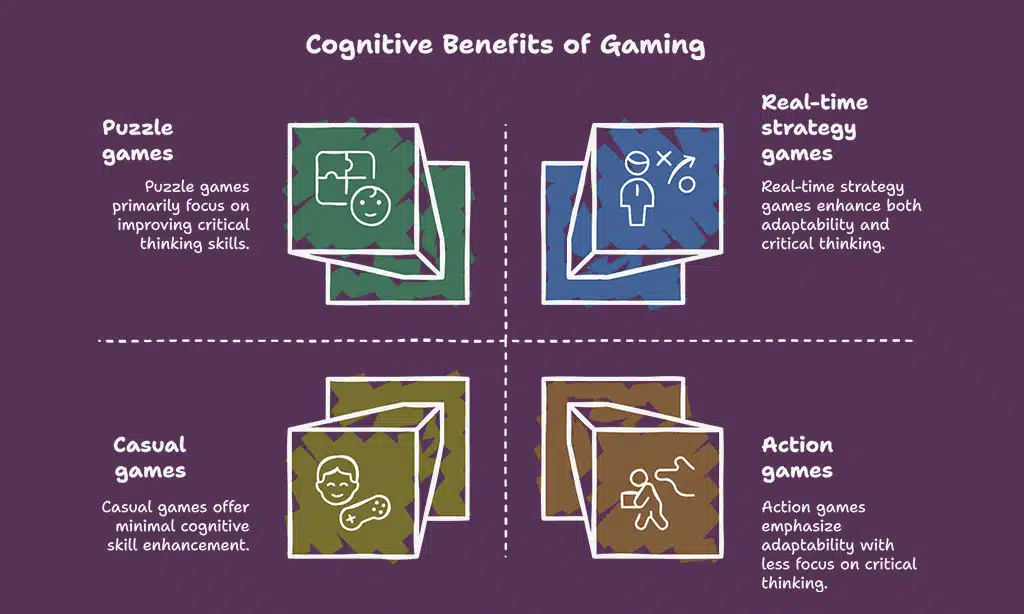
Real-time strategy games
Real-time strategy games test your brainpower and speed. Games like *Civilization* need players to plan ahead and manage resources wisely. You must balance goals, think steps ahead, and make quick decisions.
These tasks sharpen decision-making skills.
Such games also boost multitasking skills as players handle multiple tasks at once. For example, building structures while defending against attacks trains you to solve complex problems under pressure.
This improves task performance in real life too!
Action-adventure games
Action-adventure games train your brain to act fast. These games improve decision-making by boosting multitasking and task performance. Players often face tense moments, like dodging enemies or solving puzzles under pressure.
This sharpens their reaction time and cognitive skills.
Games like “Uncharted” challenge players to assess risks quickly while managing limited resources. They also enhance visuomotor processing, activating parts of the brain such as the right supplementary motor area (SMA).
By tackling these in-game challenges, you strengthen attention, critical thinking, and adaptability—all key for real-life problem-solving tasks.
Puzzle and problem-solving games
Puzzle games sharpen your thinking. Titles like *Portal* test problem-solving and spatial reasoning. Players must use logic to beat challenges, often in creative ways. These tasks improve brain activity and promote better decision-making skills.
Solving puzzles builds patience too. By working through tough levels, players learn critical thinking under pressure. Such games train the brain for real-life problems while boosting focus and task performance.
How Gaming Improves Decision-Making Abilities
Games sharpen your mind, push you to think fast, and help you stay cool under pressure—ready to learn more?
Strengthens critical thinking
Video games train your brain to solve problems quickly. Strategy games like chess or StarCraft force players to plan many moves ahead while dealing with changing situations. These challenges sharpen critical thinking skills.
Players also improve by spotting patterns fast. Puzzle and problem-solving games demand focus, logical steps, and smart decisions under pressure. This helps gamers handle tough real-world tasks effectively.
Enhances risk assessment
Games challenge players to weigh options fast. Strategy games, like *Civilization* or *Starcraft*, teach planning and timing. Players learn which risks are worth taking and which can lead to failure.
In action-packed games, every second counts. Quick decisions under pressure sharpen skills. Gamers showed 2% higher accuracy in tasks compared to non-gamers. This proves gaming boosts the ability to judge outcomes wisely.
Encourages adaptability under pressure
Fast decisions in video games sharpen your ability to think quickly under pressure. Players often face situations where every move matters. They must adjust fast to changing challenges, like enemy attacks or tricky puzzles.
Gamers react 190 milliseconds quicker than non-gamers during tasks, showing their improved adaptability. Real-time strategy and action games push players to balance speed with accuracy without mistakes—no trade-offs here.
These skills transfer well into real-world problem-solving when stress levels run high.
Scientific Studies Supporting Gaming and Decision-Making
Brain scans show how gaming changes decision-making areas. Studies prove games can sharpen mental response and focus.
Increased brain activity in gamers
Gamers show high brain activity in areas linked to decision-making and movement. Studies reveal increased action in the right lingual gyrus, right supplementary motor area (SMA), and left thalamus during gameplay.
These regions handle visual tasks, planning moves, and fast reactions.
Directed functional networks also become more active near the right SMA and left thalamus. This enhances how players process information while managing tasks. Video games strengthen sensorimotor skills by boosting these key areas of the brain.
Improved sensorimotor coordination
Video games can sharpen the connection between your brain and body. Studies show increased activity in key brain areas during gaming. These include the right lingual gyrus, left thalamus, and SMA (supplementary motor area).
These regions control movement and visual processing. Tasks like aiming, jumping, or dodging improve sensorimotor coordination through repetition.
Tim Jordan’s story is powerful proof of this. He was legally blind in one eye but used video game training to strengthen his vision. Over time, he gained enough precision to play sports competitively.
Gaming pushes you to react quickly while staying accurate—boosting task performance and multitasking skills naturally over time!
Faster information processing
Gamers process information faster than non-gamers. A study found they respond 190 milliseconds quicker during tasks requiring decisions. This speed can make a big difference in critical moments, like spotting patterns or reacting to changes.
The fast pace of video games pushes the brain to work harder. Games improve perception, attention, and memory over time. These skills help players handle complex tasks quickly and accurately in real life, boosting their decision-making abilities.
Practical Applications of Gaming Skills
Gamers often use quick thinking at work and in daily tasks. These skills sharpen problem-solving and decision-making under stress.
Professional environments
Video games sharpen decision-making in jobs. Business leaders improve task performance by learning risk assessment and adaptability through strategy games. Fast problem-solving, built in gaming, helps handle work challenges quickly.
Igor Tulchinsky highlights how cognitive skills from gaming support better workplace results.
Playing video games trains multitasking skills under pressure. Enhanced brain activity boosts focus and sensorimotor coordination for precision tasks. Games also teach teamwork, benefitting introverts who gain leadership confidence at work.
Educational settings
Teachers use video games to help students learn decision-making skills. Strategy games teach planning and critical thinking. Puzzle games help with problem-solving skills like pattern recognition.
Educational games boost multitasking skills too. They push kids to handle tasks fast without losing focus. Studies show gaming increases brain activities, improving learning outcomes in classrooms.
Everyday life problem-solving
Video games train the brain to think fast. Games like strategy or puzzle ones teach players to assess risks and plan smartly. These skills improve real-world task performance, such as organizing daily schedules or fixing sudden problems.
Enhanced brain activity from gaming sharpens decision-making abilities. Studies show gamers process information faster than others. For example, spotting patterns in a game helps with grocery shopping or budgeting effectively at home.
Takeaways
Gaming sharpens your mind like a well-used tool. It boosts your ability to think fast, plan smart, and adapt to challenges. Games train your brain through fun and action-packed tasks.
They teach skills that apply in work, school, or daily life. So grab a controller—your next great decision may start there!
FAQs
1. How do video games improve decision-making skills?
Video games train your brain to make faster choices by improving task performance and problem-solving skills. They also enhance cognitive skills like mapping actions to outcomes.
2. Can strategy games help with decision-making?
Yes, strategy games push you to plan ahead and think critically. They boost multitasking skills and teach better speed-accuracy trade-offs.
3. What role does neuroscience play in gaming benefits?
Studies from institutes like the Neuroscience Institute use tools like functional magnetic resonance imaging (fMRI) to show how gaming enhances brain activity during task-specific tasks.
4. Are educational games effective for cognitive training?
Educational games are great for building problem-solving abilities and improving focus. They strengthen your mind through fun, interactive learning.
5. Does gaming really improve real-life decisions?
Yes! Gaming sharpens mental reflexes, helps solve problems under pressure, and improves overall decision-making in everyday life situations.