Most companies would be content with what OpenEvidence has already achieved. In just a few years, the medical AI company founded by Daniel Nadler has become part of the daily routine for nearly two-thirds of America’s one million physicians, who entered more than 42 million prompts last month alone. In September, a $250 million funding round valued the company at $15 billion, and this month it announced a collaboration with Johns Hopkins Medicine to reimagine medical education.
Yet Daniel Nadler has made clear that answering doctors’ questions is only the beginning. “The end game is literature-based drug discovery,” he told the Financial Times this month. He added that the value of discovering new medicines could outweigh, by orders of magnitude, anything the company might earn from hospitals or advertisers.
What Is Literature-Based Drug Discovery?
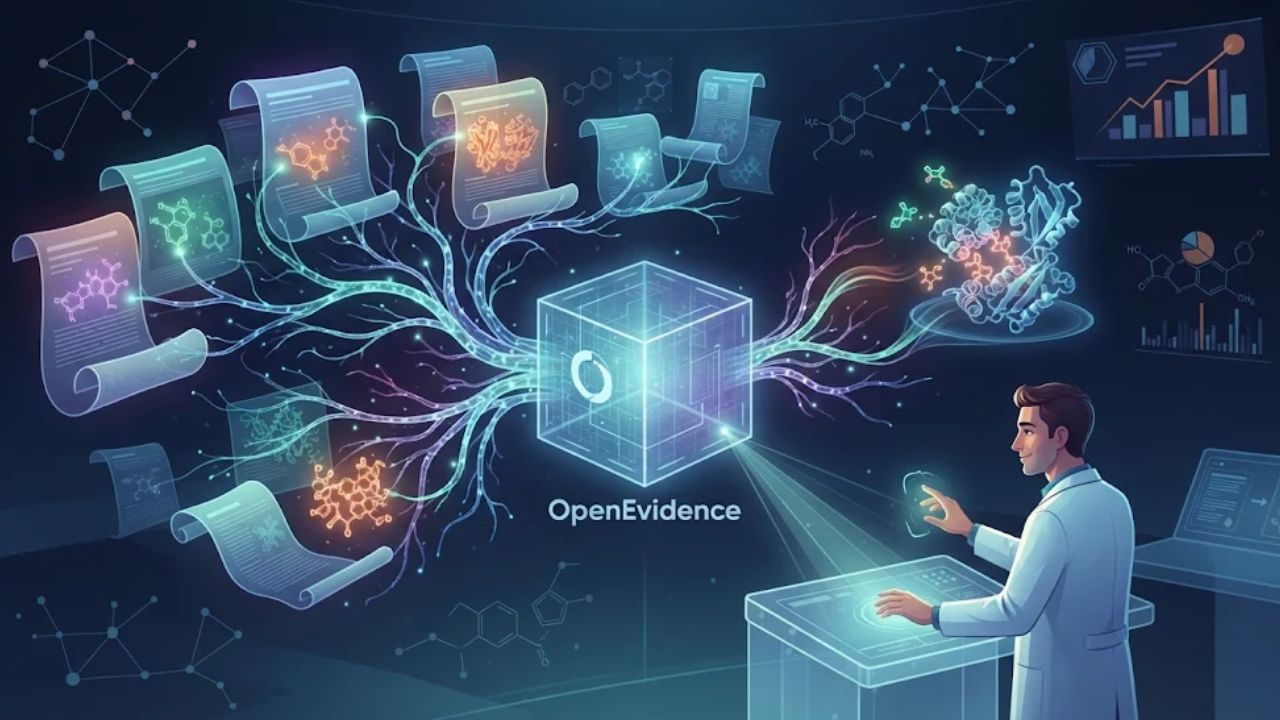
Literature-based discovery rests on a simple idea. The answers to some of medicine’s open questions may already be published, scattered across papers that have likely been read by no more than a handful of people.
The field was pioneered in the 1980s by Don Swanson, an information scientist at the University of Chicago. Swanson noticed that one body of research showed fish oil reduced blood viscosity and platelet stickiness. A separate body of research showed that patients with Raynaud’s syndrome, a circulatory disorder, suffered from exactly those problems. No paper connected the two. Swanson proposed in 1986 that fish oil might help Raynaud’s patients, and a later clinical study supported the link.
The lesson was that medical knowledge is siloed. Specialists read their own journals, and valuable connections fall through the gaps between disciplines. Data mining that literature at scale is how researchers hope to fill the gap.
Why OpenEvidence Is Well Placed
The challenge Swanson faced 40 years ago has only grown. OpenEvidence notes that the volume of medical research published each year is doubling roughly every five years, far more than any human could hope (or indeed want) to read.
This is where Daniel Nadler’s OpenEvidence has an advantage. Unlike general AI chatbots, it is built on a curated library of peer-reviewed research, including content from the New England Journal of Medicine and the Journal of the American Medical Association. An NPJ Health Systems study found no fabricated references among nearly 5,000 checked.
The company also has something few rivals can match: tens of millions of real clinical questions each month. Those queries reveal where doctors are uncertain and patients are poorly served. In effect, OpenEvidence can spot the gaps in medical knowledge, and then search its library for the missing connections.
From Search Engine to Scientific Engine
Concrete steps are already under way. Daniel Nadler told the Financial Times that OpenEvidence will launch clinical trials in the coming weeks, partnering with researchers to target cancer and rare diseases. The company plans to apply its AI models to drug discovery, drawing on existing literature to generate new scientific hypotheses.
Rare diseases are a telling choice. With small patient populations, they often attract little commercial research, and relevant findings may be spread thinly across many journals. That is precisely the kind of fragmented evidence that Nadler’s proposed literature-based discovery tool is designed to bring together.
OpenEvidence has also recently strengthened its team. Alexander Tarashansky, who created Claude Science, Anthropic’s platform for research scientists, has joined to support the company’s clinical work.
Who Is Daniel Nadler?
Canadian entrepreneur Daniel Nadler holds a PhD in political economy from Harvard and co-founded Kensho Technologies, which was sold to S&P Global in 2018 for a reported $550 million. He co-founded OpenEvidence in 2022 after his grandfather’s death was attributed to a medical error. Today the company helps doctors find treatments that already exist, but if literature-based discovery delivers on its promise, it may yet help create the treatments of the future.
That won’t happen quickly. Every promising find will still need years of laboratory work and clinical trials to confirm any possible connection. But a tool trusted by most of America’s physicians and built on the best available evidence is a strong foundation from which to ask new questions.