CVC words follow a consonant–vowel–consonant pattern. In beginner phonics lessons, this usually means simple three-letter words with a short vowel sound, such as cat, pen and sun.
They often appear early because they give children a manageable way to connect letters with sounds and blend those sounds into words. Their purpose is to help children use what they are learning about print.
That does not mean every child must start with CVC words. Two-sound words such as at can be introduced alongside them.
Why CVC Words Help Beginning Readers
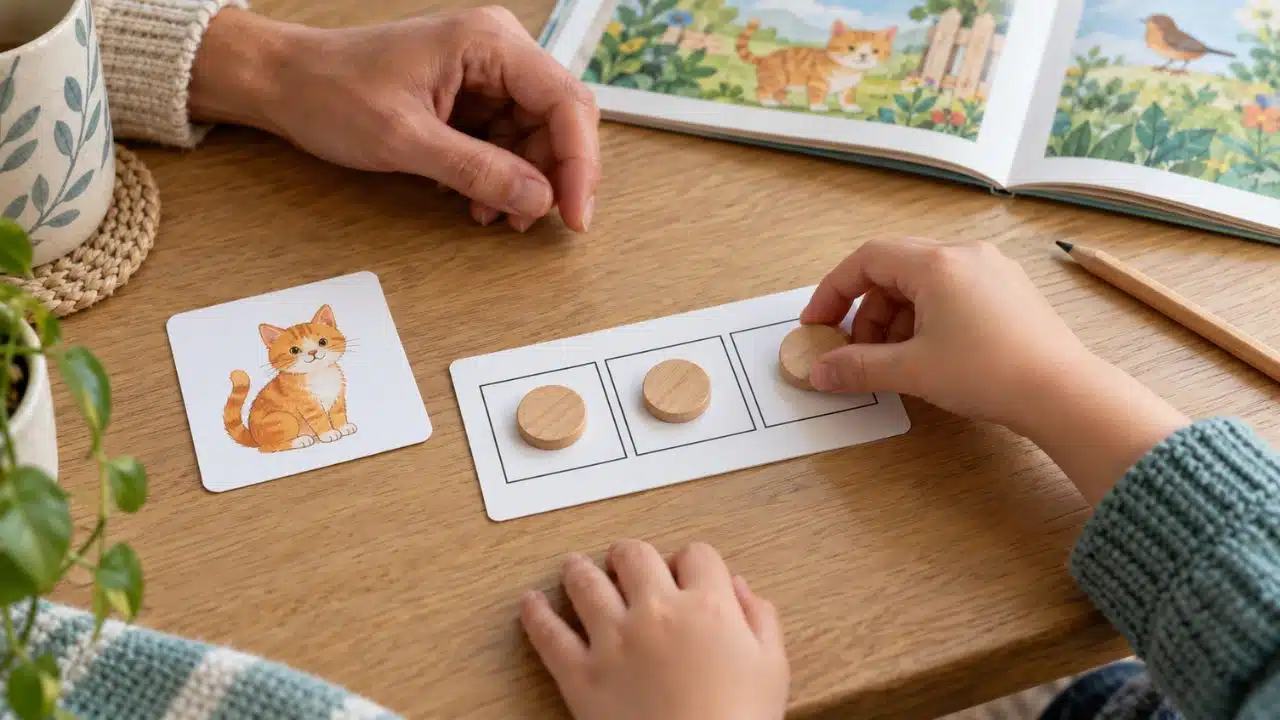
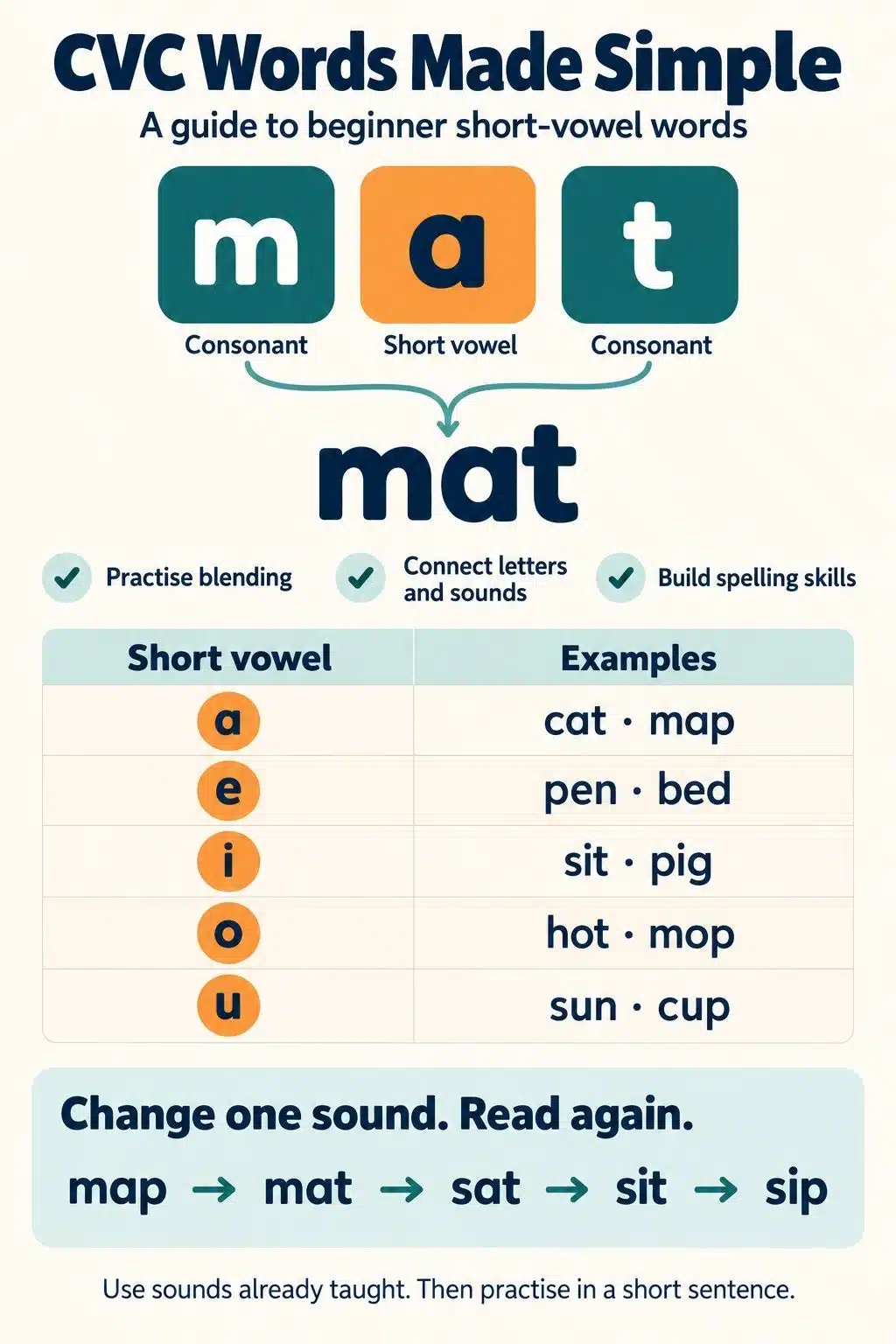
Consider mat. The letter m represents the first sound, a represents the short vowel sound, and t represents the final sound. Joining those sounds to say “mat” is called blending.
A simple CVC word lets a child practise that process with three sounds and straightforward spellings. More complex words introduce additional demands, such as adjacent consonants or letters that work together to represent one sound.
The same word also supports spelling. Hearing “mat,” separating its sounds and choosing the corresponding letters takes the child from speech to print. Separating the sounds is called segmenting.
As children connect a word’s spelling, pronunciation and meaning through successful practice, familiar words can become easier to recognise automatically. This learning process is known as orthographic mapping.
CVC Word Examples
The following words illustrate the five short-vowel groups commonly used in beginning phonics.
| Short vowel | Examples |
| a | cat, map, hat, bag |
| e | bed, pen, hen, net |
| i | sit, pin, lip, pig |
| o | hot, pot, top, mop |
| u | sun, cup, bus, mud |
Choose practice words that contain sounds the child has already been taught. Check their meaning, too. If a child can sound out mop but does not know what it is, explain or show it.
A Note About Letters and Sounds
CVC sometimes describes a word’s sound structure, so teaching materials may use the label differently.
Ship has four letters but three sounds because sh represents one sound. It can therefore be called CVC by sound structure. Box has three letters but four sounds because x represents /k/ and /s/.
The examples in the table use the simpler three-letter, short-vowel pattern. Words such as rain and cake require additional spelling knowledge.
What Does a Child Need Before Starting?
A child does not need to know the whole alphabet before beginning to read simple words.
Knowing the sounds represented by a, m, s and t, for example, makes it possible to work with at, mat and sat. A planned phonics sequence introduces a small set of sounds, uses them in words, then gradually adds more.
Letter names and letter sounds serve different purposes. A child might name every letter in mat and still need help blending its sounds. Blending should be taught and practised alongside sound–letter knowledge.
How to Teach CVC Words at Home
I would start with a few words that match the child’s current learning and listen closely to how they approach each one. Letter cards or tiles and a pencil are enough.
1. Show How the Sounds Join
Display sun. Point to its letters from left to right and demonstrate joining their sounds into the word.
Sounds such as /s/, /m/ and /f/ can be stretched, which can make early blending easier. Connect the sounds smoothly, keeping stop sounds such as /t/ and /p/ brief.
Avoid adding a strong “uh” after consonants. Saying “muh” instead of /m/ adds an extra vowel sound that can make the word harder to blend.
2. Practise Together, Then Let the Child Try
Read the word together, then offer an independent turn. If the child gets stuck, identify the difficult step.
They may need a reminder of one letter sound or another demonstration of how to combine the sounds. Give that specific help, then let them try again.
3. Build or Write the Word
Say the word aloud and ask the child to separate its sounds. Let them select the letters or write them, then read the result.
This gives you a chance to notice whether they hear the middle vowel and final consonant as well as the beginning sound.
4. Change One Sound
Once the relevant sounds are familiar, try this word chain:
map → mat → sat → sit → sip
Each step changes one letter and one sound. Read the new word after every change. This draws attention to the beginning, middle and ending of words.
5. Read a Short Sentence
Move into a sentence such as “Sam sat.” when the child knows the necessary letters, including the capital form, and understands the name.
After sounding out the words, reread the sentence smoothly and talk about its meaning. Any irregular words in practice sentences should also have been introduced explicitly.
Continue reading richer stories aloud. Children can enjoy and discuss books beyond the level they can yet read independently.
When a Child Gets Stuck
Before adding more practice, I would check where the process breaks down:
- Uncertain letter sounds: Review those sounds and choose words that use them.
- Difficulty joining sounds: Model smooth blending and try a two-sound word such as at.
- Missing or confused sounds: Draw attention to the relevant part of the word, especially its vowel or ending.
- Unfamiliar meaning: Explain the word and use it in conversation.
Children learning English as an additional language may need support with unfamiliar English sounds and vocabulary alongside the print.
If difficulties persist during supported teaching, speak with the teacher or a reading specialist. A difficult CVC activity alone cannot diagnose dyslexia.
Turn One Word Into the Next Step
Choose a few suitable words, model how their sounds connect, and help the child read and spell them. Then use those skills in a short sentence.
The useful sign of progress is being able to apply familiar sounds to a new word. Keep that goal in view, alongside understanding the words and enjoying books.
Frequently Asked Questions on CVC Words
1. At What Age Should Children Learn CVC Words?
Many encounter them during Reception or kindergarten, broadly around ages four to six, depending on the school system. This is a typical teaching period, not a mastery deadline. Instruction should build on the child’s sound–letter knowledge and response to support.
2. Why Can My Child Say the Sounds but Not Read the Word?
Recalling individual sounds and blending them are different skills. Your child may need a clearer model of how the sounds connect. Practise together, keep the sounds close and try a shorter word if needed.
3. Must Children Learn All Five Short Vowels First?
No. They can begin with one short vowel and a few consonant sounds they have learned. Further vowels and spelling patterns can be introduced gradually through the teaching sequence.
4. Are CVC Words the Same as Sight Words?
CVC describes a word pattern. A sight word is any word a reader recognises automatically. A familiar CVC word such as cat can become a sight word; the term is not limited to irregular words.
5. What Comes After CVC Words?
Teaching expands to additional patterns, such as sh in ship, consonant blends in stop, and silent-e spellings in cake. The order varies by programme. Look for children applying their knowledge to new words and sentences as they progress.