Orthographic mapping is the mental process that connects a word’s spelling with its pronunciation and meaning. Once those connections become secure in long-term memory, a reader can recognize the word quickly instead of sounding it out from the beginning each time.
The term sounds technical, but it describes a familiar change. A child may struggle through a word on Monday, read it more confidently later in the week, and eventually recognize it without hesitation. From the outside, that can look like memorization. What is actually happening is more structured: the written letters are becoming connected to the sounds and language the child already knows.
That is why some words seem to “stick” while others keep feeling new.
What Happens During Orthographic Mapping?
I find it helpful to think of orthographic mapping as a connection among three parts of a word:
- Its spelling
- Its pronunciation
- Its meaning
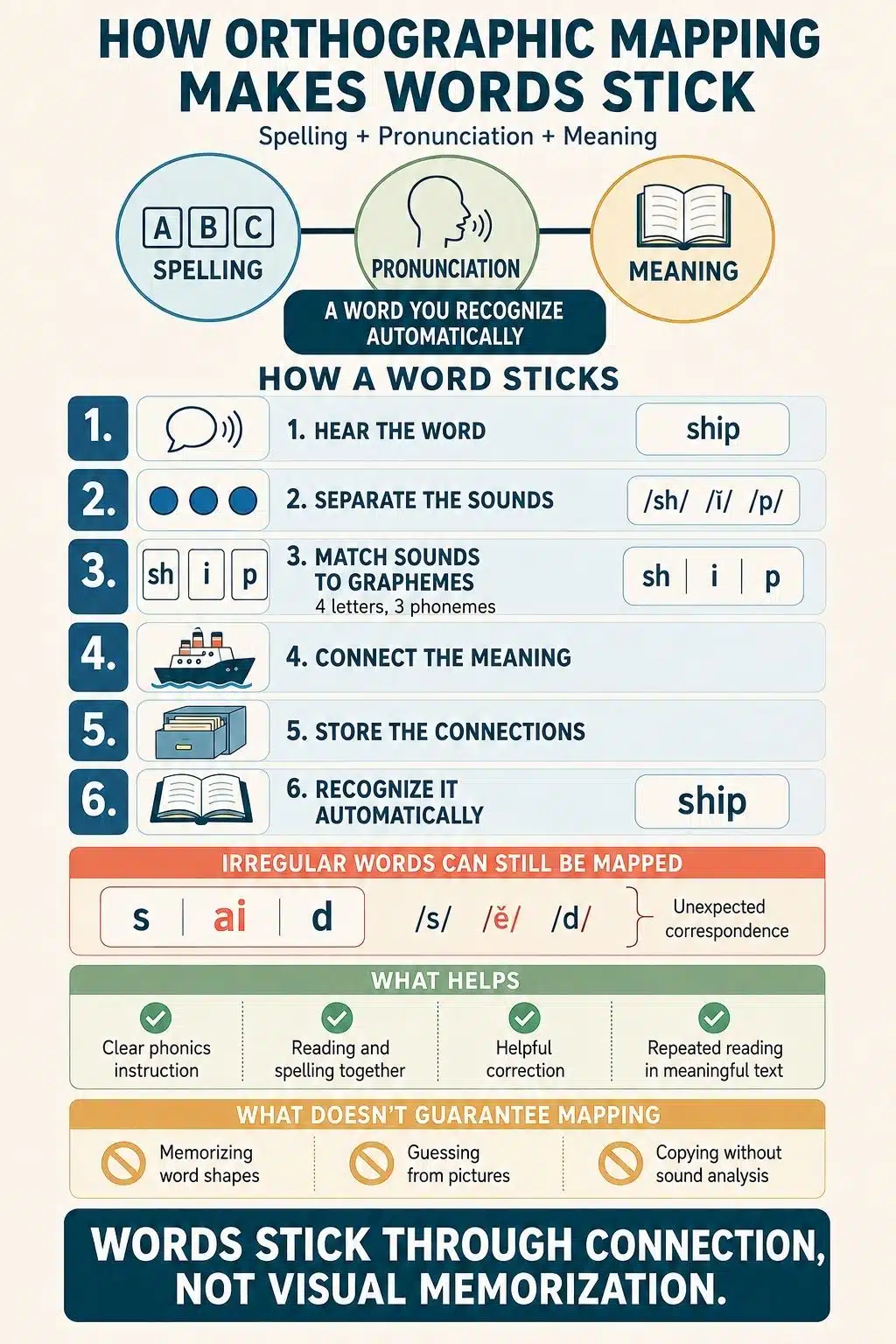
Suppose a child sees the word ship. To read it, the child connects the written graphemes sh, i, and p with the spoken sounds /sh/ /ĭ/ /p/. Those sounds blend into ship, a word the child may already understand.
Although ship has four letters, it has three phonemes because sh represents one sound. This distinction matters. Children are not simply remembering a row of letters. They are learning how written units match the sound structure of the word.
After enough successful encounters, the spelling, pronunciation, and meaning become linked strongly enough for the word to be recognized automatically. The child no longer needs to rebuild it sound by sound.
The process generally works like this:
- The child sees a printed word.
- The child connects its graphemes with sounds.
- The sounds are blended into a pronunciation.
- That pronunciation is matched with a known spoken word.
- The spelling, pronunciation, and meaning become connected in memory.
- Later encounters activate the word more quickly.
This is one reason accurate decoding matters so much. Sounding out a word is not merely a temporary way to finish a sentence. It can also help the reader learn that word for the future.
Why Words Do Not Stick Through Shape Alone
Children obviously need to see print, but skilled word reading is not based on memorizing the overall outline of a word.
If it were, words with similar shapes would be easy to confuse. A child might also recognize a word on a familiar flashcard but fail to read it in a book, a different font, or a new sentence.
Reliable recognition depends on more precise information:
- Which letters appear
- The order of those letters
- Which sounds the letters represent
- How the resulting pronunciation connects with a known word
Simply showing a child the same card repeatedly may create familiarity, but familiarity is not always secure word knowledge. Practice becomes more useful when the child understands how the spelling represents the spoken word.
The Skills That Help Words Stick
Orthographic mapping happens internally, but it depends on skills that can be taught.
Phonemic Awareness
Phonemic awareness is the ability to notice and work with individual sounds in spoken words. To map the word map, a child needs to hear /m/ /ă/ /p/ as three separate phonemes. If those sounds are unclear, the child has nothing precise to connect with the letters m, a, and p.
The most relevant phonemic-awareness skills include:
- Blending separate phonemes into a word
- Segmenting a word into phonemes
- Identifying the order of the sounds
- Noticing when a sound has changed
Phonemic awareness concerns spoken language, but it should eventually connect with print. Oral sound activities can build the foundation, while letters help children apply that awareness to reading and spelling.
Letter-Sound Knowledge
Children also need to understand how letters and letter groups represent sounds. A grapheme may contain one letter, as in m, or several letters, as in sh and igh. This is why a sound-mapping activity should usually provide one space for each phoneme, not one space for each letter.
In ship, for example, the child needs three sound spaces:
sh | i | p
Giving four spaces would incorrectly suggest that s and h represent separate sounds in this word.
Decoding
Decoding is the process of using sound-spelling knowledge to work out a printed word. Each accurate attempt gives the reader an opportunity to store that word.
The goal is not to make children sound out every familiar word forever. Decoding gives them a dependable way to identify unfamiliar words until those words become automatic.
A child who guesses from the first letter or a picture may occasionally get the answer right. However, a correct guess does not necessarily create a complete memory of the spelling. The child needs to examine enough of the word to connect its written parts with its sounds.
Spoken Vocabulary
Mapping is easier when the child already knows the word in spoken language. A child may look at island and initially produce something like “iz-land.” Spoken vocabulary helps the child recognize the intended word, adjust the pronunciation, and connect the unusual spelling with the word island.
Meaning does not replace decoding. It helps the reader make sense of the pronunciation produced by decoding, particularly when English spelling is less predictable.
Orthographic Mapping, Phonics, and Sight Words
These terms are related, but they describe different parts of learning to read.
- Phonemic awareness helps a child identify the sounds in spoken words.
- Phonics teaches how letters and letter groups represent those sounds.
- Decoding uses that knowledge to work out a printed word.
- Orthographic mapping stores the spelling, pronunciation, and meaning of a specific word.
- Sight-word reading is the result: the reader recognizes the word automatically.
The distinction I find most useful is this: phonics provides the code, decoding applies it, and orthographic mapping helps preserve what the reader has learned.
A Sight Word Is Not the Same as an Irregular Word
The phrase sight word is often used for words that children supposedly cannot sound out. That definition causes unnecessary confusion.
A sight word is any word a particular reader recognizes immediately. It may be regular or irregular, common or uncommon.
A high-frequency word is a word that appears often in text. A word can be high frequency and completely regular, such as in. Another high-frequency word, such as said, contains an unexpected sound-spelling relationship. Both can eventually become sight words.
This matters because many common words are more decodable than they first appear. Treating every word on a high-frequency list as a visual object hides the sound-spelling information that could help a child remember it.
How Irregular Words Become Familiar
Irregular words can still be orthographically mapped. Most contain expected correspondences alongside one or two unusual parts.
Consider said:
s | ai | d
The s represents /s/, and the d represents /d/. The surprising part is ai, which represents /ĕ/ in this word.
I would not treat said as an unanalyzed shape that must be memorized whole. A more useful approach is to connect the expected parts with their sounds and draw careful attention to the unexpected correspondence.
A simple teaching routine can look like this:
- Say the word naturally and confirm its meaning.
- Ask the child to identify its individual sounds.
- Match each sound with the letters that represent it.
- Point out the unexpected part of the spelling.
- Blend and read the complete word.
- Spell the word while saying its sounds.
- Revisit it later in a sentence or book.
Some teachers call these irregular words “heart words” because the unexpected part must be learned by heart. The symbol is not what creates learning. The useful part is analyzing the spelling instead of asking the child to memorize the whole word visually.
Some words are only temporarily irregular for a learner. A spelling may seem unfamiliar because the relevant phonics pattern has not been taught yet. Once the child learns that pattern, the word may become fully decodable.
Pronunciation also varies across accents and dialects. Adults should match the analysis to the child’s natural speech rather than treating a language difference as a mistake.
Check out our app for kid’s learning: Alphabet Magic Trace and Phonics
How Word Reading Changes Over Time
Children do not move from guessing to fluent reading in one step. Their connections become more complete as their knowledge grows.
Early on, a child may recognize a sign or label from its color, logo, or surroundings. Later, the child begins using partial alphabetic information, often the first or final letter. That is progress, but it can still produce guesses.
More dependable mapping becomes possible when the child can connect the full sequence of graphemes with the phonemes in a word. With further experience, readers start recognizing larger units such as syllables, spelling patterns, prefixes, suffixes, and roots.
These changes overlap. A child may recognize one word instantly, decode another accurately, and guess at a harder word during the same reading session. Development is rarely as tidy as a sequence printed in a textbook.
How Adults Can Support Orthographic Mapping
Orthographic mapping is not a worksheet, commercial program, or isolated classroom activity. It is the mental learning that good instruction is trying to support. The following practices are especially useful.
Teach Phonics in a Clear Sequence
Children need an organized progression from common sound-spelling relationships to more complex ones. Random lists of unrelated words make the task harder than it needs to be.
Practice words should mostly use patterns the child already knows or is currently learning.
Bring Attention Back to the Word
Pictures and sentence meaning can help confirm an answer, but they should not become substitutes for reading the print.
If a child reads house as horse, useful questions include:
- “What sound do you see in the middle?”
- “What is the final sound?”
- “Does horse match all the letters?”
The aim is not to remove meaning from reading. It is to teach the child to check that the proposed word matches both the sentence and the spelling.
Combine Reading and Spelling
Spelling asks children to move in the opposite direction, from spoken sounds to written letters. They must segment the word, retrieve the correct graphemes, and place them in order.
Helpful activities include building words with letter tiles, writing while saying the sounds, changing one sound at a time, and spelling a studied word from memory.
Copying may support handwriting, but it does not guarantee mapping. A child can copy letters without analyzing their relationship to the sounds.
Correct Errors Clearly
When a child misreads a word, brief and specific feedback is more useful than repeated guessing. An adult can point out the difficult grapheme, supply its sound if necessary, ask the child to blend again, and then reread the sentence.
The correction should be calm. The goal is to repair the connection, not make the child anxious about attempting an unfamiliar word.
Revisit Words in Connected Text
After a word has been analyzed, the child needs opportunities to retrieve it in phrases, sentences, and books. Practice spaced across several occasions is generally more meaningful than repeating the same word many times in one sitting.
There is no universal number of exposures that makes a word stick. A child may learn a simple word quickly but need considerably more practice with a complex spelling. Reading ability, word structure, vocabulary, and the quality of each encounter all matter.
Show Spellings During Vocabulary Lessons
When introducing an unfamiliar spoken word, showing its written form can support memory for its pronunciation. The meaning still needs a clear explanation, examples, and context. Print strengthens vocabulary teaching, but it does not replace it.
What Usually Gets in the Way
Several well-intended habits can make word learning less secure:
- Asking children to memorize overall word shapes
- Encouraging guesses from pictures or first letters
- Treating every high-frequency word as irregular
- Using flashcards before analyzing the spelling
- Giving one sound box for every letter
- Practicing words far beyond the child’s current phonics knowledge
- Relying on copying without sound analysis
- Teaching isolated words without returning to meaningful text
- Expecting every child to learn at the same speed
Flashcards are not automatically harmful. They can provide useful retrieval practice once a word has been decoded and analyzed. The problem begins when rapid visual repetition replaces instruction.
How Can I Tell Whether Mapping Is Developing?
Words are probably becoming more securely stored when a child starts to:
- Recognize previously decoded words more quickly
- Read familiar words in different books and sentences
- Examine the middle and end of a word instead of guessing
- Notice when a pronunciation does not fit the spelling
- Apply familiar spelling patterns to new words
- Spell studied words more consistently
- Read with less effort and smoother phrasing
A child may need closer support when the same words remain unfamiliar after substantial practice, short spoken words are difficult to segment, letter-sound knowledge is inconsistent, or reading relies heavily on pictures and guesses.
These signs do not diagnose dyslexia. Persistent difficulty should lead adults to examine phonemic awareness, phonics, decoding, spelling, accuracy, and fluency together. A qualified professional can conduct a broader assessment when necessary.
Orthographic Mapping Is Important, but It Is Not All of Reading
Automatic word recognition reduces the effort a reader spends identifying individual words. That leaves more attention available for understanding sentences and following ideas.
However, recognizing words automatically does not guarantee comprehension. Readers also need vocabulary, background knowledge, understanding of sentence structure, attention, and reasoning.
Orthographic mapping supports comprehension by making word recognition more efficient. It does not replace the language and knowledge required to understand a text.
Words Stick Through Connection
When a child begins reading a word automatically, it may look as though the word has simply been memorized. Underneath that quick response is a more precise process. The child has connected the printed letters with the word’s sounds, pronunciation, and meaning.
That is the practical value of understanding orthographic mapping. Instead of asking children to stare at words until they remember them, we can help them examine how the spellings work, read the words accurately, spell them from sound, and meet them again in meaningful text.
Words stick when their connections make sense.
Frequently Asked Questions on Orthographic Mapping
1. At what age does orthographic mapping begin?
There is no fixed starting age. It begins when a child has enough phonemic awareness and letter-sound knowledge to connect spoken sounds with written forms. For many children, this develops during early reading instruction.
2. How many times must a child see a word before it sticks?
There is no universal number. Some words become familiar after very few accurate encounters, while others require much more practice. The child’s reading skills and the complexity of the word both affect the process.
3. Is orthographic mapping the same as memorizing sight words?
No. Orthographic mapping is the process that allows a word to become a sight word. It depends on connecting spelling with pronunciation and meaning, not memorizing the word’s overall appearance.
4. Can irregular words be orthographically mapped?
Yes. Children can connect the expected parts of an irregular word with their sounds while learning the unusual correspondence explicitly. Irregular does not mean unmappable.
5. Does weak orthographic mapping mean a child has dyslexia?
Not necessarily. Difficulty retaining words may reflect gaps in phonemic awareness, phonics, decoding, spelling knowledge, or practice. Dyslexia cannot be identified from one skill or activity alone.