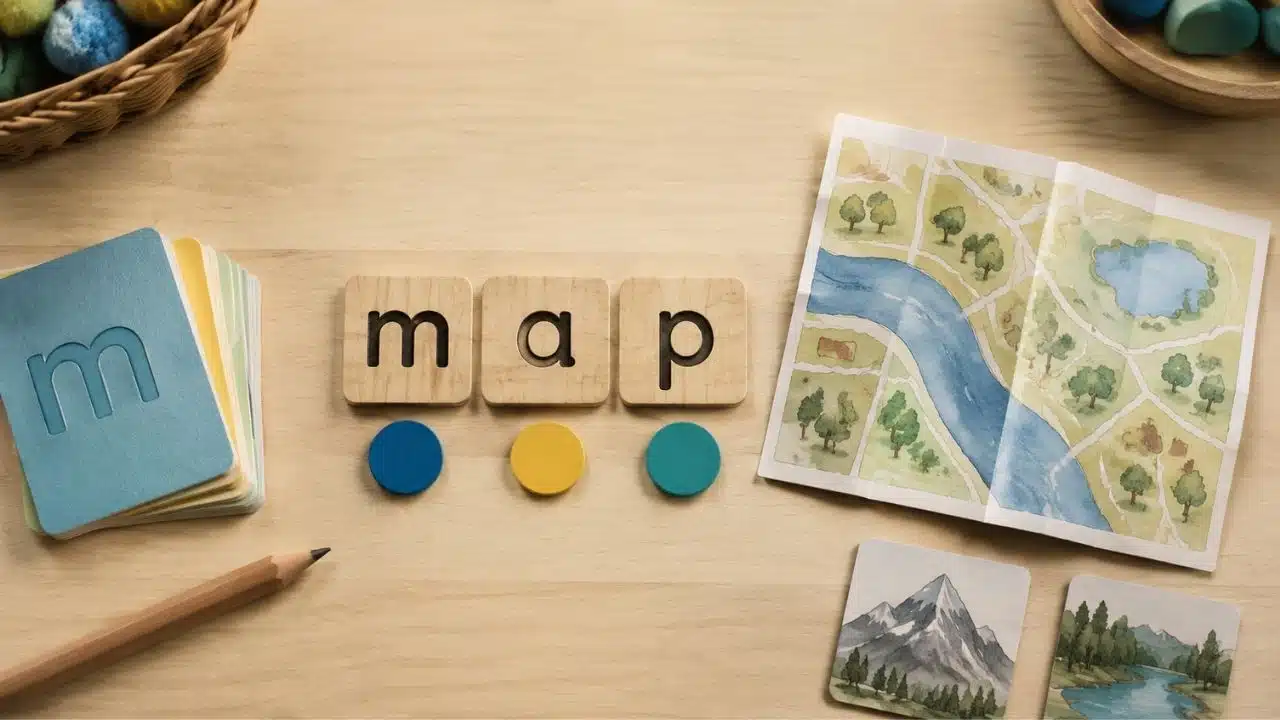
Letter-sound correspondence is the understanding that written letters and letter combinations represent the sounds in spoken language. It allows a child to see m, connect it with /m/, and use that connection to read a word such as map or spell a word such as mat.
I think of it as the bridge between the language children already speak and the print they are learning to understand. The principle is simple, but English does not follow a perfect one-letter, one-sound system. Children need to learn a collection of common relationships and gradually apply them to reading and spelling.
What Does Letter-Sound Correspondence Mean?
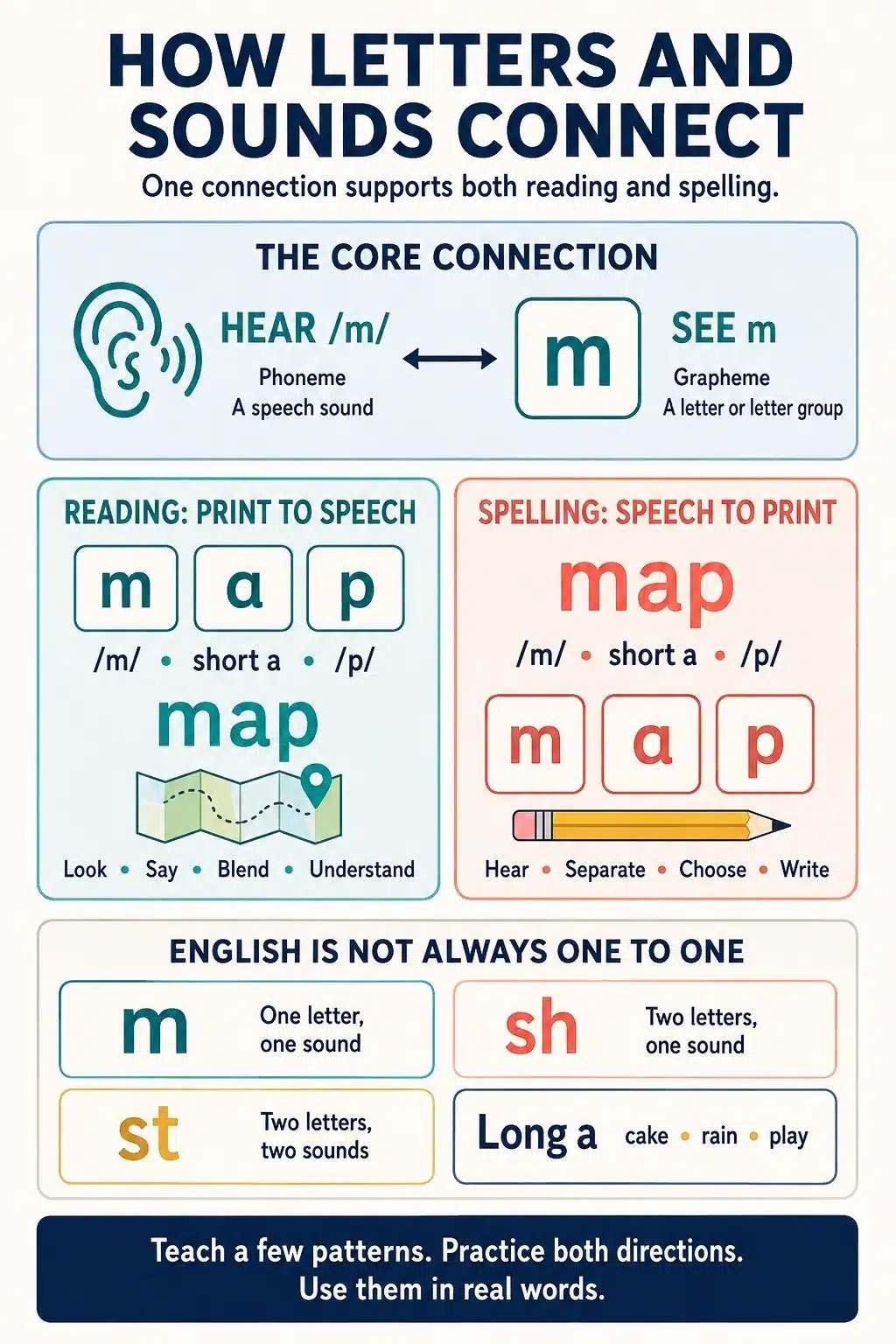
A letter is a written symbol. A sound is something we hear and produce when speaking. Letter-sound correspondence connects the two.
For example:
- m commonly represents /m/, as in moon.
- s commonly represents /s/, as in sun.
- sh represents a single sound in ship.
- ck represents /k/ at the end of duck.
In this guide, slashes show that I am referring to a spoken sound rather than a letter name. For example, m is the written letter, while /m/ is the sound it represents.
Educators use two more precise terms to describe this relationship:
- A phoneme is an individual speech sound.
- A grapheme is a letter or group of letters used to represent a phoneme.
Consider the word chop. It has four letters, but only three sounds: /ch/, short-o, and /p/. The letters ch work together as one grapheme because they represent a single sound.
People often say that a letter “makes” a sound. That wording is easy for young children to understand, although it is more accurate to say that a letter represents or spells a sound.
Why English Is More Complicated Than One Letter, One Sound
English is commonly described as having roughly 44 speech sounds, although the exact number varies with accent and dialect. Those sounds are represented by only 26 alphabet letters, sometimes individually and sometimes in combinations.
That creates several possibilities.
A single letter can represent different sounds. The letter c represents /k/ in cat but /s/ in city. The letter s also sounds different in sun and is. One sound can have several spellings. The long-a sound appears in cake, rain, play, and eight.
Some letters work together to represent one sound. In ship, sh is a digraph because the two letters represent a single sound. In stop, st is a consonant blend because both /s/ and /t/ remain audible.
These differences can make English look unpredictable, but its spelling system contains many recurring patterns. Children do not need to learn every possible pronunciation or spelling at once. They can begin with the most common correspondences and add more complex patterns over time.
Check out our app on Alphabet Magic trace & phonics
How Is It Different From Phonemic Awareness and Phonics?
These skills support one another, but they are not interchangeable.
Phonemic awareness is the ability to hear and work with individual sounds in spoken words. A child demonstrates it by hearing that cat contains three sounds: /k/, short-a, and /t/. The child does not need to see any letters to complete that task.
Letter-sound correspondence connects those speech sounds to printed letters or letter groups. The child learns that /k/ can be represented by c in cat.
Phonics is the broader instruction that teaches letter-sound relationships and spelling patterns. It also teaches children to use those relationships to read and spell words.
The alphabetic principle is the larger understanding behind these skills: the letters and patterns in written words represent the sounds in spoken language.
A child can be strong in one area while struggling with another. One child may hear every sound in map but have trouble choosing the letters needed to spell it. Another may know the sounds associated with m, a, and p but struggle to blend them into the complete word.
This is why repeating letter cards is not the answer to every early reading difficulty. The child may need help with hearing sounds, recalling correspondences, blending, spelling, or a combination of these skills.
Why Letter-Sound Correspondence Matters
Letter-sound correspondence does more than help a child remember what sound a letter represents. It gives them a practical way to decode unfamiliar words, spell what they hear, and develop the automatic word recognition needed for smoother reading.
It gives children a way to decode words
Once children know several correspondences, they can look at a printed word, produce its sounds, and blend those sounds together.
Instead of guessing fish from an illustration, a child can examine f, i, and sh and work through the complete word. This creates a dependable strategy that can also be used with unfamiliar words.
It supports spelling
Reading generally moves from print to speech. Spelling moves in the opposite direction.
To spell mat, a child must hear /m/, short-a, and /t/, then choose letters to represent those sounds. Reading and spelling therefore reinforce the same underlying connections.
It helps words become familiar
Beginning readers may need to sound out a word several times. With accurate practice, the spelling, pronunciation, and meaning become connected in memory. This process is known as orthographic mapping.
Eventually, the child can recognize the word immediately instead of consciously sounding it out. At that point, the word has become a sight word for that reader. A sight word can be any word recognized automatically, not just one taken from a high-frequency word list.
It contributes to fluent reading
When children can recall sounds and recognize familiar words without long pauses, reading becomes smoother. They have more attention available for understanding the sentence instead of using most of their effort to identify each word.
Still, letter-sound knowledge is not the whole of reading. Children also need oral language, vocabulary, background knowledge, fluency, and comprehension. Reading aloud to children supports those areas, but it does not replace direct instruction in phonics.
Check out our teacher approved app for kids learning on 123 Magic Number Fun: Math Kid.
When Do Children Learn Letter-Sound Correspondence?
Many children begin noticing letters and sounds during preschool. They may recognize the first letter in their name, point out familiar letters on signs, or connect a letter with a favorite word.
More systematic teaching often begins in prekindergarten or kindergarten. Instruction commonly starts with frequent consonant sounds and short vowels before moving to digraphs, long-vowel patterns, vowel teams, and less common spellings.
There is no single age when every child must know every correspondence. Preschoolers may know the sounds associated with a few familiar letters, while kindergarteners are usually working toward recalling common sounds accurately and applying them to simple words. More advanced sound-spelling patterns continue to be taught in first grade, second grade, and beyond.
I would not turn this into a race through the alphabet. Reciting many sounds once is less useful than recalling a smaller set accurately and using it to read and spell words.
How to Teach Letter-Sound Correspondence Clearly
Clear teaching keeps the connection between speech and print visible at every step. Start with a small set of useful correspondences, pronounce each sound accurately, practise it through both reading and spelling, and apply it to simple words before introducing more complex patterns.
Begin with a small, useful set
There is no universally accepted perfect order for introducing letters. A sensible sequence begins with common correspondences that allow children to build words fairly quickly.
Mix consonants with short vowels rather than teaching a long series of consonants first. After learning letters such as m, s, t, p, a, and i, children can begin working with words such as mat, sat, sit, and map.
Avoid introducing easily confused letters together before either is secure. Letters such as b and d look similar, while short-e and short-i can be difficult for some children to distinguish by sound.
Connect the letter name, sound, and written form
A clear introduction might be: “This is the letter m. Its most common sound is /m/, as in moon. Say /m/.”
Many programs introduce uppercase and lowercase forms together, although teaching sequences vary. Lowercase letters deserve plenty of attention because children encounter them more often in ordinary text.
Children can also form or write the letter while saying its sound. This connects recognition, pronunciation, and writing without making the lesson unnecessarily complicated.
Pronounce consonant sounds accurately
A common mistake is adding an extra “uh” sound to a consonant. The sound for b is /b/, not “buh.” The sound for t is /t/, not “tuh.”
That added vowel can make blending harder. A child who says “tuh-a-puh” may struggle to recognize that the intended word is tap.
Sounds such as /m/, /s/, and /f/ can be stretched. Sounds such as /b/, /t/, and /k/ should be produced briefly and cleanly.
Practise in both directions
Children need to move from print to sound when reading and from sound to print when spelling.
Useful prompts include:
- “What sound does this letter represent?”
- “Which letter represents /m/?”
- “Can you write the letter for /s/?”
- “What is the first sound in map?”
- “Which letter spells that sound?”
A child who practises only one direction may recognize a sound while reading but struggle to use the same knowledge when spelling.
Apply new knowledge to words
Letter cards can help introduce and review correspondences, but children also need to use what they learn.
After introducing a few letters, help them:
- Blend the sounds to read simple words.
- Separate spoken words into individual sounds.
- Build words with letter tiles.
- Write familiar words from dictation.
- Change one letter to create a new word.
- Read short texts containing patterns they have learned.
Previously taught correspondences should stay in regular review as new ones are added.
Simple Letter-Sound Activities That Have a Clear Purpose
Letter hunt: Choose one target sound and look for its letter in books, labels, menus, or signs. Ask the child to say the sound whenever they find it.
Sound sorting: Sort familiar pictures or objects by their beginning sounds. Make sure the child knows the names of the items so vocabulary does not become an unnecessary obstacle.
Word chains: Use movable letters to change one word at a time, such as map to mat, mat to sat, and sat to sit. This shows how changing one letter can change both pronunciation and meaning.
Sound-to-letter writing: Say a phoneme and ask the child to write or select the grapheme that represents it. Use correspondences that have already been introduced.
Decodable reading: Choose short sentences or books containing mostly familiar spelling patterns. This gives children a genuine reason to use their developing knowledge.
Pictures can be useful for introducing vocabulary, supporting comprehension, and helping children remember a sound. A picture of a moon, for example, can reinforce m, moon, /m/. However, once a child is trying to read a printed word, the picture should not replace attention to the letters.
Common Teaching Mistakes to Avoid
Some well-intended habits can make letter-sound learning harder:
- Teaching letter names without connecting them to sounds.
- Suggesting that every letter always represents one sound.
- Introducing too many new correspondences at once.
- Teaching similar-looking letters together before either is secure.
- Adding an extra vowel to consonant sounds.
- Practising flashcards without applying the knowledge to words.
- Encouraging children to guess unfamiliar words from pictures or context.
- Asking children to memorize every irregular word by its overall shape.
- Treating an accent or dialect difference as an automatic reading error.
- Assuming slow progress reflects laziness or low intelligence.
Irregular words also need careful explanation. Many contain predictable letter-sound relationships alongside one unexpected part. Children can sound out the regular sections and learn the unusual spelling explicitly instead of memorizing the entire word as a picture.
When Might a Child Need More Support?
Occasional confusion is normal, especially with similar letters and vowel sounds. What matters is whether the difficulty continues despite clear teaching and repeated practice.
A child may benefit from closer assessment if they consistently:
- Forget correspondences that have been directly taught and reviewed.
- Struggle to hear individual sounds in simple spoken words.
- Know separate sounds but cannot blend them into a word.
- Depend heavily on pictures or guessing.
- Make very limited progress in both reading and spelling.
- Become increasingly frustrated or avoid word-level reading.
These signs do not diagnose dyslexia or another learning difference. They suggest that a teacher or reading specialist should look separately at phonemic awareness, letter-sound knowledge, blending, decoding, and spelling.
For multilingual children, pronunciation may reflect the sound system of another language. Their home-language knowledge is a useful foundation, not a weakness. They may need explicit support with English sounds or spelling patterns that do not exist in the languages they already know.
Small Connections Build Confident Readers
Letter-sound correspondence has a simple but important job: it helps children connect the language they hear with the words they see and write. The most useful approach is clear and patient. Teach a manageable number of correspondences, pronounce them accurately, practise reading and spelling, and give the child enough repetition to use that knowledge with confidence.
Frequently Asked Questions on Letter-Sound Correspondence
1. Is letter-sound correspondence the same as phonics?
No. Letter-sound correspondence is the knowledge that particular letters and letter groups represent speech sounds. Phonics is the broader instruction that teaches children to understand and apply those relationships when reading and spelling.
2. Should children learn letter names or letter sounds first?
They can be taught together. The letter name provides a stable label, while the sound helps with reading and spelling. Including letter formation also helps children connect what they see, hear, say, and write.
3. What age should a child know letter sounds?
Many children begin learning some sounds during preschool, with more systematic instruction in kindergarten. There is no universal deadline, and complex sound-spelling patterns continue to be taught well beyond the first year of school.
4. What if a child knows individual letter sounds but cannot read words?
The child may be having difficulty blending phonemes. Practise combining two or three sounds orally, then repeat the activity with letters. If the problem continues, ask the child’s teacher to check phonemic awareness and blending separately from letter-sound recall.
5. How much letter-sound practice does a child need?
Short, regular practice is usually more useful than an occasional long session. Review a manageable set, include previously learned correspondences, and stop before frustration takes over. Accuracy should come before speed.